RoMem
RoMem: Continuous Phase Rotation for Temporal Knowledge Graphs and Agentic Memory (EMNLP 2026 Main)
- 10
- Python
- 8 wk ago
EMNLP 2026 Main | DARS: Distribution-Aware Routing Supervision for LLM routing. Official code and scored benchmark.
Repo AIGNLAI/DARS, read from GitHub 9 h ago. AIGNLAI has not joined Take My Repo.
AIGNLAI/DARS is a public repo on GitHub by AIGNLAI. EMNLP 2026 Main | DARS: Distribution-Aware Routing Supervision for LLM routing. Official code and scored benchmark. It declares the MIT license on GitHub. It is written mainly in Python, has 5 stars and last changed on 2026-10-10. Nobody has reviewed it on Take My Repo yet, which says nothing about its quality. Read from GitHub on 2026-11-24.
Guannan Lai · Haoran Hu · Long Chen · Zhenguo Li · Han-Jia Ye
EMNLP 2026 · Main Conference
Official implementation and data for DARS (Distribution-Aware Routing Supervision).
Project Page · Paper · PDF · Dataset
Key Results · Quick Start · Reproduce Experiments · Build from Raw Data · Citation
Most LLM routers learn from a single sampled answer for every query–model pair. DARS instead estimates a capability distribution from meaning-preserving query rewrites and repeated stochastic generations. It turns these observations into expected quality, expected cost, and performance risk:
U(x, m) = μq(x, m) − λ μc(x, m) − β σq(x, m)
DARS supplies supervision to existing routers, including regression, classification, retrieval, graph, clustering, representation-learning, and IRT methods. Repeated sampling happens during offline supervision construction; at inference, the trained router selects a model from the original query.
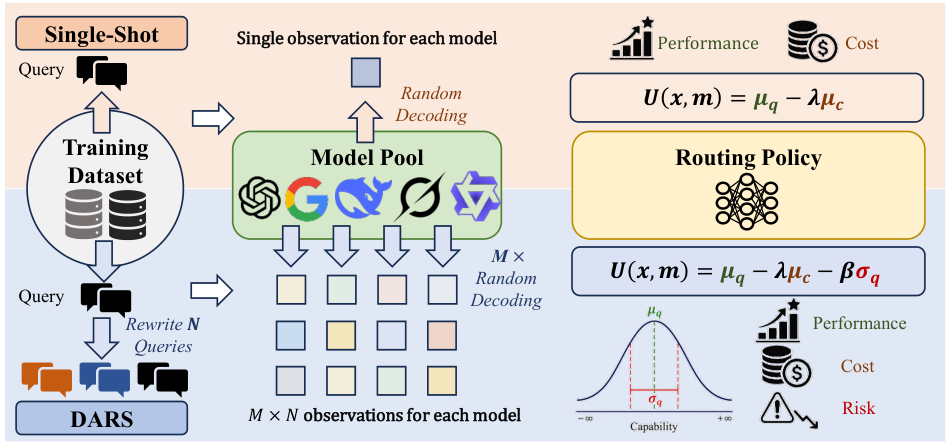
Figure 3 from the paper.
Selected results for the MIRT router, from Table 1 of the paper:
| Dataset | Rewrite utility: single-shot → DARS | Decoding utility: single-shot → DARS |
|---|---|---|
| GPQA | 0.409 → 0.444 | 0.433 → 0.468 |
| MATH-500 | 0.697 → 0.759 | 0.714 → 0.760 |
| DROP-800 | 0.687 → 0.705 | 0.734 → 0.751 |
Utilities use λ = 0.05; higher is better. Single-shot results average 100 independently sampled training sets. These are reported paper results. See the complete results and protocol, machine-readable Table 1, and interactive project page for all routers, including the two settings where utility decreases.
The fastest reproducible path uses the precomputed, scored generations hosted on Hugging Face. It does not call any paid model API.
git clone https://github.com/AIGNLAI/DARS.git
cd DARS

conda create -n dars python=3.10 -y
conda activate dars
pip install -r requirements.txt
Python 3.10 or newer is recommended.
Use the included downloader; it downloads only the scored files required by the routing experiments and verifies the resulting directory layout.
python dataset/download_hf_data.py --output-dir data
Equivalent Hugging Face CLI command:
hf download AIGNLAI/DARS \
  --repo-type dataset \
  --include 'gpqa/*.json*' 'math-500/*.json*' 'drop-800/*.json*' \
  --local-dir data
The expected layout is:
data/
├── gpqa/
│   ├── train_scored_generations.jsonl
│   ├── test_scored_generations.jsonl
│   └── metadata.json
├── math-500/
│   └── ...
└── drop-800/
    └── ...
The hosted benchmark contains 600 training queries and 1,148 held-out test queries across three tasks:
| Dataset | Task | Train queries / rows | Test queries / rows |
|---|---|---|---|
| GPQA | Graduate-level science QA | 200 / 30,000 | 248 / 8,928 |
| MATH-500 | Mathematical reasoning | 200 / 30,000 | 300 / 10,800 |
| DROP-800 | Discrete reasoning over text | 200 / 30,000 | 600 / 21,600 |
For dataset exploration, use load_dataset("AIGNLAI/DARS", "gpqa") (also math-500 and drop-800). The three task configurations preserve their distinct answer schemas. See the dataset card for fields, scoring, costs, and loading examples. For archival experiments, pin a Hugging Face commit with the downloader's --revision option.
This command compares single-shot supervision with DARS using the MLP router on all datasets:
python methods/mlp.py \
  --data-dir data \
  --datasets gpqa math-500 drop-800 \
  --mode both \
  --feature-backend tfidf \
  --single-point-runs 100 \
  --output-dir outputs/mlp
--mode both runs the two supervision settings with the same router implementation:
single-point: one randomly sampled observation per query–model pair, averaged over --single-point-runs routers;distribution: DARS supervision using mean quality, mean cost, and quality variability.For a quick CPU smoke test, reduce the scope and repetitions:
python methods/mlp.py \
  --data-dir data \
  --datasets gpqa \
  --mode both \
  --feature-backend tfidf \
  --single-point-runs 1 \
  --max-iter 20 \
  --output-dir outputs/smoke
The summary and per-query predictions are written as CSV files under the selected output directory.
All router entry points share the important arguments --data-dir, --datasets, --mode, --single-point-runs, and --output-dir. Run them from the repository root.
| Router | Entry point | Main idea |
|---|---|---|
| MLP | methods/mlp.py |
Regression-based routing |
| kNNRouter | methods/knn_router.py |
Non-parametric retrieval |
| EmbedLLM | methods/embed_llm.py |
Model-embedding regression |
| MIRT | methods/mirt.py |
Item-response-theory routing |
| RM-Softmax | methods/rm_softmax.py |
Classification and regret minimization |
| GraphRouter | methods/graph_router.py |
Query–model edge prediction |
| AvengersPro | methods/avengers_pro.py |
Cluster-based routing |
For example:
# Retrieval-based router
python methods/knn_router.py \
  --data-dir data --mode both --feature-backend tfidf \
  --single-point-runs 100 --output-dir outputs/knn_router

# Representation-learning router (uses CUDA automatically when available)
python methods/embed_llm.py \
  --data-dir data --mode both --feature-backend tfidf \
  --single-point-runs 100 --device auto --output-dir outputs/embed_llm

# Graph-based router
python methods/graph_router.py \
  --data-dir data --mode both --feature-backend tfidf \
  --single-point-runs 100 --device auto --output-dir outputs/graph_router

# Paper's classification / regret-minimization baseline
python methods/rm_softmax.py \
  --data-dir data --mode both --feature-backend tfidf \
  --single-point-runs 100 --loss softmax --device auto \
  --output-dir outputs/rm_softmax
Use python methods/<router>.py --help for router-specific hyperparameters. The tfidf feature backend is self-contained and is the easiest way to reproduce the pipeline. To use sentence embeddings instead:
hf download sentence-transformers/all-MiniLM-L6-v2 \
  --local-dir models/all-MiniLM-L6-v2

python methods/mlp.py \
  --data-dir data \
  --mode both \
  --feature-backend sentence-transformer \
  --local-encoder-path models/all-MiniLM-L6-v2 \
  --output-dir outputs/mlp_minilm
The commands above reproduce the released pipeline. To compare exact paper numbers, match the encoder, router hyperparameters, seeds, and observation settings described in Appendix C.1. Changing the feature backend can change the results; the TF-IDF smoke run is a functionality check.
λ = 0.05 for cost and β = 0.2 for risk.This route reconstructs the benchmark from the original Hugging Face datasets and calls models through OpenRouter. It incurs API cost and provider-side model updates may make newly generated outputs differ from the released snapshot. For exact router comparisons, prefer the precomputed DARS data.
GPQA is gated on Hugging Face. Accept its access conditions first, then authenticate without placing a token in source code:
hf auth login
# Alternatively: export HF_TOKEN=hf_...

python dataset/prepare_datasets.py \
  --output_dir data \
  --datasets gpqa math-500 drop-800 \
  --train_size 200 \
  --drop_max_records 800 \
  --seed 42
This downloads Idavidrein/gpqa, HuggingFaceH4/MATH-500, and ucinlp/drop, normalizes their schemas, and creates query-level train/test splits.
export OPENROUTER_API_KEY=your_key_here

python dataset/rewrite_queries.py \
  --data_dir data \
  --datasets gpqa math-500 drop-800 \
  --num_variants 5 \
  --model openai/gpt-4o \
  --max_workers 8
python dataset/collect_train_generations.py \
  --data_dir data \
  --datasets gpqa math-500 drop-800 \
  --num_prompt_variants 5 \
  --num_decodes 5 \
  --max_workers 12

python dataset/collect_test_generations.py \
  --data_dir data \
  --datasets gpqa math-500 drop-800 \
  --num_prompt_variants 3 \
  --max_workers 12
The rewrite and generation scripts are resumable: after interruption, rerun the same command and completed records will be skipped. Tune worker counts to your OpenRouter rate limits.
python dataset/score_generations.py \
  --data-dir data \
  --datasets gpqa math-500 drop-800 \
  --splits train test
You can now run any router command from the previous section against the reconstructed scored files.
The repository uses Ruff for linting and formatting, plus unittest regression tests for shared method behavior:
pip install -r requirements-dev.txt
ruff check methods tests dataset/download_hf_data.py
ruff format --check methods tests dataset/download_hf_data.py
python -m unittest discover -s tests -v
DARS/
├── dataset/
│   ├── download_hf_data.py          # download the released scored benchmark
│   ├── prepare_datasets.py          # normalize original HF datasets
│   ├── rewrite_queries.py           # create semantic query variants
│   ├── collect_train_generations.py # collect 5 × 5 training observations
│   ├── collect_test_generations.py  # collect test observations
│   └── score_generations.py         # task-specific automatic scoring
├── methods/                         # seven router implementations
├── tests/                           # method and data-contract regression tests
├── pyproject.toml                   # lint and formatting configuration
├── requirements.txt
└── README.md
If DARS helps your work, please cite:
AIGNLAI/DARS is a public repo on GitHub by AIGNLAI. EMNLP 2026 Main | DARS: Distribution-Aware Routing Supervision for LLM routing. Official code and scored benchmark.
It declares the MIT license on GitHub.
Its maker has not tagged a system, so it is unknown here. Its README says what it needs.
Open "Take it" on its page: Take My Repo writes an install plan for your machine and hands it to your AI agent (Claude Code, Codex or Cursor), which asks you before each step. Take My Repo has not tested it on any machine.
Its last change on GitHub was on 2026-10-10. Take My Repo does not judge from that whether it is maintained.
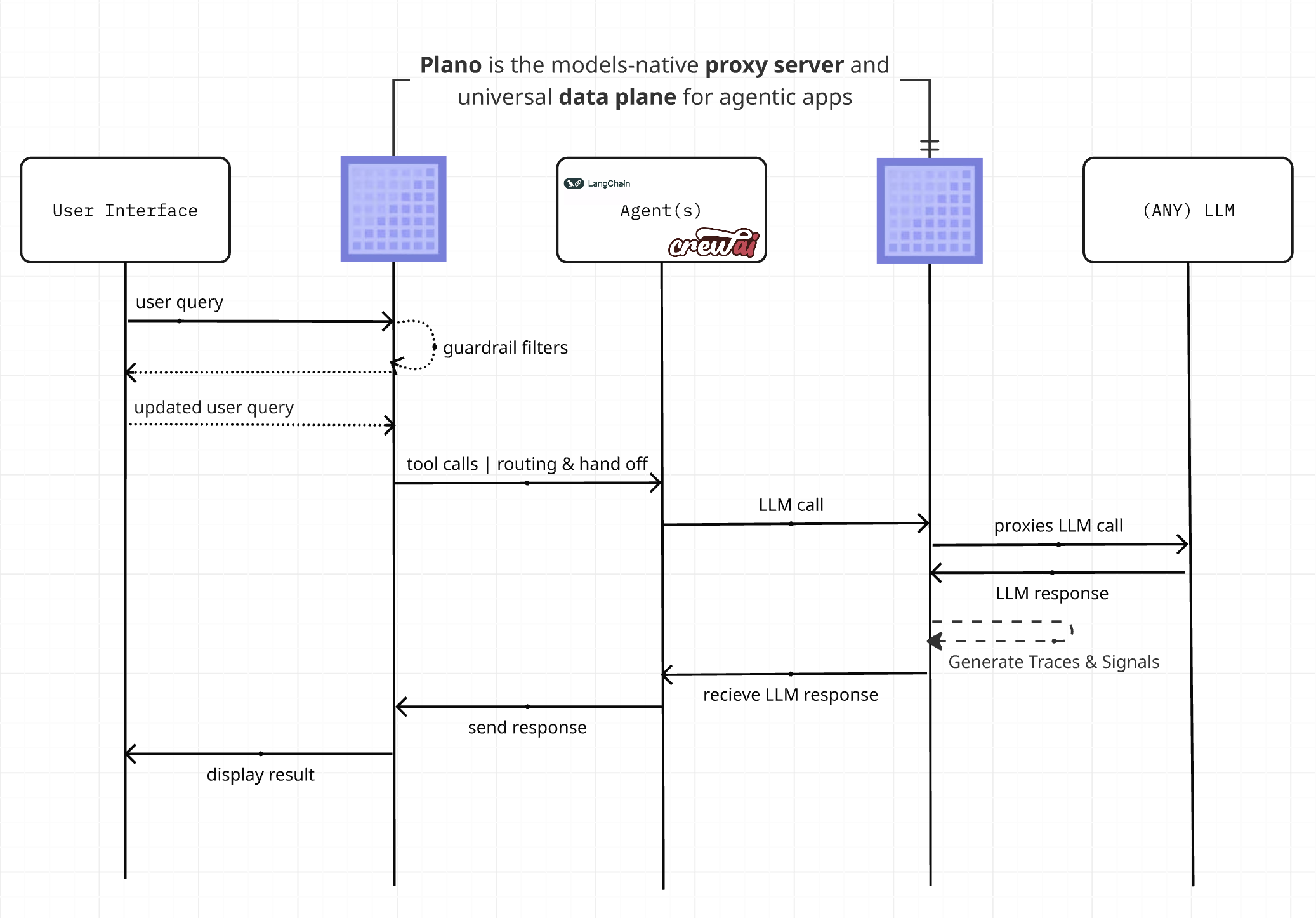
Plano is an AI-native proxy server and data plane for agentic apps. Smart LLM routing, observability, agent orchestration, and guardrails so you stay focused on your agents core logic.
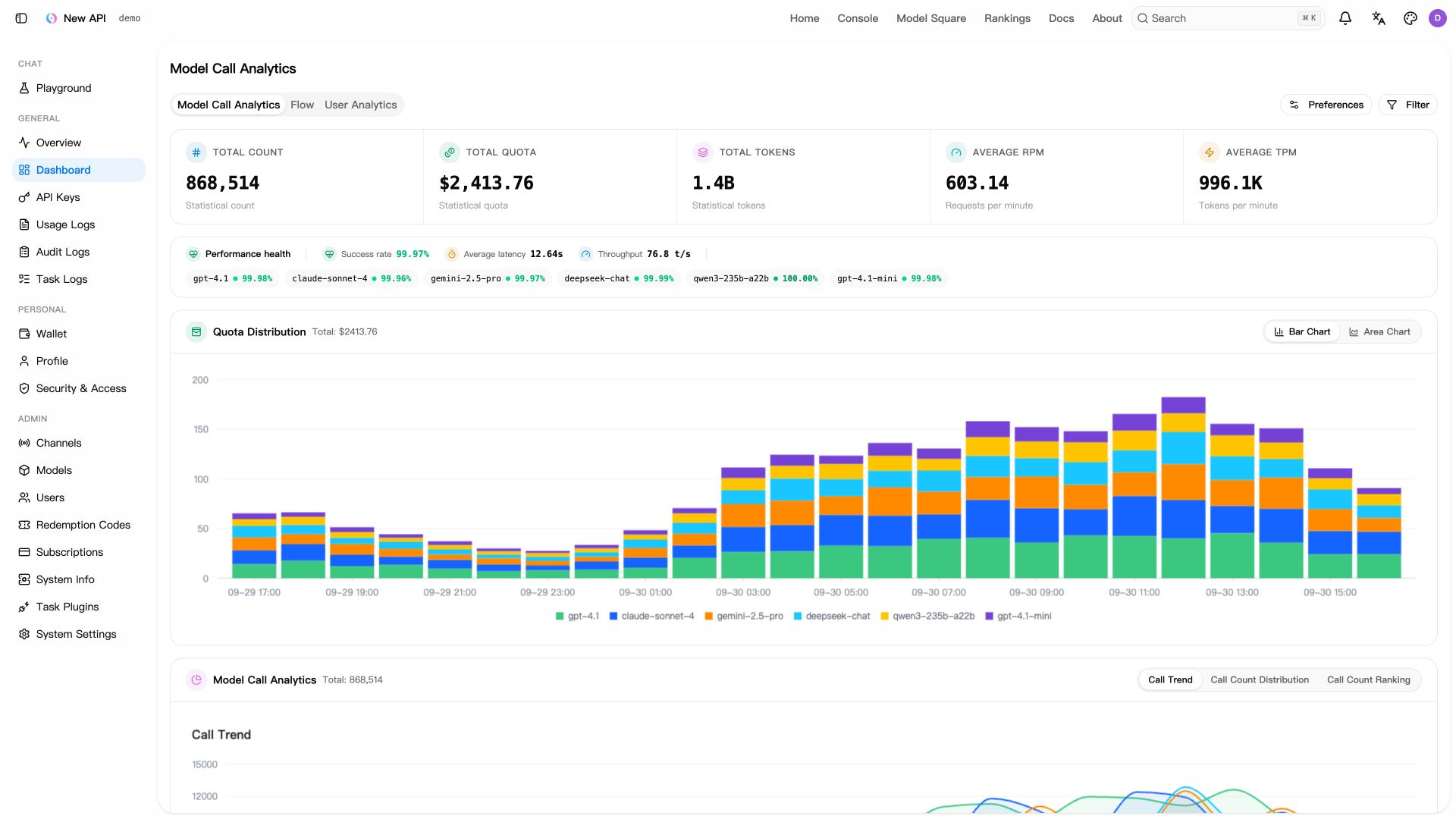
Open-source AI gateway. Self-hosted LLM gateway with OpenAI-, Claude- and Gemini-compatible APIs, model routing, access control, usage tracking and cost accounting.
Implement a ChatGPT-like LLM in PyTorch from scratch, step by step
Structured multi-perspective deliberation for hard decisions. Run full councils, focused triads, or duo debates across Claude Code, Codex, Gemini CLI, and OpenCode.
Nobody has reviewed it on Take My Repo yet, which says nothing about its quality.
Take My Repo cannot say: it does not audit code and has not run DARS. What is known comes from GitHub. It declares the MIT license on GitHub. Its last change was on 2026-10-10. It has 5 stars, which measure popularity, not safety. Nobody has reviewed it on Take My Repo yet, which says nothing about its quality. Read the source before you run it. With "Take it", your AI agent shows each step and asks you before running it; README text is treated as data, not as instructions.