rea
Reverse engineer anything with agents, from app behavior down to native binaries.
- 476k
- TypeScript
- MIT
- 27 min ago
A Python framework for modular, self-contained skill management for machines.
Repo ARPAHLS/skillware, read from GitHub 7 h ago. ARPAHLS has not joined Take My Repo.
ARPAHLS/skillware is a public repo on GitHub by ARPAHLS. A Python framework for modular, self-contained skill management for machines. It declares the MIT license on GitHub. It is written mainly in Python, has 194 stars and last changed on 2026-11-23. Nobody has reviewed it on Take My Repo yet, which says nothing about its quality. Read from GitHub on 2026-11-24.

A Python framework for modular, self-contained skill management for machines.
Skillware is an open-source framework and registry for modular, actionable Agent capabilities. It installs know-how for AI agents, or modular Skills (code, contract, and host guidance) decoupling capability from intelligence. In short, don't prompt your agents, equip them.
"I know Kung Fu." - Neo
Every new agent stack tends to reinvent tool schemas, system prompts, and safety rules. Skillware packages each capability as a self-contained bundle and adapts it to Gemini, Claude, OpenAI, Ollama, and other OpenAI-compatible hosts. For the full story and roadmap, see Vision.
A Skill in this framework provides everything a host agent needs to use a capability in a domain:
Optional Corpus and Reference assets extend bundles when needed. Every bundled registry skill also ships Presentation (card.json) for catalog and UI metadata. Full reference: Introduction — Skill anatomy.
Browse capabilities by category in Supported Agent Skill Categories, the Skill library, the documentation sitemap, or on our site ↗.
flowchart LR
    Registry[Registry] -->|Load| Loader[Loader]
    Loader -->|Adapt| AnyHost["Any Host"]
Install the registry once. Skillware loads a bundle, adapts it to your host's tool format, and your app runs the agent loop (Gemini, Claude, Ollama, custom scripts, …). See the Introduction for loader details, Agent loops for the execution pattern, and Skill chaining for multi-skill sessions (SkillContext, named chains:).
Most agent frameworks treat capabilities as prompt recipes, markdown checklists, or loose protocol wrappers that ask models to generate code on the fly. Skillware treats capabilities as versioned software modules: self-contained bundles pairing typed contracts, tested Python logic, agent directives, and offline assurance suites. Pre-compiled host execution decouples capability from model hallucination and eliminates the trial-and-error debugging loops inherent in unstructured tool calling.
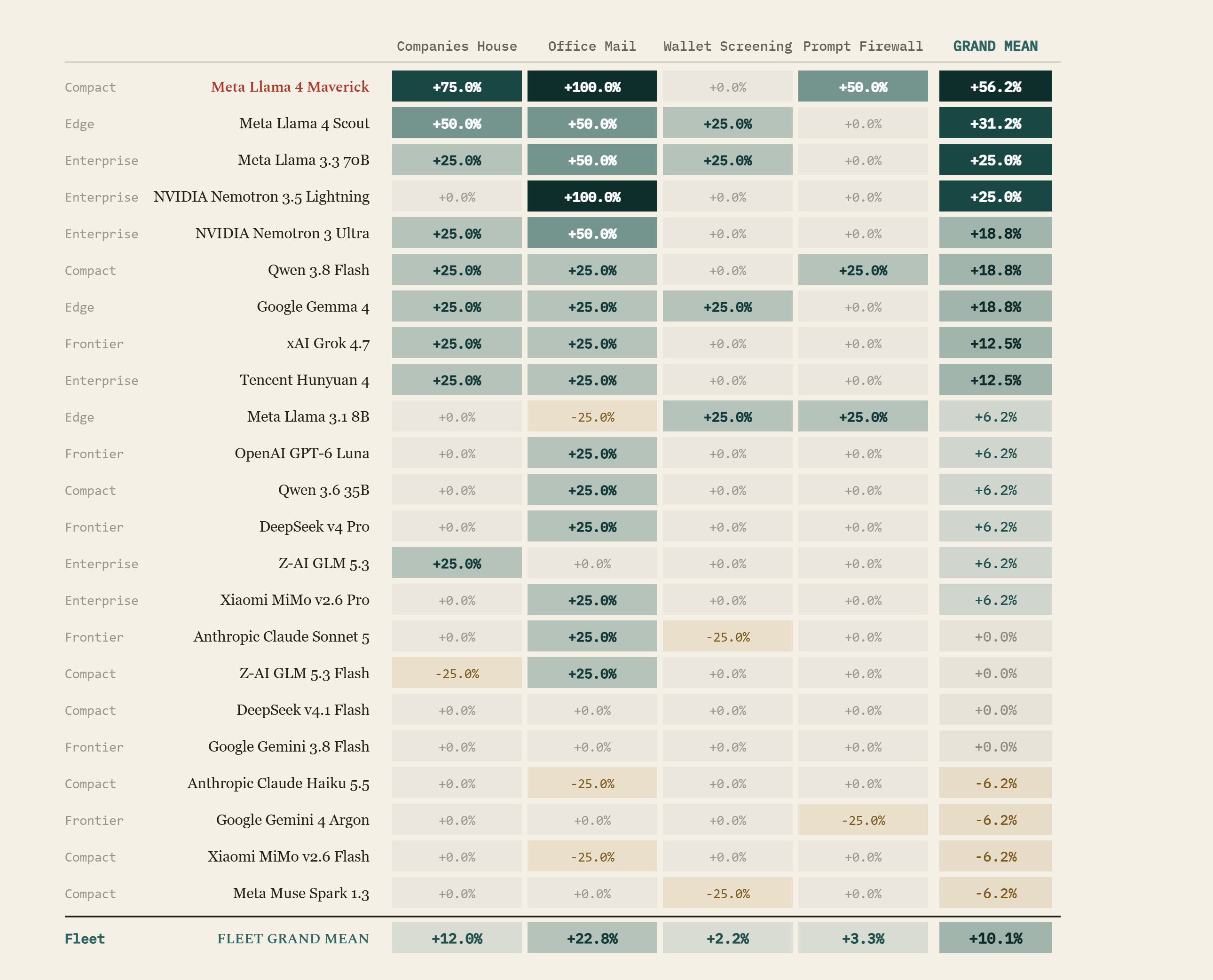
Every skill in the registry is curated, tested, and steered by ARPA Hellenic Logical Systems rather than aggregated from thousands of unvetted, arbitrary third-party uploads. At runtime, dumping full tool documentation degrades model reasoning and inflates token costs. Through just-in-time progressive disclosure, SkillContext mounts compact one-line taxonomy briefs upfront (~45 tokens per skill) and unlocks full playbooks only when an action is dispatched, excising up to 85% of redundant prompt tokens.
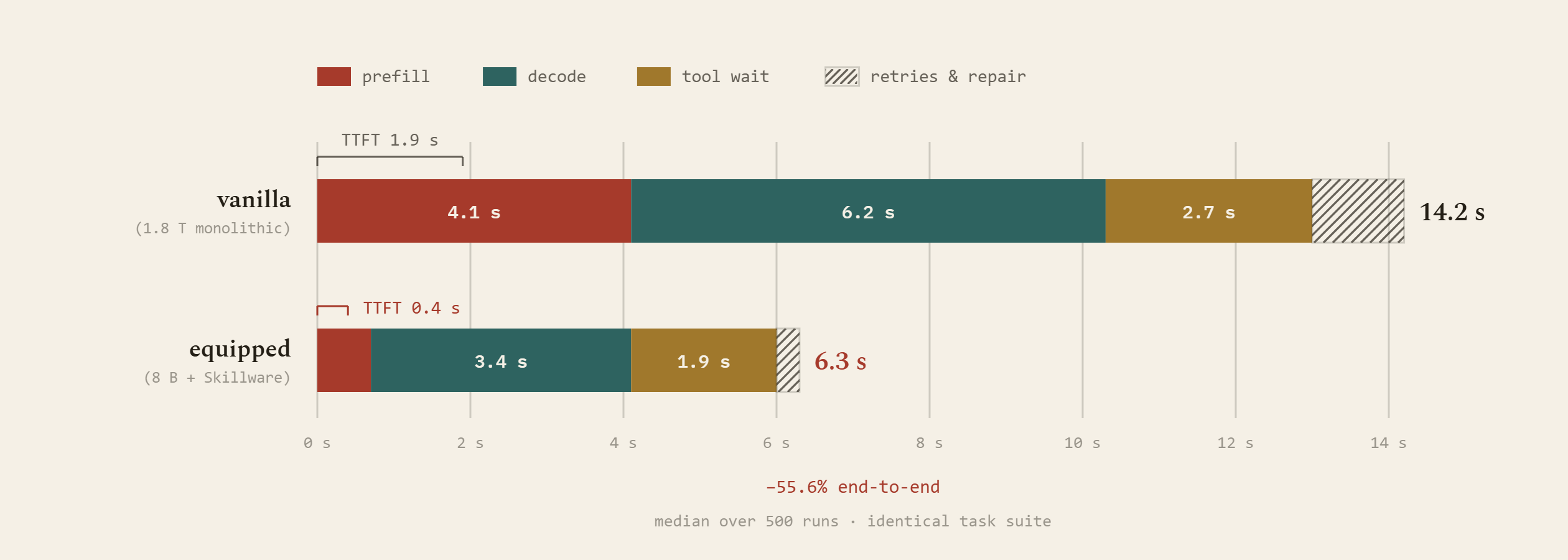
Latency anatomy across execution stages: JIT context excision shrinks prefill latency, compact model routing accelerates decoding, and deterministic host validation eliminates error-retry loops, cutting end-to-end median latency by 55.6% and collapsing time-to-first-token (TTFT).
Mission-critical enterprise workflows—such as financial transaction screening, regulatory compliance forensics, and sensor telemetry normalization—cannot afford prompt ambiguity, hallucinated edge cases, or non-deterministic event triggers. Security is embedded directly into the framework: isolated credential providers prevent ambient process leakage, AST audits prohibit runtime code synthesis, and hardware execution gates protect physical substrates. Executing pre-verified code paths replaces erratic model behavior with tight, deterministic score distributions essential for CI/CD release gating.
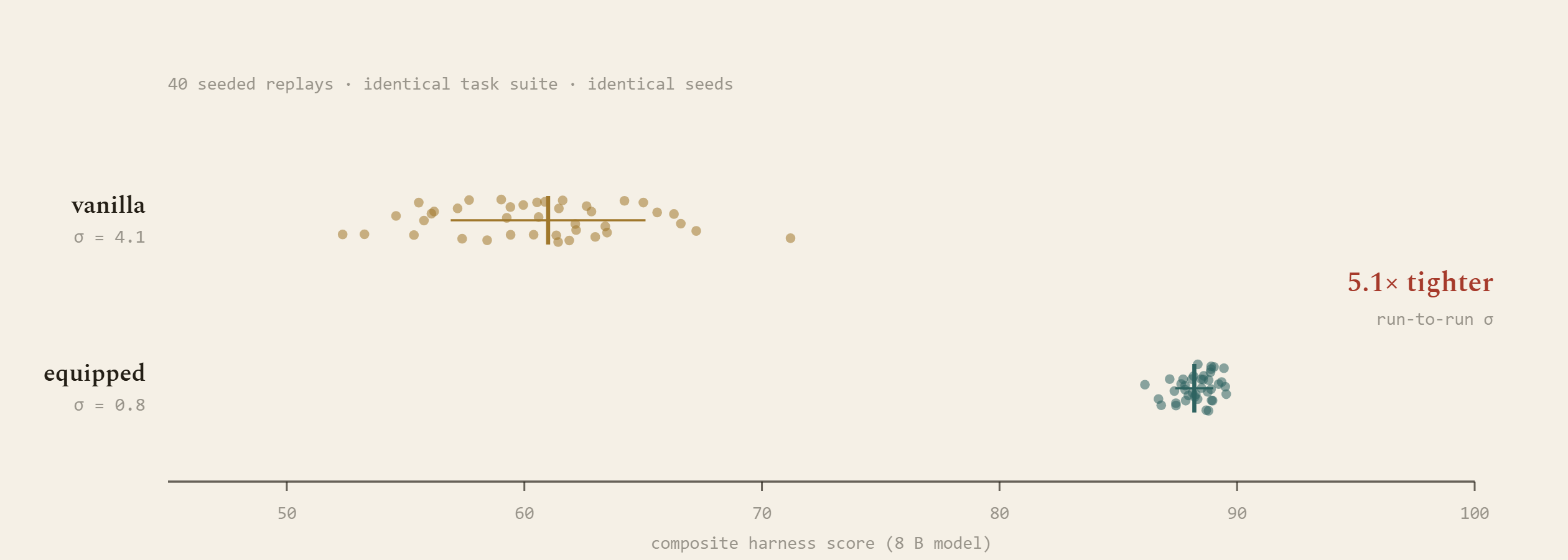
Run-to-run determinism across 40 seeded replays: Unassisted script generation scatters across an erratic score distribution (mean 61.0, σ = 4.1). Skillware contracts run-to-run variance by 5.1× (mean 88.2, σ = 0.8), establishing the reproducibility needed for regulated enterprise production.
To see how Skillware architecturally compares against MCP, Agent Skills, Antigravity, and LangChain, read COMPARISON.md. For empirical telemetry, stress crucibles, and 23-model benchmark evaluations, visit the Skillware-Bench repository.
This repository is organized into a core framework, a registry of skills, and documentation. Runnable provider scripts are indexed in examples/README.md.
Skillware/
├── docs/                       # Introduction, testing, category hubs (docs/skills/<category>/), usage guides (docs/usage/)
├── examples/                   # Provider reference scripts — usage demos, not pytest (see examples/README.md)
├── skills/                     # Skill Registry
│   └── category/               # Domain boundaries (e.g., finance)
│       └── skill_name/         # The Skill bundle
│           ├── manifest.yaml   # Contract: schema, constitution, issuer
│           ├── skill.py        # Effect: deterministic execution
│           ├── instructions.md # Directive: host guidance
│           ├── card.json       # Presentation: catalog / UI metadata
│           └── test_skill.py   # Assurance (required for registry skills)
├── skillware/                  # Core Framework Package
│   ├── audit.py                # Dispatch audit hook & SHA-256 hash-chained JSONL
│   ├── cli.py                  # Command-line interface
│   ├── context.py              # SkillContext — multi-skill registry host context
│   ├── chains.py               # Named skill chain runner (run_chain, validate_chain)
│   └── core/
│       ├── base_skill.py       # Abstract Base Class for skills
│       ├── chains_config.py    # chains: YAML parsing
│       ├── env.py              # Environment Management
│       ├── integrity.py        # Bundle fingerprint & lockfile verification
│       └── loader.py           # Universal Skill Loader and Model Adapter
├── templates/                  # Boilerplate templates for new skills
│   └── python_skill/           # Standard template with required files
└── tests/                      # Clone-repo tests (framework + optional maintainer skill tests)
    ├── test_*.py               # Framework tests (loader, CLI, issuer, …)
    └── skills/                 # Optional maintainer skill tests (edge cases)
Category hubs live under docs/skills/<category>/. Full catalog: Skill library. Crawl map: documentation sitemap.
| Category | Skills | Description |
|---|---|---|
| Data Engineering | 5 | Datasets, generation, and ETL-style tooling |
| Compliance | 3 | Privacy, policy, and regulatory guardrails |
| DeFi | 3 | On-chain ops, trading, and agent wallet management |
| Finance | 3 | Fintech, blockchain, payments, and financial services |
| Monitoring | 3 | Agent loop observability, budget gates, RPC health, and task control |
| Office | 3 | Documents, desktop work, and productivity automation |
| Security | 3 | Defenses for untrusted input reaching logical systems |
| Creative | 2 | Image processing, media editing, and creative utilities |
| Optimization | 2 | Middleware, efficiency, and token economics |
| Bio | 1 | Life sciences, bioinformatics, genomics, and biotechnology |
| Dev Tools | 1 | Developer workflows, repo tooling, and coding |
| Linguistics | 1 | Language adapters and internet-register lexicons |
| Networking | 1 | Egress proxy rotation, multi-region inspection, and transport middleware |
| Wellness | 1 | Coaching guardrails and mental health support |
Requires Python 3.10 or newer (see requires-python in pyproject.toml).
You can install Skillware directly from PyPI:
pip install skillware
Or for development, clone the repository and install in editable mode:
git clone https://github.com/arpahls/skillware.git
cd skillware
pip install -e ".[dev,all]"
For documentation-only work, pip install -e ".[dev]" is enough. Skill and framework contributors should use [dev,all] to match CI (see TESTING.md and Install extras).
Note: Every skill has a dedicated pip extra (
pip install "skillware[category_skill]"). TheSkillLoadervalidatesmanifest.yaml
ARPAHLS/skillware is a public repo on GitHub by ARPAHLS. A Python framework for modular, self-contained skill management for machines.
It declares the MIT license on GitHub.
Its maker has not tagged a system, so it is unknown here. Its README says what it needs.
Open "Take it" on its page: Take My Repo writes an install plan for your machine and hands it to your AI agent (Claude Code, Codex or Cursor), which asks you before each step. Take My Repo has not tested it on any machine.
Composio powers 1000+ toolkits, tool search, context management, authentication, and a sandboxed workbench to help you build AI agents that turn intent into action.
Transparent evaluation harness for AI agent constitutions, deterministic skill execution, and verifiable causal provenance.
Its last change on GitHub was on 2026-11-23. Take My Repo does not judge from that whether it is maintained.
Nobody has reviewed it on Take My Repo yet, which says nothing about its quality.
Take My Repo cannot say: it does not audit code and has not run skillware. What is known comes from GitHub. It declares the MIT license on GitHub. Its last change was on 2026-11-23. It has 194 stars, which measure popularity, not safety. Nobody has reviewed it on Take My Repo yet, which says nothing about its quality. Read the source before you run it. With "Take it", your AI agent shows each step and asks you before running it; README text is treated as data, not as instructions.