
airflow
Apache Airflow - A platform to programmatically author, schedule, and monitor workflows
- 48k
- Python
- Apache-2.0
- 29 min ago
Retail data analytics pipeline covering Python-based data cleaning, SQL Server star-schema warehousing, Airflow orchestration, and business-focused SQL analysis, with documented data-quality checks, engineering learnings, and limitations.
Repo Aaisha-Nexus/CodeConnect26-DataAnalytics-Datathon, read from GitHub 2 d ago. Aaisha-Nexus has not joined Take My Repo.
Aaisha-Nexus/CodeConnect26-DataAnalytics-Datathon is a public repo on GitHub by Aaisha-Nexus. Retail data analytics pipeline covering Python-based data cleaning, SQL Server star-schema warehousing, Airflow orchestration, and business-focused SQL analysis, with documented data-quality checks, engineering learnings, and limitations. It declares no license on GitHub. Public does not mean open source: without a license, nobody is granted the right to reuse it. It is written mainly in Jupyter Notebook, has 1 stars and last changed on 2026-10-18. Nobody has reviewed it on Take My Repo yet, which says nothing about its quality. Read from GitHub on 2026-11-22.
Apache Airflow - A platform to programmatically author, schedule, and monitor workflows
From raw retail data to a validated SQL Server warehouse, orchestrated workflow, and business-focused analysis.
Individual project · Built by Aaisha Iqbal
NexusMart is a retail analytics case study developed for CodeConnect’26 — Module 02: Data Analytics. The project works with nine related CSV datasets covering customers, locations, orders, order items, payments, products, returns, sellers, and shipping.
The objective was to build and document a practical analytics workflow that moves beyond one-off queries: profile the source data, clean and validate records, load a SQL Server warehouse, model the data for analysis, orchestrate key workflow checks with Apache Airflow, and use SQL to investigate the challenge's 15 business questions.
The work includes Python-based profiling and cleaning artifacts, staging tables, a dimensional warehouse model, SQL analysis scripts, a local Airflow DAG, and supporting evidence and documentation. Power BI model and DAX work was also started; a completed interactive Power BI dashboard is not part of the current submission.
Scope note: This repository reflects the implementation reached during the hackathon. Some stages are demonstrated through existing processed outputs and validation tasks rather than a fully reproducible raw-to-warehouse rebuild. Known limitations are documented explicitly rather than presented as resolved.
The diagram below represents the current implemented workflow at a high level. It intentionally does not show Power BI as a completed reporting stage.
flowchart TD
    A["Nine source CSV datasets"] --> B["Python profiling and cleaning artifacts"]
    B --> C["Processed and quarantined/rejected CSVs"]
    C --> D["SQL Server staging tables"]
    D --> E["Dimensional warehouse"]
    E --> F["FactSales + five dimensions"]
    F --> G["SQL business-question analysis"]
    G --> H["Business Answers document and query evidence"]

    I["Apache Airflow DAG"] -. "orchestrates checks / validates existing state" .-> C
    I -.-> D
    I -.-> E

    J["Quality reports and audit CSVs"] --- B
    J --- D
    J --- E

    classDef source fill:#EAF2FF,stroke:#4776B8,color:#172554;
    classDef processing fill:#E8F6F3,stroke:#168477,color:#123C38;
    classDef warehouse fill:#FFF4DF,stroke:#C78B24,color:#533A0A;
    classDef evidence fill:#F1EDFF,stroke:#7C65B1,color:#30235A;
    class A source;
    class B,C processing;
    class D,E,F warehouse;
    class G,H,J evidence;
Important distinction: the current Airflow DAG successfully ran its seven configured tasks, but several tasks validate existing processed files or populated warehouse tables rather than rebuilding every stage from raw data. See Airflow Orchestration and Known Limitations.
| Area | Tools | Role in the project |
|---|---|---|
| Data preparation | Python, pandas, notebooks | Profiling, cleaning, validation, and exception reporting |
| Source format | CSV | Supplied retail datasets and processed outputs |
| Database | Microsoft SQL Server | Staging tables, dimensional tables, fact table, and analytical SQL |
| Data modelling | Star schema | Organizes order-line facts around shared dimensions |
| Orchestration | Apache Airflow, Astro CLI, Docker Desktop | Runs the local DAG and its validation workflow |
| Analytics | SQL | Business metrics, comparisons, trends, and question-based analysis |
| Semantic modelling | Power BI, DAX | Initial model and measure development; dashboard remains future work |
| Version control | Git, GitHub | Source control and submission repository |
| Documentation | Markdown, Word, screenshots | Business answers, implementation notes, and execution evidence |
The repository is organized around code, SQL, reports, documentation, and screenshots. The tree below is a guide to the main folders, not a guarantee that every optional file listed in a generic project template exists.
CodeConnect26_DataAnalytics/
├── airflow/                         # Local Airflow/Astro-related project files, if included
├── dags/                            # Submitted DAG source
├── data/                            # Source and/or processed datasets, subject to repository contents
├── important documentations/
│   ├── Business Answers.docx
│   ├── CodeConnect26_NexusMart_Challenges_Learnings_Limitations.docx
│   └── NexusMart_DAX_Measures.docx
├── logs/                            # Local execution logs; inspect before publishing
├── notebooks/                       # Profiling and cleaning notebooks
├── powerbi/                         # Power BI-related files, if present
├── reports/
│   ├── Star_Schema_Diagram.png       # Schema evidence may also be under screenshots/
│   └── ...                          # Data-quality reports and audit outputs
├── screenshots/
│   ├── airflow/                     # Airflow UI / DAG execution evidence
│   └── star schema/                 # Star schema screenshot
├── sql/                             # Staging, dimensions, fact loading, and validation scripts
├── src/                             # Python profiling, cleaning, and loading utilities
├── .gitignore
└── README.md
dags/ — DAG source included for review and submission.sql/ — SQL scripts for staging, dimensions, FactSales, date dimension, relationships, and quality checks.src/ — Python utilities related to profiling, cleaning finalization, and data loading.notebooks/ — exploratory profiling and cleaning work.reports/ — quality summaries, reconciliation reports, exception/audit outputs, and other supporting artifacts.screenshots/airflow/ — evidence of the local Airflow environment and successful DAG run.screenshots/star schema/ — visual evidence of the dimensional model.important documentations/ — the business-question answers, engineering challenges/limitations, and DAX implementation notes.Before publishing, review
data/,logs/, and row-level audit CSVs. Include only files permitted by the challenge and useful to reviewers; never commit credentials,.envfiles, or local secrets.
The challenge supplied nine datasets:
| Dataset | Analytical role |
|---|---|
| Customers | Customer attributes and registration information |
| Locations | Geographic attributes used for location analysis |
| Orders | Order-level dates, statuses, channels, and order information |
| OrderItems | Line-level products, quantities, and item values |
| Payments | Payment-method information and payment records |
| Products | Product, category, and cost/price attributes |
| Returns | Return statuses, reasons, and refund information |
| Sellers | Seller attributes and seller-tier analysis |
| Shipping | Courier, shipping-fee, shipment, and delivery-date information |
The cleaning work focused on more than removing duplicates. It included profiling, type and date checks, missing and negative value review, duplicate analysis, reference validation, and retained-versus-quarantined record accounting.
The project notes record the following results from the cleaning and validation work:
These are recorded findings from the current project artifacts. Consult the reports and exception files for the precise definitions and row-level evidence behind each figure.
| Dataset | Source rows | Retained | Quarantined | Duplicate copies |
|---|---|---|---|---|
| Customers | 45,000 | 45,000 | 0 | 0 |
| Locations | 650 | 650 | 0 | 0 |
| Orders | 163,200 | 158,250 | 1,750 | 3,200 |
| OrderItems | 315,143 | 313,250 | 1,893 | 0 |
| Payments | 168,111 | 163,586 | 1,229 | 3,296 |
| Products | 3,200 | 3,200 | 0 | 0 |
| Returns | 16,048 | 15,912 | 136 | 0 |
| Sellers | 420 | 416 | 4 | 0 |
| Shipping | 151,228 | 149,122 | 2,106 | 0 |
The counts above should be read alongside the cleaning reports. Quarantined rows, duplicate copies, and retained rows describe different outcomes and should not be added together without considering how the reconciliation was defined.
The analysis and warehouse work considered the challenge's specified rules, including:
order_total represents merchandise value after discounts.Rejected are not valid returns for refund calculations.In Transit status that are not cancelled still count toward NMV.The SQL Server warehouse uses a star-schema approach with FactSales at order-line grain and five dimensions.
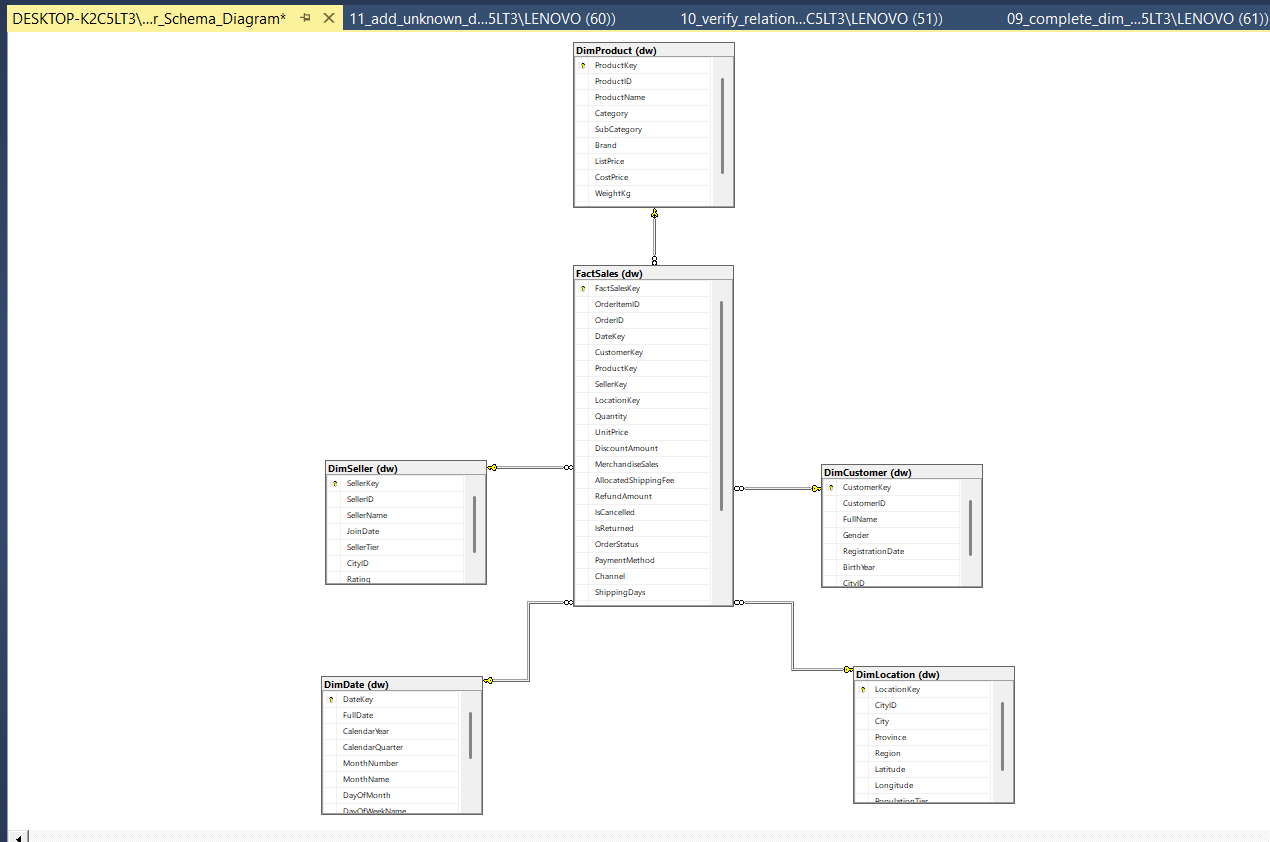
If the image does not render in the GitHub preview, open it directly from the screenshots/star schema folder.
Aaisha-Nexus/CodeConnect26-DataAnalytics-Datathon is a public repo on GitHub by Aaisha-Nexus. Retail data analytics pipeline covering Python-based data cleaning, SQL Server star-schema warehousing, Airflow orchestration, and business-focused SQL analysis, with documented data-quality checks, engineering learnings, and limitations.
Apache Superset is a Data Visualization and Data Exploration Platform
Resources for the Society of Critical Care Medicine (SCCM) Datathon
Python ETL framework for stream processing, real-time analytics, LLM pipelines, and RAG.
It declares no license on GitHub. Public does not mean open source: without a license, nobody is granted the right to reuse it.
Its maker has not tagged a system, so it is unknown here. Its README says what it needs.
Open "Take it" on its page: Take My Repo writes an install plan for your machine and hands it to your AI agent (Claude Code, Codex or Cursor), which asks you before each step. Take My Repo has not tested it on any machine.
Its last change on GitHub was on 2026-10-18. Take My Repo does not judge from that whether it is maintained.
Nobody has reviewed it on Take My Repo yet, which says nothing about its quality.
Take My Repo cannot say: it does not audit code and has not run CodeConnect26-DataAnalytics-Datathon. What is known comes from GitHub. It declares no license on GitHub. Public does not mean open source: without a license, nobody is granted the right to reuse it. Its last change was on 2026-10-18. It has 1 stars, which measure popularity, not safety. Nobody has reviewed it on Take My Repo yet, which says nothing about its quality. Read the source before you run it. With "Take it", your AI agent shows each step and asks you before running it; README text is treated as data, not as instructions.


