vision.cpp
Computer Vision ML inference in C++
- 62
- MIT
- 8 mo ago
Repo Acly/vision.cpp, read from GitHub 1 min ago. Acly has not joined Take My Repo.
In short
Acly/vision.cpp is a public repo on GitHub by Acly. Computer Vision ML inference in C++. It declares the MIT license on GitHub. It is written mainly in C++, has 62 stars and last changed on 2026-04-02. Nobody has reviewed it on Take My Repo yet, which says nothing about its quality. Read from GitHub on 2026-11-22.
vision.cpp
Computer Vision ML inference in C++
- Self-contained C++ library
- Efficient inference on consumer CPU and GPUs (NVIDIA, AMD, Intel)
- Lightweight deployment on many platforms (Windows, Linux, MacOS)
- Growing number of supported models behind a simple API
- Modular design for full control and implementing your own models
Based on ggml similar to the llama.cpp project.
Features
| Model | Task | Backends |
|---|---|---|
| MobileSAM | Promptable segmentation | CPU, Vulkan |
| BiRefNet | Dichotomous segmentation | CPU, Vulkan |
| Depth-Anything | Depth estimation | CPU, Vulkan |
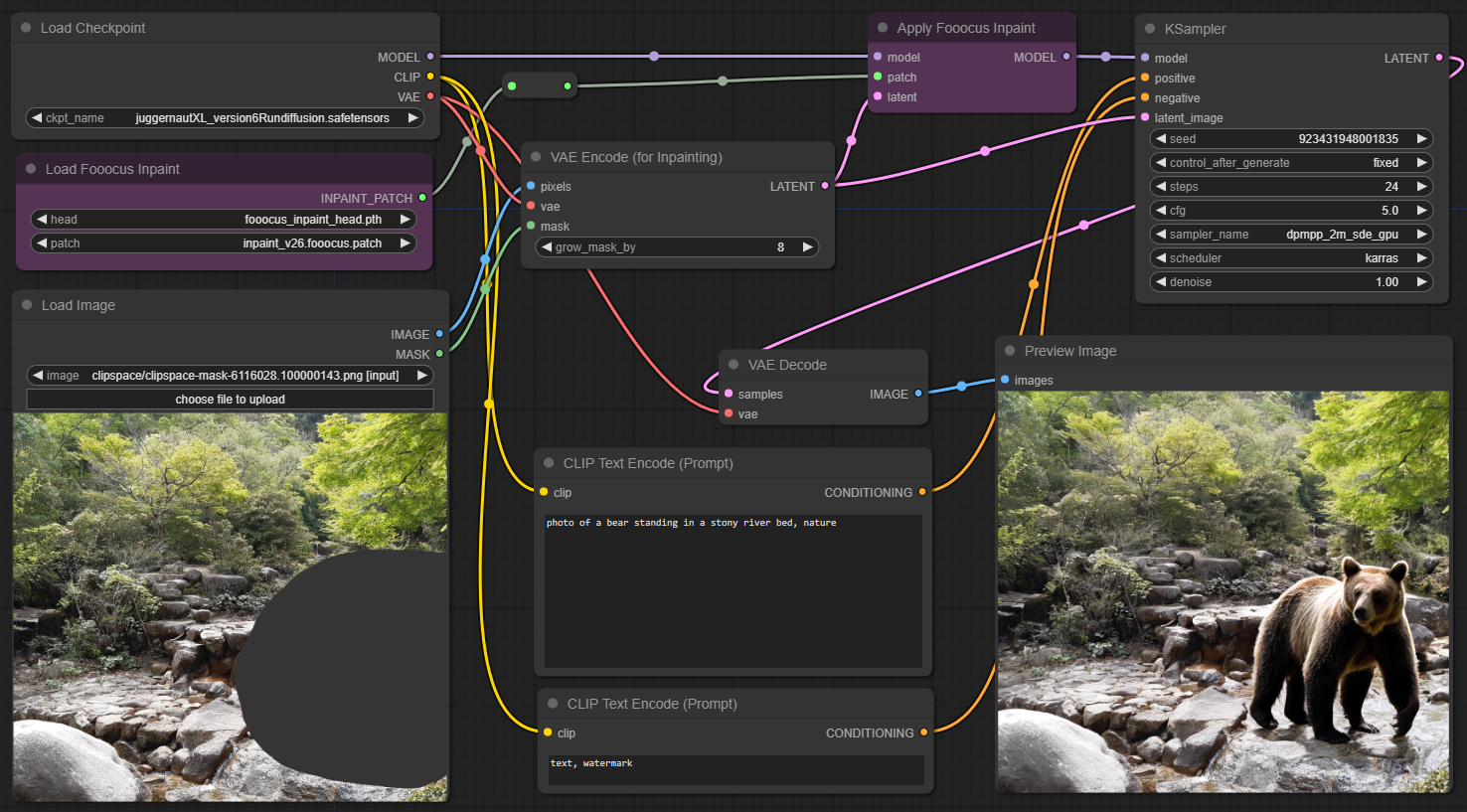
| MI-GAN | Inpainting | CPU, Vulkan |
| ESRGAN | Super-resolution | CPU, Vulkan |
| Implement a model [Guide] |
Backbones: SWIN (v1), DINO (v2), TinyViT
Get Started
Get the library and executables:
- Download a release package and extract it,
- or build from source.
Example: Select an object in an image
Let's use MobileSAM to generate a segmentation mask of the plushy on the right by passing in a box describing its approximate location.

You can download the model and input image here: MobileSAM-F16.gguf | input.jpg
CLI
Find the vision-cli executable in the bin folder and run it to generate the mask:
vision-cli -m MobileSAM-F16.gguf -i input.jpg -p 420 120 650 430 -o mask.png
Pass --composite output.png to composite input and mask. Use --help for more options.
API
#include <visp/vision.h>
using namespace visp;

void main() {
  backend_device cpu = backend_init(backend_type::cpu);
  sam_model sam = sam_load_model("MobileSAM-F16.gguf", cpu);

  image_data input_image = image_load("input.jpg");
  sam_encode(sam, input_image);

  image_data object_mask = sam_compute(sam, box_2d{{420, 120}, {650, 320}});
  image_save(object_mask, "mask.png");
}
This shows the high-level API. Internally it is composed of multiple smaller functions that handle model loading, pre-processing inputs, transferring data to backend devices, post-processing output, etc. These can be used as building blocks for flexible functions which integrate with your existing data sources and infrastructure.
Models
MobileSAM

Model download | Paper (arXiv) | Repository (GitHub) | Segment-Anything-Model | License: Apache-2
vision-cli sam -m MobileSAM-F16.gguf -i input.png -p 300 200 -o mask.png --composite comp.png
BiRefNet

Model download | Paper (arXiv) | Repository (GitHub) | License: MIT
vision-cli birefnet -m BiRefNet-lite-F16.gguf -i input.png -o mask.png --composite comp.png
Depth-Anything V2

Model download | Paper (arXiv) | Repository (GitHub) | License: Apache-2 / CC-BY-NC-4
vision-cli depth-anything -m Depth-Anything-V2-Small-F16.gguf -i input.png -o depth.png
MI-GAN

Model download | Paper (thecvf.com) | Repository (GitHub) | License: MIT
vision-cli migan -m MIGAN-512-places2-F16.gguf -i image.png mask.png -o output.png
Real-ESRGAN

Model download | Paper (arXiv) | Repository (GitHub) | License: BSD-3-Clause
vision-cli esrgan -m ESRGAN-4x-foolhardy_Remacri-F16.gguf -i input.png -o output.png
Converting models
Models need to be converted to GGUF before they can be used. This will also rearrange or precompute tensors for more optimal inference.
To convert a model, install uv and run:
uv run scripts/convert.py <arch> MyModel.pth
where <arch> is one of sam, birefnet, esrgan, ....
This will create models/MyModel.gguf. See convert.py --help for more options.
Building
Building requires CMake and a compiler with C++20 support.
Get the sources
git clone https://github.com/Acly/vision.cpp.git --recursive
cd vision.cpp
Configure and build
cmake . -B build
cmake --build build --config Release
Vulkan (Optional)
Building with Vulkan GPU support requires the Vulkan SDK to be installed.
cmake . -B build -D VISP_VULKAN=ONTests (Optional)
Build with -DVISP_TESTS=ON. Run all C++ tests with the following command:
cd build
ctest -C Release
Some tests require a Python environment. It can be set up with uv:
# Setup venv and install dependencies (once only)
uv sync --dev

# Run python tests
uv run pytest
Performance
Performance optimization is an ongoing process. The aim is to be in the same ballpark as other frameworks for inference speed, but with:
- much faster initialization and model loading time (<100 ms)
- lower memory overhead
- tiny deployment size (<5 MB for CPU, +30 MB for GPU)
Inference speed
- CPU: AMD Ryzen 5 5600X (6 cores)
- GPU: NVIDIA GeForce RTX 4070
MobileSAM, 1024x1024
| vision.cpp | PyTorch | ONNX Runtime | ||
|---|---|---|---|---|
| cpu | f32 | 669 ms | 601 ms | 805 ms |
| gpu | f16 | 19 ms | 16 ms |
BiRefNet, 1024x1024
| Model | vision.cpp | PyTorch | ONNX Runtime | ||
|---|---|---|---|---|---|
| Full | cpu | f32 | 16333 ms | 18290 ms | |
| Full | gpu | f16 | 208 ms | 190 ms | |
| Lite | cpu | f32 | 4505 ms | 10900 ms | 6978 ms |
| Lite | gpu | f16 | 85 ms | 84 ms |
Depth-Anything, 518x714
| Model | vision.cpp | PyTorch | ||
|---|---|---|---|---|
| Small | gpu | f16 | 11 ms | 10 ms |
| Base | gpu | f16 | 24 ms | 22 ms |
MI-GAN, 512x512
| Model | vision.cpp | PyTorch | ||
|---|---|---|---|---|
| 512-places2 | cpu | f32 | 523 ms | 637 ms |
| 512-places2 | gpu | f16 | 21 ms | 17 ms |
Setup
- vision.cpp: using vision-bench, GPU via Vulkan, eg.
vision-bench -m sam - PyTorch: v2.7.1+cu128, eager eval, GPU via CUDA, average n iterations after warm-up
Dependencies (integrated)
Questions
What is vision.cpp?
Acly/vision.cpp is a public repo on GitHub by Acly. Computer Vision ML inference in C++.
Is vision.cpp open source?
It declares the MIT license on GitHub.
Does vision.cpp run on macOS, Windows or Linux?
Its maker tagged it for macOS, Windows and Linux, or as Docker or cross-platform. That is declared by the maker; Take My Repo has not tested it.
How do I install vision.cpp?
Open "Take it" on its page: Take My Repo writes an install plan for your machine and hands it to your AI agent (Claude Code, Codex or Cursor), which asks you before each step. Take My Repo has not tested it on any machine.
Is vision.cpp still maintained?
Its last change on GitHub was on 2026-04-02. GitHub counts 3 open issues and pull requests. Take My Repo does not judge from that whether it is maintained.
What do people who ran vision.cpp say?
Nobody has reviewed it on Take My Repo yet, which says nothing about its quality.