
BackAI
The open-source, self-hosted backend for agent-built, agent-powered SaaS—auth, Postgres, AI runtime, sandbox, browser, jobs, billing, security, and observability in one stack.
- 7
- Apache-2.0
- 4 d ago
Repo Agent-Field/BackAI, read from GitHub 1 min ago. Agent-Field has not joined Take My Repo.
In short
Agent-Field/BackAI is a public repo on GitHub by Agent-Field. The open-source, self-hosted backend for agent-built, agent-powered SaaS—auth, Postgres, AI runtime, sandbox, browser, jobs, billing, security, and observability in one stack. It declares the Apache-2.0 license on GitHub. It is written mainly in Go, has 7 stars and last changed on 2026-11-17. Nobody has reviewed it on Take My Repo yet, which says nothing about its quality. Read from GitHub on 2026-11-21.
BackAI
The backend for agent-built, agent-powered SaaS.
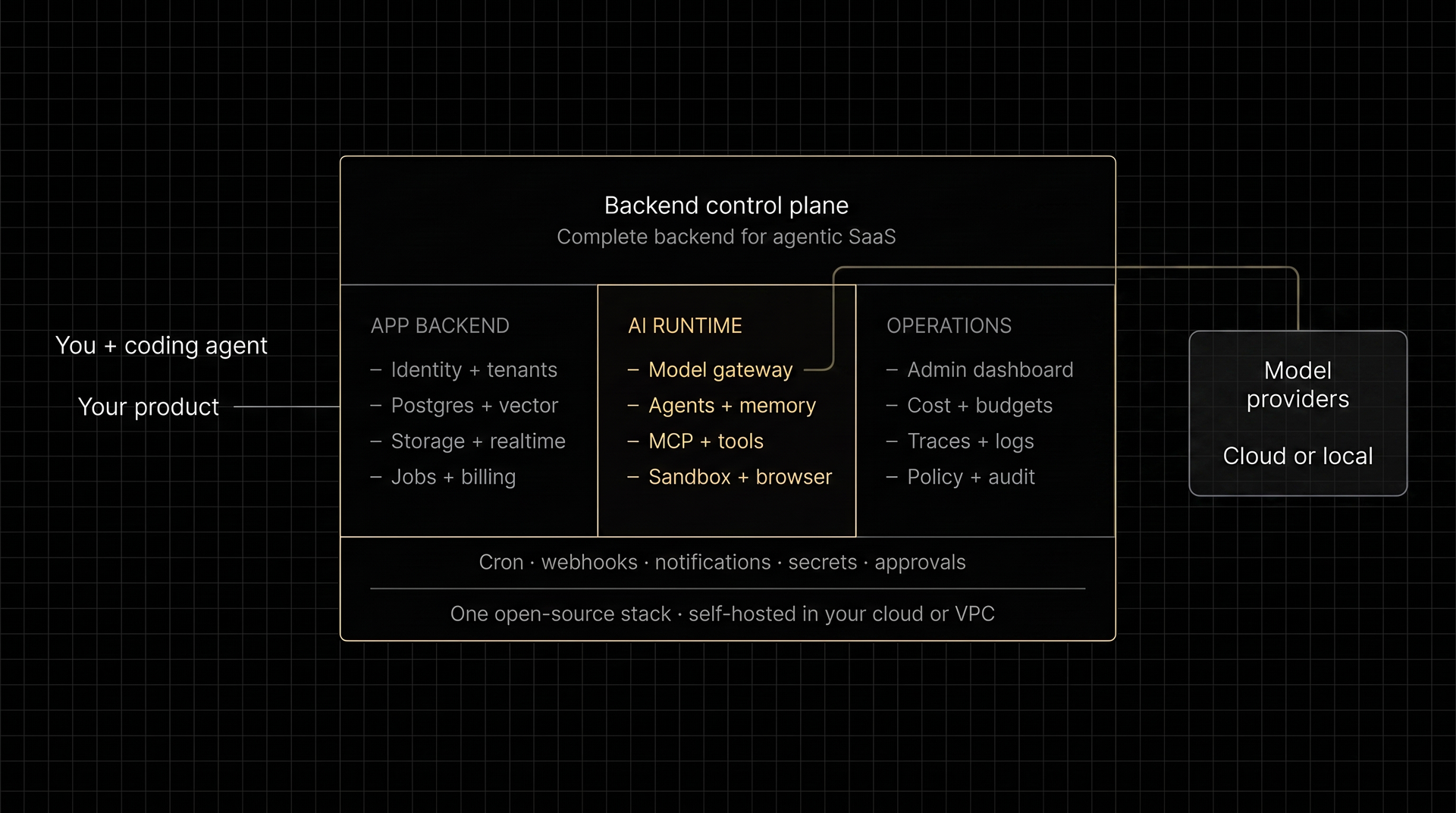
Think Supabase for agentic SaaS—with the AI runtime and operating plane included. Auth, Postgres, model routing, agent execution, sandboxed execution, browser automation, durable jobs, billing, cost controls, and observability are wired together in one open-source, self-hosted stack.
Give a coding agent (Codex, Claude Code, Gemini CLI, OpenCode, or another coding harness) a backend, not a blank repo. Build the product without assembling the AI infrastructure. Own the code, data, and deployment.
⚠️ Beta
BackAI is currently in beta and under active development. Expect rapid improvements and the occasional rough edge. If something breaks, feels unclear, or doesn't work as expected, please open an issue.

Included and wired: auth, data, AI runtime, jobs, billing, sandbox, browser, security, and operations.
Quickstart
Prerequisite: Docker with Compose. Node 18+ is optional in this checkout:
af-stack dev uses it to auto-allocate conflict-free ports and falls back
to the defaults without it.
git clone https://github.com/Agent-Field/backai.git
cd backai

# Install the CLI, then start the complete local stack.
curl -fsSL https://raw.githubusercontent.com/Agent-Field/backai/main/scripts/install.sh | bash
af-stack dev
Prefer not to pipe an installer into a shell? Inspect it first
or run go install github.com/Agent-Field/backai/services/cli/cmd/af-stack@latest.
Open the customer app first at http://localhost:34000, then inspect what it
did in the operator console at http://localhost:33000 — sign in with
operator@af-stack.local / changeme123. Set
AF_STACK_DEFAULT_OPERATOR_EMAIL / AF_STACK_DEFAULT_OPERATOR_PASSWORD in
.env before the first boot to seed different credentials; the seed only
runs while no operator exists; to change the seeded credentials later, reset
the Postgres volume, or set AF_STACK_DEFAULT_OPERATOR_DISABLED=true and
provision operators yourself. af-stack mode personal turns the login off
entirely.
No model key is required. The first run uses a deterministic demo provider but still exercises the real gateway, tenant context, cost ledger, customer app, and dashboard. Add an OpenRouter, OpenAI, Anthropic, Gemini, or other supported provider key when you want live model calls through LiteLLM.
Prefer raw Compose? Run node scripts/preflight.mjs --fix and then
docker compose up. Preflight resolves local port conflicts and prints every
service URL.
Pre-alpha: the golden path works, but workload auto-mounting and remote Python/TypeScript durable-job handlers are not wired yet. See current limits.
What you get
In the AI era, auth and a database are no longer a complete backend. Products also need controlled model and agent execution, durable work, cost enforcement, and observability.
| Primitive | Wired into BackAI |
|---|---|
| Identity | Users, sessions, tenants, memberships, roles, OAuth, scoped API keys, and row-level tenant isolation |
| Data | Postgres, pgvector, tenant-aware memory, search, realtime, migrations, storage, and an operator database browser |
| Models | OpenAI-compatible gateway, provider routing, streaming, embeddings, cache, guardrails, budgets, and model-level cost records |
| Agents | Multi-reasoner execution, streaming, approvals, cancellation, durable jobs, crons, webhooks, and run traces |
| Agent tools | Isolated sandboxes, browser adapters, MCP servers, native tools, skills, secrets, and coding-harness discovery |
| Commercial layer | Usage metering, cost ledger, per-tenant budgets, plan entitlements, and Stripe-shaped billing |
| Operations | Admin dashboard for traffic, errors, spend, budgets, queues, runs, traces, logs, webhooks, customers, audit, integrations, and service health |
| Product shell | A customer-facing Next.js app and SupportDesk AI flow that can be replaced with your product |
| Delivery | One CLI-managed Compose stack plus production recipes for Helm, Fly.io, Railway, Render, and a private VM or VPC |
These are one system, not a catalog of disconnected containers. Tenant identity flows through model calls, jobs, storage, billing, audit, and cost so builders do not have to recreate those connections for every product. Model and agent engines remain replaceable; the product is the secure wiring around them.
Operate what you ship
Cost, latency, failures, queues, tenants, and audit are first-class backend state—not separate dashboards developers must assemble later.

Spend, budgets, forecasts, and cost by model, agent, or tenant. |

Request volume, latency, runtime resources, routes, and errors. |
What can you build?
- Multi-tenant copilots with per-customer identity, usage, and budgets
- Support, operations, research, extraction, and document products
- Long-running coding-agent and approval-driven workflows
- AI features attached to an existing web, mobile, or backend application
Start from the neutral examples/starter/, the bundled
SupportDesk product, or a focused example: LLM gateway,
multi-tenant notes,
deep research, or
coding agents.
Built for coding agents
BackAI is designed to be handed to coding agents (Codex, Claude Code, Gemini
CLI, OpenCode, and others) after initialization. The repo includes AGENTS.md,
CLAUDE.md, and a versioned BackAI skill that explain the architecture, safe
edit boundaries, SDKs, and verification workflow.
Repo access is not runtime authority. Scoped keys, tenant policy, budgets, approvals, sandbox limits, and audit records keep build and live operations inside explicit boundaries.
# A complete app with its own bundled backend. Works in any directory; needs Docker.
af-stack init my-ai-product && cd my-ai-product
npm install && npm start   # boots the backend, then talks to it

# Or brand a full fork and hand it to your coding agent. These run inside
# a clone of this repo; that clone is where the four surfaces below live.
git clone https://github.com/Agent-Field/backai acme-ai && cd acme-ai
af-stack init --name "Acme AI" --color "#2563EB"
# optional: --logo ./your-logo.svg sets the light+dark mark in brand.yaml
af-stack agent new researcher
The first path needs no clone: the scaffold carries a docker-compose.yml
that boots Postgres, the LLM gateway, the runtime, the operator dashboard,
and a demo agent from the published release images, pinned to the CLI's
version.
Inside a fork, builders and agents usually edit only four surfaces:
| Surface | Path | Purpose |
|---|---|---|
| Customer product | apps/customer-app/ |
End-user UI and product flows |
| Agent | apps/backend/agents/<name>/ |
AgentField reasoners and agent logic |
| Workload module | workload-modules/<id>/ |
Domain routes, jobs, crons, and migrations |
| Dashboard plugin | apps/dashboard/plugins/<id>/ |
Product-specific operator views |
The platform runtime stays behind those boundaries. Existing apps can skip the customer shell and attach BackAI as a backend.

Build, operate, improve
BackAI records backend signals such as usage, latency, errors, model cost, and tenant activity. Connect product analytics such as PostHog through APIs, webhooks, MCP servers, or a custom integration instead of duplicating an analytics platform inside this stack.
A coding agent can correlate those signals and propose changes to prompts, model routing, UI, onboarding, traffic allocation, entitlements, or pricing logic. Tests, scoped credentials, budgets, approvals, and audit remain between a proposal and production. Automate only inside explicit policy boundaries. High-impact changes such as pricing or traffic shifts should require approval.
One URL, two compatible interfaces
Use the standard OpenAI SDK by changing its base URL:
import OpenAI from "openai"

const ai = new OpenAI({
  baseURL: "https://backai.example.com/api/v1/llm",
  apiKey: process.env.BACKAI_API_KEY,
})

const answer = await ai.chat.completions.create({
  model: "qwen/qwen-2.5-72b-instruct",
  messages: [{ role: "user", content: "Summarize this support request." }],
})
Use the Suite SDK when you need the rest of the backend:
from af_stack import suite

result = await suite.agents.call("researcher.run", {"topic": "AI backends"})
await suite.memory.put("latest-report", result)
await suite.billing.meter("reports_created", quantity=1)
The rule is simple:
app.*defines reasoners inside an AgentField agent.suite.*calls agents and every other BackAI primitive.
Python is the canonical full SDK. TypeScript is near parity with documented differences. REST and OpenAPI work from any language. The Go SDK is a version stub today, not a usable client. See the SDK reference.
Security is a system property
BackAI wires the controls that are easy to omit when teams assemble an AI backend service by service:
- Postgres row-level tenant isolation and scoped serving roles
- short-lived sessions plus issue, rotate, and revoke flows for API keys
- one LLM gateway for tenant, policy, budget, and audit enforcement
- encrypted secret storage with KMS adapter support
- PII redaction and configurable request/response moderation
- sandbox limits for CPU, memory, timeout, filesystem, and egress
- signed webhooks, replay protection, idempotency, retry, and delivery logs
- audit records for security-sensitive operator mutations
- separate health, readiness, metrics, backup, and restore paths
These defaults remove repeated integration work; they do not make an arbitrary deployment automatically compliant or secure. Before production, replace all development secrets, use external Postgres and object storage, choose a production sandbox adapter, configure backups, TLS, provider keys, monitoring, and your own threat model. Start with deployment guidance, configuration, and the security policy.
How it fits together

Every app-level model call should go through /api/v1/llm/*. Direct provider
calls bypass BackAI's tenant identity, budgets, cost records, and guardrails.
Open-source layers
The repository is Apache 2.0 and assembles the stack around open-source components. Optional model, email, billing, and remote-sandbox providers remain adapters; they are not a required hosted control plane.
| Layer | Responsibility | Current implementation |
|---|---|---|
| 1. Interfaces | Customer app, admin dashboard, API explorer, docs, SDKs, and CLI | Next.js, React, shadcn/ui, Scalar, Astro Starlight, Python, TypeScript, Go |
| 2. Edge | TLS termination and routing | Caddy |
| 3. Control plane | HTTP/OpenAPI, identity, tenancy, authorization, policy, audit, and secrets | Go runtime, better-auth, Postgres RLS, AES-GCM |
| 4. AI runtime | Model routing, agent execution, memory, tools, and coding harnesses | LiteLLM, AgentField, MCP, pluggable harnesses |
| 5. Execution | Durable jobs, crons, webhooks, and isolated code execution | River, robfig/cron, Docker, gVisor, Firecracker; optional e2b adapter |
| 6. Delivery | Signed outbound events, notifications, and billing | Native Postgres outbox, Lago; optional Resend and Stripe adapters |
| 7. Observability | Traces, metrics, structured logs, cost, queues, and service health | OpenTelemetry, Prometheus, slog, and the admin dashboard |
| 8. Data | Relational data, vectors, full-text search, queues, and objects | Postgres 16, pgvector, MinIO or S3-compatible storage |
The value is the wiring between layers, not the number of logos. If you use another open-source package, implement its existing adapter contract where one exists. If the capability or contract is missing, open an issue with the use case, project, license, deployment model, and expected interface. We add maintained OSS when it removes platform work, not merely to grow the dependency list.
Self-host it
af-stack dev starts the complete local composition. The same open-source
stack can run in your cloud or VPC without a mandatory hosted control plane.
Use your own model keys, Postgres, object storage, secrets, backups, and network
policy. See the OSS audit for what is included and why.
The development Compose file mounts the Docker socket for local code sandboxes. Do not expose it as a production deployment. Use the production Compose/Helm path and a gVisor, Firecracker, or remote sandbox adapter.
Choose the target that matches your operations posture:
| Target | Best for |
|---|---|
| Docker Compose | Local development or one controlled VM |
| Railway / Render | Fast hosted evaluation and small deployments |
| Fly.io | A compact regional deployment |
| Helm | Kubernetes, external state, and production scaling |
See deploy/ for the maintained artifacts and
docs/deploy.md for required secrets, external services,
backups, and production caveats.
Where it fits
The closest overlap is InsForge. This comparison describes each category's primary system boundary, not checkbox parity; these products evolve quickly.
| Category | Primarily owns | This project's boundary |
|---|---|---|
| Agent-native BaaS — InsForge | Backend resources that coding agents provision and operate | Closest comparison. This repo adds a deeper runtime and operating plane around tenant-aware agent calls, jobs, billing, cost, audit, sandboxes, and customer/admin surfaces. |
| General and reactive BaaS — Supabase, Appwrite, Convex | Data, auth, storage, functions, and realtime | Starts with the application foundation, then makes models, agents, jobs, policy, and cost part of the same tenant-aware system. |
| Agent runtimes and workflow platforms — Cloudflare Agents, Xians, Dify, Flowise | Agent execution, state, tools, or visual authoring | Includes the surrounding SaaS backend, commercial layer, customer shell, and operator plane; the agent runtime is one layer rather than the product boundary. |
| Gateways and observability — LiteLLM, Langfuse, Helicone | Model routing, traces, evaluations, and cost visibility | Treats gateway and observability as layers behind identity, tenancy, jobs, billing, audit, and product operations. |
The bet is not that every component is novel. It is that an agentic SaaS should not have to assemble and secure these categories independently before it can ship.
Project status
BackAI is pre-alpha. The current golden path is the SupportDesk first run, no-key demo mode, OpenAI-compatible gateway, Python/TypeScript SDKs, cost ledger, customer app, operator console, and self-hosted deployment artifacts.
Two important limits are explicit:
- Workload modules scaffold today, but automatic runtime mounting is not wired.
- Durable jobs execute Go in-process handlers today; remote Python and TypeScript job handlers are not implemented yet.
Track shipped behavior in docs/product.md and extension
contracts in docs/architecture.md.
Documentation
- Developer experience — build surfaces, local run, SDK, jobs, and webhooks
- Architecture — layers, ownership, and OSS composition
- Repository map — what belongs where
- Attach an existing app — gateway and tenant-key integration
- OSS audit — what BackAI uses and why
- Examples — capability-declared product shapes
Community
Read CONTRIBUTING.md before opening a change and use GitHub
Issues for bugs and product proposals. Security reports belong in the private
channel described in SECURITY.md.
Apache 2.0. See LICENSE.
Questions
What is BackAI?
Agent-Field/BackAI is a public repo on GitHub by Agent-Field. The open-source, self-hosted backend for agent-built, agent-powered SaaS—auth, Postgres, AI runtime, sandbox, browser, jobs, billing, security, and observability in one stack.
Is BackAI open source?
It declares the Apache-2.0 license on GitHub.
Does BackAI run on macOS, Windows or Linux?
Its maker tagged it for macOS, Windows and Linux, or as Docker or cross-platform. That is declared by the maker; Take My Repo has not tested it.
How do I install BackAI?
Open "Take it" on its page: Take My Repo writes an install plan for your machine and hands it to your AI agent (Claude Code, Codex or Cursor), which asks you before each step. Take My Repo has not tested it on any machine.
Is BackAI still maintained?
Its last change on GitHub was on 2026-11-17. Take My Repo does not judge from that whether it is maintained.
What do people who ran BackAI say?
Nobody has reviewed it on Take My Repo yet, which says nothing about its quality.