
agentorch
专注于多智能体架构的AI智能体设计框架
- 3
- MIT
- 3 mo ago
Repo Akun-python/agentorch, read from GitHub 8 h ago. Akun-python has not joined Take My Repo.
In short
Akun-python/agentorch is a public repo on GitHub by Akun-python. 专注于多智能体架构的AI智能体设计框架. It declares the MIT license on GitHub. It is written mainly in Python, has 3 stars and last changed on 2026-08-28. Nobody has reviewed it on Take My Repo yet, which says nothing about its quality. Read from GitHub on 2026-11-23.
agentorch
Code-first · Async-first Python framework for multi-agent orchestration

English | 简体中文 | 繁體中文 | Français | 日本語 | 한국어 | Español
An explicit runtime for real-world agent systems: compose models, tools, retrieval, memory, workflows, and delegation into observable software.
The PyPI distribution is masarch; install it with pip install masarch and import it as agentorch.
Project Overview
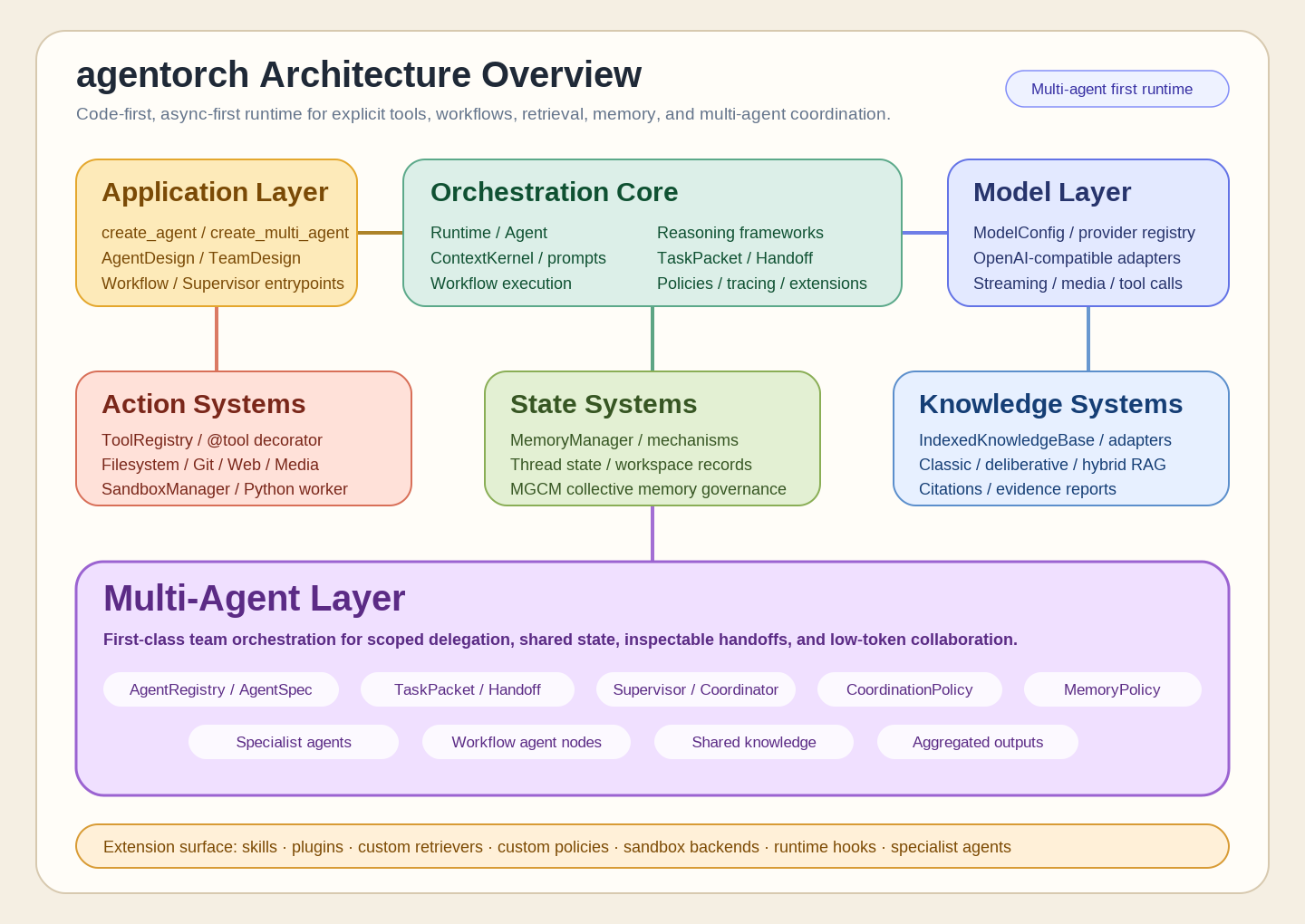
agentorch is for teams and researchers who need controllable agent systems rather than hidden prompt pipelines. It provides explicit runtime objects, policy boundaries, and structured state so a system can grow from one agent into coordinated multi-agent execution.
Typical Scenarios
- Coding assistants with bounded filesystem, shell, Git, and review access.
- Knowledge assistants with retrieval evidence, RAG, citations, and explainable output.
- Workflow automation with DAG execution, retries, audit trails, and persistence.
- Long-running tasks with threads, workspaces, cross-turn memory, and resumability.
Repository Layout
| Directory | Contents |
|---|---|
agentorch/ |
Core runtime, models, tools, memory, and workflow components |
projects/ |
Application projects such as AI text detection and AI short drama |
experiments/ |
Long-term memory, context, and baseline experiments |
resource/ |
Architecture diagrams, runtime flows, and brand assets |
tests/ |
Cross-module integration and project tests |
data/ |
Local data contract; raw data is ignored by default |
Technology Stack
| Layer | Technology | Purpose |
|---|---|---|
| Core language | Python 3.10+, asyncio |
Async-first runtime and task scheduling |
| Types and validation | Pydantic | Validate requests, responses, tools, and configuration |
| Model adapters | OpenAI API and compatible endpoints | Chat, embeddings, vision, and speech models |
| Orchestration | Runtime and Workflow DAG | Routing, delegation, handoffs, retries, and state |
| Tooling | filesystem, execution, git, web, media | Policy-controlled tool execution |
| Knowledge and memory | RAG, Memory, optional Neo4j | Evidence retrieval, long-term memory, and graphs |
| Engineering | pytest, Jinja2, HTTPX | Testing, generation templates, and HTTP adapters |
Core Capabilities
- Model adapters, structured output, and streaming responses
- Tool registries, allowlists, sandboxes, and permission policies
- Reasoning strategies such as
reactandplan_execute - Multi-agent delegation, task packets, and explicit handoff records
- RAG retrieval, evidence mounting, memory retention, and promotion
- Workflow execution, runtime tracing, and observability events
Architecture Overview
Runtime Flow
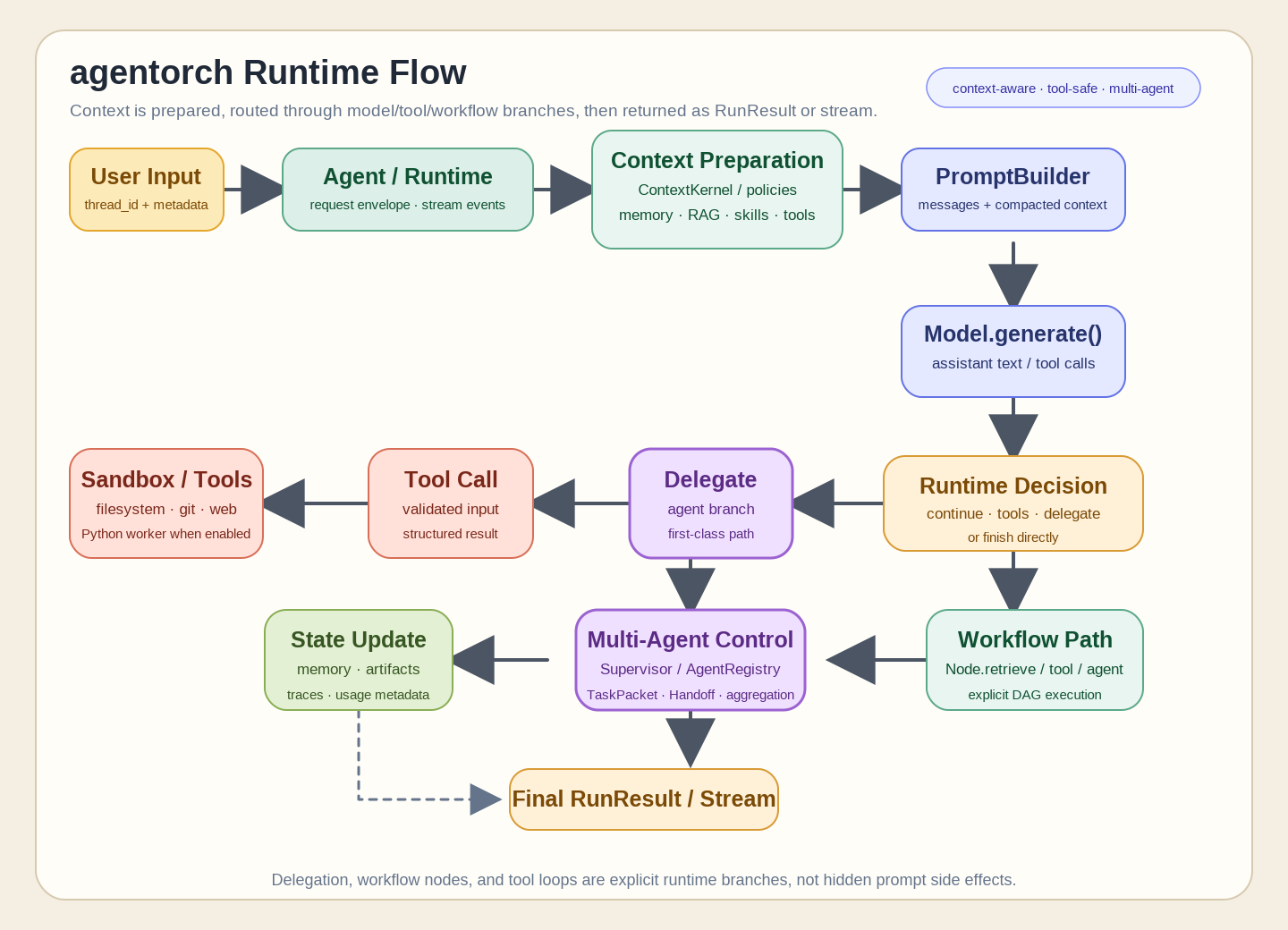
Architecture diagrams, technology icons, and project logos live in resource/brand.
Datasets, databases, model files, and generated experiment artifacts are ignored by default. See
data/README.mdfor the sharing contract.
Source repository: https://github.com/Akun-python/agentorch
WHY
Why This Project Exists 🎯
Many projects hit a wall after the "single assistant + one prompt" phase.
The moment you need specialist roles, constrained tools, repeatable state, and observable handoffs, ad-hoc prompt glue becomes difficult to reason about.
agentorch is designed to keep these concerns explicit:
- model adapter choices
- tool exposure and safety boundaries
- retrieval strategy and evidence mounting
- memory retention and promotion
- workflow execution order
- multi-agent coordination and delegation
Why It Helps Engineering Teams 🧭
- You can inspect system assembly with exported blueprint/config.
- You can enforce policy boundaries with typed configs.
- You can evolve behavior (reasoning/RAG/workflow) without rewriting everything.
- You can test behavior through code-level contracts.
Why It Helps Research Teams 🔬
- Swappable reasoning modes (
react,plan_execute, etc.) - Search/evolution support for strategy comparison
- Source-aware RAG flow and evidence-oriented outputs
- Long-horizon memory patterns for iterative tasks
Typical Scenarios
- multi-agent coding assistants with bounded filesystem/shell access
- research copilots that must cite retrieved sources
- workflow-driven automation that needs deterministic node execution
- long-running assistants with thread/workspace memory
WHAT
Core Facade API
create_agent(...)create_multi_agent(...)
These are the recommended entrypoints for most users.
Key Runtime Building Blocks 🧩
- model adapters (
OpenAIModel, compatible HTTP adapters) - tool registry and bundles
- sandbox manager and policy
- knowledge base and RAG strategy
- memory manager and memory policy
- workflow DAG builder and runner
- observability hooks and SQLite event store
Built-In Capability Surface
- structured tool calling via Pydantic I/O
- filesystem / execution / git / web / media bundles
- multi-format ingestion (
md,txt,pdf,docx, code artifacts) - reasoning strategy selection
- human feedback and resumable flows
- extension hooks for lifecycle interception
What "Orchestration" Means Here
In agentorch, orchestration is not a marketing word.
It means each runtime concern has a concrete type and place in assembly:
- coordinator policies decide routing behavior
- supervisor plans are inspectable objects
- handoffs and task packets are explicit records
- memory scopes and shared state are controlled by policy
Compatibility and Stability
- Python
3.10+ - minimal core dependencies
- stable high-level facade surface for day-to-day use
- compatibility exports for older integrations
HOW
Installation 📦
Install from PyPI:
pip install masarch
If your package mirror has not synchronized the latest release yet, use the official PyPI index:
pip install -i https://pypi.org/simple --no-cache-dir masarch
Verify the installed distribution and import package:
python -c "import importlib.metadata as m; import agentorch; print(m.version('masarch')); print(agentorch.__file__)"
Query release versions:
pip index versions masarch -i https://pypi.org/simple
Local editable install:
pip install -e .
Direct install from GitHub:
pip install "git+https://github.com/Akun-python/agentorch.git"
Optional extras example:
pip install "masarch[neo4j]"
Local editable install with optional extras:
pip install -e ".[neo4j]"
Environment Setup
Set provider credentials through environment variables:
OPENAI_API_KEY=sk-xxxx
OPENAI_BASE_URL=https://api.openai.com/v1
OPENAI_EMBEDDING_MODEL=text-embedding-3-small
Local .env loading is opt-in.
Recommended Start Path
- Start with
create_agent(...)and one minimal tool. - Add RAG only after baseline behavior is stable.
- Add workflow DAG only when execution order matters.
- Move to
create_multi_agent(...)when role separation is clear.
Validation Commands
Run package tests:
py -3.10 -m pytest -q
Run README contract tests:
py -3.10 -m pytest -q agentorch/tests/test_readme_contracts.py
Practical Guardrails ✅
- keep tool allowlists narrow
- avoid enabling shell where not required
- keep thread IDs explicit for traceability
- close agents/runtimes after use
QUICKSTART
1) Minimal Agent (sync)
from agentorch import create_agent

agent = create_agent(
    model="gpt-4.1-mini",
    system_prompt="You are concise and accurate.",
    reasoning="react",
)

result = agent.run_sync(
    "Explain what agent orchestration is in three bullet points.",
    thread_id="quickstart-en-001",
)

print(result.output_text)
agent.close()
2) Tool Calling
from pydantic import BaseModel

from agentorch import ToolRegistry, create_agent, tool

class AddInput(BaseModel):
    a: int
    b: int

@tool(description="Add two integers.")
async def add_numbers(input: AddInput):
    return {"sum": input.a + input.b}

agent = create_agent(
    model="gpt-4.1-mini",
    tools=ToolRegistry.from_tools(add_numbers),
    reasoning="react",
)

result = agent.run_sync("Use add_numbers to compute 12 + 30.", thread_id="quickstart-tools-001")
print(result.output_text)
agent.close()
3) Multi-Agent Starter
from agentorch import create_agent, create_multi_agent

planner = create_agent(model="gpt-4.1-mini", reasoning="plan_execute", name="planner")
reviewer = create_agent(model="gpt-4.1-mini", reasoning="react", name="reviewer")

team = create_multi_agent(
    model="gpt-4.1-mini",
    agents=[
        {"agent": planner, "name": "planner", "role": "planner"},
        {"agent": reviewer, "name": "reviewer", "role": "reviewer"},
    ],
    system_prompt="Coordinate specialists and return one final answer.",
)

result = team.run_sync("Draft and review a migration plan.", thread_id="quickstart-team-001")
print(result.output_text)
team.close()
4) Next Steps
The recommended path from a prototype to a maintainable system is to make one new boundary explicit at a time:
A. Mount project knowledge with RAG
Use knowledge_paths for local Markdown, text, code, or supported documents.
enable_rag=True makes retrieval part of the runtime contract instead of
leaving it to prompt assembly. Keep the source directory small, versioned, and
safe to share; do not point it at raw datasets or generated artifacts.
from agentorch import create_agent

agent = create_agent(
    model="gpt-4.1-mini",
    enable_rag=True,
    knowledge_paths=["docs/", "src/"],
    knowledge_scope=["public-docs", "source-code"],
)
result = agent.run_sync("根据项目文档解释认证流程。", thread_id="rag-001")
print(result.output_text)
agent.close()
B. Make important steps deterministic with a workflow DAG
Use a workflow when the order, retry boundary, approval point, or handoff must be inspectable. Keep open-ended reasoning inside a model node, and use explicit tool, retrieval, approval, and aggregation nodes for system boundaries.
from agentorch import WorkflowBuilder, create_agent
from agentorch.workflow import Node

workflow = (
    WorkflowBuilder(max_steps=8)
    .add(Node.retrieve("retrieve", question="用户问题"), entry=True)
    .then(Node.model_node("draft", prompt="基于检索证据形成初稿。"))
    .then(Node.model_node("review", prompt="检查事实、引用和风险。"))
    .build()
)
agent = create_agent(model="gpt-4.1-mini", workflow=workflow)
result = agent.run_sync("整理本次变更", thread_id="workflow-001")
agent.close()
C. Turn on observability before cost or quality tuning
Observability records runtime events, usage, handoffs, and failure context in a local SQLite store. Use a project-local path, redact secrets, and compare traces by model, prompt version, workflow version, and thread type.
from agentorch import create_agent
from agentorch.config import ObservabilityConfig

agent = create_agent(
    model="gpt-4.1-mini",
    observability=ObservabilityConfig(
        enabled=True,
        sqlite_path=".agentorch/observability.db",
        console_mode="important_only",
    ),
)
Track at least: success rate, tool failure rate, latency, prompt/completion tokens, estimated cost, retrieval hit quality, citation coverage, and human fallback rate. Do not put API keys, raw personal data, or datasets into trace payloads.
D. Encode team boundaries with policy objects
Policies are executable configuration. Pin them in code or a reviewed config file so a multi-agent team has predictable context, state, routing, memory, and tool behavior.
Questions
What is agentorch?
Akun-python/agentorch is a public repo on GitHub by Akun-python. 专注于多智能体架构的AI智能体设计框架.
Is agentorch open source?
It declares the MIT license on GitHub.
Does agentorch run on macOS, Windows or Linux?
Its maker has not tagged a system, so it is unknown here. Its README says what it needs.
How do I install agentorch?
Open "Take it" on its page: Take My Repo writes an install plan for your machine and hands it to your AI agent (Claude Code, Codex or Cursor), which asks you before each step. Take My Repo has not tested it on any machine.
Is agentorch still maintained?
Its last change on GitHub was on 2026-08-28. Take My Repo does not judge from that whether it is maintained.