ECC
The agent harness performance optimization system. Skills, instincts, memory, security, and research-first development for Claude Code, Codex, Opencode, Cursor and beyond.
- 310k
- JavaScript
- MIT
- 1 d ago
Run only the tests your change can affect. pytest plugin for AI coding agents and CI.
Repo Ar9av/testscope, read from GitHub 11 h ago. Ar9av has not joined Take My Repo.
Ar9av/testscope is a public repo on GitHub by Ar9av. Run only the tests your change can affect. pytest plugin for AI coding agents and CI. It declares the Apache-2.0 license on GitHub. It is written mainly in Python, has 13 stars and last changed on 2026-11-18. Nobody has reviewed it on Take My Repo yet, which says nothing about its quality. Read from GitHub on 2026-11-23.
Run only the tests your change can affect. Built for AI coding agents and CI.
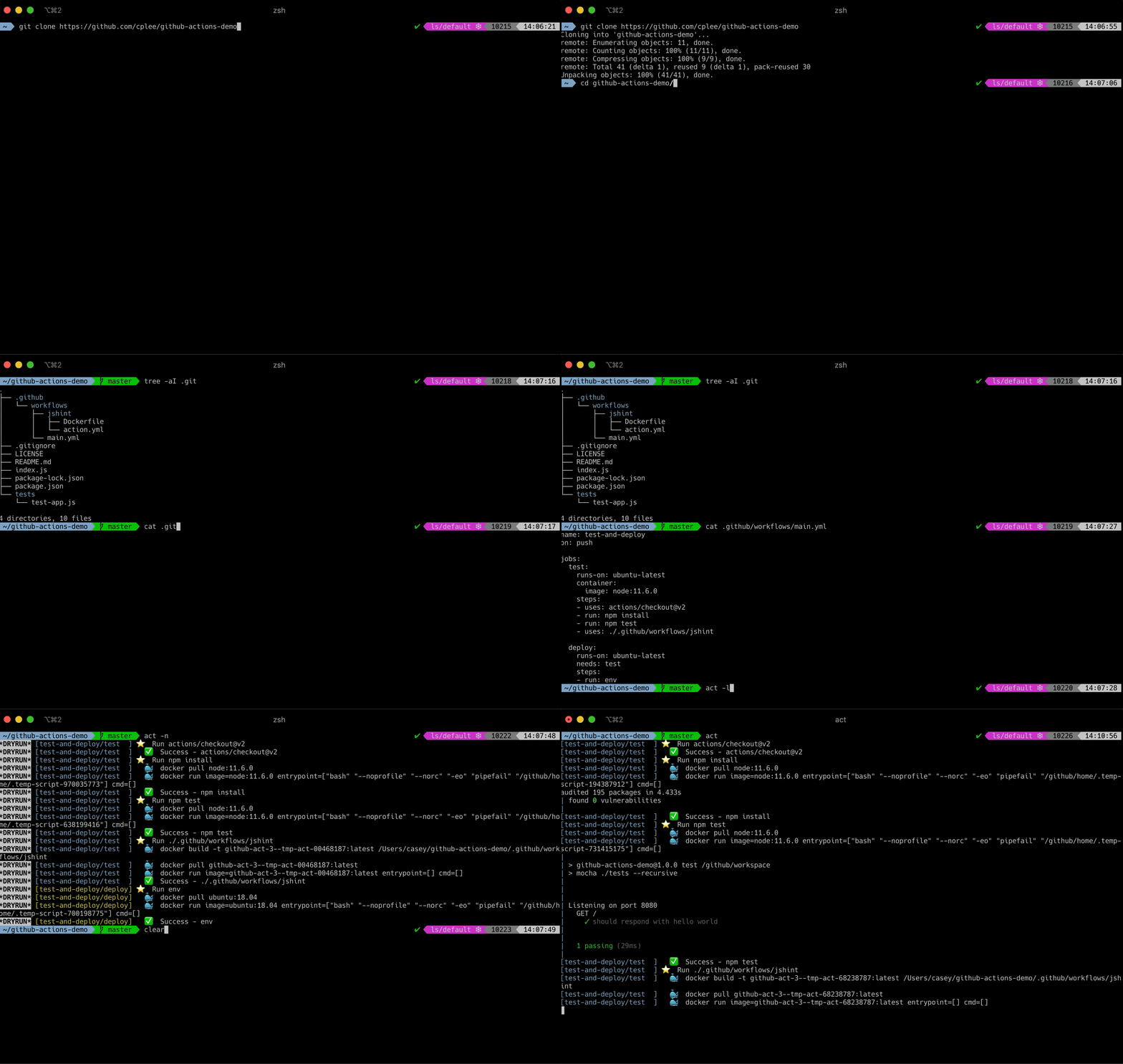
Coding agents run pytest after every edit. On a 6,000-test suite that is minutes per
run. It goes past Claude Code's ~2-minute foreground limit, so the run moves to the
background and the agent stops reading its output. testscope records which code and
files each test really touches. After that, plain pytest runs only the tests your
change can reach.
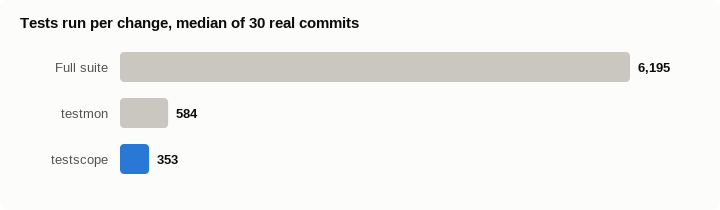
On a real 6,195-test project, over its last 30 commits:
| testscope | pytest-testmon | import graph | |
|---|---|---|---|
| Median tests run per real commit (of 6,195) | 353 | 584 | 352 files of 378 |
| Injected faults caught (34 that break a test) | 33 | 22 | 22 |
| Faults in data files caught (YAML, JSON, shell) | 10 / 10 | 0 / 10 | 0 / 10 |
| Bad package upgrades caught (4 that break a test) | 4, running 92 to 2,278 tests | 4, running all 6,195 | 0 |
Mean time to first failure with -x (same selection) |
4.0 s fail-first; 21.3 s in pytest's order | not measured | - |
| Recording overhead on a 3m36s suite | none measured | +23 s | - |
| Selection time (testscope logic only) | 0.13 s | not measured | - |
Method, caveats and raw data: bench/RESULTS.md.
Install it as a dev dependency: pip install testscope (or uv add --dev testscope).
Add .testscope/ to .gitignore. The map is local state; do not commit it.
Record the map once. This is one full run (Python 3.12+):
pytest --testscope-record
Edit code, then run only the affected tests:
pytest --testscope
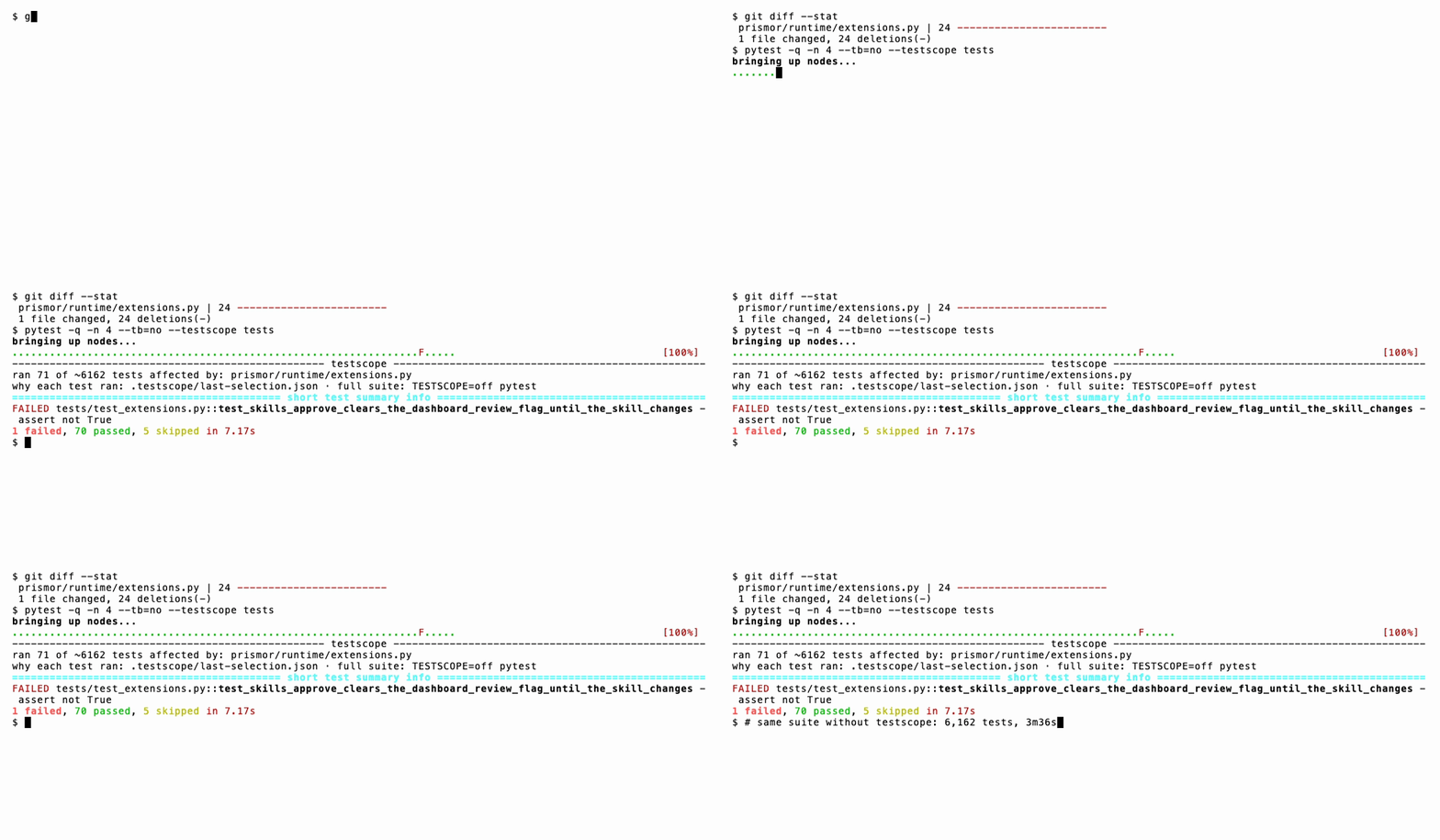
The header line testscope: ... tells you what was selected and why.
.testscope/last-selection.json gives the reason for each test.
Agents. When an agent runs pytest and a map exists, selection turns on by itself. The
agent needs no new command and no hook. testscope detects Claude Code (CLAUDECODE),
Codex (CODEX_SANDBOX, CODEX_THREAD_ID), Cursor (CURSOR_AGENT) and Gemini CLI
(GEMINI_CLI). For other agents, set TESTSCOPE=on in their environment.
Always: TESTSCOPE=off pytest runs everything. Named targets
(pytest tests/test_x.py::test_y) are never narrowed.
Set it up with an agent. Tell your coding agent: "Set up testscope in this repo,
following https://github.com/Ar9av/testscope/blob/master/AGENTS.md". That file has the
steps, the checks, and a block of text to add to your project's own AGENTS.md /
CLAUDE.md.
A git worktree with no map of its own uses the main checkout's map. When a change forces a
full run (a config or lockfile changed), testscope records a fresh map during that run, so
the next run is narrow again. A run that covers less than 90% of the old map's tests (-k,
-x, a subdirectory) keeps the old map. TESTSCOPE_AUTORECORD=off turns this off.
| Dependency | How | testmon | import graph |
|---|---|---|---|
| Functions a test runs | sys.monitoring PY_START, disabled after the first hit, re-armed per test |
yes (coverage) | no |
| Code run in child Python processes | sitecustomize on PYTHONPATH, tagged with the running test |
no | no |
| Data files read (YAML, JSON, fixtures, shell scripts run) | audit hooks: open, subprocess.Popen |
no | no |
| Files added to / removed from a listed directory | audit hooks: os.listdir, os.scandir |
no | no |
| Module-level code (constants, decorators, class bodies) | by name: tests that ran code reading the changed name, in this module or its importers; plus up to 5 tests that import the module, to catch import crashes | yes | yes |
Data files named by other files (a script that sources _lib.sh, a config that names a fixture) |
one hop from files tests read; chains only through shell scripts | no | no |
Config / lockfile change (pyproject.toml, *.lock, requirements*.txt, …) |
full run | full run | no |
| Installed packages (upgrade, downgrade, removal) | the packages whose code each test ran, with their versions; a version change reruns only those tests | full run | no |
| Tests that failed last run | always rerun, and run first | yes | no |
Selected tests run in fail-first order: tests that failed last time, then tests that ran
the changed code, then indirect reasons; shorter files first. Whole files move, so module
fixtures still run once. TESTSCOPE_ORDER=off keeps pytest's order.
Fingerprints are token-stream hashes without line numbers or comments, so moving code or changing a comment selects nothing. The map is a baseline. Selection compares the working tree with it by content, so it works on uncommitted edits and on branches built from an older main. As you edit, the selection can only grow. Re-record to reset it.
TESTSCOPE_AI=claude pytest          # your coding agent's own login, no API key
pip install 'testscope[ai]' && TESTSCOPE_AI=anthropic pytest   # or the API, ANTHROPIC_API_KEY
TESTSCOPE_AI= |
runs | auth |
|---|---|---|
claude |
claude -p |
Claude Code login |
codex |
codex exec |
Codex login (ChatGPT plan) or API key |
cursor |
cursor-agent -p |
Cursor login |
gemini |
gemini -p |
Google login or GEMINI_API_KEY |
copilot |
copilot -p |
Copilot login |
qwen |
qwen |
Qwen Code's own auth |
opencode |
opencode run |
any provider opencode is set up with |
anthropic |
Anthropic API | ANTHROPIC_API_KEY |
Each CLI runs read-only in an empty directory, so it sees no project files. TESTSCOPE_AI_MODEL
picks the model. Measured: Claude, Codex and opencode. Cursor, Gemini, Copilot and Qwen are
tested against their documented output only.
Until a map is recorded, a model reads the diff and a test index and picks the test files
to run. On the same faults it caught 33 of 34 while it ran about 3 files, for about 1 cent a
call on Opus 5.5 (0.05 cents on Haiku 5.5). It is a guess: it found every failing file only
21 times in 34. Once a map exists the AI step is off. (We measured it on top of the map
too: it caught nothing extra, so that mode was removed.) Details:
bench/RESULTS.md.
pytest --testscope-record; the map goes into the Actions cache.pytest --testscope.sys.monitoring). Selection works on any 3.9+.env={}), or with
python -I / -E, hides that child's deps. Shell scripts that read files themselves
are seen only as "script ran".requirements*.txt edit still triggers a full run.eval/exec strings and other dynamic code that no recorded test reached cannot be mapped.bench/RESULTS.md: real commits and fault injection on one 6,195-test
project. For each injected fault, a full-suite run gives the ground truth. Missed files are
rerun to rule out flaky tests. The harness is in bench/, so you can run it on
your own suite.
Ar9av/testscope is a public repo on GitHub by Ar9av. Run only the tests your change can affect. pytest plugin for AI coding agents and CI.
It declares the Apache-2.0 license on GitHub.
Its maker has not tagged a system, so it is unknown here. Its README says what it needs.
Open "Take it" on its page: Take My Repo writes an install plan for your machine and hands it to your AI agent (Claude Code, Codex or Cursor), which asks you before each step. Take My Repo has not tested it on any machine.
Reverse engineer anything with agents, from app behavior down to native binaries.
Full-stack web application template with FastAPI, React, SQLModel, PostgreSQL, Vite, Tailwind CSS, shadcn/ui, FastAPI Cloud, and Docker Compose.
The most comprehensive database of Chinese poetry 🧶最全中华古诗词数据库, 唐宋两朝近一万四千古诗人, 接近5.5万首唐诗加26万宋诗. 两宋时期1564位词人,21050首词。
Its last change on GitHub was on 2026-11-18. Take My Repo does not judge from that whether it is maintained.
Nobody has reviewed it on Take My Repo yet, which says nothing about its quality.
Take My Repo cannot say: it does not audit code and has not run testscope. What is known comes from GitHub. It declares the Apache-2.0 license on GitHub. Its last change was on 2026-11-18. It has 13 stars, which measure popularity, not safety. Nobody has reviewed it on Take My Repo yet, which says nothing about its quality. Read the source before you run it. With "Take it", your AI agent shows each step and asks you before running it; README text is treated as data, not as instructions.