abxpkg
📦 Modern strongly typed Python library for managing system dependencies with package managers like apt, brew, pip, npm, etc.
- 28
- MIT
- 20 h ago
Repo ArchiveBox/abxpkg, read from GitHub 1 min ago. ArchiveBox has not joined Take My Repo.
In short
ArchiveBox/abxpkg is a public repo on GitHub by ArchiveBox. 📦 Modern strongly typed Python library for managing system dependencies with package managers like apt, brew, pip, npm, etc. It declares the MIT license on GitHub. It is written mainly in Python, has 28 stars and last changed on 2026-11-22. Nobody has reviewed it on Take My Repo yet, which says nothing about its quality. Read from GitHub on 2026-11-23.
abxpkg 📦 apt brew pip uv npm pnpm yarn bun deno cargo gem goget nix docker bash puppeteer playwright chromewebstore ansible pyinfra
All-in-one multi-package manager CLI + Python API.
Use abxpkg to detect & auto-install dependencies at runtime, serialize your dependencies to DB/config, and manage bins across many ecosystems.
This is a Python library and all-in-one CLI for managing packages locally with a variety of package managers.
It's designed for when you have to detect or install binary or source dependencies at runtime.
Stop distributing your apps via curl | sh! Instead you can bake package installation into your app, or use our uv-style abxpkg run --script shebang headers to auto-install dependencies for you.
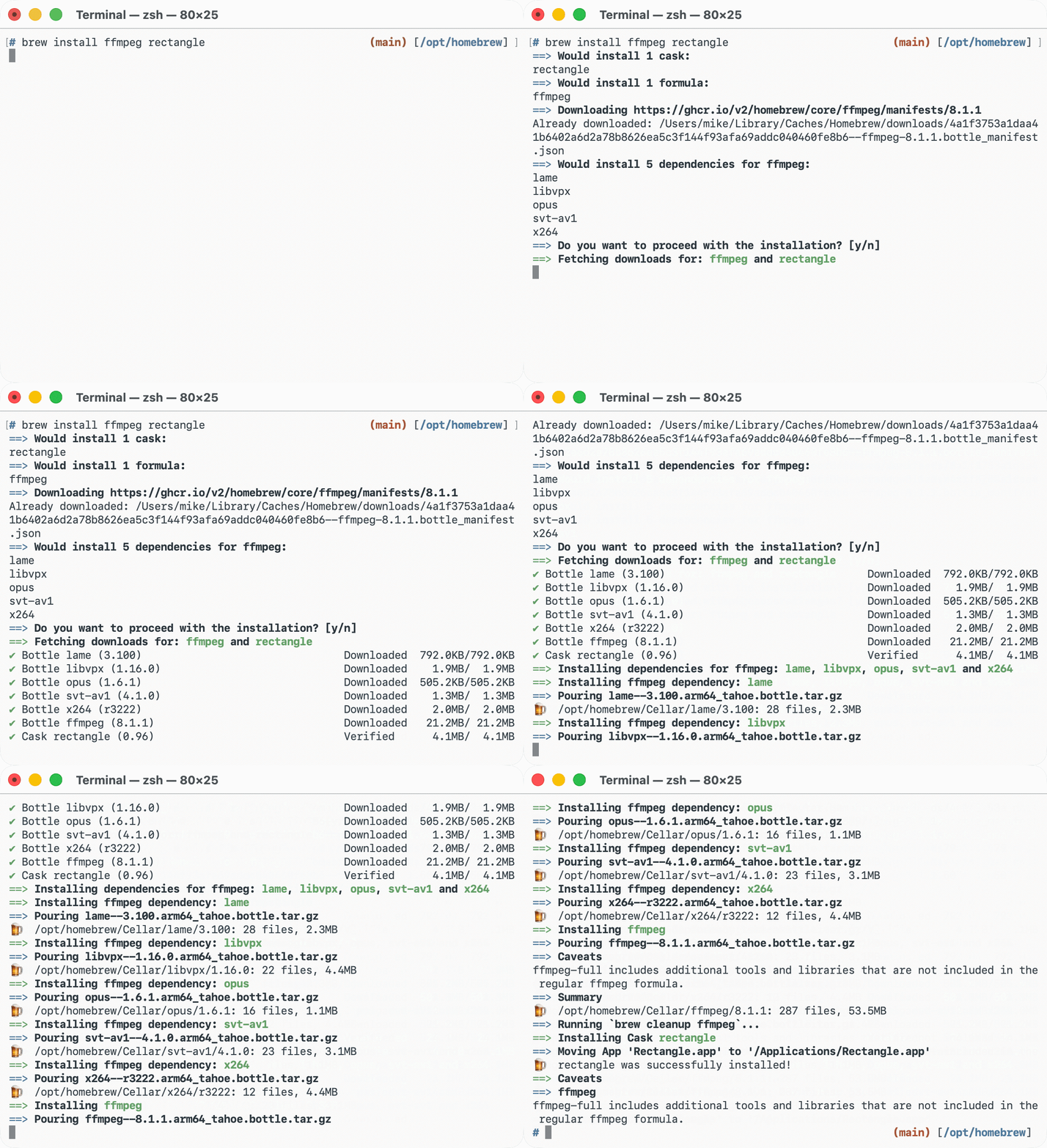
pip install abxpkg    # uv tool install abxpkg
abxpkg --version
from pathlib import Path from tempfile import TemporaryDirectory from abxpkg import Binary, env, npm, brew prettier = env.load('prettier') or npm.install('prettier') or brew.install('prettier') # or equivalent: prettier = Binary(name='prettier', binproviders=[env, npm, brew]).install() print(prettier.abspath, prettier.version) # ~/.cache/abx/lib/npm/bin/prettier 2.2.1 with TemporaryDirectory() as temp_dir: example = Path(temp_dir) / 'example.js' example.write_text('const answer=42\n') prettier.exec(cmd=['--write', str(example)]) # Search a provider's package index for matches: matches = npm.search('puppeteer') # -> list[Binary] with name + install_args populated assert isinstance(matches, list)
📦 Provides consistent interfaces for runtime dependency resolution & installation across multiple package managers & OSs ✨ Built with
pydanticv2 for strong static typing guarantees and easy conversion to/from json 🌈 Usable withdjango>= 4.0,django-ninja, and OpenAPI +django-jsonformto build UIs & APIs 🦄 Driver layer can bepyinfra/ansible/ or built-inabxpkgengine
Built by ArchiveBox to install & auto-update our extractor dependencies at runtime (chrome, wget, curl, etc.) on macOS/Linux/Docker.
Source Code: https://github.com/ArchiveBox/abxpkg/
Documentation: https://github.com/ArchiveBox/abxpkg/blob/main/README.md
from abxpkg import Binary, apt, brew, docker, env, npm, pip, playwright, pnpm, puppeteer, uv

# Provider singletons are available as simple imports — no manual instantiation needed
dependencies = [
    Binary(name='curl',       binproviders=[env, apt, brew]),
    Binary(name='yt-dlp',     binproviders=[env, pip, uv, apt, brew]),
    Binary(name='playwright', binproviders=[env, npm, pnpm]),
    Binary(name='chromium',   binproviders=[env, playwright, puppeteer, apt]),
    Binary(name='postgres',   binproviders=[env, docker, apt, brew]),
]
assert dependencies[0].binproviders == [env, apt, brew]
assert dependencies[1].binproviders == [env, pip, uv, apt, brew]
Tip
🔒 Stay safe from supply-chain attcaks with abxpkg: We default to safe behavior (when providers allow):
min_release_age=7(we only install packages that have been published for 7 days or longer)postinstall_scripts=False(we don't run post-install scripts for packages by default)install_root=<platform default abx lib dir>(the CLI defaults to a dedicated provider-rooted library dir so host system stays clean)
You can customize these defaults on Binary or BinProvider, or with ABXPKG_MIN_RELEASE_AGE/ABXPKG_POSTINSTALL_SCRIPTS/ABXPKG_LIB_DIR (see Configuration below).
Usage
Install
pip install abxpkg
abxpkg --version
Or install the isolated CLI tool:
uv tool install abxpkg
abxpkg --version
CLI
Installing abxpkg also provides an abxpkg CLI entrypoint:
abxpkg --version
abxpkg version
abxpkg list

abxpkg install yt-dlp
abxpkg load yt-dlp
abxpkg env yt-dlp
abxpkg activate yt-dlp
abxpkg update yt-dlp
abxpkg uninstall yt-dlp
Search package indexes:
abxpkg search chromium                          # search all providers in parallel
abxpkg --binproviders=apt,npm,brew search node  # restrict to specific providers
abxpkg --version and abxpkg version stream the package version first, then a host/env summary line, then one section per selected provider showing its current resolved runtime state (INSTALLER_BINARY, PATH, ENV, install_root, bin_dir, and any active cached dependency / installed binaries).
abxpkg version <binary> is a thin alias for abxpkg load <binary>.
abxpkg list prints the full active cache for the selected providers, grouping provider installer binaries first and normal cached binaries after a blank line. You can optionally pass binary names and/or provider names positionally to filter the output:
abxpkg list
abxpkg list yt-dlp chromium
abxpkg list env puppeteer chromium
Execute an installed binary via the configured providers
abxpkg run yt-dlp --help                          # resolves yt-dlp via the configured providers and execs it
abxpkg --binproviders=pip,brew run pip show black # restrict provider resolution (exercises PipProvider.exec)
abxpkg --binproviders=pip --install run yt-dlp    # load first, then install via selected providers if needed
abxpkg --binproviders=pip --update  run yt-dlp    # ensure the binary is available, then update before exec
abxpkg --binproviders=pip --no-cache --install run yt-dlp  # bypass cached/current-state checks during resolution + install

abxpkg env yt-dlp                                 # print dotenv-style KEY=value lines for yt-dlp's runtime env
abxpkg --binproviders=pip env --install black     # install if needed, then print the runtime env in .env format
eval "$(abxpkg --binproviders=pip activate black)" # emit bash export lines and apply them to the current shell
abxpkg activate --fish black | source             # emit fish set -x lines and source them into fish
eval "$(abxpkg --binproviders=pip activate --zsh black)" # emit zsh export lines
abxpkg env resolves binaries the same way as run, then prints the runtime env as dotenv-style KEY=value lines. abxpkg activate emits a short usage comment plus shell-specific activation commands: bash by default, --zsh for zsh export KEY=value, and --fish for fish set -x KEY VALUE.
abxpkg options (e.g. --binproviders, --lib, --install, --update, --no-cache) must appear before the run subcommand; every argument after the binary name is forwarded verbatim to the underlying binary. The same install/update flags also apply to env / activate. run exits with the child's exit code, passes its stdout/stderr through unbuffered, and routes any abxpkg install/load logs to stderr only — no headers, no footers, no parsing.
abx: auto-install-and-run shortcut
Think npx / uvx / pipx run — but for every package manager abxpkg supports. abx is a thin alias for abxpkg --install run ...: it resolves the binary via the configured providers, installs it if missing, then execs it with the forwarded arguments.
abx --binproviders=env python3 --version        # run an existing host binary through the same resolution path
abx --binproviders=env python3 -c 'print("abx works")'
Options before the binary name (--lib, --binproviders, --dry-run, --debug, --no-cache, --update) are forwarded to abxpkg; everything after the binary name is forwarded to the binary itself.
Per-Binary / per-BinProvider options as CLI flags
Every Binary / BinProvider configuration field is exposed as a CLI flag on the group and on subcommands (install, update, uninstall, load), and is also available to run / abx via group-level flags placed before the binary name. Providers that can't enforce a given option emit a warning to stderr and continue — no hard failure.
abxpkg --min-version=1.2.3 --min-release-age=7 install yt-dlp
abxpkg --postinstall-scripts=False --binproviders=apt,uv,pip install black
abxpkg --no-cache install black
abxpkg --install-root=/tmp/yt-dlp-root --bin-dir=/tmp/yt-dlp-bin install yt-dlp
abxpkg --overrides='{"pip":{"install_args":["yt-dlp[default]"]}}' install yt-dlp
abxpkg --install-timeout=600 --version-timeout=20 --euid=1000 install yt-dlp
abxpkg --global install yt-dlp
abx --min-version=2024.1.1 --min-release-age=3 yt-dlp --help| Flag | Type | Meaning |
|---|---|---|
--min-version=SEMVER |
str |
Minimum acceptable version (set on Binary.min_version). |
--max-version=SEMVER |
str |
Maximum acceptable version (set on Binary.max_version). |
--postinstall-scripts[=BOOL] |
bool |
Allow post-install scripts. Bare --postinstall-scripts = True. Providers that can't disable them warn-and-ignore. |
--min-release-age=DAYS |
float |
Minimum days since publication. Non-supporting providers warn-and-ignore. |
--no-cache[=BOOL] |
bool |
Skip cached/current-state checks and force fresh install/update/load probes. Bare --no-cache = True. |
--overrides=JSON |
dict |
Per-provider Binary.overrides patches for shared provider fields (PATH, INSTALLER_BIN, install_root, bin_dir, euid, postinstall_scripts, min_release_age, dry_run, install_timeout, version_timeout) plus per-binary handler replacements (install_args, abspath, version, install, update, uninstall). |
--global[=BOOL] |
bool |
Thin alias for --lib=None. Bare --global = True. |
--install-root=PATH |
Path |
Override the per-provider install directory. |
--bin-dir=PATH |
Path |
Override the per-provider bin directory. |
--euid=UID |
int |
Pin the UID used when providers shell out. |
--install-timeout=SECONDS |
int |
Seconds to wait for install/update/uninstall subprocesses. |
--version-timeout=SECONDS |
int |
Seconds to wait for version/metadata probes. |
--dry-run[=BOOL] |
bool |
Show installer commands without executing them. Bare --dry-run = True. |
--debug[=BOOL] |
bool |
Emit DEBUG logs to stderr. Bare --debug = True. Defaults to ABXPKG_DEBUG or False. |
Every value-taking flag also accepts the literal string None / null / "" to reset to the provider's default resolution path. For postinstall_scripts / min_release_age, that means the action-specific effective default for that provider (False / 7 on supporting providers, True / 0 otherwise). The precedence is: explicit per-subcommand flag > group-level flag > environment variable > built-in default.
Select specific providers / re-order provider precedence
abxpkg install --binproviders=env,uv,pip,apt,brew prettier
# or
env ABXPKG_BINPROVIDERS=env,uv,pip,apt,brew abxpkg install yt-dlp
Customize where installed packages are located
abxpkg --lib=./vendor/abxpkg --binproviders=env load python3
env ABXPKG_LIB_DIR=./vendor/abxpkg abxpkg --binproviders=env load python3
Run in "dry mode" to see what commands will do before executing
abxpkg install --dry-run some-dangerous-package      # outputs commands that would be run without executing them
# or
env ABXPKG_DRY_RUN=1 abxpkg install some-dangerous-package
CLI result lines are written to stdout. Progress logging is written to stderr at INFO by default. Enable DEBUG logging with ABXPKG_DEBUG=1 or --debug.
Shebang Line in Scripts
⚡️ Inspired by uv's inline script metadata, abxpkg lets you declare arbitrary package dependencies at the top of any script.
It will automatically fetch, install, and make the packages available to your script across a wide variety of languages.
#!/usr/bin/env -S abxpkg run --script node

// /// script
// dependencies = [
//     {name = "node", binproviders = ["env", "apt", "brew"], min_version = "22.0.0"},
//     {name = "playwright", binproviders = ["env", "pnpm", "npm"], install_args = ["playwright@next"]},
//     {name = "chromium", binproviders = ["env", "playwright", "puppeteer", "apt"], min_version = "131.0.0"},
// ]
// [tool.abxpkg]
// ABXPKG_POSTINSTALL_SCRIPTS = true
// ///

const { chromium } = require('playwright');

(async () => {
    const browser = await chromium.launch();
    const page = await browser.newPage();
    await page.goto('https://example.com');
    console.log(await page.title());
    await browser.close();
})();
<30ms cold-start overhead once cached.
The metadata parser is comment-syntax-agnostic — it looks for /// script and /// delimiters and strips the first whitespace-delimited token from each line, so #, //, --, ;, and any other single-token comment prefix all work.
Python Library
Basic Usage
All built-in providers are available as lazy singletons — just import them by name:
from abxpkg import apt, brew, pip, npm, env

apt.install('curl')
env.load('wget')
These are instantiated on first access and cached for reuse. If you need custom configuration, you can still instantiate provider classes directly:
from pathlib import Path
from abxpkg import PipProvider

custom_pip = PipProvider(install_root=Path("/tmp/abxpkg-pip"), min_release_age=3)
Use the Binary class to declare a package that can be installed by one of several ordered providers, with an optional version floor:
from abxpkg import Binary, SemVer, env, brew

curl = Binary(
    name="curl",
    min_version=SemVer("7.0.0"),
    binproviders=[env, brew],
).install()
min_version and max_version are inclusive bounds enforced after a provider resolves or installs a binary, including cached requests. A None bound is unconstrained. Set both to the same SemVer to require an exact version. Provider-specific install_args still select the package to install; they do not constrain an already-installed binary. For example, pair min_version="2.5.8", max_version="2.5.8" with overrides={"uv": {"install_args": ["opendataloader-pdf==2.5.8"]}} to reject an existing newer version and install the declared pin. Bounds validate the result; they do not choose an upper-bounded package version for the package manager.
Pass no_cache=True to load() / install() / update() / uninstall() when you want to bypass cached/current-state checks. For install(), no_cache=True skips the initial load() check and forces a fresh install path. The equivalent CLI and env controls are --no-cache and ABXPKG_NO_CACHE=1.
For maintainers: provider caching design and history explains why ownership, absolute paths, runtime environments and cache validation must remain distinct.
Provider installer binaries also resolve lazily through the active provider chain. If a provider needs pip, npm, cargo, or another installer tool and it is missing, abxpkg will auto-install that dependency using the currently selected providers and the same ABXPKG_LIB_DIR / --lib / --global settings.
Advanced Usage
Define a reusable Binary subclass with per-provider overrides
Define a reusable Binary subclass with per-provider overrides
from pydantic import InstanceOf
from abxpkg import BinProvider, Binary, BinProviderName, BinName, HandlerDict, BrewProvider
from abxpkg import env, pip, apt

class CustomBrewProvider(BrewProvider):
    name: BinProviderName = 'custom_brew'

    def get_macos_packages(self, bin_name: str, **context) -> list[str]:
        return ['yt-dlp'] if bin_name == 'ytdlp' else [bin_name]

class YtdlpBinary(Binary):
    name: BinName = 'ytdlp'
    description: str = 'YT-DLP (Replacement for YouTube-DL) Media Downloader'

    # define the providers this binary supports
    binproviders: list[InstanceOf[BinProvider]] = [env, pip, apt, CustomBrewProvider()]

    # customize installed package names for specific package managers
    overrides: dict[BinProviderName, HandlerDict] = {
        'pip': {'install_args': ['yt-dlp[default,curl-cffi]']},   # literal values
        'apt': {'install_args': lambda: ['yt-dlp', 'ffmpeg']},    # any pure Callable
        'custom_brew': {'install_args': 'self.get_macos_packages'},  # or a string ref to a method on self
    }


ytdlp = YtdlpBinary()
assert [provider.name for provider in ytdlp.binproviders] == ['env', 'pip', 'apt', 'custom_brew']
assert ytdlp.overrides['pip']['install_args'] == ['yt-dlp[default,curl-cffi]']
Use Binary objects as a stable typed interface to interact with installed packages
Use Binary objects as a stable typed interface to interact with installed packages
from abxpkg import Binary, env

# Use providers directly for host binary discovery
python = env.load('python3')
assert python and python.is_valid
print(env.PATH, env.get_abspaths('python3'), env.get_version('python3'))

# our Binary API provides a nice type-checkable, validated, serializable handle
python = Binary(name='python3', binproviders=[env]).load()
print(python)                       # Binary(name='python3', abspath=Path(...), version=SemVer(...), sha256='...', mtime=1712890123456789000)
print(python.abspaths)              # show all matching binaries found via each provider PATH
print(python.model_dump(mode='json'))  # JSON-ready dict
print(python.model_json_schema())   # ... OpenAPI-ready JSON schema showing all available fields
from pydantic import InstanceOf
from abxpkg import Binary, BinProvider, BrewProvider, EnvProvider

# You can also instantiate provider classes manually for custom configuration,
# or define binaries as classes for type checking
class CurlBinary(Binary):
    name: str = 'curl'
    binproviders: list[InstanceOf[BinProvider]] = [EnvProvider(), BrewProvider()]

curl = CurlBinary().install()
assert isinstance(curl, CurlBinary)                                 # CurlBinary is a unique type you can use in annotations now
print(curl.abspath, curl.version, curl.binprovider, curl.is_valid)  # Path(...) SemVer(...) BrewProvider()/EnvProvider() True
curl.exec(cmd=['--version'])                                        # curl 8.4.0 (x86_64-apple-darwin23.0) libcurl/8.4.0 ...
Captured commands default to disconnected stdin so installers and version probes cannot take over the caller's terminal. Pass input= to supply input, or explicit stdin=None to inherit it; interactive execution keeps its existing terminal behavior.
Customize binary resolution/install/other behavior via per-provider or per-binary overrides
Customize binary resolution/install/other behavior via per-provider or per-binary overrides
import platform
import shutil
from pydantic import InstanceOf
from abxpkg import BinProvider, Binary, BinProviderName, BinName, HandlerDict
from abxpkg import env, apt

class DockerBinary(Binary):
    name: BinName = 'docker'
    binproviders: list[InstanceOf[BinProvider]] = [env, apt]

    overrides: dict[BinProviderName, HandlerDict] = {
        'env': {
            # prefer podman if installed, fall back to docker
            'abspath': lambda: shutil.which('podman') or shutil.which('docker') or shutil.which('docker-ce'),
        },
        'apt': {
            # vary the installed package name based on CPU architecture
            'install_args': {
                'x86_64': ['docker.io'],
                'armv7l': ['docker.io'],
                'aarch64': ['docker.io'],
            }.get(platform.machine(), ['docker.io']),
        },
    }

docker = DockerBinary().install()
Subclass BinProvider to add support for a new package manager
Subclass BinProvider to add support for a new package manager
from pathlib import Path
from abxpkg import (
    BinProvider,
    BinProviderName,
    BinName,
    HostBinPath,
    InstallArgs,
    SemVer,
    bin_abspath,
)

class CargoProvider(BinProvider):
    name: BinProviderName = 'cargo'
    INSTALLER_BIN: BinName = 'cargo'
    PATH: str = str(Path.home() / '.cargo/bin')

    def default_install_args_handler(self, bin_name: BinName, **context) -> InstallArgs:
        return [bin_name]

    def default_install_handler(
        self,
        bin_name: BinName,
        install_args: InstallArgs | None = None,
        postinstall_scripts: bool | None = None,
        min_release_age: float | None = None,
        min_version: SemVer | None = None,
        timeout: int | None = None,
    ) -> str:
        install_args = install_args or self.get_install_args(bin_name)
        installer = self.INSTALLER_BINARY()
        assert installer and installer.loaded_abspath
        proc = self.exec(bin_name=installer.loaded_abspath, cmd=['install', *install_args], timeout=timeout)
        if proc.returncode != 0:
            self._raise_proc_error('install', install_args, proc)
        return proc.stdout.strip() or proc.stderr.strip()

    def default_abspath_handler(self, bin_name: BinName, **context) -> HostBinPath | None:
        return bin_abspath(bin_name, PATH=self.PATH)

    def default_version_handler(
        self,
        bin_name: BinName,
        abspath: HostBinPath | None = None,
        timeout: int | None = None,
        **context,
    ) -> SemVer | None:
        return self._version_from_exec(bin_name, abspath=abspath, timeout=timeout)


cargo = CargoProvider()
assert cargo.get_install_args('ripgrep') == ('ripgrep',)
assert cargo.default_install_args_handler('ripgrep') == ['ripgrep']
Configure python logging to customize the stderr/stdout logging
Configure python logging to customize the stderr/stdout logging
abxpkg uses the standard Python logging module. By default it stays quiet unless your application configures logging explicitly.
import logging
from abxpkg import Binary, env, configure_logging

configure_logging(logging.INFO)

python = Binary(name='python', binproviders=[env]).load()
To enable Rich logging:
pip install "abxpkg[rich]"import logging from abxpkg import Binary, EnvProvider, configure_rich_logging configure_rich_logging(logging.DEBUG) python = Binary(name='python', binproviders=[EnvProvider()]).load()
Debug logging is hardened so logging itself does not become the failure. If a provider/model object has a broken or overly-expensive repr(), abxpkg falls back to a short ClassName(...) summary instead of raising while formatting log output.
configure_rich_logging(...) uses rich.logging.RichHandler under the hood, so log levels, paths, arguments, and command lines render with terminal colors when supported.
You can also manage it with standard logging primitives:
import logging

logging.basicConfig(level=logging.INFO)
logging.getLogger("abxpkg").setLevel(logging.DEBUG)
Django integration: store BinProvider / Binary in DB models and render them in the Admin
Django integration: store BinProvider / Binary in DB models and render them in the Admin
With a few more packages, you get type-checked Django fields & forms that support BinProvider and Binary.
[!TIP] For the full Django experience, we recommend installing these 3 excellent packages:
django-admin-data-viewsdjango-pydantic-fielddjango-jsonformpip install abxpkg django-admin-data-views django-pydantic-field django-jsonform
Django model fields:
from django.conf import settings

if not settings.configured:
    settings.configure(
        INSTALLED_APPS=[
            'django.contrib.admin',
            'django.contrib.auth',
            'django.contrib.contenttypes',
        ],
        DATABASES={'default': {'ENGINE': 'django.db.backends.sqlite3', 'NAME': ':memory:'}},
        SECRET_KEY='abxpkg-docs',
    )

import django
django.setup()

from django.db import models
from django.db import connection
from abxpkg import Binary, EnvProvider, SemVer
from django_pydantic_field import SchemaField

provider_runtime_fields = {name: True for name in EnvProvider.model_computed_fields}
binary_runtime_fields = {name: True for name in Binary.model_computed_fields}
binary_runtime_fields['binproviders'] = True
binary_runtime_fields['loaded_binprovider'] = True

class Dependency(models.Model):
    label = models.CharField(max_length=63)
    default_binprovider: EnvProvider = SchemaField(exclude=provider_runtime_fields)
    binaries: list[Binary] = SchemaField(
        default=[],
        exclude={'__all__': binary_runtime_fields},
    )
    min_version: SemVer = SchemaField(default=(0, 0, 1))

    class Meta:
        app_label = 'abxpkg_docs'

with connection.schema_editor() as schema_editor:
    schema_editor.create_model(Dependency)
Saving a Binary using the model:
from abxpkg import Binary, env

python = Binary(name='python3', binproviders=[env]).load()

obj = Dependency(
    label='runtime tools',
    default_binprovider=env,   # store BinProvider values directly
    binaries=[python],          # store Binary/SemVer values directly
)
obj.save()
When fetching back from the DB, Binary fields are auto-deserialized and immediately usable:
obj = Dependency.objects.get(label='runtime tools')
assert obj.binaries[0].abspath == python.abspath
obj.binaries[0].exec(cmd=['--version'])
For a full example see the bundled django_example_project/.
Django Admin integration:


# settings.py
INSTALLED_APPS = [
    # ...
    'admin_data_views',
    'abxpkg',
]

ABXPKG_GET_ALL_BINARIES = 'project.views.get_all_binaries'
ABXPKG_GET_BINARY = 'project.views.get_binary'

ADMIN_DATA_VIEWS = {
    "NAME": "Environment",
    "URLS": [
        {
            "route": "binaries/",
            "view": "abxpkg.views.binaries_list_view",
            "name": "binaries",
            "items": {
                "route": "<str:key>/",
                "view": "abxpkg.views.binary_detail_view",
                "name": "binary",
            },
        },
    ],
}
If you override the default site admin, register the views manually:
from django.conf import settings
if not settings.configured:
    settings.configure(INSTALLED_APPS=[])

import django
django.setup()
from django.contrib.admin import AdminSite
from abxpkg.admin import register_admin_views

custom_admin = AdminSite(name='custom')
register_admin_views(custom_admin)
Configuration
All abxpkg env vars are read once at import time and only apply when set. Explicit constructor kwargs always override these defaults.
Behavioral controls (apply across all providers):
| Variable | Default | Effect |
|---|---|---|
ABXPKG_DRY_RUN / DRY_RUN |
0 |
Flips the shared dry_run default. ABXPKG_DRY_RUN wins if both are set. Provider subprocesses are logged and skipped, install() / update() return a placeholder, uninstall() returns True. |
ABXPKG_NO_CACHE |
0 |
Flips the shared no_cache default. When enabled, install() skips the initial load() check and forces a fresh install path, while load() / update() / uninstall() bypass cached probe results. |
ABXPKG_DEBUG |
0 |
Enables DEBUG-level CLI logging on stderr for abxpkg / abx. The matching CLI flag is --debug. Default CLI logging level is INFO. |
ABXPKG_INSTALL_TIMEOUT |
120 |
Seconds to wait for install() / update() / uninstall() handler subprocesses. |
ABXPKG_VERSION_TIMEOUT |
10 |
Seconds to wait for version / metadata probes (--version, npm show, pip show, etc.). |
ABXPKG_POSTINSTALL_SCRIPTS |
unset | Hydrates the provider-level default for the postinstall_scripts kwarg on every provider that supports it (pip, uv, npm, pnpm, yarn, bun, deno, brew, chromewebstore, puppeteer). When left unset, action execution resolves to the provider/action default (False on supporting providers, True otherwise). |
ABXPKG_MIN_RELEASE_AGE |
7 |
Hydrates the provider-level default (in days) for the min_release_age kwarg on every provider that supports it (pip, uv, npm, pnpm, yarn, bun, deno). When left unset, action execution resolves to the provider/action default (7 on supporting providers, 0 otherwise). |
ABXPKG_BINPROVIDERS |
shared default order | Comma-separated list of provider names to enable (and their order) for the abxpkg CLI. By default this uses DEFAULT_PROVIDER_NAMES from abxpkg.__init__ (which excludes ansible / pyinfra, and also excludes apt on macOS). |
Install-root controls (one global default + one per-provider override):
| Variable | Applies to | Effect |
|---|---|---|
ABXPKG_LIB_DIR |
providers whose default install_root is abxpkg-managed |
Centralized library root. When set, each matching provider points its default install_root at $ABXPKG_LIB_DIR/<provider name> (e.g. <lib>/env, <lib>/npm, <lib>/pip, <lib>/gem, <lib>/playwright). Accepts relative (./lib), tilde (~/.config/abx/lib), and absolute (/tmp/abxlib) paths. --global is a thin alias for --lib=None, which clears this root for the current CLI invocation. |
ABXPKG_<BINPROVIDER>_ROOT |
the matching provider's install_root |
Generic per-provider override; beats ABXPKG_LIB_DIR/<provider name>. Examples: ABXPKG_PIP_ROOT, ABXPKG_UV_ROOT, ABXPKG_NPM_ROOT, ABXPKG_GOGET_ROOT, ABXPKG_CHROMEWEBSTORE_ROOT. The <BINPROVIDER> token is the provider name uppercased. |
Install-root precedence (most specific wins): explicit install_root= / provider alias kwarg > ABXPKG_<NAME>_ROOT > ABXPKG_LIB_DIR/<name> > provider-specific built-in default / native global mode.
Provider-specific binary overrides:
Each provider also honors a <NAME>_BINARY=/abs/path/to/<name> env var to pin the exact executable it shells out to — PIP_BINARY, UV_BINARY, NPM_BINARY, PNPM_BINARY, YARN_BINARY, BUN_BINARY, DENO_BINARY, etc.
Per-Binary / per-BinProvider fields (constructor kwargs, most-specific wins):
min_versionandmax_versioncan be set on any individualBinary.min_release_agecan be set onBinaryorBinProvider, or viaABXPKG_MIN_RELEASE_AGE(days).postinstall_scriptscan be set onBinaryorBinProvider, or viaABXPKG_POSTINSTALL_SCRIPTS.no_cachecan be passed per-call toload()/install()/update()/uninstall(), or enabled globally for the CLI viaABXPKG_NO_CACHE.install_root/bin_dircan be set on anyBinProviderwith an isolated install location, or default toABXPKG_<NAME>_ROOT/ABXPKG_LIB_DIR/<provider name>/ the provider's own built-in default.dry_runcan be set onBinProvideror passed per-call toinstall()/update()/uninstall(), or viaABXPKG_DRY_RUN/DRY_RUN.install_timeoutcan be set onBinProvideror viaABXPKG_INSTALL_TIMEOUT(seconds).version_timeoutcan be set onBinProvideror viaABXPKG_VERSION_TIMEOUT(seconds).euidcan be set onBinProviderto pin the UID used tosudo/drop into when running provider subprocesses; otherwise it's auto-detected frominstall_rootownership.overridesis adict[BinProviderName, HandlerDict](onBinary) ordict[BinName, HandlerDict](onBinProvider) mapping to per-provider field patches and per-binary handler replacements. Supported keys arePATH,INSTALLER_BIN,euid,install_root,bin_dir,dry_run,postinstall_scripts,min_release_age,install_timeout,version_timeout,install_args/packages,abspath,version,install,update, anduninstall. See Advanced Usage for examples.
Precedence is always: explicit action kwarg > Binary(...) field > BinProvider(...) field > env var > built-in default.
API Reference
Built-in implementations: EnvProvider, AptProvider, BrewProvider, PipProvider, UvProvider, NpmProvider, PnpmProvider, YarnProvider, BunProvider, DenoProvider, CargoProvider, GemProvider, GoGetProvider, NixProvider, DockerProvider, PyinfraProvider, AnsibleProvider, BashProvider, ChromeWebstoreProvider, PuppeteerProvider, PlaywrightProvider
This type represents a provider of binaries, e.g. a package manager like apt / pip / npm, or env (which only resolves binaries already present in $PATH).
🧩 Shared API
Every provider exposes the same lifecycle surface:
load()/install()/update()/uninstall()search()to discover installable package matches from a provider indexget_install_args()to resolve package names / formulae / image refs / module specsget_abspath()/get_abspaths()/get_version()/get_sha256()/get_docs_url()
Shared base defaults come from abxpkg/binprovider.py and apply unless a concrete provider overrides them:
import sys
from pathlib import Path

INSTALLER_BIN = "env"              # base-class placeholder; real providers override this
PATH = str(Path(sys.executable).parent)
postinstall_scripts = None           # some providers override this with ABXPKG_POSTINSTALL_SCRIPTS
min_release_age = None               # some providers override this with ABXPKG_MIN_RELEASE_AGE
install_timeout = 120                # or ABXPKG_INSTALL_TIMEOUT=120
version_timeout = 10                 # or ABXPKG_VERSION_TIMEOUT=10
dry_run = False                      # or ABXPKG_DRY_RUN=1 / DRY_RUN=1
dry_run: useprovider.get_provider_with_overrides(dry_run=True), passdry_run=Truedirectly toinstall()/update()/uninstall(), or setABXPKG_DRY_RUN=1/DRY_RUN=1. If both env vars are set,ABXPKG_DRY_RUNwins. Provider subprocesses are logged and skipped,install()/update()return a placeholder loaded binary, anduninstall()returnsTruewithout mutating the host.no_cache: use--no-cache/ABXPKG_NO_CACHE=1on the CLI, or passno_cache=Truedirectly toload()/install()/update()/uninstall(). Forinstall(), this skips the initialload()check and forces a fresh install path.install_timeout: shared provider-level timeout used byinstall(),update(), anduninstall()handler execution paths. Can also be set withABXPKG_INSTALL_TIMEOUT.version_timeout: shared provider-level timeout used by version / metadata probes such as--version,npm show,npm list,pip show,go version -m, and brew lookups. Can also be set withABXPKG_VERSION_TIMEOUT.postinstall_scriptsandmin_release_ageare standard provider/binary/action kwargs. Supporting providers hydrate defaults fromABXPKG_POSTINSTALL_SCRIPTSandABXPKG_MIN_RELEASE_AGE; when those remain unset/None, install/update/uninstall resolve them to effective action defaults (False/7on supporting providers,True/0otherwise).- Providers that do not support one of those controls leave the provider default as
None. If you pass an explicit unsupported value duringinstall()/update(), it is logged as a warning and ignored. INSTALLER_BINARY()overrides call the base resolver when the installer is an externally supplied tool that can be found through the selected upstream providers (pip,npm,cargo,gem, etc.). Providers whose installer CLI is produced by their own setup path, such as Puppeteer and Playwright, first resolve an already-bootstrapped CLI from the sharedABXPKG_LIB_DIRnpm space, a custom provider-local npm prefix, or ambient PATH, then raise unavailable so setup can bootstrap it through the intended provider when missing.- Precedence is: explicit action args >
Binary(...)defaults > provider defaults.
For the full list of env vars that hydrate these defaults, see Configuration above.
Supported override keys are the same everywhere:
from pathlib import Path
from abxpkg import PipProvider

provider = PipProvider(install_root=Path("/tmp/venv")).get_provider_with_overrides(
    overrides={
        "black": {
            "install_args": ["black==24.4.2"],
            "version": "self.default_version_handler",
            "abspath": "self.default_abspath_handler",
            "docs_url": "self.default_docs_url_handler",
            "search": "self.default_search_handler",
        },
    },
    dry_run=True,
    version_timeout=30,
)
install_args/packages: package-manager arguments for that provider.packagesis the legacy alias.abspath,version,install,update,uninstall,docs_url,search: literal values, callables, or"self.method_name"references that replace the provider handler for a specific binary.PATH,INSTALLER_BIN,euid,install_root,bin_dir,dry_run,postinstall_scripts,min_release_age,install_timeout,version_timeout: shared provider field patches applied to the copied provider instance before handler resolution.
Providers with isolated install locations also expose a shared constructor surface:
install_root: shared provider root for package state, metadata, caches, venvs, project dirs, profiles, or downloaded assets, depending on the provider.bin_dir: shared executable output dir when a provider separates package state from runnable binaries.provider.install_root/provider.bin_dir: normalized computed properties you can inspect after construction, regardless of which provider-specific args were used.- Legacy provider-specific args still work. The shared aliases are additive, not replacements.
- Providers that do not have an isolated install location reject
install_root/bin_dirat construction time instead of silently ignoring them. - When an explicit install root or bin dir is configured, that provider-specific bin location wins during binary discovery and subprocess execution instead of being left behind ambient host
PATHentries.
Supported BinProviders
🌍 EnvProvider (env)
🌍 EnvProvider (env)
Source: abxpkg/binprovider.py • Tests: tests/test_envprovider.py
from abxpkg.binprovider import DEFAULT_ENV_PATH

INSTALLER_BIN = "which"
PATH = DEFAULT_ENV_PATH              # current PATH + current Python bin dir
- Install root: defaults to
ABXPKG_ENV_ROOT, orABXPKG_LIB_DIR/env, or the platform default abx lib dir underenv/.envis still read-only: it only resolves binaries that already exist on the host PATH, but when an install root is configured it also keeps a managedbin/symlink dir andderived.envcache there. - Auto-switching: none.
- Security:
min_release_ageandpostinstall_scriptsare unsupported here and are ignored with a warning if explicitly passed toinstall()/update(). - Overrides:
abspath/versionare the useful ones here.pythonhas a built-in override to the currentsys.executableand interpreter version. - Notes: with a managed env root, compatible host binaries are projected into
env/bin/<name>and resolved through that stable symlink.install()/update()return explanatory no-op messages, anduninstall()is a no-op.
🐧 AptProvider (apt)
🐧 AptProvider (apt)
Source: abxpkg/binprovider_apt.py • Tests: tests/test_aptprovider.py
INSTALLER_BIN = "apt-get"
PATH = ""                            # populated from `dpkg -L bash` bin/sbin roots
euid = 0                             # always runs as root
- Install root: no hermetic prefix support. Installs into the host package database.
- Auto-switching: none. Shells out to
apt-getdirectly. dry_run: shared behavior.- Security:
min_release_ageandpostinstall_scripts=Falseare unsupported and are ignored with a warning if explicitly requested. - Overrides:
install_argsbecomesapt-get install -y -qq --no-install-recommends ...;update()usesapt-get install --only-upgrade ...;uninstall()usesapt-get remove -y -qq .... - Notes: direct mode uses the existing apt index first, refreshing stale indexes only after an install fails or a custom repository is added. It requests privilege escalation when needed. Executables without a usable version flag are versioned from their owning package's
dpkg-querymetadata.
🍺 BrewProvider (brew)
🍺 BrewProvider (brew)
Source: abxpkg/binprovider_brew.py • Tests: tests/test_brewprovider.py
INSTALLER_BIN = "brew"
PATH = "/home/linuxbrew/.linuxbrew/bin:/opt/homebrew/bin:/usr/local/bin"
brew_prefix = "/opt/homebrew"        # guessed host prefix: /opt/homebrew, /usr/local, or linuxbrew
- Install root:
brew_prefixis the Homebrew prefix used for discovery and shelling out tobrew. By default it resolves fromABXPKG_BREW_ROOT, orABXPKG_LIB_DIR/brew, or a guessed host prefix (/opt/homebrew,/usr/local, or linuxbrew).bin_diris used for linked formula binaries when abxpkg manages them separately. - Installer: reuses host Homebrew when available. Otherwise the provider bootstraps it through BashProvider using the pinned official noninteractive installer, with normal abxpkg installation locks and caches. Formula operations then use that Homebrew installation.
dry_run: shared behavior.- Security:
min_release_ageis unsupported and is ignored with a warning if explicitly requested.postinstall_scripts=Falseis supported onbrew installvia--skip-post-install, andABXPKG_POSTINSTALL_SCRIPTShydrates the provider default here. Homebrew has no equivalent flag forbrew upgrade, so updates run without it. - Overrides:
install_argsmaps to formula / cask args passed tobrew install,brew upgrade, andbrew uninstall. - Notes: direct mode runs
brew updateat most once per day. Explicit--skip-post-installargs ininstall_argswin over derived defaults for installs.
🐍 PipProvider (pip)
🐍 PipProvider (pip)
Source: abxpkg/binprovider_pip.py • Tests: tests/test_pipprovider.py, tests/test_security_controls.py
INSTALLER_BIN = "pip"
PATH = ""                            # auto-built from global/user Python bin dirs
install_root = None                  # None = ambient/global mode, Path(...) = provider root
- Install root:
install_root=Noneuses the system/user Python environment. Setinstall_root=Path(...)for a hermetic provider root whose actual virtualenv lives at<install_root>/venv, with executables under<install_root>/venv/binand provider metadata likederived.envkept at<install_root>. - Auto-switching: none. Shells out to
pipdirectly. HonorsPIP_BINARY=/abs/path/to/pip. UseUvProviderfor uv-backed installs. dry_run: shared behavior.- Security: supports
postinstall_scripts=False(always) andmin_release_age(on pip >= 26.0 or in a freshly bootstrapped pip venv). Hydrated fromABXPKG_POSTINSTALL_SCRIPTSandABXPKG_MIN_RELEASE_AGE. For stricter enforcement on hosts with older system pip, useUvProviderinstead. - Overrides:
install_argsis passed as pip requirement specs; unpinned specs get a>=min_versionfloor whenmin_versionis supplied. - Notes:
postinstall_scripts=Falseaddspip --only-binary :all:(wheels only, no arbitrary sdist build scripts).min_release_ageis enforced withpip --uploaded-prior-to=<ISO8601>on pip >= 26.0 (see pypa/pip#13625); older pip silently skips the flag. Explicit conflicting flags already present ininstall_argswin over the derived defaults.get_version/get_abspathfall back to parsingpip show <package>output when the console script can't report its own version.
🚀 UvProvider (uv)
🚀 UvProvider (uv)
Source: abxpkg/binprovider_uv.py • Tests: tests/test_uvprovider.py
INSTALLER_BIN = "uv"
PATH = ""                            # prepends <install_root>/venv/bin or the uv tool bin dir
install_root = None                  # None = global uv tool mode, Path(...) = provider root
- Install root: two modes, picked by whether
install_rootis set.- Hermetic venv mode (
install_root=Path(...)): treatsinstall_rootas a provider root, creates the real venv at<install_root>/venvviauv venv, and installs packages into it withuv pip install --python <install_root>/venv/bin/python .... Binaries land in<install_root>/venv/bin/<name>, while provider metadata likederived.envstays at<install_root>. This matchesPipProvider's layout. - Global tool mode (
install_root=None): delegates touv tool installwhich creates a fresh venv per tool underUV_TOOL_DIR(default~/.local/share/uv/tools) and writes shims intoUV_TOOL_BIN_DIR(default~/.local/bin). Passbin_dir=Path(...)to override the shim dir. This is the idiomatic "install a CLI tool globally" path.
- Hermetic venv mode (
- Auto-switching: none. Honors
UV_BINARY=/abs/path/to/uv. Ifuvisn't on the host, the provider is unavailable. dry_run: shared behavior.- Security: supports both
min_release_ageandpostinstall_scripts=False, and hydrates their provider defaults fromABXPKG_MIN_RELEASE_AGEandABXPKG_POSTINSTALL_SCRIPTS. In both modes,postinstall_scripts=Falsebecomes--no-build(wheels-only, no arbitrary sdist build scripts) andmin_release_agebecomes--exclude-newer=<ISO8601>(uv 0.4+). An explicit zero emits the current UTC timestamp so a caller'suv.tomlcannot silently impose a different age cutoff. Explicit conflicting flags already present ininstall_argswin over the derived defaults. - Overrides:
install_argsis passed as requirement specs; unpinned specs get a>=min_versionfloor whenmin_versionis supplied. - Notes: update in venv mode is
uv pip install --upgrade; update in global mode isuv tool install --force(re-installs the tool's venv). Uninstall in venv mode usesuv pip uninstall --python <venv>/bin/python; in global mode it usesuv tool uninstall <name>.
📦 NpmProvider (npm)
📦 NpmProvider (npm)
Source: abxpkg/binprovider_npm.py • Tests: tests/test_npmprovider.py, tests/test_security_controls.py
INSTALLER_BIN = "npm"
PATH = ""                            # auto-built from npm local + global bin dirs
install_root = None                  # None = global install, Path(...) = prefix/project root
- Install root:
install_root=Noneinstalls globally (walks up from the host'snpm prefix/npm prefix -gto seedPATH). Setinstall_root=Path(...)to install under<prefix>/node_modules/.bin; that prefix bin dir becomes the provider's active executable search path. - Auto-switching: none. Shells out to
npmdirectly and expectsnpmto be installed on the host. HonorsNPM_BINARY=/abs/path/to/npm. UsePnpmProviderfor pnpm. dry_run: shared behavior.- Security: supports both
postinstall_scripts=Falseandmin_release_age, hydrated fromABXPKG_POSTINSTALL_SCRIPTSandABXPKG_MIN_RELEASE_AGE.min_release_agerequires an npm build that ships--min-release-age(detected once by probingnpm install --help). - Overrides:
install_argsis passed as npm package specs; unpinned specs get rewritten topkg@>=<min_version>whenmin_versionis supplied. - Notes:
postinstall_scripts=Falseadds--ignore-scripts;min_release_ageadds--min-release-age=<days>; and installs always include npm's standard non-interactive flags (--force --no-audit --no-fund --loglevel=error).puppeteeris special-cased to install bothpuppeteerand@puppeteer/browsers, andpuppeteer-browsersresolves to@puppeteer/browsers. Explicit conflicting flags already present ininstall_argswin over the derived defaults.get_version/get_abspathfall back to parsingnpm show --json <package>andnpm list --json --depth=0output when the console script can't report its own version.
📦 PnpmProvider (pnpm)
📦 PnpmProvider (pnpm)
Source: abxpkg/binprovider_pnpm.py • Tests: tests/test_pnpmprovider.py
INSTALLER_BIN = "pnpm"
PATH = ""                            # auto-built from pnpm local + global bin dirs
install_root = None                  # None = global install, Path(...) = prefix/project root
- Install root:
install_root=Noneinstalls globally. Setinstall_root=Path(...)to install under<prefix>/node_modules/.bin; that prefix bin dir becomes the provider's active executable search path. - Shells out to
pnpmdirectly. HonorsPNPM_BINARY=/abs/path/to/pnpm. UseNpmProviderfornpm. dry_run: shared behavior.- Security: supports both
min_release_ageandpostinstall_scripts=False, and hydrates their provider defaults fromABXPKG_MIN_RELEASE_AGEandABXPKG_POSTINSTALL_SCRIPTS.min_release_agerequires pnpm 10.16+, andsupports_min_release_age()returnsFalseon older hosts (then it logs a warning and continues). - Native dependencies: managed projects default
pnpm.supportedArchitectures.libcto["current"], so fresh installs and newly resolved versions exclude incompatible glibc/musl optional packages. Existing architecture settings and explicit--libcoverrides remain supported; workspace and global configuration are not changed. - Overrides:
install_argsis passed as pnpm package specs; unpinned specs get rewritten topkg@>=<min_version>whenmin_versionis supplied. - Notes: pnpm has no
--min-release-ageCLI flag; this provider passes--config.minimumReleaseAge=<minutes>(the camelCase / kebab-case form pnpm exposes via its--config.<key>=<value>override). Installs always include--loglevel=error, andPNPM_HOMEis auto-populated sopnpm add -gworks without polluting the user's shell config.puppeteeris special-cased to install bothpuppeteerand@puppeteer/browsers, andpuppeteer-browsersresolves to@puppeteer/browsers.
🧶 YarnProvider (yarn)
🧶 YarnProvider (yarn)
Source: abxpkg/binprovider_yarn.py • Tests: tests/test_yarnprovider.py
INSTALLER_BIN = "yarn"
PATH = ""                            # prepends <install_root>/node_modules/.bin
install_root = None                  # project dir, defaults to ABXPKG_YARN_ROOT or ABXPKG_LIB_DIR/yarn
- Install root: Yarn operates inside a project directory. Set
install_root=Path(...)for an isolated project dir; that directory is auto-initialized with a stubpackage.jsonand.yarnrc.yml(nodeLinker: node-modulesso binaries land in<install_root>/node_modules/.bin). When unset, the provider relies on$ABXPKG_YARN_ROOTor$ABXPKG_LIB_DIR/yarn; if neither is configured, the provider is unavailable. - Auto-switching: none. Honors
YARN_BINARY=/abs/path/to/yarn. Both Yarn classic (1.x) and Yarn Berry (2+) work for basic install/update/uninstall, but only Yarn 4.10+ supports the security flags. dry_run: shared behavior.- Security: supports both
min_release_ageandpostinstall_scripts=False, and hydrates their provider defaults fromABXPKG_MIN_RELEASE_AGEandABXPKG_POSTINSTALL_SCRIPTS. Both controls require Yarn 4.10+; on older hostssupports_min_release_age()/supports_postinstall_disable()returnFalseand explicit values are logged-and-ignored. - Overrides:
install_argsis passed as Yarn package specs; unpinned specs get rewritten topkg@>=<min_version>whenmin_versionis supplied. - Notes: Yarn has no
--ignore-scripts/--minimum-release-ageCLI flags; the provider writesnpmMinimalAgeGate: 7d(or whatever days value is configured) andenableScripts: falseinto<install_root>/.yarnrc.ymland additionally passes--mode skip-buildtoyarn add/yarn upwhenpostinstall_scripts=False. Updates useyarn up <pkg>(Berry) oryarn upgrade <pkg>(classic).YARN_GLOBAL_FOLDERandYARN_CACHE_FOLDERare pointed at the provider cache dir so installs share a single cache across workspaces.puppeteeris special-cased to install bothpuppeteerand@puppeteer/browsers, andpuppeteer-browsersresolves to@puppeteer/browsers.
🥖 BunProvider (bun)
🥖 BunProvider (bun)
Source: abxpkg/binprovider_bun.py • Tests: tests/test_bunprovider.py
INSTALLER_BIN = "bun"
PATH = ""                            # prepends <install_root>/bin
install_root = None                  # mirrors $BUN_INSTALL, None = ~/.bun (host-default)
- Install root:
install_root=Nonewrites into the host$BUN_INSTALL(default~/.bun). Setinstall_root=Path(...)to install under<install_root>/bin; the provider also creates<install_root>/install/globalfor the globalnode_modulesdir, which is where bun puts the actual package state. The bin dir becomes the provider's active executable search path. - Auto-switching: none. Honors
BUN_BINARY=/abs/path/to/bun. dry_run: shared behavior.- Security: supports both
min_release_ageandpostinstall_scripts=False, and hydrates their provider defaults fromABXPKG_MIN_RELEASE_AGEandABXPKG_POSTINSTALL_SCRIPTS.min_release_agerequires Bun 1.3+, andsupports_min_release_age()returnsFalseon older hosts. - Overrides:
install_argsis passed as Bun package specs; unpinned specs get rewritten topkg@>=<min_version>whenmin_versionis supplied. - Notes: install/update use
bun add -g(with--forceas the update fallback). The provider passes--ignore-scriptsforpostinstall_scripts=Falseand--minimum-release-age=<seconds>(Bun's unit is seconds; this provider converts from days).puppeteeris special-cased to install bothpuppeteerand@puppeteer/browsers, andpuppeteer-browsersresolves to@puppeteer/browsers. Explicit conflicting flags already present ininstall_argswin over the derived defaults.
🦕 DenoProvider (deno)
🦕 DenoProvider (deno)
Source: abxpkg/binprovider_deno.py • Tests: tests/test_denoprovider.py
INSTALLER_BIN = "deno"
PATH = ""                            # prepends <install_root>/bin
install_root = None                  # mirrors $DENO_INSTALL_ROOT, None = ~/.deno
- Install root:
install_root=Nonewrites into the host$DENO_INSTALL_ROOT(default~/.deno). Setinstall_root=Path(...)for a hermetic root with executables under<install_root>/bin;DENO_DIRis then derived as<install_root>/.cache. - Auto-switching: none. Honors
DENO_BINARY=/abs/path/to/deno. dry_run: shared behavior.- Security: supports both
min_release_ageandpostinstall_scripts=False/True, and hydrates their provider defaults fromABXPKG_MIN_RELEASE_AGEandABXPKG_POSTINSTALL_SCRIPTS.min_release_agerequires Deno 2.5+, andsupports_min_release_age()returnsFalseon older hosts. - Overrides:
install_argsis passed asdeno installpackage specs and is auto-prefixed withnpm:when an unqualified bare name is supplied. Already-qualified specs (npm:,jsr:,https://...) are passed through verbatim. Unpinned specs get rewritten topkg@>=<min_version>whenmin_versionis supplied. - Notes: install / update both run
deno install -g --force --allow-all -n <bin_name> <pkg>because Deno's idiomatic update path is just a fresh global install. Deno's npm lifecycle scripts are opt-in (the opposite of npm), so the provider only adds--allow-scriptswhenpostinstall_scripts=True.min_release_ageis passed as--minimum-dependency-age=<minutes>(Deno's preferred unit; this provider converts from days).puppeteeris special-cased to install bothpuppeteerand@puppeteer/browsers, andpuppeteer-browsersresolves to@puppeteer/browsers.DENO_TLS_CA_STORE=systemis set so installs work on hosts with corporate / sandboxed CA bundles.
🧪 BashProvider (bash)
🧪 BashProvider (bash)
Source: abxpkg/binprovider_bash.py • Tests: tests/test_bashprovider.py
import os
from pathlib import Path

INSTALLER_BIN = "bash"
PATH = ""
lib_dir = Path(os.environ.get("ABXPKG_LIB_DIR", "~/.config/abx/lib")).expanduser()
install_root = Path(os.environ.get("ABXPKG_BASH_ROOT", lib_dir / "bash"))
bin_dir = install_root / "bin"
- Install root: set
install_rootfor the state dir, andbin_dirfor the executable output dir. - Auto-switching: none.
dry_run: shared behavior.- Security:
min_release_ageandpostinstall_scripts=Falseare unsupported and are ignored with a warning if explicitly requested. - Overrides: this provider is driven by literal per-binary shell overrides for
install,update, anduninstall. - Notes: the provider exports
INSTALL_ROOT,BIN_DIR,BASH_INSTALL_ROOT, andBASH_BIN_DIRinto the shell environment for those commands.
🦀 CargoProvider (cargo)
🦀 CargoProvider (cargo)
Source: abxpkg/binprovider_cargo.py • Tests: tests/test_cargoprovider.py
INSTALLER_BIN = "cargo"
PATH = ""                            # prepends cargo_root/bin and cargo_home/bin
cargo_root = None                    # set this for hermetic installs
- Install root: set
install_root=Path(...)orcargo_root=Path(...)for isolated installs under<cargo_root>/bin; otherwise installs go throughcargo_home. - Auto-switching: none.
dry_run: shared behavior.- Security:
min_release_ageandpostinstall_scripts=Falseare unsupported and are ignored with a warning if explicitly requested. - Overrides:
install_argsis passed tocargo install;min_versionbecomescargo install --version >=.... - Notes: the provider also sets
CARGO_HOME,CARGO_TARGET_DIR, andCARGO_INSTALL_ROOTwhen applicable.
💎 GemProvider (gem)
💎 GemProvider (gem)
Source: abxpkg/binprovider_gem.py • Tests: tests/test_gemprovider.py
from abxpkg.binprovider import DEFAULT_ENV_PATH

INSTALLER_BIN = "gem"
PATH = DEFAULT_ENV_PATH
install_root = None                  # defaults to $GEM_HOME or ~/.local/share/gem
bin_dir = None                       # defaults to <install_root>/bin
- Install root: set
install_root, and optionallybin_dir, for hermetic installs; otherwise it uses$GEM_HOMEor~/.local/share/gem. - Auto-switching: none.
dry_run: shared behavior.- Security:
min_release_ageandpostinstall_scripts=Falseare unsupported and are ignored with a warning if explicitly requested. - Overrides:
install_argsmaps togem install ...,gem update ..., andgem uninstall ...;min_versionbecomes--version >=.... - Notes: generated wrapper scripts are patched so they activate the configured
GEM_HOMEinstead of the host default.
🐹 GoGetProvider (goget)
🐹 GoGetProvider (goget)
Source: abxpkg/binprovider_goget.py • Tests: tests/test_gogetprovider.py
from abxpkg.binprovider import DEFAULT_ENV_PATH

INSTALLER_BIN = "go"
PATH = DEFAULT_ENV_PATH
install_root = None                  # defaults to $GOPATH or ~/go
bin_dir = None                       # defaults to <install_root>/bin
- Install root: set
install_rootfor the Go install tree, and optionallybin_dirfor the executable dir; otherwise installs land in<install_root>/bin. - Auto-switching: none. Resolves a compatible host
gofirst, then installs Go through Apt or Homebrew if it is missing. dry_run: shared behavior.- Security:
min_release_ageandpostinstall_scripts=Falseare unsupported and are ignored with a warning if explicitly requested. - Overrides:
install_argsis passed togo install ...; the default is["<bin_name>@latest"]. - Notes:
update()is justinstall()again. Version detection prefersgo version -m <binary>and falls back to the generic version probe. The provider name isgoget, notgo_get.
❄️ NixProvider (nix)
❄️ NixProvider (nix)
Source: abxpkg/binprovider_nix.py • Tests: tests/test_nixprovider.py
import os
from pathlib import Path

INSTALLER_BIN = "nix"
PATH = ""                            # prepends <install_root>/bin
install_root = Path(os.environ.get("ABXPKG_NIX_PROFILE", "~/.nix-profile")).expanduser()
- Install root: set
install_root=Path(...)for a custom profile. - Auto-switching: none.
dry_run: shared behavior.- Security:
min_release_ageandpostinstall_scripts=Falseare unsupported and are ignored with a warning if explicitly requested. - Overrides:
install_argsis passed tonix profile install ...; the default is[bin_name]. Search results use the explicit officialnixpkgs-unstablechannel archive instead of the host's Nix registry. - Notes: update/uninstall operate on the resolved profile element name rather than reusing the full flake ref.
🐳 DockerProvider (docker)
🐳 DockerProvider (docker)
Source: abxpkg/binprovider_docker.py • Tests: tests/test_dockerprovider.py
import os
from pathlib import Path

INSTALLER_BIN = "docker"
PATH = ""                            # prepends bin_dir
lib_dir = Path(os.environ.get("ABXPKG_LIB_DIR", "~/.config/abx/lib")).expanduser()
docker_root = Path(os.environ.get("ABXPKG_DOCKER_ROOT", lib_dir / "docker"))
bin_dir = docker_root / "bin"
- Install root: partial only. Images are pulled into Docker's host image store; the provider only controls the local shim dir and metadata dir. Use
install_root=Path(...)for the shim/metadata root orbin_dir=Path(...)for the shim dir directly. - Auto-switching: none.
dry_run: shared behavior.- Security:
min_release_ageandpostinstall_scripts=Falseare unsupported and are ignored with a warning if explicitly requested. - Overrides:
install_argsis a list of Docker image refs. The first item is treated as the main image and becomes the generated shim target. - Notes: default install args are
["<bin_name>:latest"].install()/update()rundocker pull, write metadata JSON, and create an executable wrapper that runsdocker run .... Expects image refs as install args, typically via overrides on aBinary. It writes a local wrapper script for the binary and executes it viadocker run ...; the binary version is parsed from the image tag, so semver-like tags work best.
🧩 ChromeWebstoreProvider (chromewebstore)
🧩 ChromeWebstoreProvider (chromewebstore)
Source: abxpkg/binprovider_chromewebstore.py • Tests: tests/test_chromewebstoreprovider.py
import os
from pathlib import Path

INSTALLER_BIN = "node"
PATH = ""
lib_dir = Path(os.environ.get("ABXPKG_LIB_DIR", "~/.config/abx/lib")).expanduser()
install_root = Path(os.environ.get("ABXPKG_CHROMEWEBSTORE_ROOT", lib_dir / "chromewebstore"))
bin_dir = install_root / "extensions"
- Install root: set
install_rootfor the extension cache root, andbin_dirfor the unpacked extension output dir. - Download cache: CRX archives live in
install_root.parent/cache/chromewebstore, orABXPKG_CHROMEWEBSTORE_CACHE_DIRwhen set. Clearing downloaded archives leaves installed extensions usable offline. Explicit no-cache installs useABXPKG_TMP_CACHE_DIRoutside the installed library. - Auto-switching: none.
dry_run: shared behavior.- Security:
min_release_ageis unsupported and is ignored with a warning if explicitly requested.postinstall_scripts=Falseis supported as a standard kwarg andABXPKG_POSTINSTALL_SCRIPTShydrates the provider default here, but there is no extra install-time toggle beyond the packaged JS helper this provider already uses. - Overrides:
install_argsare[webstore_id, "--name=<extension_name>"]. - Notes: the packaged
chromewebstore_utils.jshelper is used to download, unpack, and cache the extension, and the resolved binary path is the unpackedmanifest.json.no_cache=Truebypasses that metadata cache on the next install/update without deleting the unpacked extension tree.
🎭 PuppeteerProvider (puppeteer)
🎭 PuppeteerProvider (puppeteer)
Source: abxpkg/binprovider_puppeteer.py • Tests: tests/test_puppeteerprovider.py
import os
from pathlib import Path

INSTALLER_BIN = "puppeteer-browsers"
PATH = ""
lib_dir = Path(os.environ.get("ABXPKG_LIB_DIR", "~/.config/abx/lib")).expanduser()
install_root = Path(os.environ.get("ABXPKG_PUPPETEER_ROOT", lib_dir / "puppeteer"))
bin_dir = install_root / "bin"
- Install root: set
install_rootfor the root dir andbin_dirfor symlinked executables. Leave it unset for ambient/global mode, where cache ownership stays with the host.INSTALLER_BINARY()intentionally resolves only an already-bootstrappedpuppeteer-browsersCLI from the sharedABXPKG_LIB_DIR/npmbin dir, a custom provider-local npm prefix, or ambient PATH; it does not delegate to the generic cross-provider installer resolver. - Browser cache: when
install_rootis pinned, abxpkg manages<install_root>/cacheend-to-end — it's exported asPUPPETEER_CACHE_DIRto every subprocess, used for--path=onpuppeteer-browsers install/list, anduninstall()resolves the real browser directory viaload()then rmtrees it. Wheninstall_rootis unset the provider is in pure passthrough mode: the caller's ambient$PUPPETEER_CACHE_DIR(or the CLI's~/.cache/puppeteerdefault) flows through to subprocesses unchanged,load()trusts whatever pathpuppeteer-browsers listreports, anduninstall()still rmtrees the real browser directory returned byload()— leaving any unrelated browsers in the shared cache alone. - Auto-switching: setup bootstraps
@puppeteer/browsersthroughNpmProviderand then uses that CLI for browser installs. dry_run: shared behavior.- Security:
min_release_ageis unsupported for browser installs and is ignored with a warning if explicitly requested.postinstall_scripts=Falseis supported for the underlying npm bootstrap path, andABXPKG_POSTINSTALL_SCRIPTShydrates the provider default here. - Overrides:
install_argsare passed through to@puppeteer/browsers install ..., with the provider appending--path=<cache_dir>. Installingpuppeteer-browsersitself is treated as the CLI bootstrap case, not as a browser target. - On APT-based Linux,
--install-depsalso installsfonts-wqy-zenheiso Chinese, Japanese, and Korean text renders in minimal container images. - Notes: installed-browser resolution uses semantic version ordering, not lexicographic string sorting. The provider records
nodeandpuppeteer-browsersas dependency cache entries when they are resolved through upstream providers.
🎬 PlaywrightProvider (playwright)
🎬 PlaywrightProvider (playwright)
Source: abxpkg/binprovider_playwright.py • Tests: tests/test_playwrightprovider.py
from pathlib import Path

INSTALLER_BIN = "playwright"
PATH = ""
install_root = None              # abxpkg-managed root dir for bin_dir / nested npm prefix
bin_dir = Path("/tmp/abxpkg-playwright/bin")  # symlink dir when install_root is configured
euid = 0                         # routes exec() through sudo-first-then-fallback
- Install root: set
install_rootto pin the abxpkg-managed root dir (wherebin_dirsymlinks and the nested npm prefix live). Leave it unset to let playwright use its own OS-default browsers path (~/.cache/ms-playwrighton Linux etc.) — in that case abxpkg maintains no symlink dir or npm prefix at all, theplaywrightnpm CLI bootstraps against the host's npm default, andload()returns the resolvedexecutablePath()directly.bin_diroverrides the symlink directory wheninstall_rootis pinned.INSTALLER_BINARY()intentionally resolves only an already-bootstrappedplaywrightCLI from the sharedABXPKG_LIB_DIR/npmbin dir, a custom provider-local npm prefix, or ambient PATH; it does not delegate to the generic cross-provider installer resolver. - Browser cache: when
install_rootis pinned, abxpkg manages<install_root>/cacheend-to-end — exported asPLAYWRIGHT_BROWSERS_PATHto every subprocess (including theenv KEY=VAL -- ...wrapper used when we go through sudo), used to scopeexecutablePath()hits onload(), anduninstall()resolves the real browser directory viaload()then rmtrees it. Wheninstall_rootis unset the provider is in pure passthrough mode: the caller's ambient$PLAYWRIGHT_BROWSERS_PATH(or playwright's~/.cache/ms-playwrightdefault on Linux) flows through to subprocesses unchanged,load()trusts whatever pathexecutablePath()reports, anduninstall()still rmtrees the real browser directory returned byload(). - Auto-switching: setup bootstraps the
playwrightnpm package throughNpmProvider, then runsplaywright install --with-deps <install_args>against it. Resolves each installed browser's real executable via theplaywright-coreNode.js API (chromium.executablePath()etc.) and writes a symlink intobin_dirwhen one is configured. dry_run: shared behavior — the install handler short-circuits to a placeholder without touching the host.- Privilege handling:
--with-depsinstalls system packages and requires root on Linux.euiddefaults to0, which routes everyexec()call through the baseBinProvider.execsudo-first-then-fallback path — it triessudo -n -- playwright install --with-deps ...first on non-root hosts, falls back to running the command directly if sudo fails or isn't available, and merges both stderr outputs into the final error if both attempts fail. - Security:
min_release_ageandpostinstall_scripts=Falseare unsupported for browser installs and are ignored with a warning if explicitly requested. - Overrides:
install_argsare appended ontoplaywright installafterplaywright_install_args(defaults to["--with-deps"]) and passed through verbatim — use whatever browser names / flags theplaywright installCLI accepts (chromium,firefox,webkit,--no-shell,--only-shell,--force, etc.). - Notes:
update()bumps theplaywrightnpm package ininstall_rootfirst (viaNpmProvider.update) so its pinned browser versions refresh, then re-runsplaywright install --force <install_args>to pull any new browser builds.uninstall()resolves the browser's real install directory viaplaywright-core'sexecutablePath(), walks up to the containing<bin_name>-<buildId>/dir, and rmtrees that dir — in both managed and passthrough modes — becauseplaywright uninstallitself has no per-browser argument and only drops unused browsers wholesale.
🛠️ PyinfraProvider (pyinfra)
🛠️ PyinfraProvider (pyinfra)
Source: abxpkg/binprovider_pyinfra.py • Tests: tests/test_pyinfraprovider.py
import os
from abxpkg.binprovider import DEFAULT_PATH

INSTALLER_BIN = "pyinfra"
PATH = os.environ.get("PATH", DEFAULT_PATH)
pyinfra_installer_module = "auto"
pyinfra_installer_kwargs = {}
- Install root: no hermetic prefix support. It delegates to host package managers through pyinfra operations.
- Auto-switching:
installer_module="auto"resolves tooperations.brew.packageson macOS andoperations.server.packageson Linux. dry_run: shared behavior.- Security:
min_release_ageandpostinstall_scripts=Falseare unsupported and are ignored with a warning if explicitly requested. - Overrides:
install_argsis the package list passed to the selected pyinfra operation. - Notes: privilege requirements depend on the underlying package manager and selected module. When pyinfra tries a privileged sudo path and then falls back, both error outputs are preserved if the final attempt also fails.
📘 AnsibleProvider (ansible)
📘 AnsibleProvider (ansible)
Source: abxpkg/binprovider_ansible.py • Tests: tests/test_ansibleprovider.py
import os
from abxpkg.binprovider import DEFAULT_PATH
from abxpkg.binprovider_ansible import ANSIBLE_INSTALL_PLAYBOOK_TEMPLATE

INSTALLER_BIN = "ansible"
PATH = os.environ.get("PATH", DEFAULT_PATH)
ansible_installer_module = "auto"
ansible_playbook_template = ANSIBLE_INSTALL_PLAYBOOK_TEMPLATE
- Install root: no hermetic prefix support. It delegates to the host via
ansible-runner. - Auto-switching:
installer_module="auto"resolves tocommunity.general.homebrewon macOS andansible.builtin.packageon Linux. dry_run: shared behavior.- Security:
min_release_ageandpostinstall_scripts=Falseare unsupported and are ignored with a warning if explicitly requested. - Overrides:
install_argsbecomes the playbook loop input for the chosen Ansible module. - Notes: when using the Homebrew module, the provider auto-injects the detected brew search path into module kwargs. Privilege requirements still come from the underlying package manager, and failed sudo attempts are included in the final error if the fallback attempt also fails.
Represents a single binary dependency aka a package (e.g. wget, curl, ffmpeg). Each Binary can declare one or more BinProviders it supports, along with per-provider overrides.
Binarys implement the following interface:
load(),install(),update(),uninstall()->Binarybinprovidersbinprovider/loaded_binproviderabspath/loaded_abspathabspaths/loaded_abspathsversion/loaded_versionsha256/loaded_sha256mtime/loaded_mtimeeuid/loaded_euid
Binary.install() and Binary.update() return a fresh loaded Binary. Binary.uninstall() returns a Binary with binprovider, abspath, version, sha256, mtime, and euid cleared after removal. Binary.load(), Binary.install(), and Binary.update() all enforce min_version and max_version consistently. All four lifecycle methods also accept no_cache=True to bypass cached/current-state checks.
from abxpkg import Binary, SemVer, env, brew

curl = Binary(
    name="curl",
    min_version=SemVer("7.0.0"),
    binproviders=[env, brew],
).load()

print(curl.binprovider)   # EnvProvider(...) or BrewProvider(...)
print(curl.abspath)       # Path('/usr/local/bin/curl')
print(curl.version)       # SemVer(7, 88, 1) or newer
print(curl.is_valid)      # True

assert curl.is_valid
For reusable Binary subclasses with per-provider overrides, see Advanced Usage above.
Questions
What is abxpkg?
ArchiveBox/abxpkg is a public repo on GitHub by ArchiveBox. 📦 Modern strongly typed Python library for managing system dependencies with package managers like apt, brew, pip, npm, etc.
Is abxpkg open source?
It declares the MIT license on GitHub.
Does abxpkg run on macOS, Windows or Linux?
Its maker tagged it for macOS, Windows and Linux, or as Docker or cross-platform. That is declared by the maker; Take My Repo has not tested it.
How do I install abxpkg?
Open "Take it" on its page: Take My Repo writes an install plan for your machine and hands it to your AI agent (Claude Code, Codex or Cursor), which asks you before each step. Take My Repo has not tested it on any machine.
Is abxpkg still maintained?
Its last change on GitHub was on 2026-11-22. GitHub counts 3 open issues and pull requests. Take My Repo does not judge from that whether it is maintained.
What do people who ran abxpkg say?
Nobody has reviewed it on Take My Repo yet, which says nothing about its quality.