
Ergopulse
AI-assisted webcam ergonomics check that tracks posture, blink patterns, and desk-session powered by DeepSeek-V4.1-Flash
- 0
- MIT
- 2 mo ago
Repo Astrodevil/Ergopulse, read from GitHub 5 h ago. Astrodevil has not joined Take My Repo.
In short
Astrodevil/Ergopulse is a public repo on GitHub by Astrodevil. AI-assisted webcam ergonomics check that tracks posture, blink patterns, and desk-session powered by DeepSeek-V4.1-Flash. It declares the MIT license on GitHub. It is written mainly in HTML, has 0 stars and last changed on 2026-09-18. Nobody has reviewed it on Take My Repo yet, which says nothing about its quality. Read from GitHub on 2026-11-24.
ErgoPulse
AI-assisted webcam posture and blink checks for developers who spend long sessions at a desk.
Want to build with open models on Nebius? Register for the Nebius Builder Program and get up to $400 in AI credits. You can also use open models with common coding harnesses through Nebius TF Relay, and discover 100+ AI projects built using open models on awesome-ai-apps.
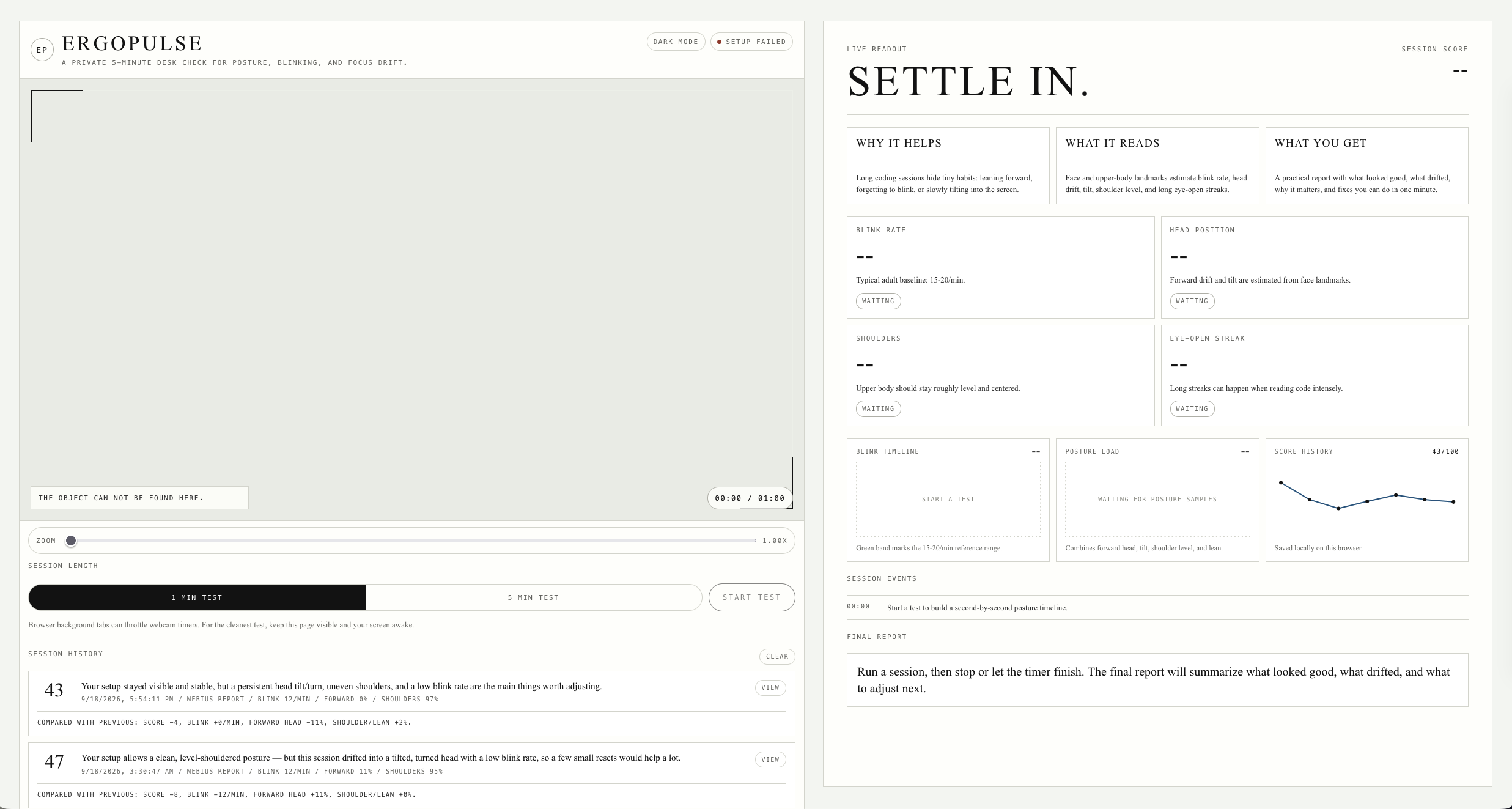
ErgoPulse is a lightweight web app that runs a 1-minute or 5-minute desk check using your webcam. It tracks face, blink, and upper-body posture signals locally in the browser, then uses an LLM vision summary to turn the session into a practical ergonomics report.
Software developers can spend hours in the same seated position, staring at nearby screens with fewer natural breaks. Over time, small habits like leaning toward the monitor, tilting the head, uneven shoulders, and long eye-open stretches can compound into eye fatigue, neck strain, shoulder tension, and back discomfort. ErgoPulse makes those patterns visible early, while they are still easy to adjust.
Screenshots
Run In Under A Minute
python -m venv .venv
source .venv/bin/activate
pip install -r requirements.txt
cp .env.example .env
Add your Nebius Token Factory key to .env:
NEBIUS_API_KEY=your_nebius_token_factory_key_here
Start ErgoPulse:
uvicorn app:app --host 127.0.0.1 --port 8010
Open http://127.0.0.1:8010/.
What It Does
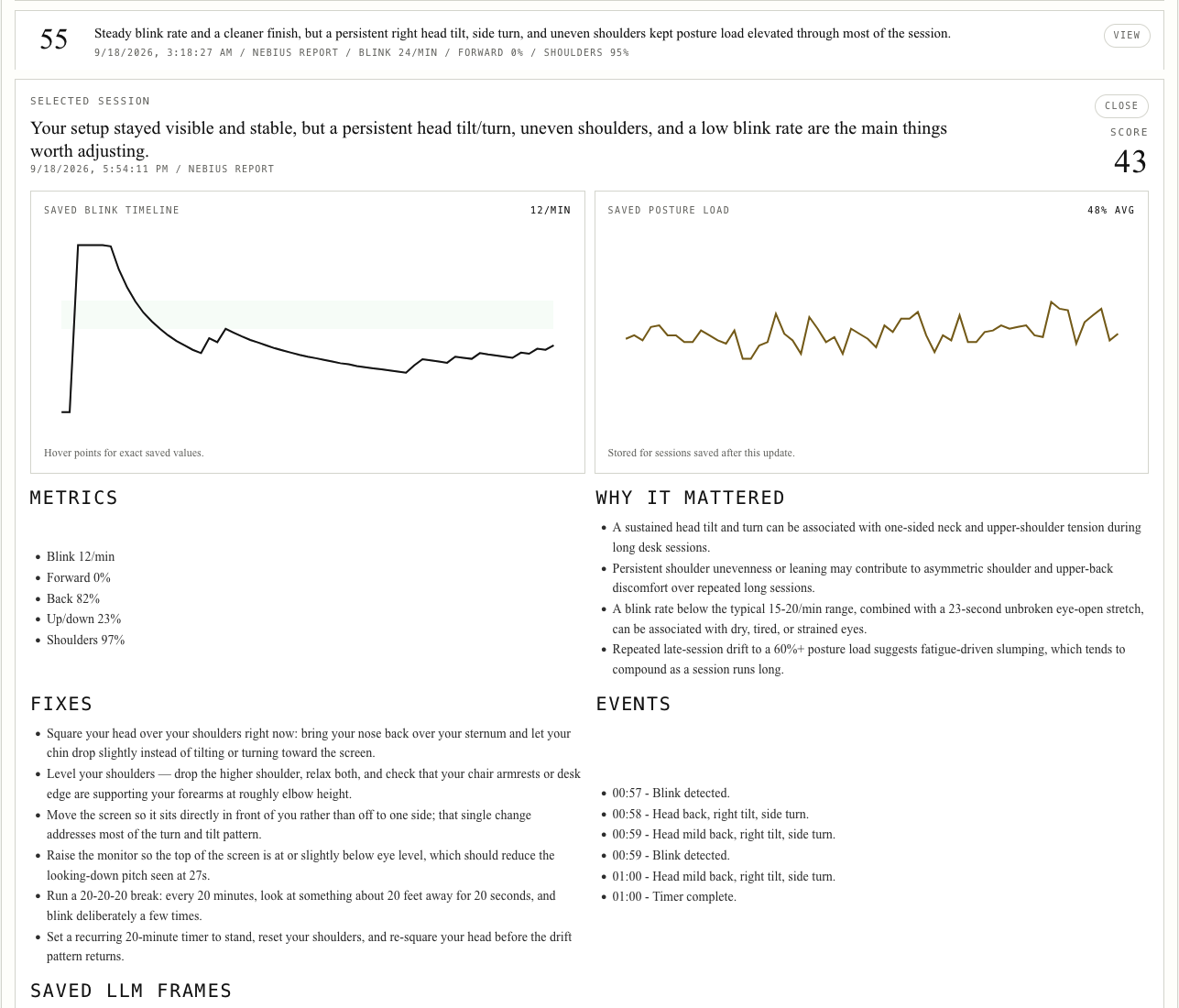
- Tracks blink rate, long eye-open streaks, head tilt/turn/drift, and shoulder/lean signals.
- Uses local MediaPipe models for real-time face and pose landmark detection.
- Sends selected session metrics and key frames to Nebius Token Factory for the final report.
- Stores session history locally in SQLite so users can compare scores, graphs, and key frames over time.
- Shows hoverable graphs for blink rate, posture load, and score history.
- Helps developers spot small desk-habit drift before it turns into a long-session comfort problem.
LLM Powered By Nebius Token Factory
The final report is generated through Nebius Token Factory using:
- Model endpoint: deepseek-ai/DeepSeek-V4.1-Flash
- Model card: DeepSeek-V4.1-Flash
DeepSeek describes V4.1-Flash as a faster, more efficient model in the V4.1 family with native visual understanding and multimodal support. ErgoPulse uses that vision capability only for the end-of-session report, while live tracking stays local in the browser.
For more sensitive usage, especially if you decide to send more key frames to the LLM, Enable zero-retention on Token Factory. In zero-retention mode, request and output content is not stored or reused. Check your Nebius account or endpoint settings before sending sensitive images.
Privacy Shape
- Live face and pose tracking runs locally with MediaPipe in your browser.
- Nebius receives the session metrics, recent timeline samples, and a small set of labeled key frames only when a report is generated.
- For sensitive usage, enable Nebius Token Factory zero-retention mode before sending additional frames or personal data.
- Session history is stored in a local SQLite database:
ergopulse_history.sqlite3. - API keys stay in your local
.envfile and should never be committed.
This is wellness and ergonomics feedback, not medical diagnosis.
How It Works
- Browser loads local MediaPipe assets from
vendor/. - MediaPipe Face Landmarker estimates blink and head signals.
- MediaPipe Pose Landmarker Lite estimates shoulder and upper-body posture signals.
- ErgoPulse samples the session and builds graphs locally.
- At the end, selected key frames plus metrics are sent to Nebius Token Factory.
- DeepSeek-V4.1-Flash returns a structured JSON report.
- The app saves the session locally for history and comparison.
For Contributors
Good next areas to build on:
- Add a short neutral calibration step for shoulders and head position.
- Improve posture scoring with landmark visibility/confidence checks.
- Add export for session reports as PDF or Markdown.
- Add optional BYOK settings in the UI instead of requiring
.env. - Add tests for history persistence, prompt normalization, and report parsing.
- Package the app with Docker for one-command local runs.
Please keep the app privacy-first: local analysis by default, explicit BYOK, and no committed session data or API keys.
Questions
What is Ergopulse?
Astrodevil/Ergopulse is a public repo on GitHub by Astrodevil. AI-assisted webcam ergonomics check that tracks posture, blink patterns, and desk-session powered by DeepSeek-V4.1-Flash.
Is Ergopulse open source?
It declares the MIT license on GitHub.
Does Ergopulse run on macOS, Windows or Linux?
Its maker tagged it for macOS, Windows and Linux, or as Docker or cross-platform. That is declared by the maker; Take My Repo has not tested it.
How do I install Ergopulse?
Open "Take it" on its page: Take My Repo writes an install plan for your machine and hands it to your AI agent (Claude Code, Codex or Cursor), which asks you before each step. Take My Repo has not tested it on any machine.