DAEDAL
[ICLR 2026] Official repository of "Beyond Fixed: Training-Free Variable-Length Denoising for Diffusion Large Language Models"
- 176
- Python
- Apache-2.0
- 9 mo ago
Minimal masked diffusion LM in PyTorch. Pretraining + SFT + a scaling family from 50M to 350M, LLaDA recipe.
Repo BY571/nanoDiff, read from GitHub 1 d ago. BY571 has not joined Take My Repo.
BY571/nanoDiff is a public repo on GitHub by BY571. Minimal masked diffusion LM in PyTorch. Pretraining + SFT + a scaling family from 50M to 350M, LLaDA recipe. It declares the MIT license on GitHub. It is written mainly in Python, has 1 stars and last changed on 2026-06-04. Nobody has reviewed it on Take My Repo yet, which says nothing about its quality. Read from GitHub on 2026-11-24.
[ICLR 2026] Official repository of "Beyond Fixed: Training-Free Variable-Length Denoising for Diffusion Large Language Models"
A minimal, clean, hackable implementation of a state-of-the-art diffusion language model, built to learn, understand, train, and improve dLLMs.
Think of it as nanoGPT / nanochat, but for diffusion language models instead of autoregressive ones. It distills the LLaDA recipe (the simplest formulation that has scaled to 8B–100B) down to a small modular package you can read in an afternoon.
Includes pretraining (pretrain/train.py, FineWeb-Edu by default) and instruction fine-tuning (sft/train.py, Alpaca-cleaned). Evaluation: held-out perplexity via eval.py and LAMBADA accuracy / PPL via benchmark/lambada.py.
Based on LLaDA: Large Language Diffusion Models (Nie et al. 2025, arXiv:2502.09992). The broader lineage (D3PM → LLaDA 2.0) is in References.
A masked diffusion LM denoises text instead of writing it left-to-right.
diffusion.py): sample t ~ U(0,1), replace each token with [MASK] independently with probability t. No Gaussians, no latents.model.py): LLaMA-style transformer (RMSNorm, SwiGLU, RoPE) with bidirectional attention. The only architectural change from a GPT.diffusion.py): 1/t-weighted cross-entropy on masked positions only. The weight makes it a real NLL upper bound, not a heuristic.sampler.py): start fully masked, predict every position, commit the most confident, re-mask the rest, iterate. See docs/sampling.md for the full algorithm.The training step is five lines, from pretrain/train.py:
x0           = train_data.get_batch(...)               # clean tokens
x_t, mask, t = forward_process(x0, mask_token_id)      # corrupt them
logits       = model(x_t)                              # predict every token
loss         = diffusion_loss(logits, x0, mask, t)     # 1/t-weighted CE on masks
loss.backward()
No noise schedule, no timestep embedding (LLaDA's time-free parameterization), no ELBO bookkeeping.
        t=1  ████████████████████   (all [MASK])
             ██ the ███ of ████ is
             ██ the meaning of life is
        t=0  the meaning of life is   (clean text)
                ▲ each step: predict, commit confident, repeat
uv sync                       # create .venv, install deps + the nanodiff package
source .venv/bin/activate     # (or prefix the commands below with `uv run`)
python tests/smoke_test.py    # optional: verify the core stack works (~2 min, CPU)

# 1. tokenize a pretraining corpus (downloads FineWeb-Edu, then tokenizes)
python scripts/prepare_data.py --out-dir data/fineweb_edu --num-tokens 2_000_000_000

# 2. pretrain a base model (single GPU)
python pretrain/train.py --config pretrain/configs/50m.py
#    ...or multi-GPU:
torchrun --standalone --nproc_per_node=8 pretrain/train.py --config pretrain/configs/50m.py

# 3. chat / evaluate
python chat.py --ckpt checkpoints/50m/ckpt.pt
python eval.py --ckpt checkpoints/50m/ckpt.pt --iters 500

# 4. (optional) instruction-tune the base on Alpaca-cleaned
python scripts/prepare_sft_data.py --out-dir data/alpaca_sft
python sft/train.py --config sft/configs/50m_alpaca.py
Scaling is a one-file change: copy a config and edit the model/optimizer fields.
# pretrain/configs/350m.py
from nanodiff.config import Config
config = Config(name="nanodiff-350m", n_layer=16, n_embd=1280, n_head=20,
                batch_size=16, grad_accum_steps=16, out_dir="checkpoints/350m")
Everything reads from the Config dataclass, so model code never changes.
Six pretrained checkpoints are on the Hugging Face Hub:
| Model | What it is |
|---|---|
| Sebasdi/nanodiff-50m-base | the 50M base, pretrained on ~2B tokens of FineWeb-Edu (val perplexity ~50) |
| Sebasdi/nanodiff-150m-base | the 150M base, pretrained on ~3B tokens of FineWeb-Edu (val perplexity ~44) |
| Sebasdi/nanodiff-350m-base | the 350M base, pretrained on ~10B tokens of FineWeb-Edu (val perplexity ~29, LAMBADA 36.95%) |
| Sebasdi/nanodiff-50m-sft-alpaca | the 50M base, instruction-tuned on Alpaca-cleaned (~51k examples) |
| Sebasdi/nanodiff-150m-sft-alpaca | the 150M base, instruction-tuned on Alpaca-cleaned: meaningfully better than the 50M SFT (LAMBADA 15.74% vs 14.32%) |
| Sebasdi/nanodiff-350m-sft-alpaca | the 350M base, instruction-tuned on Alpaca-cleaned (best SFT val ~1.07, LAMBADA 25.13%) |
Pick any model name from the table above; the pattern is the same:
# Base model (continues text, prompt document-style):
hf download Sebasdi/nanodiff-350m-base nanodiff-350m-base.pt --local-dir checkpoints/
python chat.py --ckpt checkpoints/nanodiff-350m-base.pt

# SFT model (follows instructions, note the --sft flag):
hf download Sebasdi/nanodiff-350m-sft-alpaca nanodiff-350m-sft-alpaca.pt --local-dir checkpoints/
python chat.py --ckpt checkpoints/nanodiff-350m-sft-alpaca.pt --sft
chat.py defaults to the validated fast preset
(--compile --steps 32 --block-length 32). On the 150M SFT
(DGX Spark / GB10, sampling at temp=0.8 top-p=0.9 rep-penalty=3 gen-length=96):
| Configuration | tok/s | Speedup |
|---|---|---|
| pre-optimization baseline | 236 | 1.00× |
chat.py default (--compile --steps 32) |
965 | 4.09× |
--block-length 16 (faster, but short answers on casual prompts) |
1038 | 4.40× |
--no-compile --steps 96 (max quality, no warmup) |
236 | 1.00× |
--no-compile --use-cache --tau 0.5 (compile-free fast) |
355 | 1.51× |
The flags:
--compile / --no-compile: torch.compile(model) for kernel fusion.
Default ON. One-time ~5–30 s warmup on the first generation; subsequent
generations are ~1.4× faster. Pass --no-compile to skip the warmup for
one-off queries or on builds without Triton.--steps: denoising iterations. Default 32 (--steps 96 for the LLaDA
one-commit-per-step quality maximum (--steps 24
some across-step doubling reappears. See docs/sampling.md
for the full algorithm walkthrough.--use-cache: Fast-dLLM block-wise K/V prefix cache
(Lou et al., 2025). Approximate but
measured LAMBADA-equivalent (15.74% → 15.72%, 1/5153). Pays off at
--gen-length≥256 or batched generation; skip when --compile is on
(they target the same overhead and don't stack).--tau 0.5: confidence-threshold parallel decoding. Commits every
position with model-confidence ≥ τ in this step instead of the fixed
schedule. Best with --use-cache (i.e., on the compile-free path).A small, controlled scaling result so far. All numbers are from eval.py
(500 batches on a held-out FineWeb-Edu split):
| Model | Tokens | Val NLL | Perplexity |
|---|---|---|---|
| 50M | 2B | 3.92 | 50.6 |
| 50M (matched-token control) | 3B | 3.91 | 50.1 |
| 150M | 3B | 3.78 | 43.8 |
| 350M | 10B | 3.38 | 29.3 |
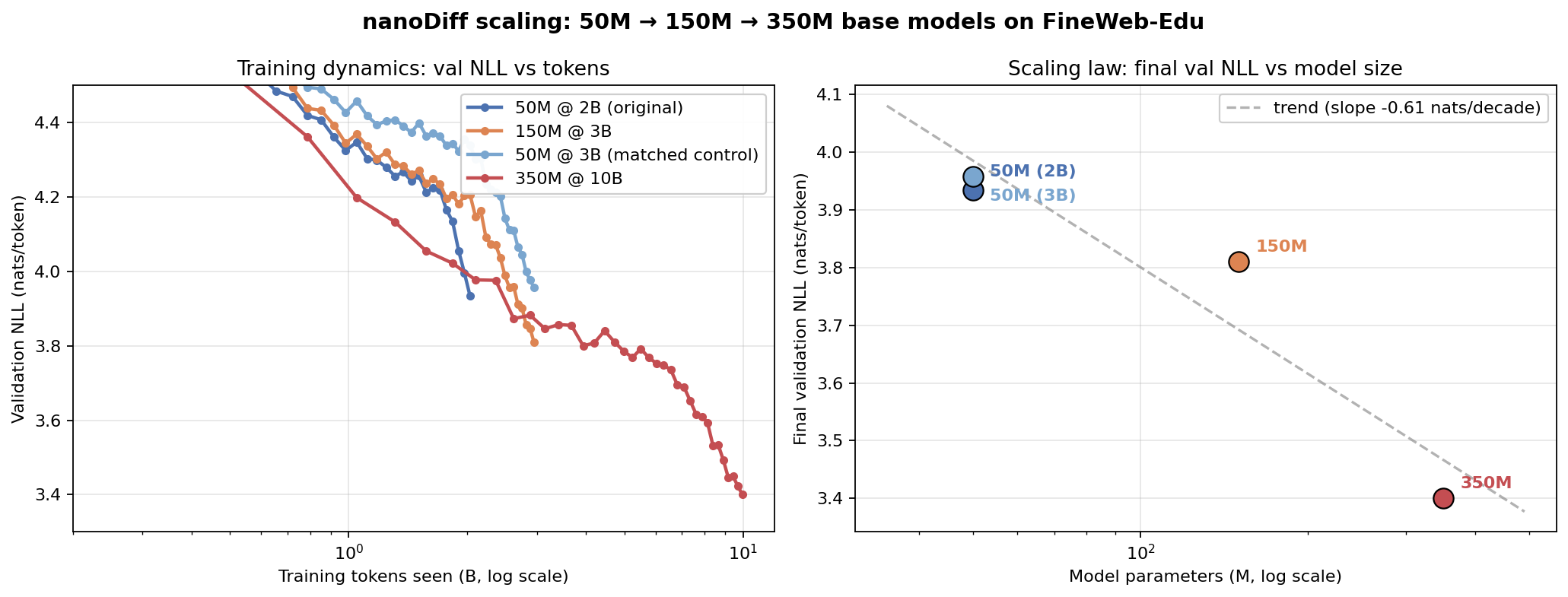
At matched 3B tokens (rows 2-3), same block_size, same schedule, same data
shard, only the model and its appropriately-scaled LR differ, the 150M wins
by 0.13 nats (~13% perplexity). The control row is what makes that
defensible: it shows the 50M, given the same 3B-token budget, only moves its
loss by ~0.01 nats versus its 2B baseline. The 50M is capacity-floored at
~3.91; the 150M lands below that floor. So the gap is capacity, cleanly
isolated, not "trained longer" and not "saw more tokens".
The 150M→350M step (10B tokens, Chinchilla-optimal at ~7B + headroom) delivers the largest jump in the family: -0.38 nats, ~31% perplexity reduction. The training was still improving when it ended; the val curve hadn't flattened, suggesting the 350M is not at its capacity ceiling at 10B tokens. Pushing to ~15B tokens would likely give another 0.05-0.10 nats.
LAMBADA last-word prediction on the public test split
(5153 examples; single-pass diffusion scoring, see benchmark/lambada.py):
| Model | LAMBADA acc | LAMBADA PPL |
|---|---|---|
| 50M base | 19.83% | 834 |
| 50M SFT | 14.32% | 3344 |
| 150M base | 21.89% | 358 |
| 150M SFT | 15.74% | 1606 |
| 350M base | 36.95% | 55.3 |
| 350M SFT | 25.13% | 286.6 |
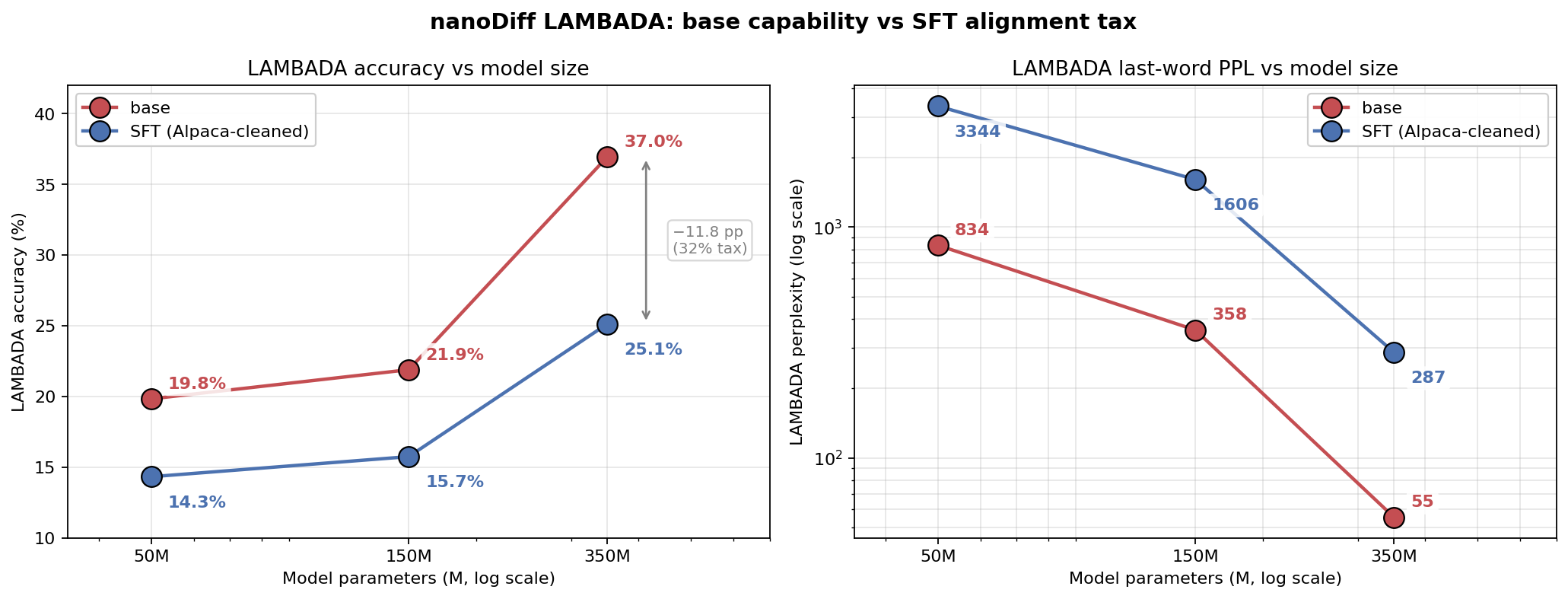
Capacity helps both stages. Base LAMBADA climbs 19.83 → 21.89 → 36.95% across 50M / 150M / 350M; SFT mirrors (14.32 → 15.74 → 25.13%).
The 150M → 350M jump outpaces val PPL. Val PPL improved 33%, but LAMBADA PPL improved 84% and accuracy jumped +15 pp (+69% relative). The bigger model is spending capacity on long-range and discourse representations, not just sharper local statistics. A capability signal, not just a fitting one.
The alignment tax grows with scale. At 50M and 150M, base → SFT costs ~28% of base accuracy, which looked like a capacity-independent distribution shift. At 350M the tax jumps to 32% (an 11.8 pp drop vs ~6 pp at smaller scales), and the SFT/base PPL blowup ratio grows in parallel (4.0× → 4.5× → 5.2×). More world-modeling capability means more to lose when SFT shifts the distribution toward Alpaca instruction-format.
Calibration vs GPT-2
BY571/nanoDiff is a public repo on GitHub by BY571. Minimal masked diffusion LM in PyTorch. Pretraining + SFT + a scaling family from 50M to 350M, LLaDA recipe.
It declares the MIT license on GitHub.
Its maker has not tagged a system, so it is unknown here. Its README says what it needs.
Open "Take it" on its page: Take My Repo writes an install plan for your machine and hands it to your AI agent (Claude Code, Codex or Cursor), which asks you before each step. Take My Repo has not tested it on any machine.
21 Lessons, Get Started Building with Generative AI
[ECCV 2026] A diffusion-based framework for document OCR that replaces autoregressive decoding with block-level parallel diffusion decoding.
The agent harness performance optimization system. Skills, instincts, memory, security, and research-first development for Claude Code, Codex, Opencode, Cursor and beyond.
A 4B diffusion grounding model for fast, precise visual evidence extraction. Unifies diverse grounding tasks through parallel decoding, with optional self-speculative decoding delivering 4.51x autoregressive throughput on COCO.
Its last change on GitHub was on 2026-06-04. Take My Repo does not judge from that whether it is maintained.
Nobody has reviewed it on Take My Repo yet, which says nothing about its quality.
Take My Repo cannot say: it does not audit code and has not run nanoDiff. What is known comes from GitHub. It declares the MIT license on GitHub. Its last change was on 2026-06-04. It has 1 stars, which measure popularity, not safety. Nobody has reviewed it on Take My Repo yet, which says nothing about its quality. Read the source before you run it. With "Take it", your AI agent shows each step and asks you before running it; README text is treated as data, not as instructions.