AutoGPT
AutoGPT is the vision of accessible AI for everyone, to use and to build on. Our mission is to provide the tools, so that you can focus on what matters.
- 188k
- Python
- 4 h ago
Held-out measurement for claimed AI and robot improvements. One comma-separated contract, one static binary, MIT.
Repo Balanov/held, read from GitHub 1 d ago. Balanov has not joined Take My Repo.
Balanov/held is a public repo on GitHub by Balanov. Held-out measurement for claimed AI and robot improvements. One comma-separated contract, one static binary, MIT. It declares the MIT license on GitHub. It is written mainly in Go, has 2 stars and last changed on 2026-11-15. Nobody has reviewed it on Take My Repo yet, which says nothing about its quality. Read from GitHub on 2026-11-24.
AutoGPT is the vision of accessible AI for everyone, to use and to build on. Our mission is to provide the tools, so that you can focus on what matters.
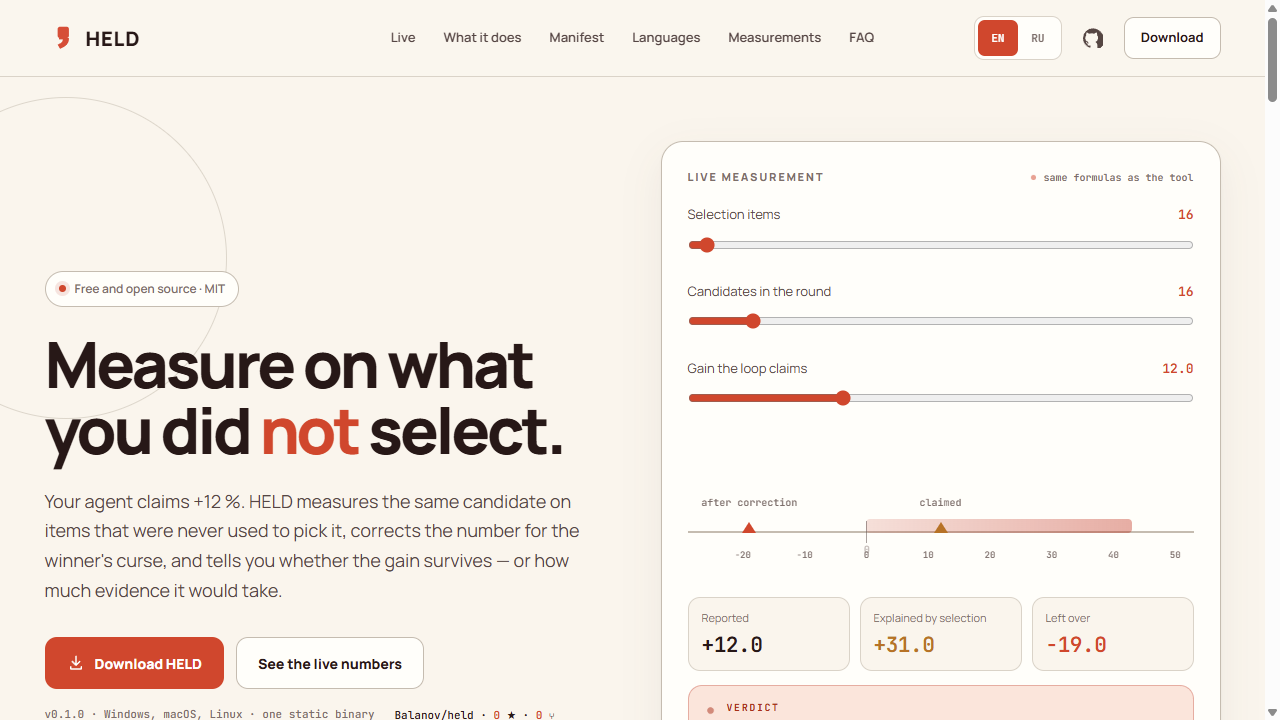
Measure on what you did not select.
HELD decides whether a claimed improvement in an AI system or a robot policy is real.
Quick start · Measurements · Why · Site · Русский
HELD measures a candidate against the baseline on data that was never used to pick the candidate, corrects the selection-split gain for the winner's curse, and tells you whether the gain survives — or how much held-out evidence it would take.
One static binary. Zero dependencies. Offline. MIT.
held gate measurement.held --data scores.jsonl
VERDICT                        CONFLICTING
                       the selection split reports +0.1875, but the held-out lower bound -0.0437 does not clear 0.0100

CLAIMED GAIN                   +0.1875
EXPECTED SELECTION INFLATION   0.1783  (16 CANDIDATES IN ROUND, expected maximum 1.7688)
GAIN AFTER SELECTION CORRECTION +0.0092
HELD-OUT GAIN                  +0.0000
HELD-OUT INTERVAL              [-0.0437, +0.0437]
LOWER BOUND                    -0.0437
HELD-OUT ITEMS NEEDED          2492
PER-ITEM SPREAD                0.1782  (estimated from the held-out split)
The loop reported +18.75 %. After the selection correction there is
+0.92 % left, and the held-out split shows 0.00 %. The verdict is
conflicting, and the exit code is 1.
A self-improving loop proposes candidates, keeps the one that scores best on a small evaluation set, and reports the score it got there. That number is inflated, and the inflation grows with the number of candidates and shrinks only slowly with the size of the evaluation set.
The published record on this is unambiguous:
| Source | Finding |
|---|---|
| arXiv 2610.09239 | In a pre-registered study, the greedy selection-set score of self-improvement loops exceeded held-out accuracy by 13–20 points with 16 selection items, and by 1–5 points with 256. Most proposals after the first were harmful. |
| arXiv 2607.25152 | Across 54 cycles a frontier agent claimed improvement every time, yet 56 % of the measured deltas were zero or negative. The self-verdict gate degenerated into accept-all and erased 19 % of the best deployed state. The strongest in-band judge accepted cycles of which 44 % were real regressions. |
| arXiv 2609.31760 | After 123 rounds of robot skill discovery, changes kept passing their own tests while the target task never succeeded: the agent optimized exactly what the evaluator measured, including where it was wrong. |
| arXiv 2608.20290 | Seven measurement failures, each of which inverted a finding without a frozen control. |
HELD is the missing primitive: a frozen control, and a gate that reads it.
Nothing in the existing toolchain closes this. Eval harnesses report means and confidence intervals but do not correct for the fact that the candidate was selected on the very set they report. Experiment trackers record parameters but do not decide whether the improvement is real. Guardrail libraries police what a model may call, not whether its gains survive a fresh set.
conflicting, not as
not_proven, because that is the exact shape of a loop that has fooled
itself.held plan computes how many held-out items a
declared gain needs at a declared significance level and power. Proving a
one point improvement on a binary metric needs about 39 000 paired items.go install github.com/Balanov/held/cmd/held@latest
Or download a binary for your platform from the releases page.
No runtime dependencies, no account, no telemetry, no network access.
Write a contract. It is one line of clauses separated by commas:
held init --out measurement.held
v=1, candidate=policy-v7, baseline=policy-v3, metric=success_rate,
judge=state_check, selection=sel, heldout=hold, candidates=16,
alpha=0.05, min_gain=0.01, power=0.8, locale=en;ru;es;zh
Every clause is key=value. A value may be quoted, and a quoted value may
contain commas. A semicolon separates the elements of a list. A hash starts a
comment. Newlines are whitespace, so a long contract may be wrapped after any
comma and still parse to exactly the same contract.
Point it at your scores. One record is one outcome of one system on one item:
{"split":"hold","system":"policy-v7","item":"h001","score":1}
held gate measurement.held --data scores.jsonl
Exit codes are 0 for a proven claim, 1 when the claim is not proven or
conflicts with the held-out measurement, and 2 for bad input. The gate is
therefore a CI step without a wrapper script:
- name: Hold-out gate
  run: held gate measurement.held --data scores.jsonl
Try it without any data of your own:
held demo --out scores.jsonl
held gate measurement.held --data scores.jsonl
| Command | What it does |
|---|---|
held init |
Write a starter measurement contract |
held check FILE |
Validate a contract and print its pin |
held plan FILE |
How much held-out evidence a declared gain needs |
held gate FILE --data FILE |
Decide whether the claim holds |
held render FILE |
Render the protocol in every language |
held seal FILE --data FILE |
Write a signed receipt |
held demo |
Write the example scores |
held gate --json prints a machine-readable receipt. held seal writes the
same numbers as a pinned receipt that includes the SHA-256 of the data file.
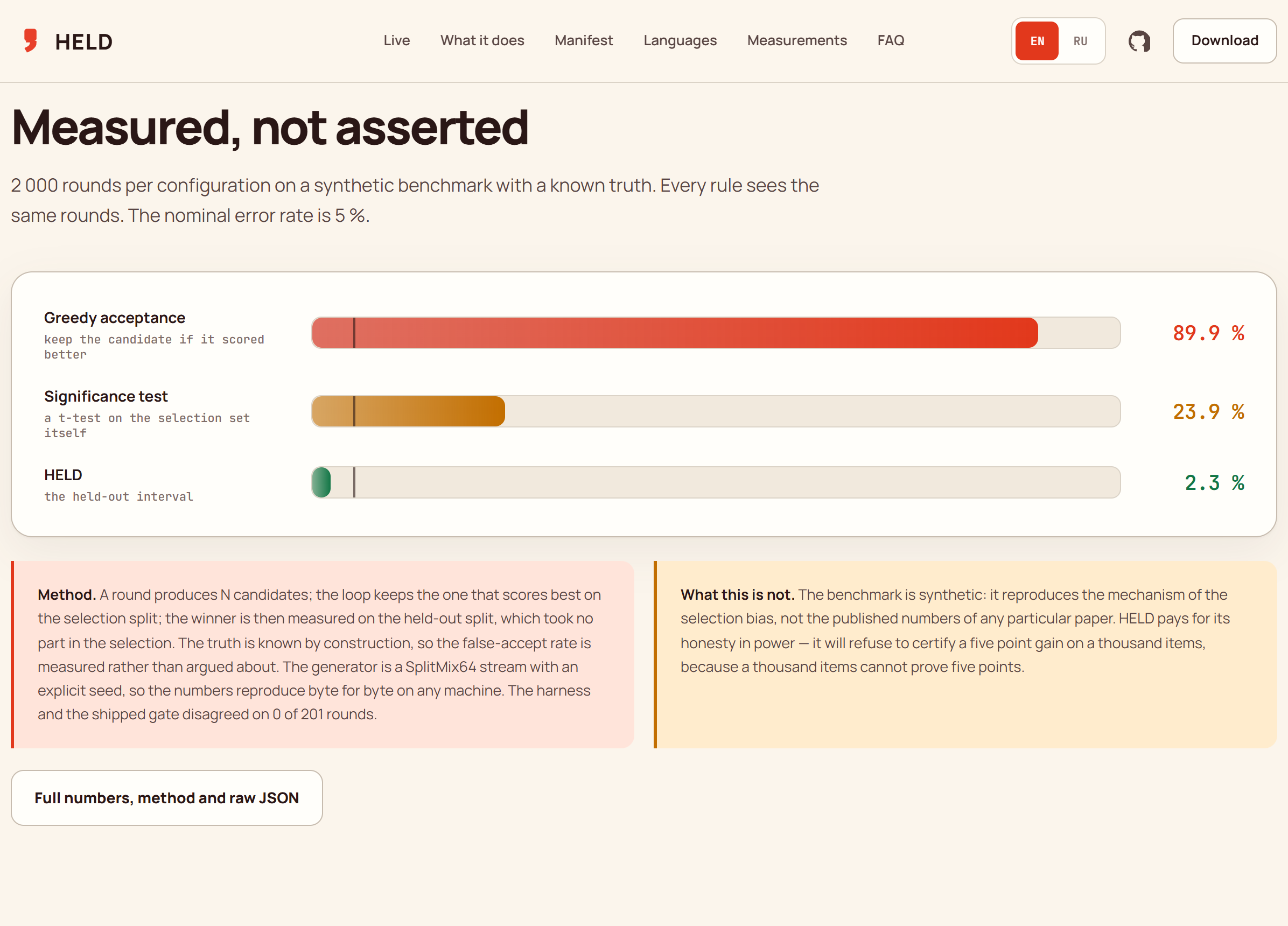
On a synthetic benchmark with a known truth, 2 000 rounds per configuration, 16 selection items and 16 candidates per round:
| Acceptance rule | False accept rate on a claim with no real improvement |
|---|---|
| Greedy: keep the candidate if it scored better | 89.9 % |
| A significance test on the selection set | 23.9 % |
| HELD: the held-out interval | 2.3 % |
The nominal error rate is 5 %. Greedy acceptance is wrong about nine rounds in ten. A plain significance test on the selection set is invalid after a selection and is wrong about one round in four.
HELD pays for that honesty in power: with 1 000 held-out items it will refuse
to certify a five point gain, because a thousand items cannot prove five
points. held plan tells you what would.
Full numbers, the method and the raw JSON are in
BENCHMARKS.md and in bench/results/.
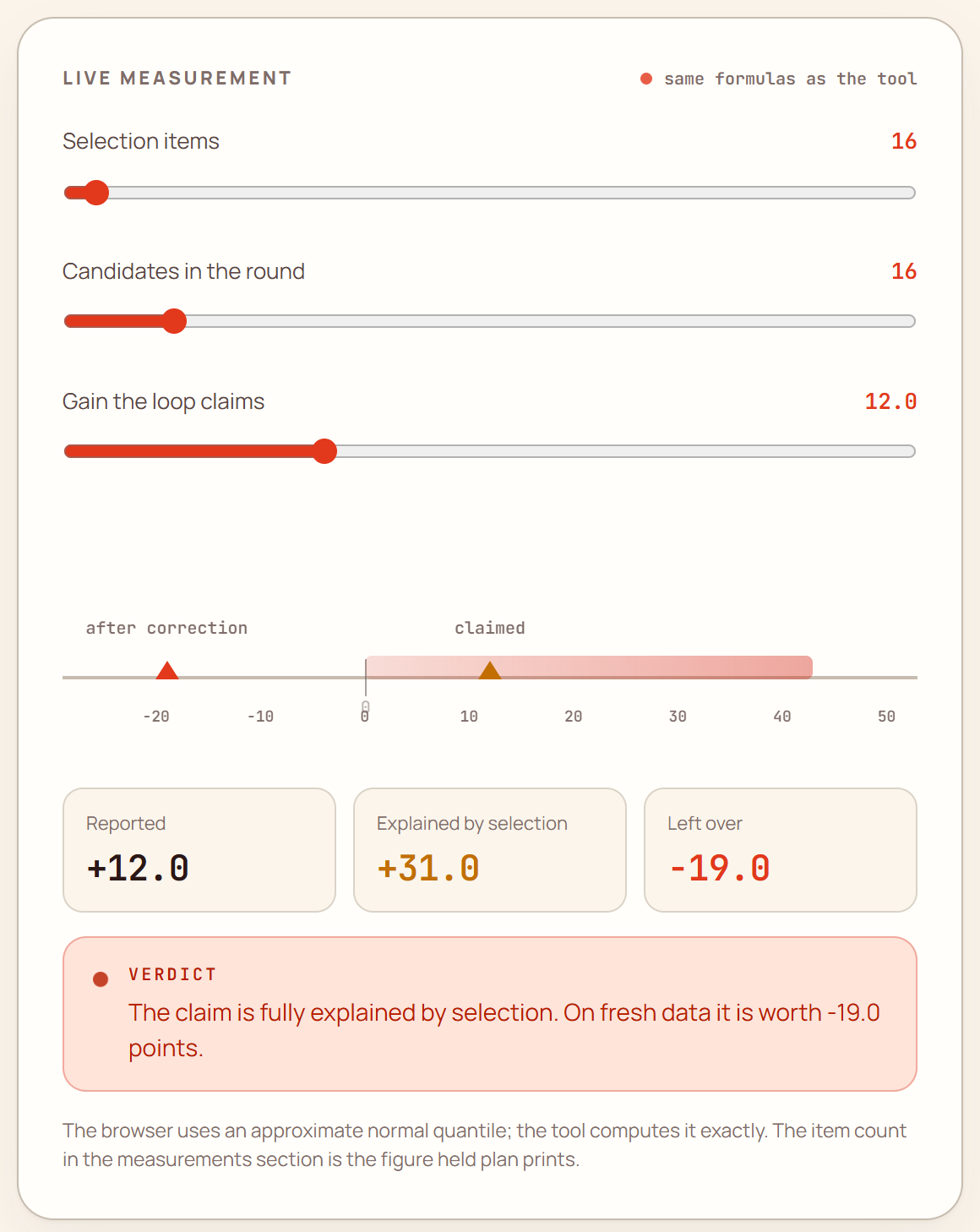
The page is the tool, running: the live console, the manifest grammar, the four languages and the benchmark behind them.
balanov.pro/held — the same measurement you can run from the binary, in the browser.
@misc{balanov2026held,
  title  = {HELD: Held-out Measurement for Claimed AI and Robot Improvements},
  author = {Balanov, Anton},
  year   = {2026},
  url    = {https://balanov.pro/held/}
}
MIT. Fork it, change it, ship it. See LICENSE.
Balanov/held is a public repo on GitHub by Balanov. Held-out measurement for claimed AI and robot improvements. One comma-separated contract, one static binary, MIT.
It declares the MIT license on GitHub.
Its maker has not tagged a system, so it is unknown here. Its README says what it needs.
Open "Take it" on its page: Take My Repo writes an install plan for your machine and hands it to your AI agent (Claude Code, Codex or Cursor), which asks you before each step. Take My Repo has not tested it on any machine.
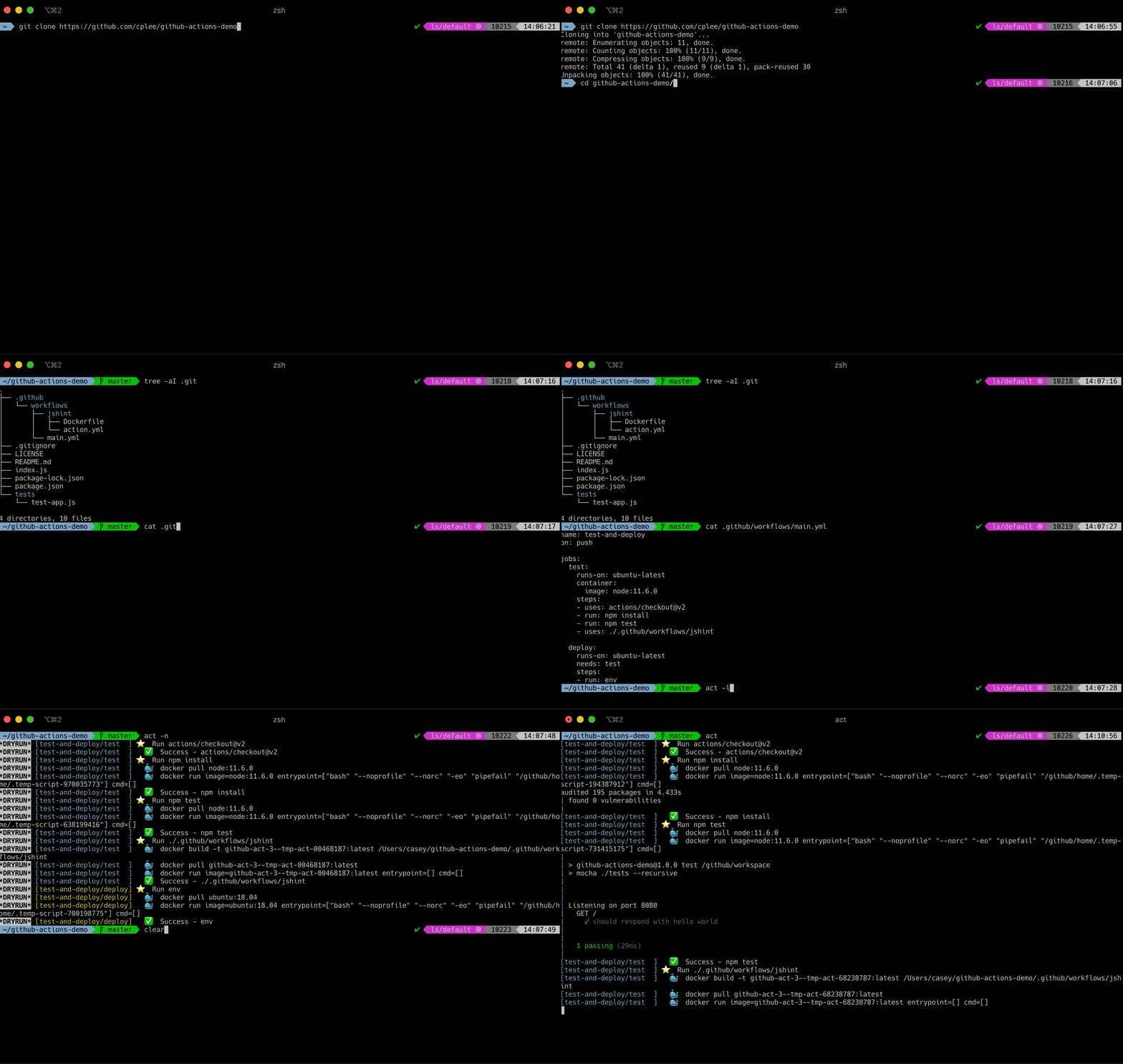
Run your GitHub Actions locally 🚀
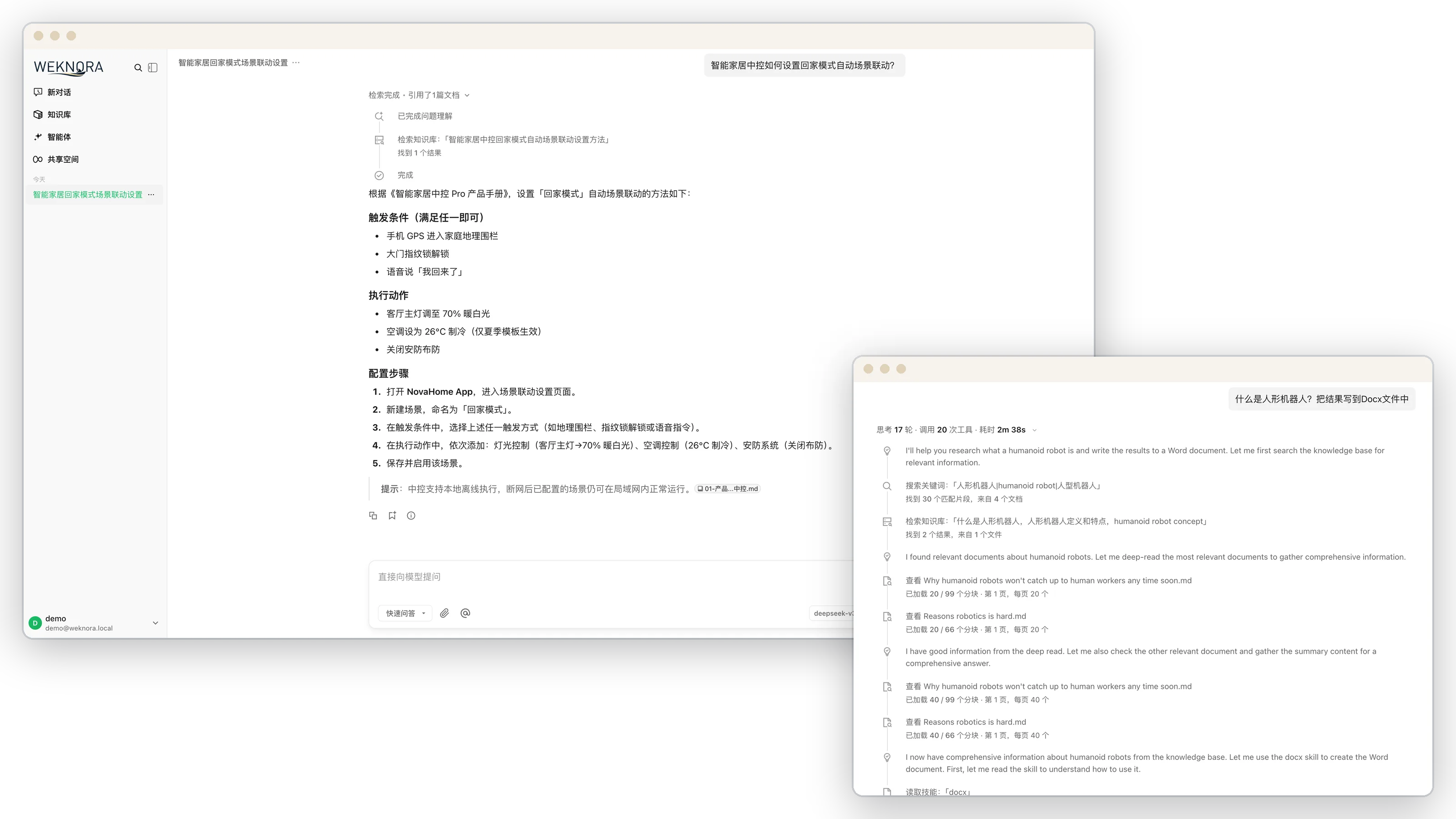
Open-source LLM knowledge platform: turn raw documents into a queryable RAG, an autonomous reasoning agent, and a self-maintaining Wiki.
The open and composable observability and data visualization platform. Visualize metrics, logs, and traces from multiple sources like Prometheus, Loki, Elasticsearch, InfluxDB, Postgres and many more.
The agent harness performance optimization system. Skills, instincts, memory, security, and research-first development for Claude Code, Codex, Opencode, Cursor and beyond.
Reverse engineer anything with agents, from app behavior down to native binaries.
Its last change on GitHub was on 2026-11-15. GitHub counts 2 open issues and pull requests. Take My Repo does not judge from that whether it is maintained.
Nobody has reviewed it on Take My Repo yet, which says nothing about its quality.
Take My Repo cannot say: it does not audit code and has not run held. What is known comes from GitHub. It declares the MIT license on GitHub. Its last change was on 2026-11-15. It has 2 stars, which measure popularity, not safety. Nobody has reviewed it on Take My Repo yet, which says nothing about its quality. Read the source before you run it. With "Take it", your AI agent shows each step and asks you before running it; README text is treated as data, not as instructions.