AutoGPT
AutoGPT is the vision of accessible AI for everyone, to use and to build on. Our mission is to provide the tools, so that you can focus on what matters.
- 188k
- Python
- 30 min ago
Evidence-gated autonomous product operations. Local-first, model-neutral, MIT. Done means proven.
Repo Balanov/until, read from GitHub 11 h ago. Balanov has not joined Take My Repo.
Balanov/until is a public repo on GitHub by Balanov. Evidence-gated autonomous product operations. Local-first, model-neutral, MIT. Done means proven. It declares the MIT license on GitHub. It is written mainly in JavaScript, has 1 stars and last changed on 2026-11-14. Nobody has reviewed it on Take My Repo yet, which says nothing about its quality. Read from GitHub on 2026-11-23.
AutoGPT is the vision of accessible AI for everyone, to use and to build on. Our mission is to provide the tools, so that you can focus on what matters.
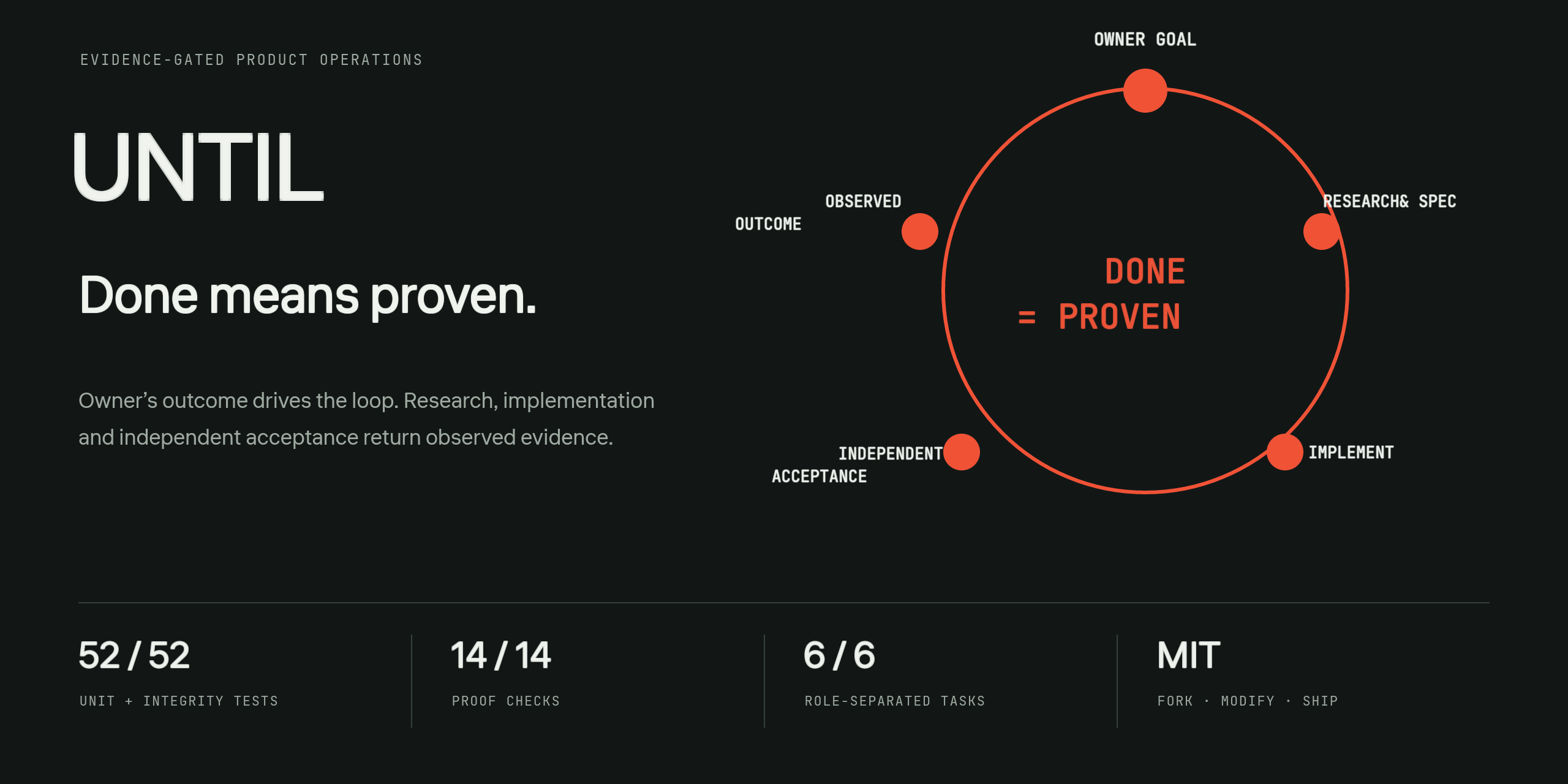
Done means proven.
Evidence-gated autonomous product operations. Local-first. Model-neutral. MIT.
Quick start · Proof · Architecture · Benchmarks · Interactive proof · Русский
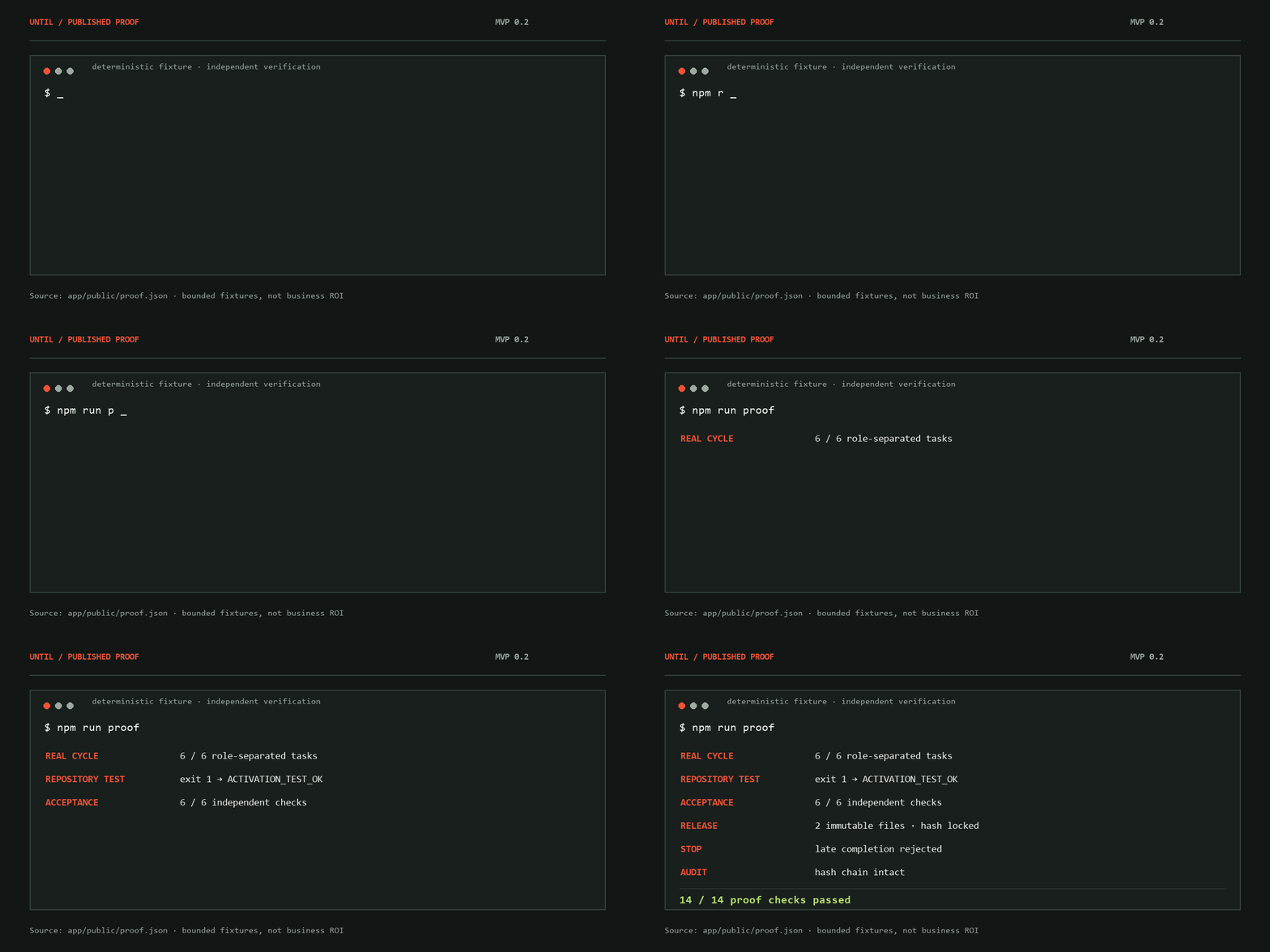
Published deterministic proof from app/public/proof.json · 14 / 14 checks. Bounded fixtures, not a business-ROI claim.
UNTIL is an open autonomous product framework for owners, CEOs and CPOs who want product work to move without manually coordinating every role. You set the business outcome, metric, budget and risk limits. UNTIL turns real customer or product signals into research, the next priority, a bounded specification, implementation, independent acceptance, a verified local release candidate and the next outcome-driven cycle.
Owner’s goal → research → priority & spec → implementation → independent test → release candidate → observed outcome → next work.
A finished LLM answer is never accepted as proof of finished product work. The builder cannot accept its own work, and the system cannot rewrite the owner’s goal, grant itself rights or invent missing evidence.
Engineering MVP 0.3. The published proof now includes an actual repository change with a failing-before/passing-after Node test, an immutable two-file release candidate, and a test-driven repair loop: the builder is given the project's own failing check as feedback and retries until it passes, with the workspace restored byte for byte if the budget is exhausted. It proves the control plane and a measured improvement on bounded JSON deliverables—not universal team replacement, arbitrary LLM quality, production deployment or business ROI. Start with low-risk, authoritatively verifiable digital-product tasks.
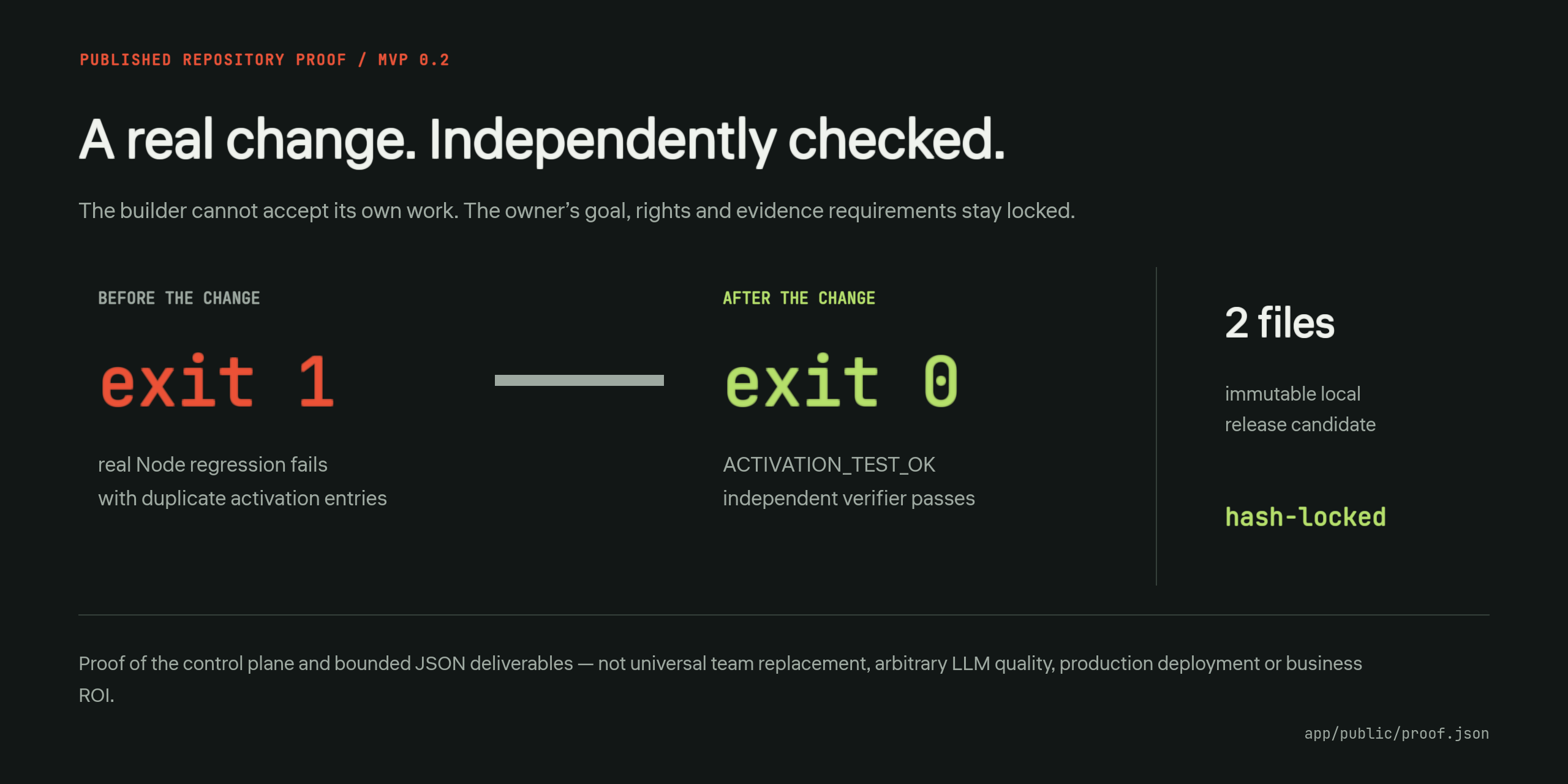
One real repository change, independent acceptance and a hash-locked local candidate. Raw repository cycle · Proof artifact.
Role-playing teams, PM copilots, coding agents, research moderators and software factories already exist. UNTIL is the neutral outer loop between them:
Read the market analysis and architecture.
Requirements: Node.js 24+. The core has zero runtime npm dependencies and needs no account, telemetry, model key or network for its deterministic proof.
git clone https://github.com/Balanov/until.git
cd until
npm ci --ignore-scripts
npm test
npm run proof
node bin/until.mjs demo
demo runs an explicitly marked deterministic fixture: six role-separated tasks from a real interview fixture to a verified local release candidate, followed by a metric observation and achieved. It also evaluates a strategy on held-out fixtures. This proves the loop, not model intelligence.
node bin/until.mjs init --goal examples/goal.json
node bin/until.mjs signal add examples/interview.json
node bin/until.mjs run --cycles 8
node bin/until.mjs status
node bin/until.mjs audit
State, artifacts and local release candidates live under .until/ in the selected workspace. The default workspace is the current directory; choose another with --workspace DIR or a different database with --state FILE.
node bin/until.mjs init --from-repo /path/to/repo
This inspects the repository, detects how the project proves itself (node --test, npm test, python -m pytest, cargo test, go test ./..., mvn test, gradle test, make test) and writes a ready-to-run goal whose acceptance gate is the project's own test command, plus the matching check profile. Merge the generated checks into until.config.json, then until init --goal until.goal.json.
node bin/until.mjs import --file support.csv --goal goal_x --kind support --source helpdesk
node bin/until.mjs import --file support.csv --goal goal_x --kind support --source helpdesk --consent
Records without an explicit consent assertion are stored with consent = 0: they can produce a hypothesis but can never unlock delivery or a release. --consent is the operator's assertion that the file carries participant consent.
node bin/until.mjs doctor
node bin/until.mjs replay task_123
doctor reports the runtime version, workspace writability, database integrity, the event hash chain, dead-lettered tasks, expired leases, pending external actions, goals without baseline/target, blocked goals and real-kind signals without consent. replay returns a dead-lettered task to the queue without reusing its idempotency key.
Add a post-release observation and run again:
node bin/until.mjs signal add examples/metric.json
node bin/until.mjs run --cycles 2
Try the evidence boundary instead:
node bin/until.mjs signal add examples/synthetic.json
node bin/until.mjs run --cycles 8
A synthetic-only goal produces an interview guide and waiting_evidence, not a delivery task.
node bin/until.mjs start
# in another process
node bin/until.mjs stop
node bin/until.mjs reset
start keeps observing and working without burning tokens while idle. stop advances the persistent epoch and rejects late work. reset clears the stop latch but never reuses an epoch. Task, model-call and cost budgets are available through --tasks, --model-calls and --max-cost.
Copy until.config.example.json to until.config.json and configure models that are actually available. Ollama, LM Studio, llama.cpp and hosted OpenAI-compatible APIs use the same boundary.
{
  "models": {
    "researcher": {
      "type": "openai-compatible",
      "baseURL": "http://127.0.0.1:11434/v1",
      "allowedOrigins": ["http://127.0.0.1:11434"],
      "model": "qwen3:8b",
      "timeoutMs": 120000
    }
  }
}
For a hosted provider add apiKeyEnv and an optional price card. The name of the environment variable is stored in config; the secret is read only from the environment and is never written to SQLite, traces or proof bundles. Unknown cost is null, not a fake zero.
Model output is validated against strict role-specific JSON Schemas and existing evidence IDs. Compatible providers receive response_format: json_schema; set structuredOutputs: false globally or on one model if the endpoint does not support it. External text, tool output and repository content are untrusted data, never authorization. Roles without a configured model use the explicit deterministic fixture implementation.
For a live model delivery, supply authoritative acceptance in the goal. The owner agent may add constraints but cannot discard them; without these checks a live contract stops instead of inventing its own definition of done:
{
  "policy": {
    "acceptance": [
      { "type": "json_field", "field": "implementation.feature", "equals": "preview-import-errors" }
    ]
  }
}
traceResponses: true opts into storing raw model content for export. Treat it as sensitive: review traces before sharing them. Export a proof bundle with node bin/until.mjs export --output proof.json; it includes tasks, verdicts, receipts, events, available model responses and integrity hashes. No secrets are intentionally exported.
The built-in executor creates only bounded experiment artifacts inside .until/artifacts/. It does not deploy production code.
An external coding harness can be registered as an argv profile with no shell interpolation. It runs only with sandboxConfirmed: true in a separately configured OS, VM or container sandbox. It cannot verify itself, publish, change the goal or execute arbitrary model-authored command profiles.
High-risk contracts stop with blocked_risk unless a separate risk boundary is deliberately implemented. Production deployment, payments, outreach and IAM changes are outside the default release path.
See SECURITY.md.
A builder is a registered argv profile that receives one JSON object on stdin and returns one JSON object on stdout. Two protocols are supported.
until-builder/v1 — the harness edits the workspace itself and returns a summary:
{ "type": "repository_change", "summary": "Removed the duplicate activation step", "repositoryChange": true }
until-builder/v2 — the harness returns the edits and the engine applies them, so the same harness can be re-run with the failed check as feedback:
{ "status": "done", "notes": "…", "edits": [{ "path": "src/activation.js", "content": "…" }] }
When the goal declares goal.policy.build.testProfile, the builder runs in a loop:
goal.policy.build.allowedPaths and any excluded directory;The v1 protocol is adapted automatically: the engine detects what the harness changed and verifies it the same way.
{
  "policy": {
    "acceptance": [{ "type": "command_profile", "profile": "repoTest", "expect": { "exitCode": 0 } }],
    "releasePaths": ["src/activation.js"],
    "build": { "testProfile": "repoTest", "maxAttempts": 3, "allowedPaths": ["src/"] }
  }
}
| Signal | Can create | Cannot prove alone |
|---|---|---|
| Real interview / support / incident | Research and a bounded experiment | Market size or profitability |
| Product metric / payment | Baseline and observed outcome | Causality without an experiment design |
| Reported / public source | A sourced market hypothesis | Your own customer demand |
Balanov/until is a public repo on GitHub by Balanov. Evidence-gated autonomous product operations. Local-first, model-neutral, MIT. Done means proven.
It declares the MIT license on GitHub.
Its maker has not tagged a system, so it is unknown here. Its README says what it needs.
Open "Take it" on its page: Take My Repo writes an install plan for your machine and hands it to your AI agent (Claude Code, Codex or Cursor), which asks you before each step. Take My Repo has not tested it on any machine.
Its last change on GitHub was on 2026-11-14. Take My Repo does not judge from that whether it is maintained.
Harness Open Source is an end-to-end developer platform with Source Control Management, CI/CD Pipelines, Hosted Developer Environments, and Artifact Registries.
Build Agentic workflows, RAG pipelines, with rich AI model and tool support on one collaborative workspace. Deploy on cloud, VPC, or self-hosted, so teams move from prototype to production without rebuilding the stack.
🌊 The original agent harness. Deploy intelligent multi-player swarms, coordinate autonomous workflows, and build conversational AI systems. Features adaptive memory, self-learning intelligence, federation, vector RAG integration, and native Claude Code / Codex / Hermes and many more Integrated
Nobody has reviewed it on Take My Repo yet, which says nothing about its quality.
Take My Repo cannot say: it does not audit code and has not run until. What is known comes from GitHub. It declares the MIT license on GitHub. Its last change was on 2026-11-14. It has 1 stars, which measure popularity, not safety. Nobody has reviewed it on Take My Repo yet, which says nothing about its quality. Read the source before you run it. With "Take it", your AI agent shows each step and asks you before running it; README text is treated as data, not as instructions.