ECC
The agent harness performance optimization system. Skills, instincts, memory, security, and research-first development for Claude Code, Codex, Opencode, Cursor and beyond.
- 311k
- JavaScript
- MIT
- 3 d ago
A collection of personal AI coding assistant configurations, specialist agents, and automated workflows optimized for Python and ML open-source development.
Repo Borda/AI-Rig, read from GitHub 26 min ago. Borda has not joined Take My Repo.
Borda/AI-Rig is a public repo on GitHub by Borda. A collection of personal AI coding assistant configurations, specialist agents, and automated workflows optimized for Python and ML open-source development. It declares the Apache-2.0 license on GitHub. It is written mainly in Python, has 31 stars and last changed on 2026-11-25. Nobody has reviewed it on Take My Repo yet, which says nothing about its quality. Read from GitHub on 2026-11-25.
The agent harness performance optimization system. Skills, instincts, memory, security, and research-first development for Claude Code, Codex, Opencode, Cursor and beyond.

Practical agent workflows for Python, ML, and open-source maintenance. AI-Rig turns recurring work—scoping a change, reproducing a bug, reviewing a pull request, running an experiment, or checking release readiness—into explicit workflows with specialist ownership, evidence gates, and reviewable artifacts.
Eight packages serve three runtimes: six marketplace plugins for Claude Code, three for Codex, and one npm plugin for OpenCode, with codemap-py and bridge_CC-Codex shared by two hosts each.
Design principles:
Choose the smallest plugin that solves the job in front of you. Every package installs independently; optional integrations add specialist depth or structural context without becoming hidden prerequisites.
| Need | Start with | What it gives you |
|---|---|---|
| Keep Claude agent configuration, routing, and reusable guidance healthy | 🏭 foundry |
10 specialist agents, 11 configuration/content skills, rules, hooks, audit, and calibration |
| Triage GitHub work, review PRs, resolve feedback, and prepare releases | 🌱 oss |
4 agents and 5 maintainer skills with human-reviewed replies and no automatic publish step |
| Plan, build, fix, refactor, debug, or review Python changes | 🛠️ develop |
6 validate-first development workflows plus setup, with reproduction/demo/safety-net gates |
| Plan and run literature-grounded ML experiments | 🔬 research |
2 research agents and 10 skills for planning, judging, running, verifying, ablation, retrospectives, and Kaggle notebooks |
| Answer import, caller, coupling, rename, and affected-test questions | 🗂️ codemap-py |
The same 6 structural-analysis skills for Claude Code and Codex, backed by a local static Python index |
| Use evidence-first workflows and specialist role cards in Codex | 🤖 Codex Rig |
13 workflow skills, 1 lifecycle manager, 15 role cards, shared gates, calibration, and artifact contracts |
| Run evidence-first workflows, gates, and Git guardrails in OpenCode | ⚡ OpenCode Rig |
11 workflow skills, 10 tools, 8 role agents, an adversarial loop, and an npm-installable TypeScript package |
| Hand bounded implement, advise, and review calls between the two hosts | 🌉 bridge_CC-Codex |
3 bridge verbs in both directions with explicit models, effort, budgets, compact envelopes, and recursion safety |
If you use Claude Code, read the Claude guide. If you use Codex, read the Codex guide. OpenCode installs the npm package directly; its README is the host guide.
These are workflow contracts, not promises that every run launches every specialist, finds every dynamic dependency, or publishes a correct change. The linked plugin READMEs define each route's prerequisites, fallback, and stop behavior.
This is the literal shipped skill inventory. The host guides list every agent, role, rule, and hook; the plugin READMEs document arguments, outputs, prerequisites, recovery, and edge cases.
| Package | Complete skill roster |
|---|---|
| 🏭 Foundry | /foundry:setup, /foundry:audit, /foundry:calibrate, /foundry:manage, /foundry:brainstorm, /foundry:investigate, /foundry:profile, /foundry:distill, /foundry:session, /foundry:create, /foundry:humanizer |
| 🌱 OSS | /oss:analyse, /oss:review, /oss:resolve, /oss:release, /oss:setup |
| 🛠️ Develop | /develop:plan, /develop:feature, /develop:fix, /develop:refactor, /develop:debug, /develop:review, /develop:setup |
| 🔬 Research | /research:topic, /research:plan, /research:judge, /research:run, /research:sweep, /research:verify, /research:fortify, /research:retro, /research:kaggle, /research:setup |
| 🗂️ Codemap-py | scan-codebase, query-code, test-impact, rename-refs, integration, debrief-coding, namespaced as /codemap-py:... in Claude Code and $codemap-py:... in Codex |
| 🤖 Codex Rig | $codex-rig:assess, $codex-rig:audit, $codex-rig:calibrate, $codex-rig:code-remediate, $codex-rig:code-review, $codex-rig:implement, $codex-rig:investigate, $codex-rig:kaggle, $codex-rig:manage, $codex-rig:optimize, $codex-rig:release, $codex-rig:research, $codex-rig:sync, $codex-rig:agent-shims |
| ⚡ OpenCode Rig | /rig-plan, /rig-investigate, /rig-research, /rig-implement, /code-review, /code-remediate, /rig-challenge, /rig-optimize, /rig-distill, /rig-release, /rig-health |
| 🌉 bridge_CC-Codex | implement, advise, review, setup, plus Claude-side detached-job status, result, cancel; namespaced as /bridge:... in Claude Code and $bridge:... in Codex |
| Runtime | Packages | What you get |
|---|---|---|
| Claude Code | foundry, oss, develop, research, codemap-py, bridge |
Specialist agents, skills, rules, and hooks loaded from marketplace |
| Codex | codex-rig, codemap-py, bridge |
Namespaced skills and role cards |
| OpenCode | opencode-rig |
npm package: tools, skills, and role agents |
plugins/ is the source of truth; .claude/ and .codex/ are host guides and configuration.<plugin>:<agent>; the Claude guide and Codex guide list every agent, role, rule, hook, and skill.Each role links to its own definition file. Claude agents dispatch as <plugin>:<agent>; Codex role cards are injected into blank agents or run as a disclosed inline pass.
| Role | Plugin | Owns | Definition |
|---|---|---|---|
sw-engineer |
🏭 foundry | Implementation, refactors, SOLID, type safety; also authors hook JS | agent · Codex card |
solution-architect |
🏭 foundry | ADRs, API surface, migration plans — specs only | agent · Codex card |
qa-specialist |
🏭 foundry | pytest, hypothesis, mutation testing; OWASP coverage | agent · Codex card |
linting-expert |
🏭 foundry | ruff, mypy, pre-commit, type annotations | agent · Codex card |
perf-optimizer / squeezer |
🏭 foundry | Profile-first CPU/GPU/memory/I/O work | agent · Codex card |
Borda/AI-Rig is a public repo on GitHub by Borda. A collection of personal AI coding assistant configurations, specialist agents, and automated workflows optimized for Python and ML open-source development.
It declares the Apache-2.0 license on GitHub.
Its maker has not tagged a system, so it is unknown here. Its README says what it needs.
Open "Take it" on its page: Take My Repo writes an install plan for your machine and hands it to your AI agent (Claude Code, Codex or Cursor), which asks you before each step. Take My Repo has not tested it on any machine.
Persistent Context Across Sessions for Every Agent – Captures everything your agent does during sessions, compresses it with AI, and injects relevant context back into future sessions. Works with Claude Code, OpenClaw, Codex, Gemini, Hermes, Copilot, OpenCode + More
Reverse engineer anything with agents, from app behavior down to native binaries.
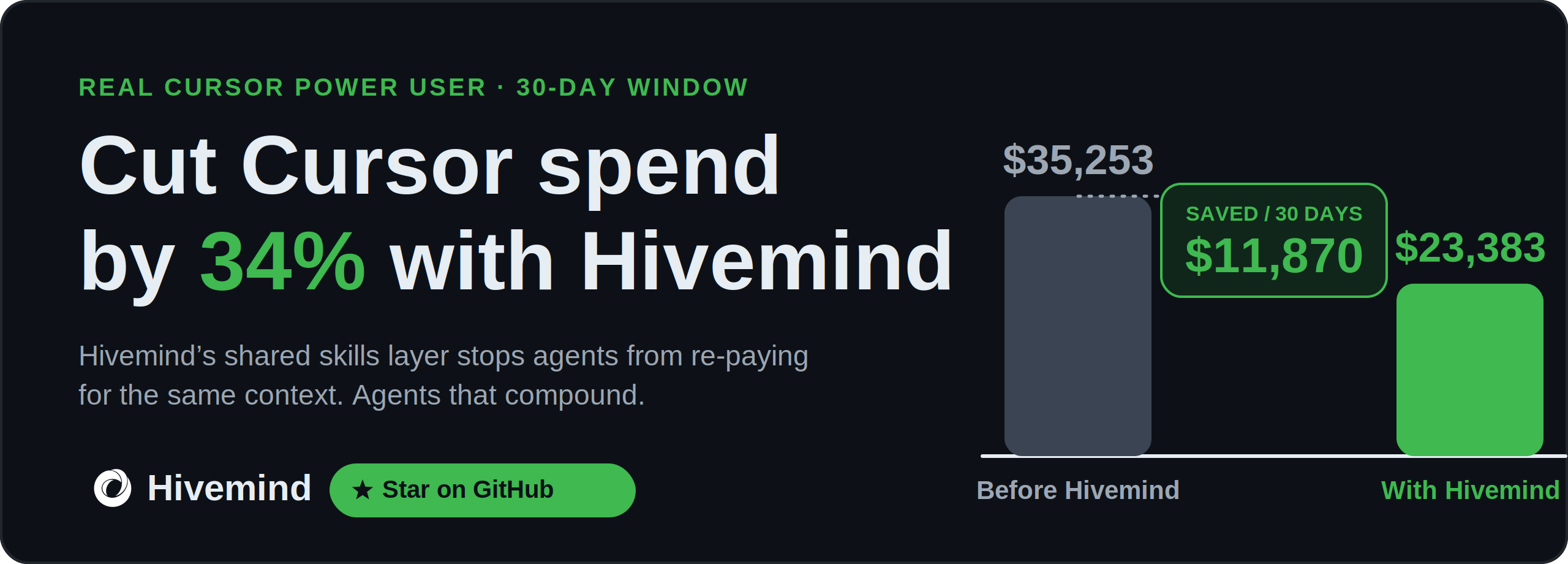
Hivemind turns your traces into reusable skills across agents
Its last change on GitHub was on 2026-11-25. Take My Repo does not judge from that whether it is maintained.
Nobody has reviewed it on Take My Repo yet, which says nothing about its quality.
Take My Repo cannot say: it does not audit code and has not run AI-Rig. What is known comes from GitHub. It declares the Apache-2.0 license on GitHub. Its last change was on 2026-11-25. It has 31 stars, which measure popularity, not safety. Nobody has reviewed it on Take My Repo yet, which says nothing about its quality. Read the source before you run it. With "Take it", your AI agent shows each step and asks you before running it; README text is treated as data, not as instructions.