
system-design-101
Explain complex systems using visuals and simple terms. Help you prepare for system design interviews.
- 91k
- 20 mo ago
The maintainer has not written a description at the source.
Repo ByteByteGoHq/ml-bytebytego, read from GitHub 3 d ago. ByteByteGoHq has not joined Take My Repo.
ByteByteGoHq/ml-bytebytego is a public repo on GitHub by ByteByteGoHq. It declares no license on GitHub. Public does not mean open source: without a license, nobody is granted the right to reuse it. It has 1,113 stars and last changed on 2025-05-13. Nobody has reviewed it on Take My Repo yet, which says nothing about its quality. Read from GitHub on 2026-11-19.
In the maintainer's words. Shown from GitHub; Take My Repo does not keep a copy.
[1] Data warehouse. https://cloud.google.com/learn/what-is-a-data-warehouse.
[2] Structured vs. unstructured data. https://signal.onepointltd.com/post/102gjab/machine-learning-libraries-for-tabular-data-problems.
[3] Bagging technique in ensemble learning. https://en.wikipedia.org/wiki/Bootstrap_aggregating.
[4] Boosting technique in ensemble learning. https://aws.amazon.com/what-is/boosting/.
[5] Stacking technique in ensemble learning. https://machinelearningmastery.com/stacking-ensemble-machine-learning-with-python/.
[6] Interpretability in Machine Mearning. https://blog.ml.cmu.edu/2020/08/31/6-interpretability/.
[7] Traditional machine learning algorithms. https://machinelearningmastery.com/a-tour-of-machine-learning-algorithms/.
[8] Sampling strategies. https://www.scribbr.com/methodology/sampling-methods/.
[9] Data splitting techniques. https://machinelearningmastery.com/train-test-split-for-evaluating-machine-learning-algorithms/.
[10] Class-balanced loss. https://arxiv.org/pdf/1901.05555.pdf.
[11] Focal loss paper. https://arxiv.org/pdf/1708.02002.pdf.
[12] Focal loss. https://medium.com/swlh/focal-loss-an-efficient-way-of-handling-class-imbalance-4855ae1db4cb.
[13] Data parallelism. https://www.telesens.co/2017/12/25/understanding-data-parallelism-in-machine-learning/.
[14] Model parallelism. https://docs.aws.amazon.com/sagemaker/latest/dg/model-parallel-intro.html.
[15] Cross entropy loss. https://en.wikipedia.org/wiki/Cross_entropy.
[16] Mean squared error loss. https://en.wikipedia.org/wiki/Mean_squared_error.
[17] Mean absolute error loss. https://en.wikipedia.org/wiki/Mean_absolute_error.
[18] Huber loss. https://en.wikipedia.org/wiki/Huber_loss.
[19] L1 and l2 regularization. https://www.analyticssteps.com/blogs/l2-and-l1-regularization-machine-learning.
[20] Entropy regularization. https://paperswithcode.com/method/entropy-regularization.
[21] K-fold cross validation. https://en.wikipedia.org/wiki/Cross-validation_(statistics).
[22] Dropout paper. https://jmlr.org/papers/volume15/srivastava14a/srivastava14a.pdf.
[23] Overview of optimization algorithm. https://ruder.io/optimizing-gradient-descent/.
[24] Stochastic gradient descent. https://en.wikipedia.org/wiki/Stochastic_gradient_descent.
[25] AdaGrad optimization algorithm. https://optimization.cbe.cornell.edu/index.php?title=AdaGrad.
[26] Momentum optimization algorithm. https://optimization.cbe.cornell.edu/index.php?title=Momentum.
[27] RMSProp optimization algorithm. https://optimization.cbe.cornell.edu/index.php?title=RMSProp.
[28] ELU activation function. https://ml-cheatsheet.readthedocs.io/en/latest/activation_functions.html#elu.
[29] ReLU activation function. https://ml-cheatsheet.readthedocs.io/en/latest/activation_functions.html#relu.
[30] Tanh activation function. https://ml-cheatsheet.readthedocs.io/en/latest/activation_functions.html#tanh.
[31] Sigmoid activation function. https://ml-cheatsheet.readthedocs.io/en/latest/activation_functions.html#softmax.
[32] FID score. https://en.wikipedia.org/wiki/Fr%C3%A9chet_inception_distance.
[33] Inception score. https://en.wikipedia.org/wiki/Inception_score.
[34] BLEU metrics. https://en.wikipedia.org/wiki/BLEU.
[35] METEOR metrics. https://en.wikipedia.org/wiki/METEOR.
[36] ROUGE score. https://en.wikipedia.org/wiki/ROUGE_(metric).
[37] CIDEr score. https://arxiv.org/pdf/1411.5726.pdf.
[38] SPICE score. https://arxiv.org/pdf/1607.08822.pdf.
[39] Quantization-aware training. https://pytorch.org/docs/stable/quantization.html.
[40] Model compression survey. https://arxiv.org/pdf/1710.09282.pdf.
[41] Shadow deployment. https://christophergs.com/machine%20learning/2019/03/30/deploying-machine-learning-applications-in-shadow-mode/.
[42] A/B testing. https://en.wikipedia.org/wiki/A/B_testing.
[43] Canary release. https://blog.getambassador.io/cloud-native-patterns-canary-release-1cb8f82d371a.
[1] Visual search at pinterest. https://arxiv.org/pdf/1505.07647.pdf.
[2] Visual embeddings for search at Pinterest. https://medium.com/pinterest-engineering/unifying-visual-embeddings-for-visual-search-at-pinterest-74ea7ea103fo.
[3] Representation learning. https://en.wikipedia.org/wiki/Feature_learning.
[4] ResNet paper. https://arxiv.org/pdf/1512.03385.pdf.
[5] Transformer paper. https://arxiv.org/pdf/1706.03762.pdf.
[6] Vision Transformer paper. https://arxiv.org/pdf/2010.11929.pdf.
[7] SimCLR paper. https://arxiv.org/pdf/2002.05709.pdf.
[8] MoCo paper. https://openaccess.thecvf.com/content_CVPR_2020/papers/He_Momentum_Contrast_for_Unsupervised_Visual_Representation_Learning_CVPR_2020_paper.pdf.
[9] Contrastive representation learning methods. https://lilianweng.github.io/posts/2019-11-10-self-supervised/.
[10] Dot product. https://en.wikipedia.org/wiki/Dot_product.
[11] Cosine similarity. https://en.wikipedia.org/wiki/Cosine_similarity.
[12] Euclidean distance. https://en.wikipedia.org/wiki/Euclidean_distance.
[13] Curse of dimensionality. https://en.wikipedia.org/wiki/Curse_of_dimensionality.
[14] Curse of dimensionality issues in ML. https://www.mygreatlearning.com/blog/understanding-curse-of-dimensionality/.
[15] Cross-entropy loss. https://en.wikipedia.org/wiki/Cross_entropy.
[16] Vector quantization. http://ws.binghamton.edu/fowler/fowler\%20personal\%20page/EE523_files/Ch_10_1\%20VQ\%20Description\%20(PPT).pdf.
[17] Product quantization. https://towardsdatascience.com/product-quantization-for-similarity-search-2f1f67c5fddd.
[18] R-Trees. https://en.wikipedia.org/wiki/R-tree.
[19] KD-Tree. https://kanoki.org/2020/08/05/find-nearest-neighbor-using-kd-tree/.
[20] Annoy. https://towardsdatascience.com/comprehensive-guide-to-approximate-nearest-neighbors-algorithms-8b94f057d6b6.
[21] Locality-sensitive hashing. https://web.stanford.edu/class/cs246/slides/03-1sh.pdf.
[22] Faiss library. https://github.com/facebookresearch/faiss/wiki.
[23] ScaNN library. https://github.com/google-research/google-research/tree/master/scann.
[24] Content moderation with ML. https://appen.com/blog/content-moderation/.
[25] Bias in $\mathrm{AI}$ and recommendation systems. https://www.searchenginejournal.com/biases-search-recommender-systems/339319/\#close.
[26] Positional bias. https://eugeneyan.com/writing/position-bias/.
[27] Smart crop. https://blog.twitter.com/engineering/en_us/topics/infrastructure/2018/Smart-Auto-Cropping-of-Images.
[28] Better search with gnns. https://arxiv.org/pdf/2010.01666.pdf.
[29] Active learning. https://en.wikipedia.org/wiki/Active_learning_(machine_learning).
[30] Human-in-the-loop ML. https://arxiv.org/pdf/2108.00941.pdf.
[1] Google Street View. https://www.google.com/streetview.
[2] DETR. https://github.com/facebookresearch/detr.
[3] RCNN family. https://lilianweng.github.io/posts/2017-12-31-object-recognition-part-3.
[4] Fast R-CNN paper. https://arxiv.org/pdf/1504.08083.pdf.
[5] Faster R-CNN paper. https://arxiv.org/pdf/1506.01497.pdf.
[6] YOLO family. https://pyimagesearch.com/2022/04/04/introduction-to-the-yolo-family.
[7] SSD. https://jonathan-hui.medium.com/ssd-object-detection-single-shot-multibox-detector-for-real-time-processing-9bd8deac0e06.
[8] Data augmentation techniques. https://www.kaggle.com/getting-started/190280.
[9] CNN. https://en.wikipedia.org/wiki/Convolutional_neural_network.
[10] Object detection details. https://dudeperf3ct.github.io/object/detection/2019/01/07/Mystery-of-Object-Detection.
[11] Forward pass and backward pass. https://www.youtube.com/watch?v=qzPQ8cEsVK8.
[12] MSE. https://en.wikipedia.org/wiki/Mean_squared_error.
[13] Log loss. https://en.wikipedia.org/wiki/Cross_entropy.
[14] Pascal VOC. http://host.robots.ox.ac.uk/pascal/VOC/voc2008/index.html.
[15] COCO dataset evaluation. https://cocodataset.org/\#detection-eval.
[16] Object detection evaluation. https://github.com/rafaelpadilla/Object-Detection-Metrics.
[17] NMS. https://en.wikipedia.org/wiki/NMS.
[18] Pytorch implementation of NMS. https://learnopencv.com/non-maximum-suppression-theory-and-implementation-in-pytorch/.
[19] Recent object detection models. https://viso.ai/deep-learning/object-detection/.
[20] Distributed training in Tensorflow. https://www.tensorflow.org/guide/distributed_training.
[21] Distributed training in Pytorch. https://pytorch.org/tutorials/beginner/dist_overview.html.
[22] GDPR and ML. https://www.oreilly.com/radar/how-will-the-gdpr-impact-machine-learning.
[23] Bias and fairness in face detection. http://sibgrapi.sid.inpe.br/col/sid.inpe.br/sibgrapi/2021/09.04.19.00/doc/103.pdf.
[24] AI fairness. https://www.kaggle.com/code/alexisbcook/ai-fairness.
[25] Continual learning. https://towardsdatascience.com/how-to-apply-continual-learning-to-your-machine-learning-models-4754adcd7f7f.
[26] Active learning. https://en.wikipedia.org/wiki/Active_learning_(machine_learning).
[27] Human-in-the-loop ML. https://arxiv.org/pdf/2108.00941.pdf.
[1] Elasticsearch. https://www.tutorialspoint.com/elasticsearch/elasticsearch_query_dsl.htm.
[2] Preprocessing text data. https://huggingface.co/docs/transformers/preprocessing.
[3] NFKD normalization. https://unicode.org/reports/tr15/.
[4] What is Tokenization summary. https://huggingface.co/docs/transformers/tokenizer_summary.
[5] Hash collision. https://en.wikipedia.org/wiki/Hash_collision.
[6] Deep learning for NLP. http://cs224d.stanford.edu/lecture_notes/notes1.pdf.
[7] TF-IDF. https://en.wikipedia.org/wiki/Tf\%E2\%80\%93idf.
[8] Word2Vec models. https://www.tensorflow.org/tutorials/text/word2vec.
[9] Continuous bag of words. https://www.kdnuggets.com/2018/04/implementing-deep-learning-methods-feature-engineering-text-data-cbow.html.
[10] Skip-gram model. http://mccormickml.com/2016/04/19/word2vec-tutorial-the-skip-gram-model/.
[11] BERT model. https://arxiv.org/pdf/1810.04805.pdf.
[12] GPT3 model. https://arxiv.org/pdf/2005.14165.pdf.
[13] BLOOM model. https://bigscience.huggingface.co/blog/bloom.
[14] Transformer implementation from scratch. https://peterbloem.nl/blog/transformers.
[15] 3D convolutions. https://www.kaggle.com/code/shivamb/3d-convolutions-understanding-use-case/notebook.
[16] Vision Transformer. https://arxiv.org/pdf/2010.11929.pdf.
[17] Query understanding for search engines. https://www.linkedin.com/pulse/ai-query-understanding-daniel-tunkelang/.
[18] Multimodal video representation learning. https://arxiv.org/pdf/2012.04124.pdf.
[19] Multilingual language models. https://arxiv.org/pdf/2107.00676.pdf.
[20] Near-duplicate video detection. https://arxiv.org/pdf/2005.07356.pdf.
[21] Generalizable search relevance. https://livebook.manning.com/book/ai-powered-search/chapter-10/v-10/20.
[22] Freshness in search and recommendation systems. https://developers.google.com/machine-learning/recommendation/dnn/re-ranking.
[23] Semantic product search by Amazon. https://arxiv.org/pdf/1907.00937.pdf.
[24] Ranking relevance in Yahoo search. https://www.kdd.org/kdd2016/papers/files/adf0361-yinA.pdf.
[25] Semantic product search in E-Commerce. https://arxiv.org/pdf/2008.08180.pdf.
[1] Facebook’s inauthentic behavior. https://transparency.fb.com/policies/community-standards/inauthentic-behavior/.
[2] LinkedIn’s professional community policies. https://www.linkedin.com/legal/professional-community-policies.
[3] Twitter’s civic integrity policy. https://help.twitter.com/en/rules-and-policies/election-integrity-policy.
[4] Facebook’s integrity survey. https://arxiv.org/pdf/2009.10311.pdf.
[5] Pinterest’s violation detection system. https://medium.com/pinterest-engineering/how-pinterest-fights-misinformation-hate-speech-and-self-harm-content-with-machine-learning-1806b73b40ef.
[6] Abusive detection at LinkedIn. https://engineering.linkedin.com/blog/2019/isolation-forest.
[7] WPIE method. https://ai.facebook.com/blog/community-standards-report/.
[8] BERT paper. https://arxiv.org/pdf/1810.04805.pdf.
[9] Multilingual DistilBERT. https://huggingface.co/distilbert-base-multilingual-cased.
[10] Multilingual language models. https://arxiv.org/pdf/2107.00676.pdf.
[11] CLIP model. https://openai.com/blog/clip/.
[12] SimCLR paper. https://arxiv.org/pdf/2002.05709.pdf.
[13] VideoMoCo paper. https://arxiv.org/pdf/2103.05905.pdf.
[14] Hyperparameter tuning. https://cloud.google.com/ai-platform/training/docs/hyperparameter-tuning-overview.
[15] Overfitting. https://en.wikipedia.org/wiki/Overfitting.
[16] Focal loss. https://amaarora.github.io/2020/06/29/FocalLoss.html.
[17] Gradient blending in multimodal systems. https://arxiv.org/pdf/1905.12681.pdf.
[18] ROC curve vs precision-recall curve. https://machinelearningmastery.com/roc-curves-and-precision-recall-curves-for-classification-in-python/.
[19] Introduced bias by human labeling. https://labelyourdata.com/articles/bias-in-machine-learning.
[20] Facebook’s approach to quickly tackling trending harmful content. https://ai.facebook.com/blog/harmful-content-can-evolve-quickly-our-new-ai-system-adapts-to-tackle-it/.
[21] Facebook’s TIES approach. https://arxiv.org/pdf/2002.07917.pdf.
[22] Temporal interaction embedding. https://www.facebook.com/atscaleevents/videos/730968530723238/.
[23] Building and scaling human review system. https://www.facebook.com/atscaleevents/videos/1201751883328695/.
[24] Abusive account detection framework. https://www.youtube.com/watch?v=YeX4MdU0JNk.
[25] Borderline contents. https://transparency.fb.com/features/approach-to-ranking/content-distribution-guidelines/content-borderline-to-the-community-standards/.
[26] Efficient harmful content detection. https://about.fb.com/news/2021/12/metas-new-ai-system-tackles-harmful-content/.
[27] Linear Transformer paper. https://arxiv.org/pdf/2006.04768.pdf.
[28] Efficient AI models to detect hate speech. https://ai.facebook.com/blog/how-facebook-uses-super-efficient-ai-models-to-detect-hate-speech/.
[1] YouTube recommendation system. https://blog.youtube/inside-youtube/on-youtubes-recommendation-system.
[2] DNN for YouTube recommendation. https://static.googleusercontent.com/media/research.google.com/en//pubs/archive/45530.pdf.
[3] CBOW paper. https://arxiv.org/pdf/1301.3781.pdf.
[4] BERT paper. https://arxiv.org/pdf/1810.04805.pdf.
[5] Matrix factorization. https://developers.google.com/machine-learning/recommendation/collaborative/matrix.
[6] Stochastic gradient descent. https://en.wikipedia.org/wiki/Stochastic_gradient_descent.
[7] WALS optimization. https://fairyonice.github.io/Learn-about-collaborative-filtering-and-weighted-alternating-least-square-with-tensorflow.html.
[8] Instagram multi-stage recommendation system. https://ai.facebook.com/blog/powered-by-ai-instagrams-explore-recommender-system/.
[9] Exploration and exploitation trade-offs. https://en.wikipedia.org/wiki/Multi-armed_bandit.
[10] Bias in AI and recommendation systems. https://www.searchenginejournal.com/biases-search-recommender-systems/339319/#close.
[11] Ethical concerns in recommendation systems. https://link.springer.com/article/10.1007/s00146-020-00950-y.
[12] Seasonality in recommendation systems. https://www.computer.org/csdl/proceedings-article/big-data/2019/09005954/1hJsfgT0qL6.
[13] A multitask ranking system. https://daiwk.github.io/assets/youtube-multitask.pdf.
[14] Benefit from a negative feedback. https://arxiv.org/abs/1607.04228?context=cs.
[1] Learning to rank methods. https://livebook.manning.com/book/practical-recommender-systems/chapter-13/53.
[2] RankNet paper. https://icml.cc/2015/wp-content/uploads/2015/06/icml_ranking.pdf.
[3] LambdaRank paper. https://www.microsoft.com/en-us/research/wp-content/uploads/2016/02/lambdarank.pdf.
[4] LambdaMART paper. https://www.microsoft.com/en-us/research/wp-content/uploads/2016/02/MSR-TR-2010-82.pdf.
[5] SoftRank paper. https://www.microsoft.com/en-us/research/wp-content/uploads/2016/02/SoftRankWsdm08Submitted.pdf.
[6] ListNet paper. https://www.microsoft.com/en-us/research/wp-content/uploads/2016/02/tr-2007-40.pdf.
[7] AdaRank paper. https://dl.acm.org/doi/10.1145/1277741.1277809.
[8] Batch processing vs stream processing. https://www.confluent.io/learn/batch-vs-real-time-data-processing/#:~:text=Batch%20processing%20is%20when%20the,data%20flows%20through%20a%20system.
[9] Leveraging location data in ML systems. https://towardsdatascience.com/leveraging-geolocation-data-for-machine-learning-essential-techniques-192ce3a969bc#:~:text=Location%20data%20is%20an%20important,based%20on%20your%20customer%20data.
[10] Logistic regression. https://www.youtube.com/watch?v=yIYKR4sgzI8.
[11] Decision tree. https://careerfoundry.com/en/blog/data-analytics/what-is-a-decision-tree/.
[12] Random forests. https://en.wikipedia.org/wiki/Random_forest.
[13] Bias/variance trade-off. http://www.cs.cornell.edu/courses/cs578/2005fa/CS578.bagging.boosting.lecture.pdf.
[14] AdaBoost. https://en.wikipedia.org/wiki/AdaBoost.
[15] XGBoost. https://xgboost.readthedocs.io/en/stable/.
[16] Gradient boosting. https://machinelearningmastery.com/gentle-introduction-gradient-boosting-algorithm-machine-learning/.
[17] XGBoost in Kaggle competitions. https://www.kaggle.com/getting-started/145362.
[18] GBDT. https://blog.paperspace.com/gradient-boosting-for-classification/
[19] An introduction to GBDT. https://www.machinelearningplus.com/machine-learning/an-introduction-to-gradient-boosting-decision-trees/.
[20] Introduction to neural networks. https://www.youtube.com/watch?v=0twSSFZN9Mc.
[21] Bias issues and solutions in recommendation systems. https://www.youtube.com/watch?v=pPq9iyGIZZ8.
[22] Feature crossing to encode non-linearity. https://developers.google.com/machine-learning/crash-course/feature-crosses/encoding-nonlinearity.
[23] Freshness and diversity in recommendation systems. https://developers.google.com/machine-learning/recommendation/dnn/re-ranking.
[24] Privacy and security in ML. https://www.microsoft.com/en-us/research/blog/privacy-preserving-machine-learning-maintaining-confidentiality-and-preserving-trust/.
[25] Two-sides marketplace unique challenges. https://www.uber.com/blog/uber-eats-recommending-marketplace/.
[26] Data leakage. https://machinelearningmastery.com/data-leakage-machine-learning/.
[27] Online training frequency. https://huyenchip.com/2022/01/02/real-time-machine-learning-challenges-and-solutions.html#towards-continual-learning.
[1] Addressing delayed feedback. https://arxiv.org/pdf/1907.06558.pdf.
[2] AdTech basics. https://advertising.amazon.com/library/guides/what-is-adtech.
[3] SimCLR paper. https://arxiv.org/pdf/2002.05709.pdf.
[4] Feature crossing. https://developers.google.com/machine-learning/crash-course/feature-crosses/video-lecture.
[5] Feature extraction with GBDT. https://towardsdatascience.com/feature-generation-with-gradient-boosted-decision-trees-21d4946d6ab5.
[6] DCN paper. https://arxiv.org/pdf/1708.05123.pdf.
[7] DCN V2 paper. https://arxiv.org/pdf/2008.13535.pdf.
[8] Microsoft’s deep crossing network paper. https://www.kdd.org/kdd2016/papers/files/adf0975-shanA.pdf.
[9] Factorization Machines. https://www.jefkine.com/recsys/2017/03/27/factorization-machines/.
[10] Deep Factorization Machines. https://d2l.ai/chapter_recommender-systems/deepfm.html.
[11] Kaggle’s winning solution in ad click prediction. https://www.youtube.com/watch?v=4Go5crRVyuU.
[12] Data leakage in ML systems. https://machinelearningmastery.com/data-leakage-machine-learning/.
[13] Time-based dataset splitting. https://www.linkedin.com/pulse/time-based-splitting-determining-train-test-data-come-manraj-chalokia/?trk=public_profile_article_view.
[14] Model calibration. https://machinelearningmastery.com/calibrated-classification-model-in-scikit-learn/.
[15] Field-aware Factorization Machines. https://www.csie.ntu.edu.tw/~cjlin/papers/ffm.pdf.
[16] Catastrophic forgetting problem in continual learning. https://www.cs.uic.edu/~liub/lifelong-learning/continual-learning.pdf.
[1] Instagram’s Explore recommender system. https://ai.facebook.com/blog/powered-by-ai-instagrams-explore-recommender-system.
[2] Listing embeddings in search ranking. https://medium.com/airbnb-engineering/listing-embeddings-for-similar-listing-recommendations-and-real-time-personalization-in-search-601172f7603e.
[3] Word2vec. https://en.wikipedia.org/wiki/Word2vec.
[4] Negative sampling technique. https://www.baeldung.com/cs/nlps-word2vec-negative-sampling.
[5] Positional bias. https://eugeneyan.com/writing/position-bias/.
[6] Random walk. https://en.wikipedia.org/wiki/Random_walk.
[7] Random walk with restarts. https://www.youtube.com/watch?v=HbzQzUaJ_9I.
[8] Seasonality in recommendation systems. https://www.computer.org/csdl/proceedings-article/big-data/2019/09005954/1hJsfgT0qL6.
[1] News Feed ranking in Facebook. https://engineering.fb.com/2021/01/26/ml-applications/news-feed-ranking/.
[2] Twitter’s news feed system. https://blog.twitter.com/engineering/en_us/topics/insights/2017/using-deep-learning-at-scale-in-twitters-timelines.
[3] LinkedIn’s News Feed system LinkedIn. https://engineering.linkedin.com/blog/2020/understanding-feed-dwell-time.
[4] BERT paper. https://arxiv.org/pdf/1810.04805.pdf.
[5] ResNet model. https://arxiv.org/pdf/1512.03385.pdf.
[6] CLIP model. https://openai.com/blog/clip/.
[7] Viterbi algorithm. https://en.wikipedia.org/wiki/Viterbi_algorithm.
[8] TF-IDF. https://en.wikipedia.org/wiki/Tf%E2%80%93idf.
[9] Word2vec. https://en.wikipedia.org/wiki/Word2vec.
[10] Serving a billion personalized news feed. https://www.youtube.com/watch?v=Xpx5RYNTQvg.
[11] Mean absolute error loss. https://en.wikipedia.org/wiki/Mean_absolute_error.
[12] Means squared error loss. https://en.wikipedia.org/wiki/Mean_squared_error.
[13] Huber loss. https://en.wikipedia.org/wiki/Huber_loss.
[14] A news feed system design. https://liuzhenglaichn.gitbook.io/system-design/news-feed/design-a-news-feed-system.
[15] Predict viral tweets. https://towardsdatascience.com/using-data-science-to-predict-viral-tweets-615b0acc2e1e.
[16] Cold start problem in recommendation systems. https://en.wikipedia.org/wiki/Cold_start_(recommender_systems).
[17] Positional bias. https://eugeneyan.com/writing/position-bias/.
[18] Determine retraining frequency. https://huyenchip.com/2022/01/02/real-time-machine-learning-challenges-and-solutions.html#towards-continual-learning.
[1] Clustering in ML. https://developers.google.com/machine-learning/clustering/overview.
[2] PYMK on Facebook. https://youtu.be/Xpx5RYNTQvg?t=1823.
[3] Graph convolutional neural networks. http://tkipf.github.io/graph-convolutional-networks/.
[4] GraphSage paper. https://cs.stanford.edu/people/jure/pubs/graphsage-nips17.pdf.
[5] Graph attention networks. https://arxiv.org/pdf/1710.10903.pdf.
[6] Graph isomorphism network. https://arxiv.org/pdf/1810.00826.pdf.
[7] Graph neural networks. https://distill.pub/2021/gnn-intro/.
[8] Personalized random walk. https://www.youtube.com/watch?v=HbzQzUaJ_9I.
[9] LinkedIn’s PYMK system. https://engineering.linkedin.com/blog/2021/optimizing-pymk-for-equity-in-network-creation.
[10] Addressing delayed feedback. https://arxiv.org/pdf/1907.06558.pdf
ByteByteGoHq/ml-bytebytego is a public repo on GitHub by ByteByteGoHq. Its maker has not written a description.
It declares no license on GitHub. Public does not mean open source: without a license, nobody is granted the right to reuse it.
Its maker has not tagged a system, so it is unknown here. Its README says what it needs.
Open "Take it" on its page: Take My Repo writes an install plan for your machine and hands it to your AI agent (Claude Code, Codex or Cursor), which asks you before each step. Take My Repo has not tested it on any machine.
Its last change on GitHub was on 2025-05-13. Take My Repo does not judge from that whether it is maintained.
Nobody has reviewed it on Take My Repo yet, which says nothing about its quality.
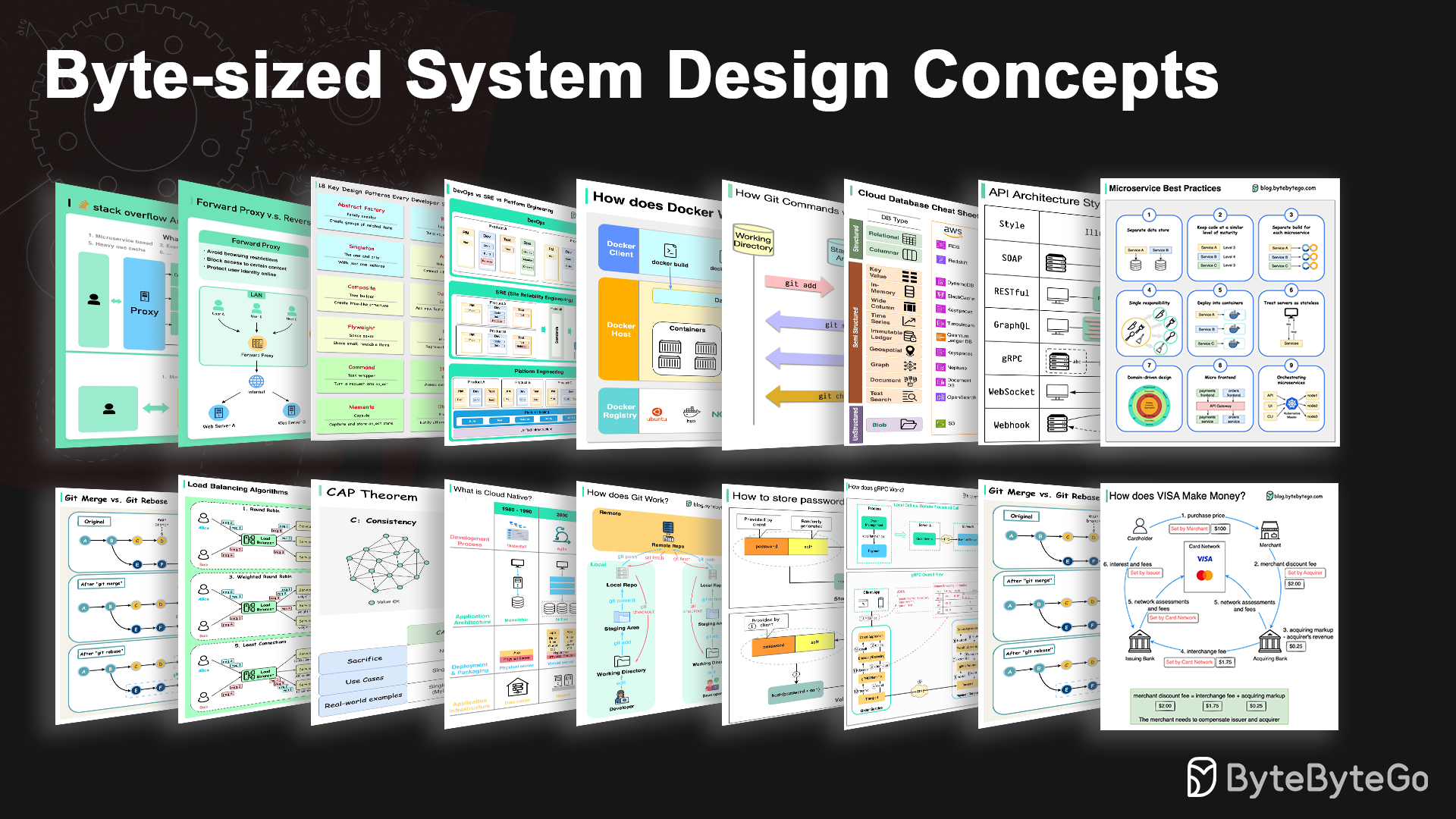
Explain complex systems using visuals and simple terms. Help you prepare for system design interviews.
Code for the OOD Interview Book by ByteByteGo. Available on Amazon:
