
Hypha
Harness-oriented agent system framework for production-grade LLM agent applications
- 452
- Apache-2.0
- 9 d ago
Repo CodeSoul-co/Hypha, read from GitHub 21 h ago. CodeSoul-co has not joined Take My Repo.
In short
CodeSoul-co/Hypha is a public repo on GitHub by CodeSoul-co. Harness-oriented agent system framework for production-grade LLM agent applications. It declares the Apache-2.0 license on GitHub. It is written mainly in TypeScript, has 452 stars and last changed on 2026-11-15. Nobody has reviewed it on Take My Repo yet, which says nothing about its quality. Read from GitHub on 2026-11-23.
Similar repos
ragflow
RAGFlow is an agent-native database: a Retrieval-Augmented Generation (RAG) engine that grew into context infrastructure.


Agent Core + Production Harness for governed, durable, and reusable domain agent.
DomainPack · Event-first Runtime · Governed Capabilities · Recovery · Cache & Reuse
English | 中文
User Guide · Official Website · Release v1.0.1 · npm Packages
@codesoul-co/hypha-*. The versioned user guide
What is hypha?
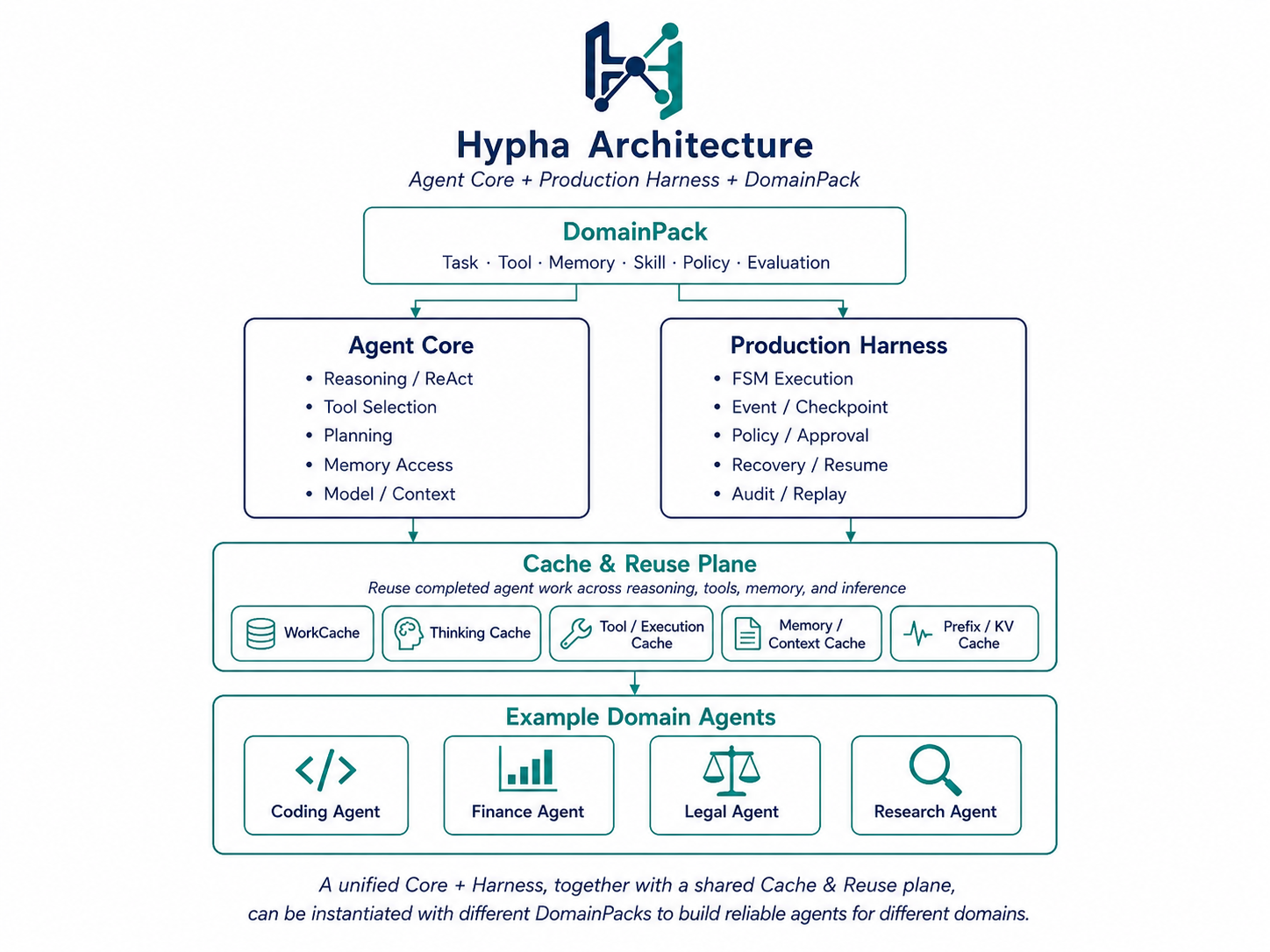
hypha is an open-source TypeScript framework built around two cooperating layers: an Agent Core and a Production Harness. The Agent Core handles reasoning/ReAct, planning, tool selection, Memory access, and model/context orchestration; the Production Harness turns those decisions into bounded, event-backed execution with FSM control, policy/approval, checkpoints, recovery, replay, and audit.
Product-specific behavior is declared through a DomainPack, not hard-coded into the runtime. A
DomainPack compiles tasks, workflows, capabilities, prompts, Memory, policy, evaluation, and output
contracts into the shared Core + Harness. A cross-cutting Cache & Reuse Plane then reuses
validated work across reasoning, tools, Memory, execution, and inference while remaining a disposable
projection: cache state can accelerate execution, but it can never become authority or replace Event,
Artifact, receipt, or checkpoint evidence.
Architecture at a glance
One Agent Core + Production Harness can be instantiated with different DomainPacks, while the Cache & Reuse Plane spans reasoning, tools, Memory, execution, and inference.
| Layer | Primary responsibility |
|---|---|
| Agent Core | Reasoning/ReAct, planning, tool selection, Memory access, model and context orchestration. |
| Production Harness | FSM execution, Event/checkpoint control, policy/approval, continuation, recovery, audit, and replay. |
| DomainPack | Declares the product-specific task, workflow, capability, Memory, Skill, Prompt, Policy, evaluation, and output contracts compiled into the shared runtime. |
| Cache & Reuse Plane | Reuses validated model work, reasoning structures, tool/execution results, Memory/context projections, and prefix/KV state without becoming a source of truth or authority. |
This separation is what lets the same runtime support very different agent products. A coding agent, finance agent, legal agent, or research agent can share the same Core + Harness while changing the DomainPack, capability bindings, policies, evaluation contracts, and domain-specific state.
Cache management and typed cache trees
Cache is a first-class control plane in hypha, not a single response-cache feature. The system distinguishes several reuse layers because an exact LLM response, a reasoning subgraph, a tool result, a Memory projection, and a KV prefix have different validity and invalidation requirements.
| Cache layer | Reusable unit | Typical validity boundary |
|---|---|---|
| Serving Cache | Exact normalized model response | Model/provider identity, normalized request, scope, TTL, and response validity. |
| Thinking Cache | Reasoning node, path, or reusable subgraph | Model/provider, reasoning strategy/version, prompt blocks, tool schema, inference parameters, and scope. |
| WorkCache | Event-derived typed agent work | Source-event provenance, dependency/revision closure, scope, validity state, and future demand. |
| Tool / Execution Cache | Eligible read-only tool results or deterministic execution results | Capability revision, Policy, external-state evidence, workspace/environment snapshot, idempotency, and scope. |
| Memory / Context Cache | Memory search and assembled context projections | Memory scope, mutation generation, source revision, provenance, and context policy. |
| Prefix / KV Cache | Prompt-prefix blocks, provider prefixes, or backend KV segments | Model/backend, Agent/Session/Domain scope, prompt dependencies, and prefix/KV revision. |
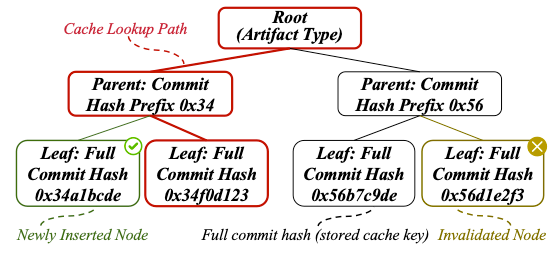
A cache tree uses a typed root to partition reusable artifacts, compact parent nodes to route lookups by hash prefix, and full logical keys at the leaves. New leaves can be inserted without rebuilding unrelated branches, while stale leaves can be invalidated locally; the physical tree is therefore a lookup structure, while Event and Artifact evidence remain the source of truth.
WorkCache extends that lookup pattern into semantic cache trees for agent execution:
| Semantic tree | What it reuses |
|---|---|
PlanTree |
Plans, plan branches, and reusable planning artifacts. |
ComputationTree |
Reasoning/computation nodes and derived work; also the natural backing plane for Thinking Cache. |
ToolTree |
Eligible tool-call results and their provenance/validity metadata. |
ObservationTree |
Reusable observations tied to source evidence and scope. |
VerificationTree |
Verification, checking, and output-validation work. |
MemoryTree |
Memory-derived projections whose validity follows Memory mutation generations and scope. |
RecoveryTree |
Recovery knowledge keyed by failure context and relevant runtime revisions; hits are advisory and must be revalidated. |
PromptPrefixTree |
Stable prompt blocks and prefix materialization used by provider/backend prefix reuse. |
The central invariant is reuse without authority. A hit may avoid recomputation, but it cannot authorize a Tool, skip Policy or Approval, fabricate a receipt, advance the FSM, or replace Event and Artifact evidence. Cache lookup, validation, invalidation, and bypass are therefore part of runtime control rather than hidden implementation details.
Cache diagnostics across benchmarks
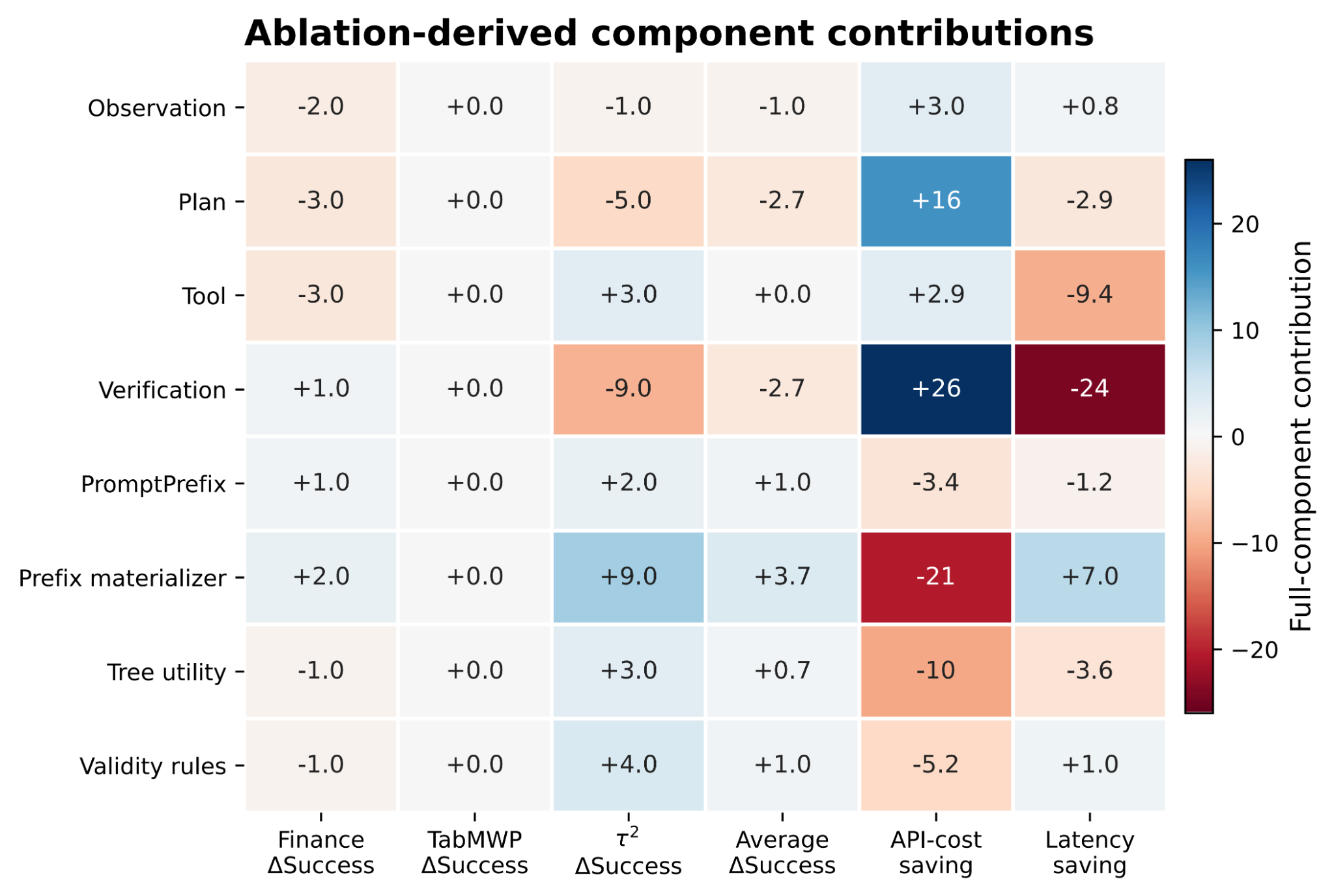
Ablation-derived component contributions across task success, API-cost saving, and latency saving.
Tau3 benchmark results
The latest three-way comparison was run against Hypha main@ef33263 with one trial per task
(385 tasks total). The base model was deepseek-v4-flash. Hypha is the framework result and
Direct is the direct model-call baseline. Neither arm reported a system error.
| Benchmark | Tasks | Hypha | Direct |
|---|---|---|---|
| Mock | 10 | 0.800 (8/10) | 0.800 (8/10) |
| Airline | 50 | 0.880 (44/50) | 0.900 (45/50) |
| Retail | 114 | 0.912 (104/114) | 0.895 (102/114) |
| Telecom | 114 | 0.605 (69/114) | 0.588 (67/114) |
| Banking knowledge | 97 | 0.206 (20/97) | 0.196 (19/97) |
| Total | 385 | 0.636 (245/385) | 0.626 (241/385) |
Product model
| Concept | Responsibility |
|---|---|
DomainPack |
Declares tasks, workflows, output contracts, skills, tools, MCP, memory, context, policy, evaluation, regression, and deployment references. |
Agent |
Selects model aliases and receives the capability references compiled from a DomainPack. |
Session |
Holds user and product context. A Session references a DomainPack and optional Session profile. |
Run |
Represents one durable execution under a Session. |
Event |
Records source-of-truth facts from which state, replay, audit, and regression views are projected. |
Artifact |
Stores content-addressed inputs, outputs, checkpoints, and execution evidence. |
The canonical execution path is:
DomainPack
  -> validated bindings and dependency snapshot
  -> framework-owned Harness FSM
  -> bounded ReAct quantum and Domain pipeline evidence
  -> governed Tool / MCP / Memory / Execution activity
  -> Event + receipt + Artifact evidence
  -> projection, continuation, recovery, replay, and evaluation
No cache hit or provider response can authorize a side effect, advance the FSM, or replace Event and Artifact evidence. Tool, MCP, Memory, file, execution, and external writes pass through policy, trace, cancellation, deadline, idempotency, and harness boundaries.
Included capabilities
| Area | Included runtime capability |
|---|---|
| Runtime | ReAct + FSM, durable session commands, bounded continuation, timers, leases, fencing, cancellation, recovery workers, human review, replay, audit, and regression projections. |
| Domain | YAML/JSON/TypeScript Domain Packs, runtime validation, overlays, registry, deterministic compiler, dependency snapshots, and Agent patches. |
| Memory | Hypha Native Memory, local Native Lite, self-hosted Mem0 OSS, Mem0 Platform, and Vertex AI Memory Bank adapters behind one governed contract. |
| Tools and MCP | Local, HTTP, plugin, mock, and MCP adapters through one governed invocation path with capability snapshots and drift control. |
| Skills and prompts | Built-in, filesystem, package, and signed remote Skill registries; progressive loading; versioned prompt references and templates. |
| Execution | Provider-neutral Workspace, Sandbox, Command, Artifact, Store, lease, recovery, and cache contracts with local-process, Docker, remote HTTP, SQLite, PostgreSQL, local-file, and S3-compatible adapters. |
| Cache | Serving Cache, event-derived WorkCache, Thinking Cache, typed semantic cache trees, capability-result caches, Memory/context projections, Prefix/KV reuse, scoped validity, and invalidation. |
| Surfaces | Express API server and an example CLI that consume the same framework runtime. |
Quick start
Requirements
- Node.js 22 or newer
- npm
- MongoDB and Redis for the bundled API server
- At least one configured model provider or a reachable local model endpoint
1. Install the workspace
git clone https://github.com/CodeSoul-co/Hypha.git
cd Hypha
npm ci
cp .env.example .env
Keep product configuration out of tracked templates. Set HYPHA_CONFIG_PATH to a user-owned YAML
overlay; see Upgrading for the conflict-free update layout.
For a disposable local MongoDB and Redis environment, you may use containers:
docker run -d --name hypha-mongodb -p 27017:27017 mongo:8
docker run -d --name hypha-redis -p 6379:6379 redis:7-alpine
You can instead set MONGODB_URI and REDIS_URL to self-hosted or managed services.
2. Configure identity and a model provider
Edit .env. Keep credentials out of config.yaml and source control.
HYPHA_OWNER_EMAIL=owner@example.com
HYPHA_OWNER_PASSWORD=replace-with-a-private-password
JWT_SECRET=replace-with-at-least-32-random-characters

HYPHA_LLM_DEFAULT_PROVIDER=openai
HYPHA_LLM_DEFAULT_MODEL=gpt-4o-mini
OPENAI_API_KEY=your-provider-key
The default deployment mode is single-user. Registration remains disabled and the configured owner is created during startup. Internal data access still retains user, Session, Run, Workspace, and tenant boundaries.
3. Start and verify the server
npm run dev
In another terminal:
curl -fsS http://127.0.0.1:3000/api/v1/health
curl -fsS http://127.0.0.1:3000/api/v1/ready
/health is process liveness. /ready is the traffic gate: it returns a failure status until
storage, the selected model provider, Memory, the canonical Runtime graph, and required workers are
ready. The route index is available at http://127.0.0.1:3000/api/v1/docs.
4. Use the CLI
npm run cli -- login --email owner@example.com
npm run cli -- chat "Explain the active runtime" --stream
npm run cli -- tools
npm run cli -- skills
npm run cli -- workflows
The CLI stores its endpoint configuration and JWT under ~/.hypha
Questions
What is Hypha?
CodeSoul-co/Hypha is a public repo on GitHub by CodeSoul-co. Harness-oriented agent system framework for production-grade LLM agent applications.
Is Hypha open source?
It declares the Apache-2.0 license on GitHub.
Does Hypha run on macOS, Windows or Linux?
Its maker tagged it for macOS, Windows and Linux, or as Docker or cross-platform. That is declared by the maker; Take My Repo has not tested it.
How do I install Hypha?
Open "Take it" on its page: Take My Repo writes an install plan for your machine and hands it to your AI agent (Claude Code, Codex or Cursor), which asks you before each step. Take My Repo has not tested it on any machine.