
PackLab
Offical Implementation of "PackLab: A Comprehensive Framework for Developing, Training, and Evaluating MLLMs in Robotic Bin Packing"
- 12
- 2 mo ago
Repo Correr-Zhou/PackLab, read from GitHub 1 min ago. Correr-Zhou has not joined Take My Repo.
In short
Correr-Zhou/PackLab is a public repo on GitHub by Correr-Zhou. Offical Implementation of "PackLab: A Comprehensive Framework for Developing, Training, and Evaluating MLLMs in Robotic Bin Packing". It declares no license on GitHub. Public does not mean open source: without a license, nobody is granted the right to reuse it. It is written mainly in Python, has 12 stars and last changed on 2026-09-23. Nobody has reviewed it on Take My Repo yet, which says nothing about its quality. Read from GitHub on 2026-11-22.
PackLab: A Comprehensive Framework for Developing, Training, and Evaluating MLLMs in Robotic Bin Packing
Donghao Zhou1,*, Jia-Hui Pan1,*, Fan Zhang1, Xingyuan Bu2, Shilong Li2, Xiaojie Gao1,
Yun-Hui Liu3, Chi-Wing Fu1,†, and Pheng-Ann Heng1,†
Yun-Hui Liu3, Chi-Wing Fu1,†, and Pheng-Ann Heng1,†
1Department of Computer Science and Engineering, The Chinese University of Hong Kong
2M-A-P
3Department of Mechanical and Automation Engineering, The Chinese University of Hong Kong
2M-A-P
3Department of Mechanical and Automation Engineering, The Chinese University of Hong Kong
*Equal contribution, †Corresponding authors
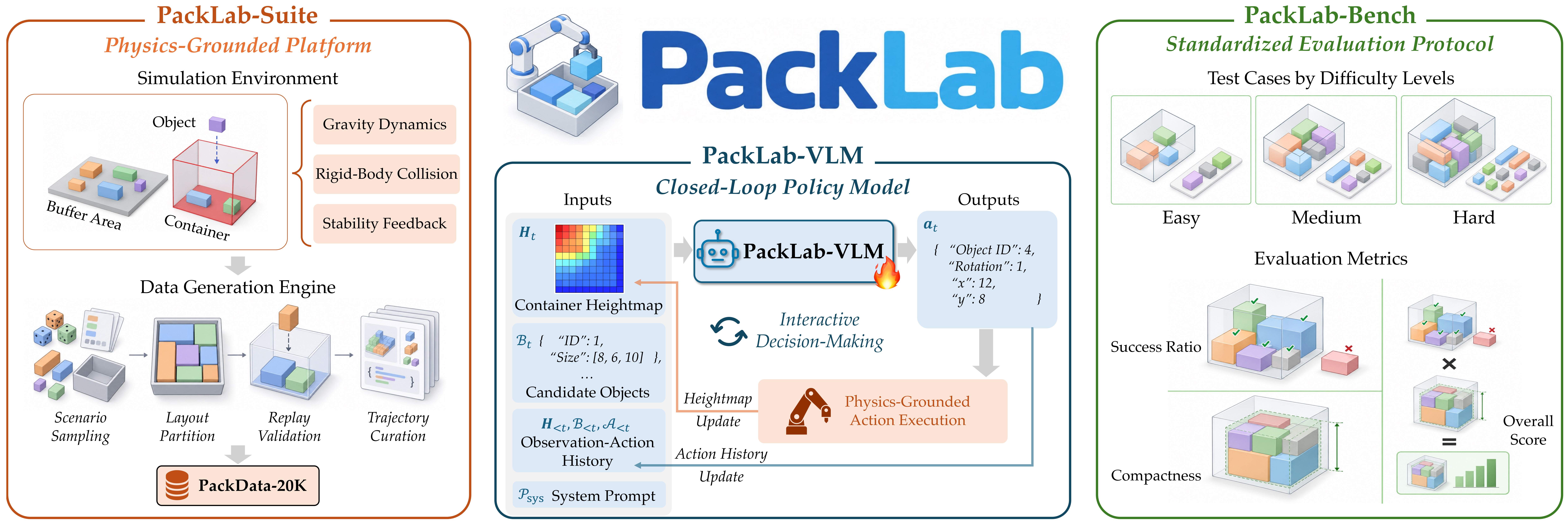
PackLab is a comprehensive framework for developing, training, and evaluating multi-modal large language models for closed-loop robotic bin packing. It contains PackLab-Suite, a physics-based simulation platform for generating diverse packing trajectories and evaluating physical outcomes; PackLab-VLM-9B, a packing-specialized MLLM that reasons over object geometries and evolving container states to select objects and predict placements; and PackLab-Bench, a standardized benchmark with multiple difficulty levels for systematic evaluation.

PackLab_intro_video.mp4
🛠️ Environment Setup
Create a clean Python environment from the cloned repository root and install the package dependencies:
git clone https://github.com/Correr-Zhou/PackLab.git
cd PackLab
conda create -n packlab python=3.10 -y
conda activate packlab
pip install -r requirement.txt
git clone https://github.com/volcengine/verl.git verl
cd verl && git checkout 5a2eed1c5265841aa1b92c809a685bd9d46fe461 && pip install -e .
cd ..
For local runs, set the project path before launching scripts:
export PYTHONPATH="$PWD:${PYTHONPATH:-}"
The training scripts use verl.trainer.sft_trainer. The release was validated with verl commit 5a2eed1c5265841aa1b92c809a685bd9d46fe461; keep verl in ./verl at that commit and do not modify its source code.
📦 Data, Benchmark, and Checkpoint
The default configs expect all assets inside the cloned repository:
PackLab/
  benchmarks/PackLab-Bench/
  checkpoints/PackLab-VLM-9B/
  data/PackData-20K/
  verl/
Download the released assets:
huggingface-cli download donghao-zhou/PackLab-VLM-9B --local-dir checkpoints/PackLab-VLM-9B
huggingface-cli download donghao-zhou/PackData-20K --repo-type dataset --local-dir data/PackData-20K
huggingface-cli download donghao-zhou/PackLab-Bench --repo-type dataset --local-dir benchmarks/PackLab-Bench
Extract the PackData-20K height-map image archives before training:
cd data/PackData-20K
for difficulty in easy medium hard; do
  for archive in images/${difficulty}/*.tar; do
    tar -xf "${archive}"
  done
done
cd ../..
The default base model for SFT is Qwen/Qwen3.5-9B. You can override it with MODEL_PATH.
🚀 Training
Run SFT with the released training config:
MODEL_PATH=Qwen/Qwen3.5-9B \
OUTPUT_DIR=outputs/checkpoints/packlab_vlm_9b_sft \
bash scripts/train_sft.sh
Common overrides:
NPROC_PER_NODE=8 \
SFT_TRAIN_BATCH_SIZE=8 \
SFT_MICRO_BATCH_SIZE_PER_GPU=1 \
SFT_LR=1e-5 \
SFT_EPOCHS=10 \
bash scripts/train_sft.sh
The released PackData-20K package contains the training split. To evaluate during SFT with your own validation parquet files, pass them through SFT_VAL_FILES using colon-separated paths.
For a minimal one-step run:
NPROC_PER_NODE=1 \
SFT_TOTAL_TRAINING_STEPS=1 \
SFT_SAVE_FREQ=1 \
OUTPUT_DIR=outputs/checkpoints/packlab_sft_minimal \
bash scripts/train_sft.sh
📊 Evaluation
Evaluate PackLab-VLM-9B on PackLab-Bench:
MODEL_PATH=checkpoints/PackLab-VLM-9B \
RUN_NAME=packlab_bench \
bash scripts/evaluate.sh
For a one-case evaluation:
MODEL_PATH=checkpoints/PackLab-VLM-9B \
RUN_NAME=packlab_bench_one_case \
bash scripts/evaluate.sh data.max_cases=1
The evaluator writes metrics.json, cases.jsonl, and resolved_config.yaml under outputs/eval/<run_name>/.
If you already have an OpenAI-compatible chat-completions server, run evaluation without launching a local vLLM server. The server must expose /v1/chat/completions and accept multimodal chat messages:
BASE_URL=http://127.0.0.1:8000/v1 \
MODEL_PATH=checkpoints/PackLab-VLM-9B \
RUN_NAME=packlab_bench_openai \
bash scripts/evaluate_openai.sh
Use API_KEY, OPENAI_API_KEY, or PACKLAB_OPENAI_API_KEY when the endpoint requires authentication.
🧩 Custom Data Generation
The released PackData-20K and PackLab-Bench assets are sufficient for the default training and evaluation commands above. The data-generation scripts are provided for users who want to generate their own packing trajectories or benchmark splits.
Generate PackData-style SFT shards:
bash scripts/build_dataset.sh
Useful shard controls:
NUM_SHARDS=100 START_SHARD=0 END_SHARD=9 SKIP_COMPLETED=1 bash scripts/build_dataset.sh
Generate PackLab-Bench-style evaluation cases:
bash scripts/build_benchmark.sh
Both commands accept Hydra-style overrides. For example, this creates a tiny custom SFT dataset:
bash scripts/build_dataset.sh \
  output_dir=outputs/tiny_packdata \
  generation.per_difficulty.easy.num_episodes=1 \
  generation.per_difficulty.medium.num_episodes=0 \
  generation.per_difficulty.hard.num_episodes=0 \
  val_generation.per_difficulty.easy.num_episodes=1 \
  val_generation.per_difficulty.medium.num_episodes=0 \
  val_generation.per_difficulty.hard.num_episodes=0
🎬 Visualization
Export model action sequences from an evaluation run:
CASES=outputs/eval/packlab_bench/cases.jsonl \
bash scripts/export_action_sequences.sh
Replay the action sequences and render visualizations:
ACTION_SEQUENCES=outputs/eval/packlab_bench/action_sequences.jsonl \
OUTPUT_DIR=outputs/visualization/packlab_bench \
bash scripts/visualize.sh
🤝 Acknowledgements
We thank the contributors of verl, PyBullet, vLLM, and the open-source MLLM ecosystem for making this release possible.
This study was funded by the InnoHK initiative of the Innovation and Technology Commission of the Hong Kong Special Administrative Region Government via the Hong Kong Centre for Logistics Robotics.
🔗 Citation
If PackLab is helpful for your research or projects, please consider citing our work:
@article{zhou2026packlab,
  title={PackLab: A Comprehensive Framework for Developing, Training, and Evaluating MLLMs in Robotic Bin Packing},
  author={Zhou, Donghao and Pan, Jia-Hui and Zhang, Fan and Bu, Xingyuan and Li, Shilong and Gao, Xiaojie and Liu, Yun-Hui and Fu, Chi-Wing and Heng, Pheng-Ann},
  journal={arXiv preprint},
  year={2026}
}
📬 Contact
For questions about PackLab, please contact Donghao Zhou at dhzhou@link.cuhk.edu.hk.
Questions
What is PackLab?
Correr-Zhou/PackLab is a public repo on GitHub by Correr-Zhou. Offical Implementation of "PackLab: A Comprehensive Framework for Developing, Training, and Evaluating MLLMs in Robotic Bin Packing".
Is PackLab open source?
It declares no license on GitHub. Public does not mean open source: without a license, nobody is granted the right to reuse it.
Does PackLab run on macOS, Windows or Linux?
Its maker has not tagged a system, so it is unknown here. Its README says what it needs.
How do I install PackLab?
Open "Take it" on its page: Take My Repo writes an install plan for your machine and hands it to your AI agent (Claude Code, Codex or Cursor), which asks you before each step. Take My Repo has not tested it on any machine.
Is PackLab still maintained?
Its last change on GitHub was on 2026-09-23. GitHub counts 4 open issues and pull requests. Take My Repo does not judge from that whether it is maintained.