ECC
The agent harness performance optimization system. Skills, instincts, memory, security, and research-first development for Claude Code, Codex, Opencode, Cursor and beyond.
- 310k
- JavaScript
- MIT
- 2 d ago
A copyable blueprint for software development when AI agents write most of the code. Based on David Shapiro's video on how Anthropic reviews Claude Code.
Repo CurioCrafter/future-software-lifecycle, read from GitHub 6 h ago. CurioCrafter has not joined Take My Repo.
CurioCrafter/future-software-lifecycle is a public repo on GitHub by CurioCrafter. A copyable blueprint for software development when AI agents write most of the code. Based on David Shapiro's video on how Anthropic reviews Claude Code. It declares the CC-BY-4.0 license on GitHub. It is written mainly in JavaScript, has 0 stars and last changed on 2026-10-24. It is archived: its maker no longer maintains it. Nobody has reviewed it on Take My Repo yet, which says nothing about its quality. Read from GitHub on 2026-11-25.
The agent harness performance optimization system. Skills, instincts, memory, security, and research-first development for Claude Code, Codex, Opencode, Cursor and beyond.
A copyable blueprint for running software development when AI agents write most of the code.
Humans can no longer read every line. So instead of asking "did a human read this?", this blueprint asks "which check, automated or human, is the right one to catch what could go wrong?", and builds the system around that question.
This blueprint is based on the ideas in David Shapiro's video:
The video breaks down Anthropic's October 2026 post on how the Claude Code team reviews its own code (where Claude writes about 90% of the code), and connects it to much older ideas: database write-ahead logs, TCP checksums, error-correcting memory, double-entry bookkeeping and Shannon's information theory. Watch it; it explains the why far better than a README can.
All the ideas belong to David Shapiro and Anthropic. This repo only turns them into a checklist-and-templates kit anyone can copy. Numbers quoted here are Anthropic's own, reported in the video, and have not been independently verified.
1. Writing code is no longer the scarce skill. Human attention is.
flowchart LR
    U["UPSTREAM (humans)<br/>decide what to build<br/>specify it so a machine can check it"]
    W["WRITING CODE (agents)<br/>no longer the scarce skill"]
    D["DOWNSTREAM (humans)<br/>design the checks<br/>own the risk"]
    U --> W --> D
2. Build the floor before you open the firehose. You can only loosen human review when almost everything is reversible.
flowchart LR
    F["🚿 Agent output (the firehose)"] --> FLOOR
    subgraph FLOOR["The floor"]
        T["Tests an agent can run"]
        FF["Feature flags"]
        S["Staged releases"]
        R["Fast rollback"]
    end
3. The end state: machines do the work, people hold what machines can't.
flowchart TD
    subgraph People
        P1["Purpose"]
        P2["Trust"]
        P3["Accountability"]
    end
    People --> C
    A1["Audit agent: safety"] -.-> C
    A2["Audit agent: security"] -.-> C
    C["Coordinate"] --> M1["Manage"] & M2["Manage"]
    M1 --> S1["Supervise"] & S2["Supervise"]
    M2 --> S3["Supervise"] & S4["Supervise"]
    S1 --> W1["Work"] & W2["Work"]
    S2 --> W3["Work"] & W4["Work"]
    S3 --> W5["Work"] & W6["Work"]
    S4 --> W7["Work"] & W8["Work"]
This is not just a document. The lifecycle/ folder is working software: a local dashboard, a command-line tool and a Claude Code skill that run your own changes through the blueprint. Clone it, point it at your project, and Claude Code starts working through the pipeline while you watch and decide. It runs on your machine, needs only Node.js, and sends nothing anywhere unless you turn on the optional API mode.
Claude Code does the work through a CLI; you watch and decide in a live dashboard. Every step it takes (tests run, findings, fixes, approvals, rollouts) moves a card across the board in real time.
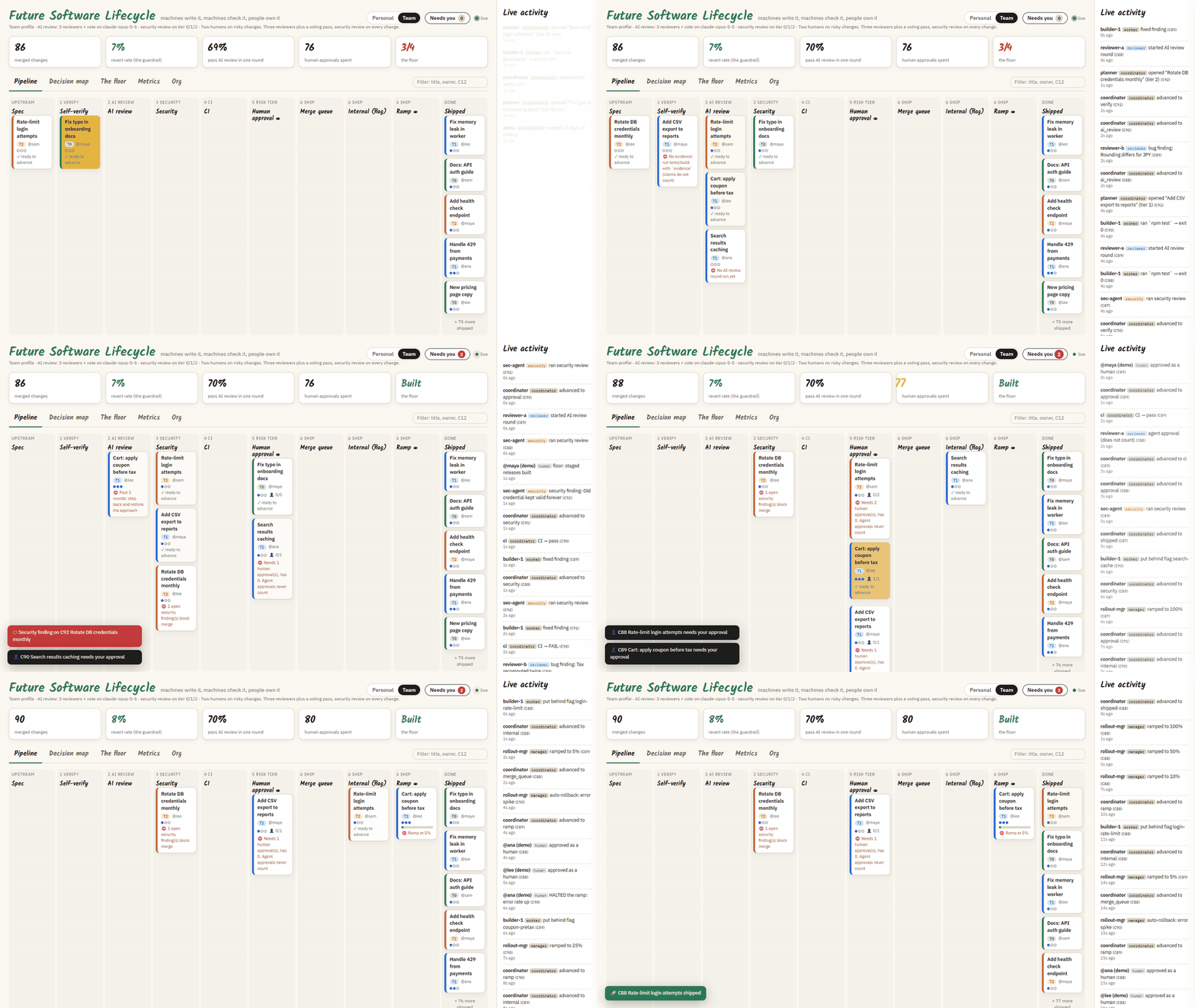
A simulated team of agents (node lifecycle/demo.mjs): a typo fix waits for the floor to be built before it can skip human review, a login change needs two human approvals, a coupon change hits the 3-round review limit and gets rethought, and a caching change is halted mid-ramp and rolled back.
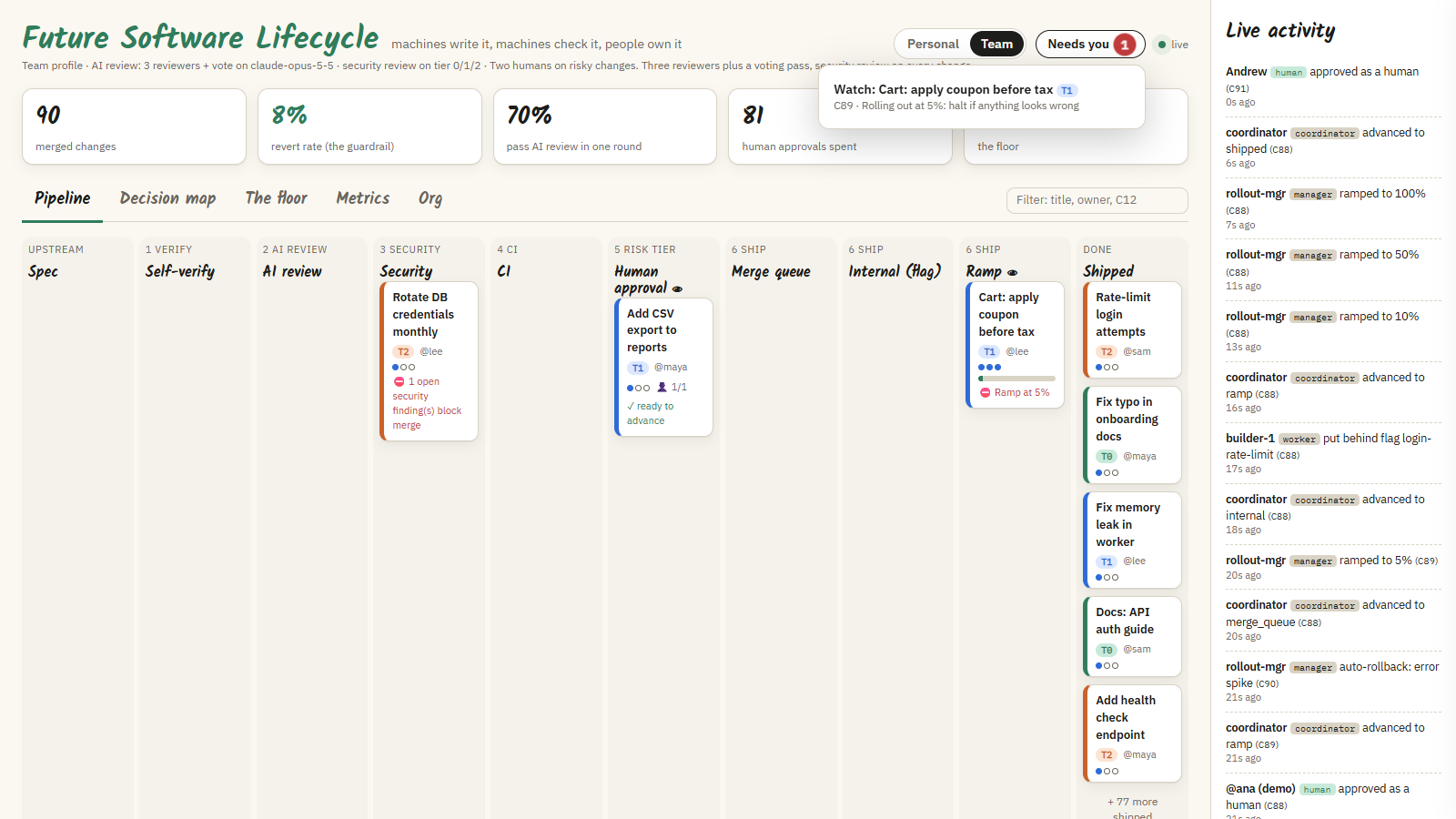 |
Needs you. The red badge counts what only a person can do right now: approvals, review loops that need a new approach, rollouts to watch. Click one to jump to it. |
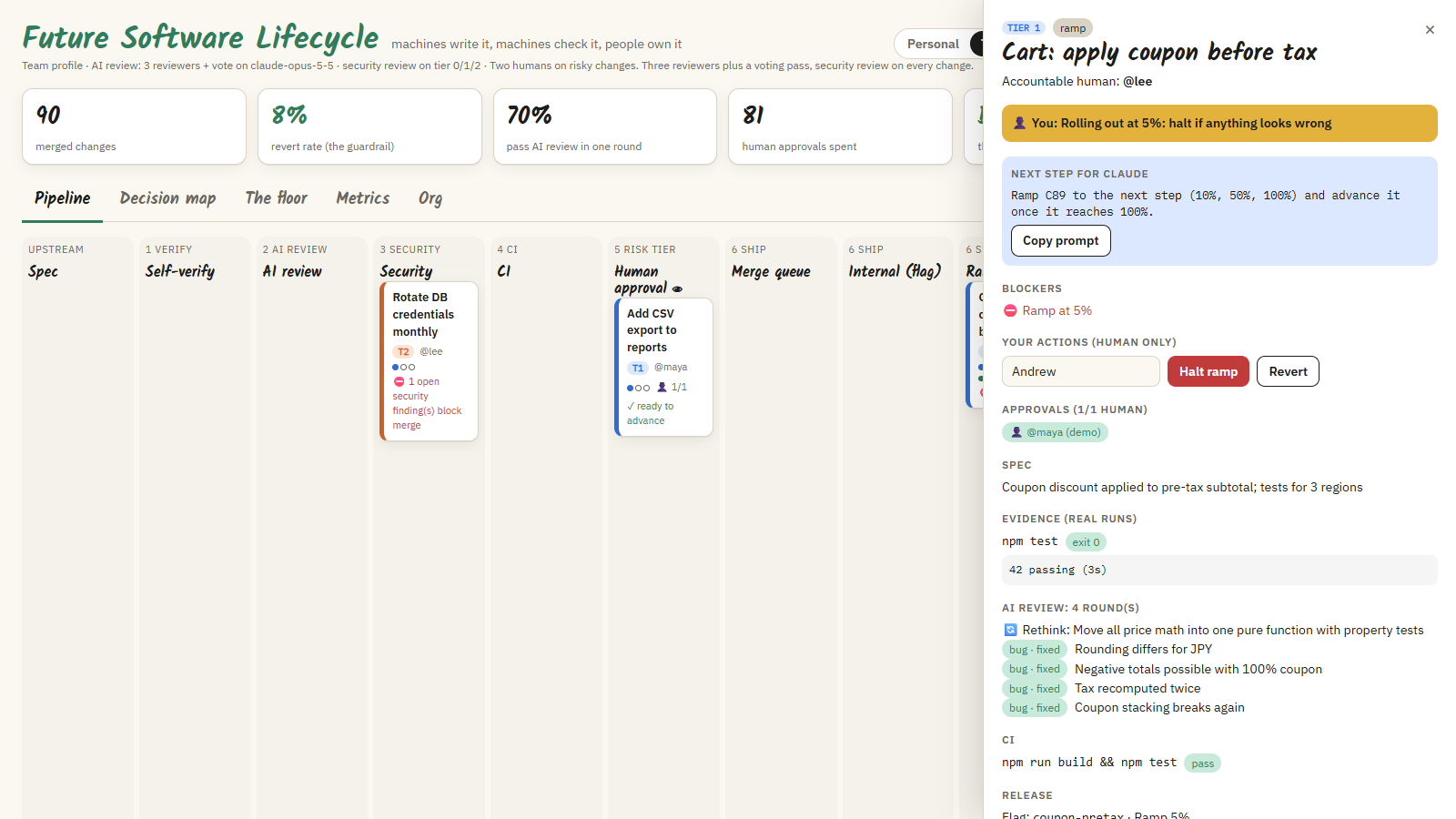 |
Next step for Claude. Every card tells you what to ask Claude next, with a Copy button. On a subscription you paste it into Claude Code; the yellow bar says what you should do. |
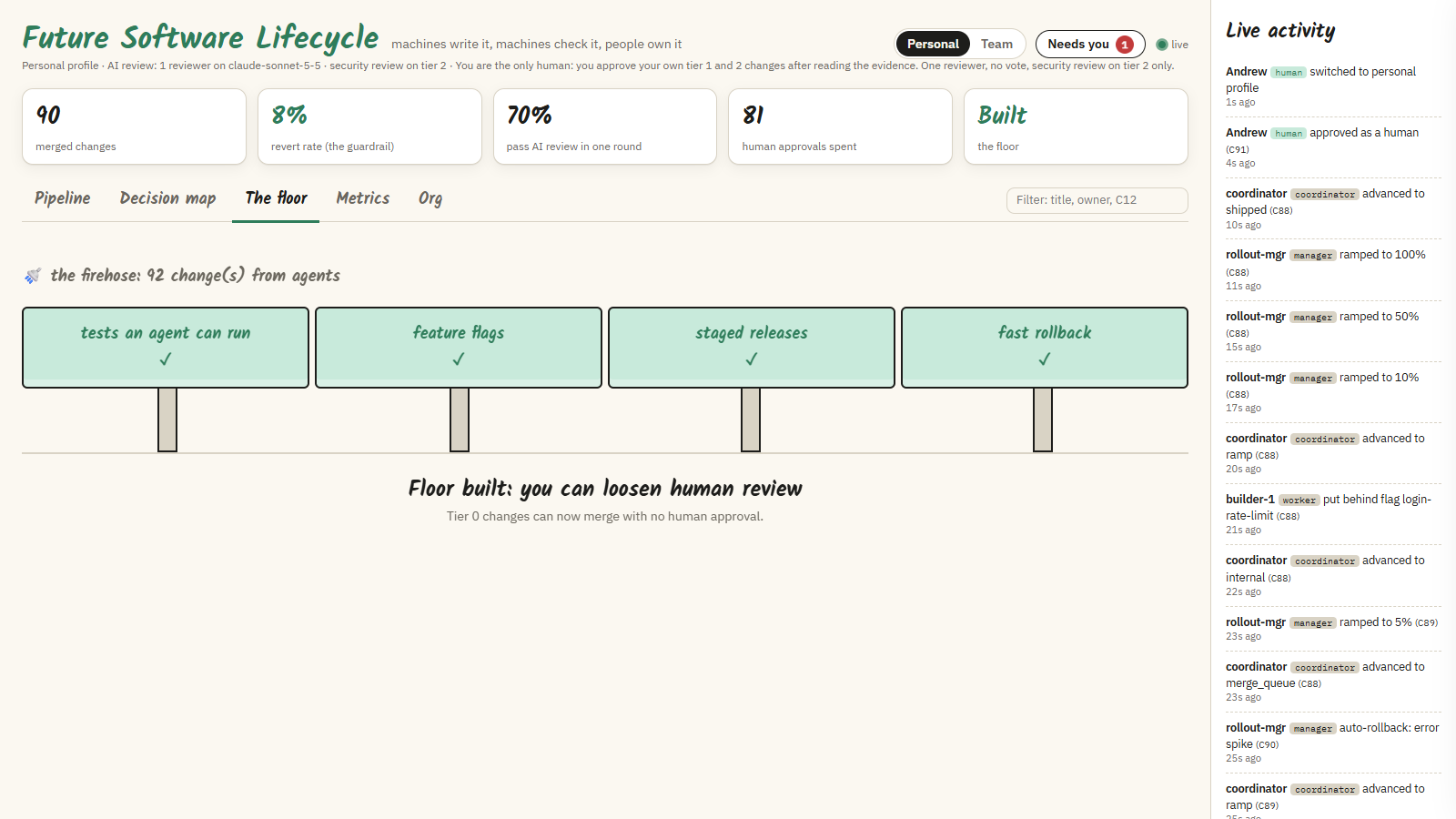 |
Personal or Team. Switch in the top bar. The line under the title shows exactly how much review depth (and token spend) the profile uses. |
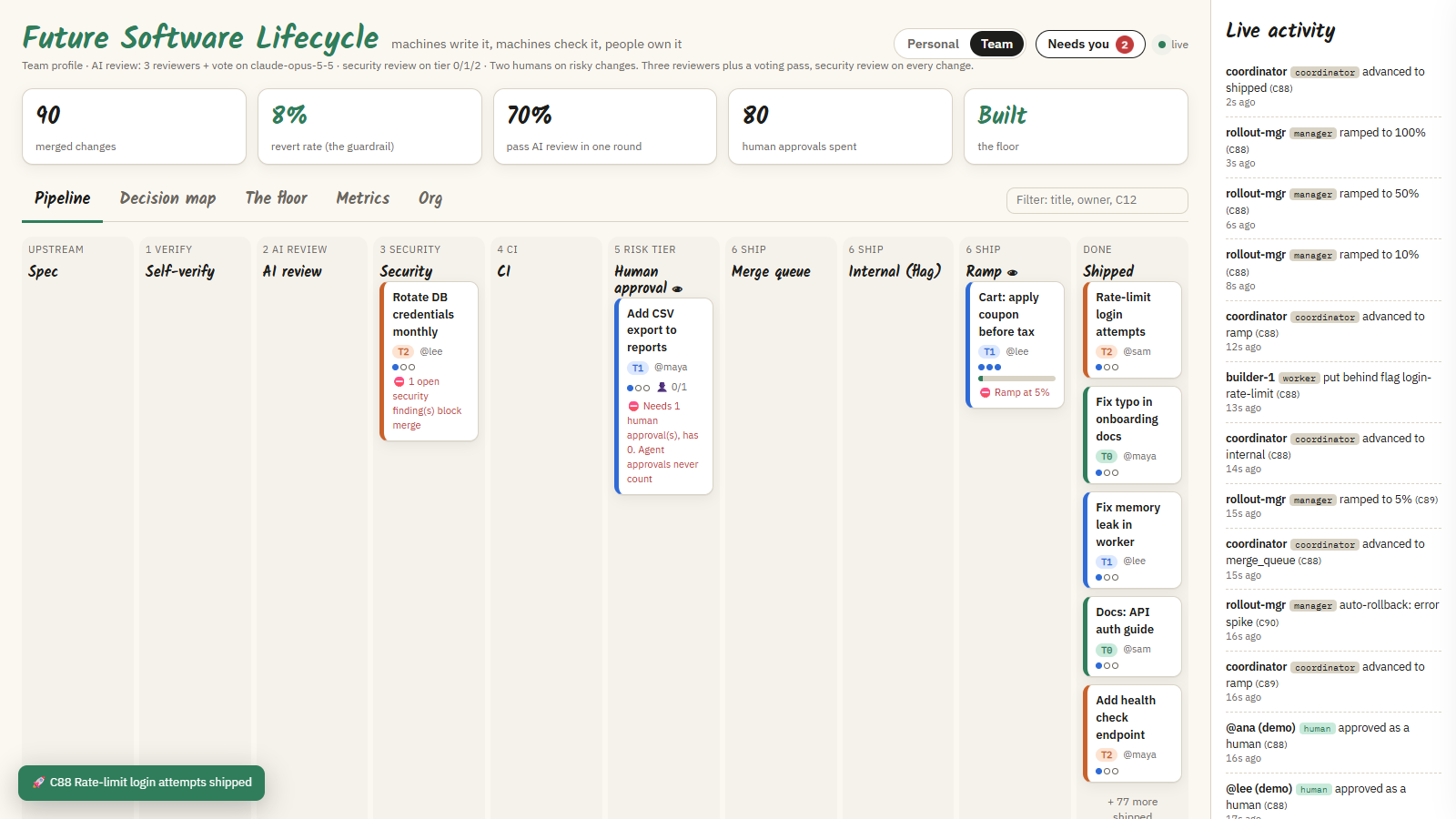 |
Pipeline. Every change moves through the six layers. Each card shows its risk tier, the human who owns it, AI review rounds (red after 3) and the exact thing blocking it. The live feed on the right shows who did what. |
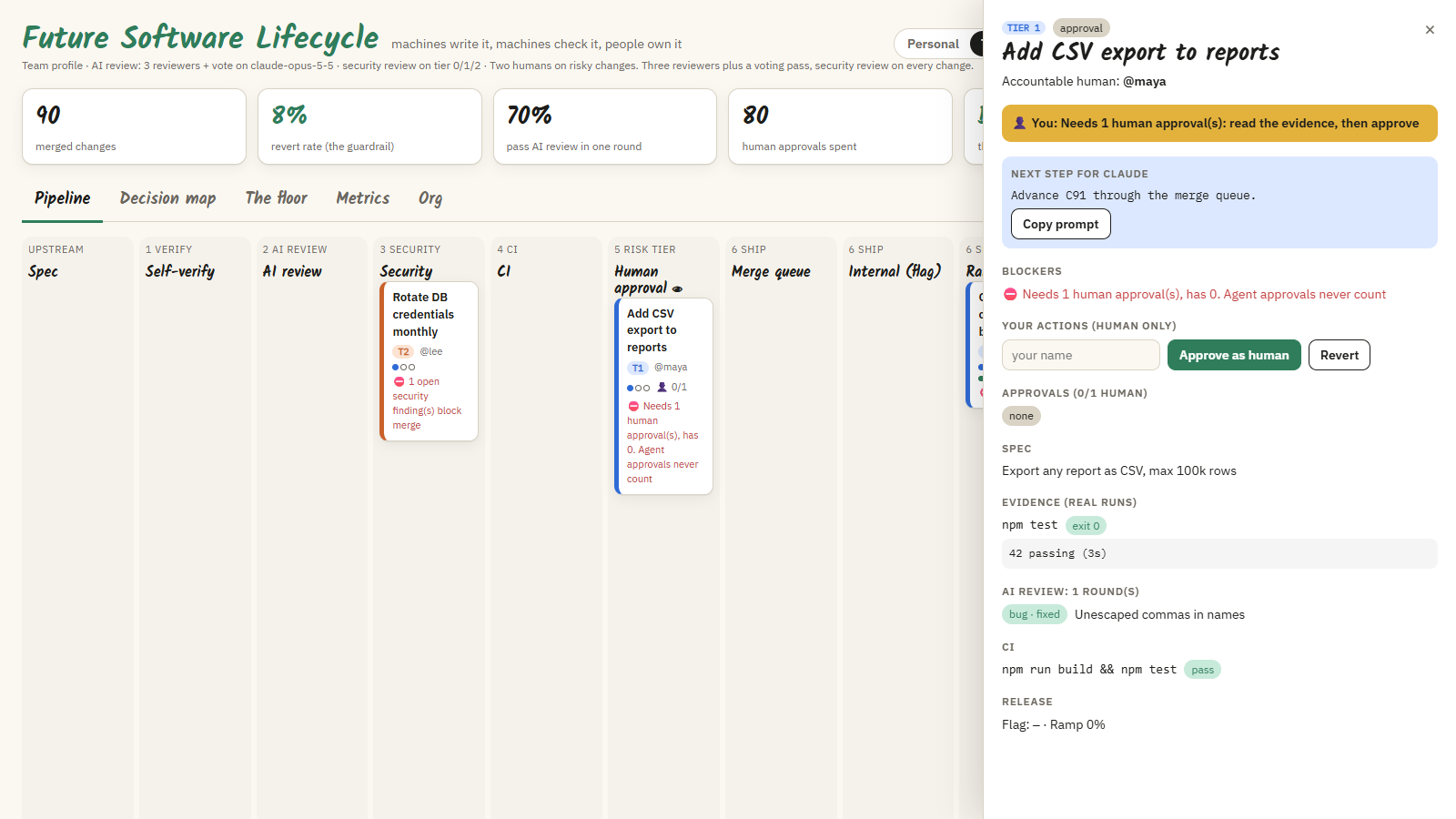 |
Human approval. Click a card to see the real test output, every finding and how it was answered. Only a person in the GUI can approve: agent approvals are shown crossed out because they never count. |
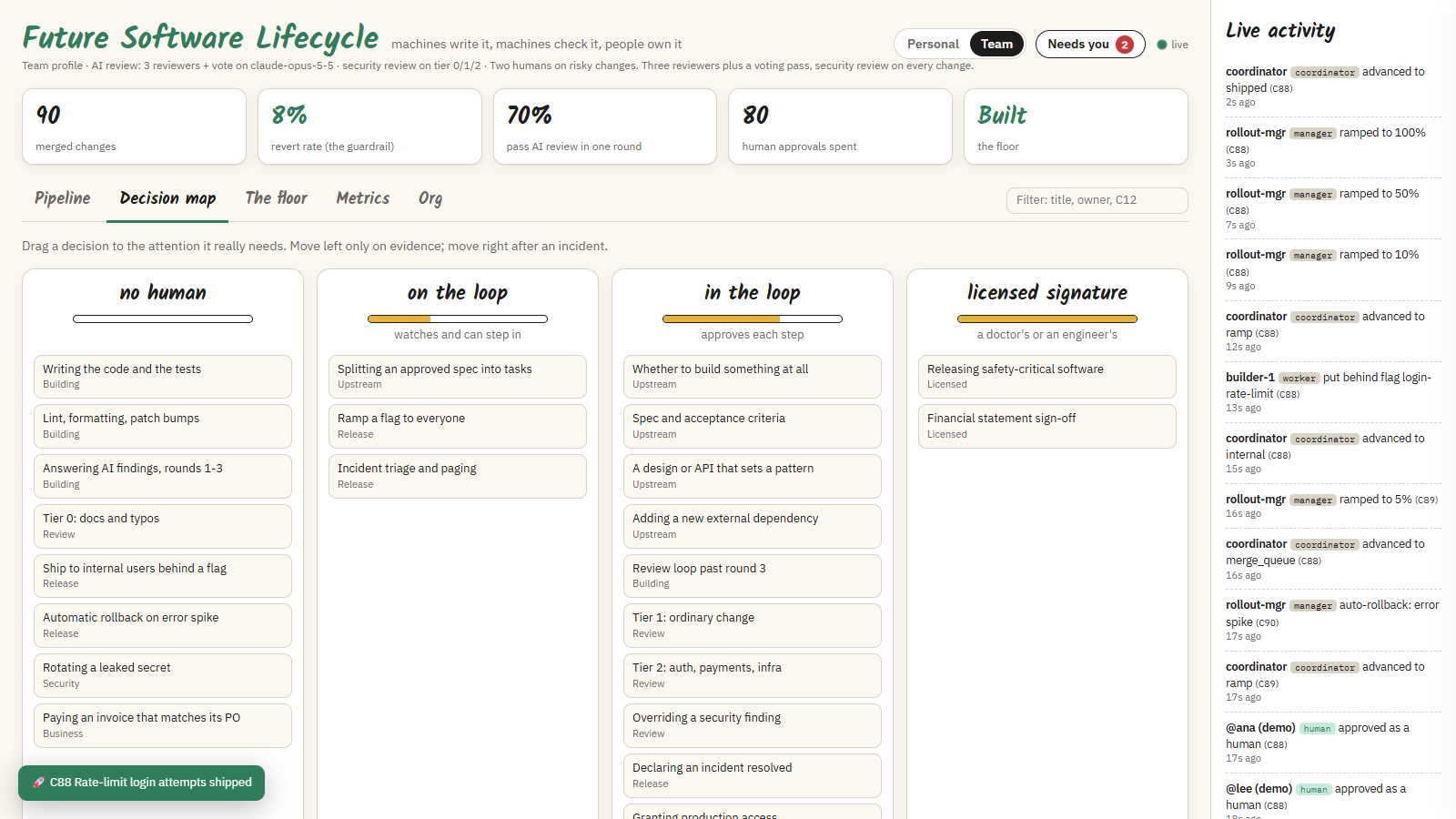 |
Decision map. Drag each kind of decision to the attention it needs: no human, on the loop, in the loop, or licensed signature. |
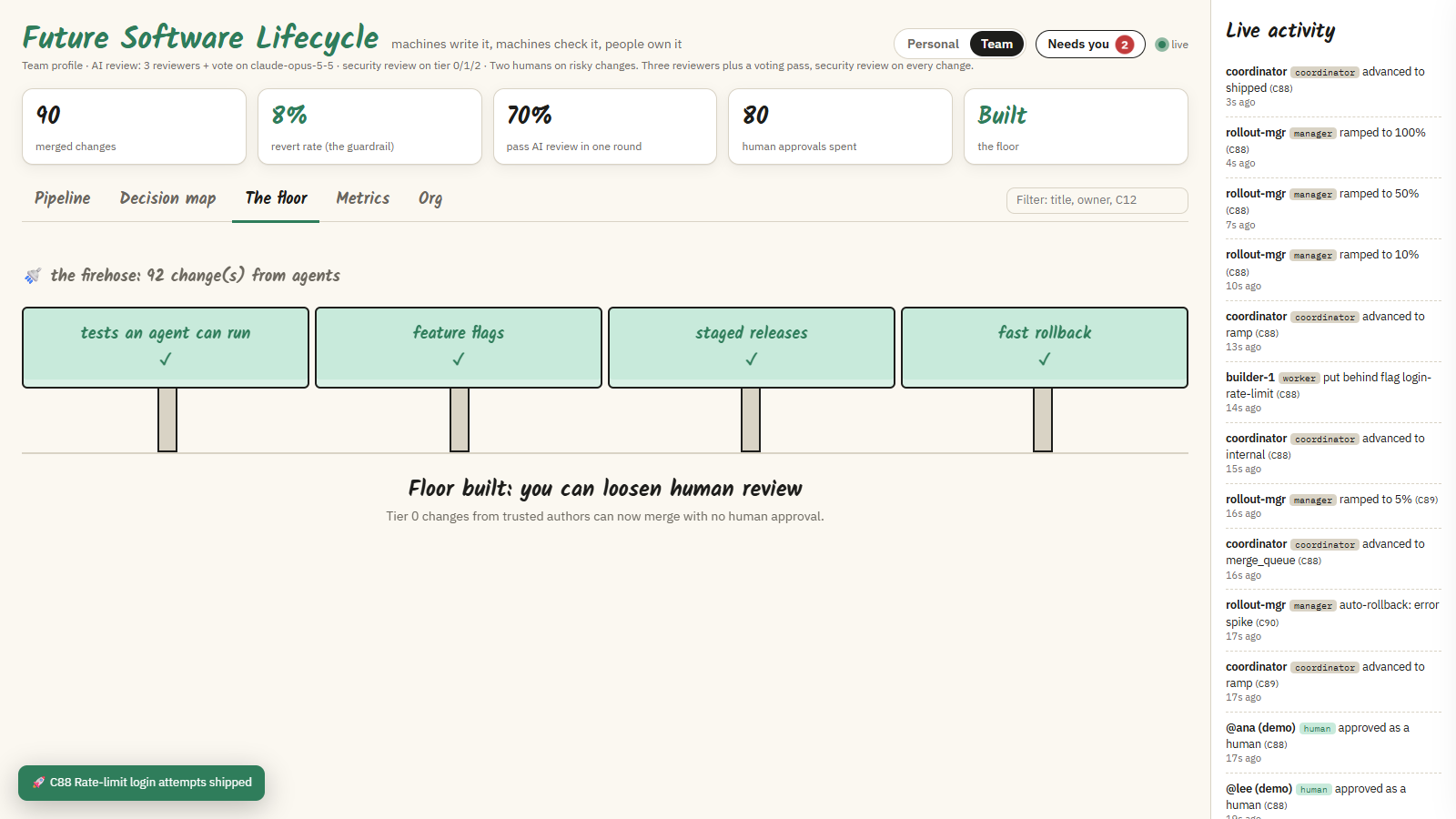 |
The floor. The four planks. Until all four exist, every change needs at least one human, even tier 0. |
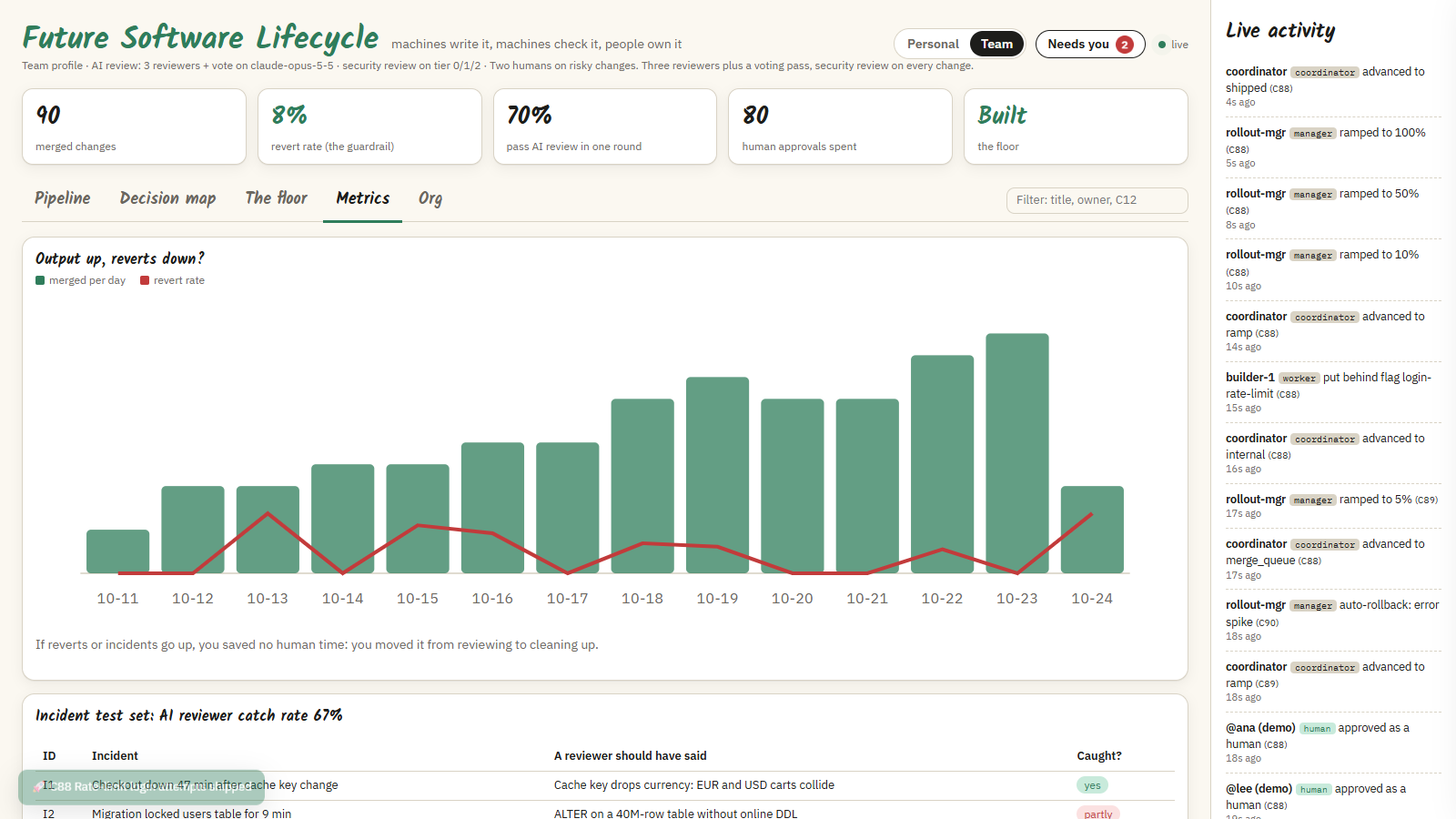 |
Metrics. Output vs revert rate (the guardrail) and how often the AI reviewer catches your past incidents. |
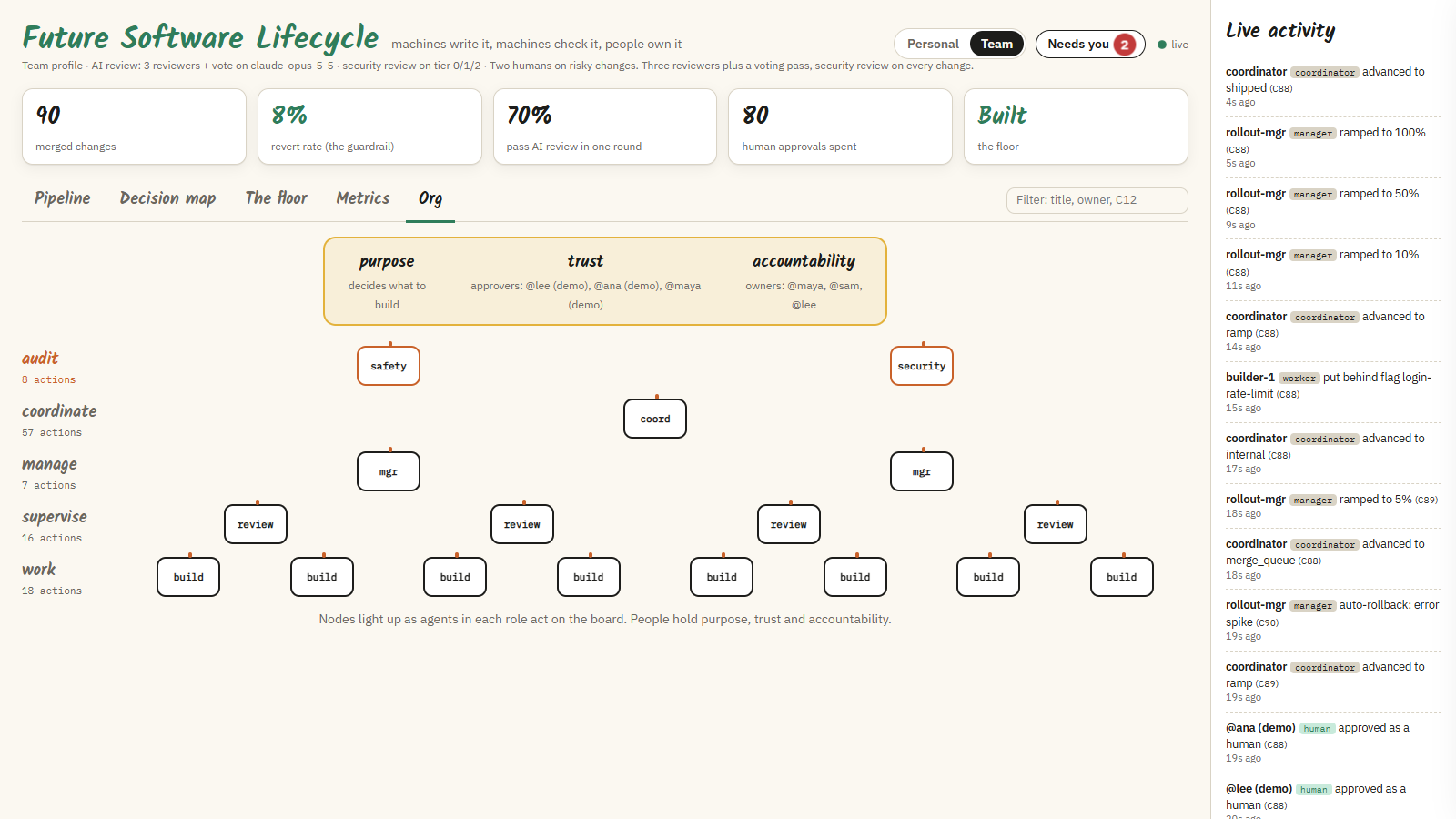 |
Org. The end-state org chart. Nodes light up as agents in each role act; people hold purpose, trust and accountability. |
Needs Node.js 18 or newer. The board and CLI have no dependencies.
git clone https://github.com/CurioCrafter/future-software-lifecycle
cd future-software-lifecycle
node lifecycle/server.mjs --dir .lifecycle-demo
Open http://localhost:4317, then in a second terminal watch a simulated team:
node lifecycle/demo.mjs --dir .lifecycle-demo
Use it on your own project:
lifecycle/ folder and .claude/skills/lifecycle/ into your repo.node lifecycle/cli.mjs init --profile personal
node lifecycle/server.mjs
A solo developer shouldn't spend a company's review budget. Pick a profile with init --profile, switch any time from the top bar or with node lifecycle/cli.mjs profile personal|team.
| Personal (one developer) | Team (a company) | |
|---|---|---|
| Human approvals | You approve your own tier 1 and 2 changes after reading the evidence | 1 human for tier 1, 2 different humans for tier 2 |
| AI review | 1 reviewer, no vote | 3 reviewers + a separate voting pass |
| Model (API mode) | claude-sonnet-5-5, medium effort |
claude-opus-5-5, high effort |
| Security review | Tier 2 changes only | Every change |
| Review round limit | 2 | 3 |
| Floor needed before tier 0 skips you | Tests + rollback (git revert counts) |
All four planks |
| API calls per review round | 1 (2 on tier 2), on the cheaper model | 7: 3 reviewers, 3 voters, 1 security |
On a Claude subscription the skill follows the same profile: in personal mode Claude reviews the diff itself in one pass; in team mode it spawns reviewer subagents and has them vote.
The board animates what's happening so you can glance at it instead of reading logs:
Keyboard: Esc closes panels. The filter box finds cards by title, owner or ID.
1. Claude subscription (Claude Code, no extra cost). The repo ships a Claude Code skill at .claude/skills/lifecycle/SKILL.md. Claude Code picks it up automatically in this folder. You prompt each part and Claude does that stage, records it on the board, and stops:
| You say | Claude does |
|---|---|
| "Open a lifecycle change for adding CSV export. I own it." | Writes the spec and acceptance criteria, picks the risk tier, opens card C1 |
| "Build it and self-verify." | Makes the change, runs your tests through cli.mjs evidence so the real output is recorded |
| "Run the AI review round." | Reviews the diff (or spawns reviewer subagents that vote), records findings, fixes or closes each |
| "Security review and CI." | Records security findings (they block merge), runs your full check |
| "What's blocking C1?" | Reads the board. At approval it tells you to click Approve in the GUI: it cannot approve for you |
| "Ship it behind a flag and ramp." | Flags it, ramps 10% → 50% → 100%. You can halt the ramp from the GUI at any time |
2. Claude API (pay per token, automated). lifecycle/autopilot.mjs runs layers 2 and 3 on your own API key: several reviewers hunt for bugs in parallel, a separate voting pass keeps only the findings most of them agree on, and a security reviewer runs last. Results land on the board. It never approves and never merges.
cd lifecycle && npm install && cd ..
export ANTHROPIC_API_KEY=sk-ant-...
node lifecycle/autopilot.mjs C1 --base main --test "npm test"
How deep it goes follows your profile: personal makes 1 Sonnet call per round (plus a security call on tier 2); team makes 3 Opus reviewer calls, 3 voting calls and a security call. Override with --reviewers N or LIFECYCLE_MODEL=.... Cost grows with the size of the diff.
The board is a local process guard, not a security boundary: anything that can write .lifecycle/state.json can change it. Real enforcement belongs in branch protection and your CI. Use the board to run and see the process.
| File | What it's for |
|---|---|
| lifecycle/ | The board: server.mjs (dashboard), cli.mjs (what Claude uses), autopilot.mjs (API mode), demo.mjs, test.mjs. |
| .claude/skills/lifecycle/SKILL.md | The Claude Code skill that teaches Claude to run each stage through the CLI. |
| BLUEPRINT.md | The full playbook: the six verification layers, risk tiers, the two non-negotiable rules, the floor, and the org model. |
CurioCrafter/future-software-lifecycle is a public repo on GitHub by CurioCrafter. A copyable blueprint for software development when AI agents write most of the code. Based on David Shapiro's video on how Anthropic reviews Claude Code.
It declares the CC-BY-4.0 license on GitHub.
Its maker has not tagged a system, so it is unknown here. Its README says what it needs.
Reverse engineer anything with agents, from app behavior down to native binaries.
Secure, fast, efficient, battle-tested at Alibaba's scale. Hybrid architecture code review tool: deterministic pipelines + LLM Agent, precise line-level comments, built-in multi-language ruleset (NPE, thread-safety, XSS, SQL injection), OpenAI & Anthropic compatible.
A collection of inspiring lists, manuals, cheatsheets, blogs, hacks, one-liners, cli/web tools and more.
Local-first code intelligence graph for MCP and CLI. Builds a persistent map of your codebase so AI coding tools read only what matters, with benchmarked context reductions on reviews and large-repo workflows.
Open "Take it" on its page: Take My Repo writes an install plan for your machine and hands it to your AI agent (Claude Code, Codex or Cursor), which asks you before each step. Take My Repo has not tested it on any machine.
No. It is archived on GitHub: its maker no longer maintains it.
Nobody has reviewed it on Take My Repo yet, which says nothing about its quality.
Take My Repo cannot say: it does not audit code and has not run future-software-lifecycle. What is known comes from GitHub. It declares the CC-BY-4.0 license on GitHub. It is archived: its maker no longer maintains it. It has 0 stars, which measure popularity, not safety. Nobody has reviewed it on Take My Repo yet, which says nothing about its quality. Read the source before you run it. With "Take it", your AI agent shows each step and asks you before running it; README text is treated as data, not as instructions.