
RuView
π RuView turns commodity WiFi signals into real-time spatial intelligence, vital sign monitoring, and presence detection — all without a single pixel of video.
- 105k
- Rust
- MIT
- 7 h ago
WHIP (Walking Hexapod Intelligence Platform): an 18-servo ESP32 hexapod with an RTrobot servo controller. Obstacle avoidance, MPU6050 tilt safety, IR remote, a browser control page and a PS2-style gamepad controller, part of the DREAM Robotics fleet.
Repo CursedPrograms/WHIP-Robot-v00, read from GitHub 4 h ago. CursedPrograms has not joined Take My Repo.
CursedPrograms/WHIP-Robot-v00 is a public repo on GitHub by CursedPrograms. WHIP (Walking Hexapod Intelligence Platform): an 18-servo ESP32 hexapod with an RTrobot servo controller. Obstacle avoidance, MPU6050 tilt safety, IR remote, a browser control page and a PS2-style gamepad controller, part of the DREAM Robotics fleet. It declares the MIT license on GitHub. It is written mainly in C++, has 2 stars and last changed on 2026-11-08. Nobody has reviewed it on Take My Repo yet, which says nothing about its quality. Read from GitHub on 2026-11-25.
π RuView turns commodity WiFi signals into real-time spatial intelligence, vital sign monitoring, and presence detection — all without a single pixel of video.

A DREAM Robotics Agent


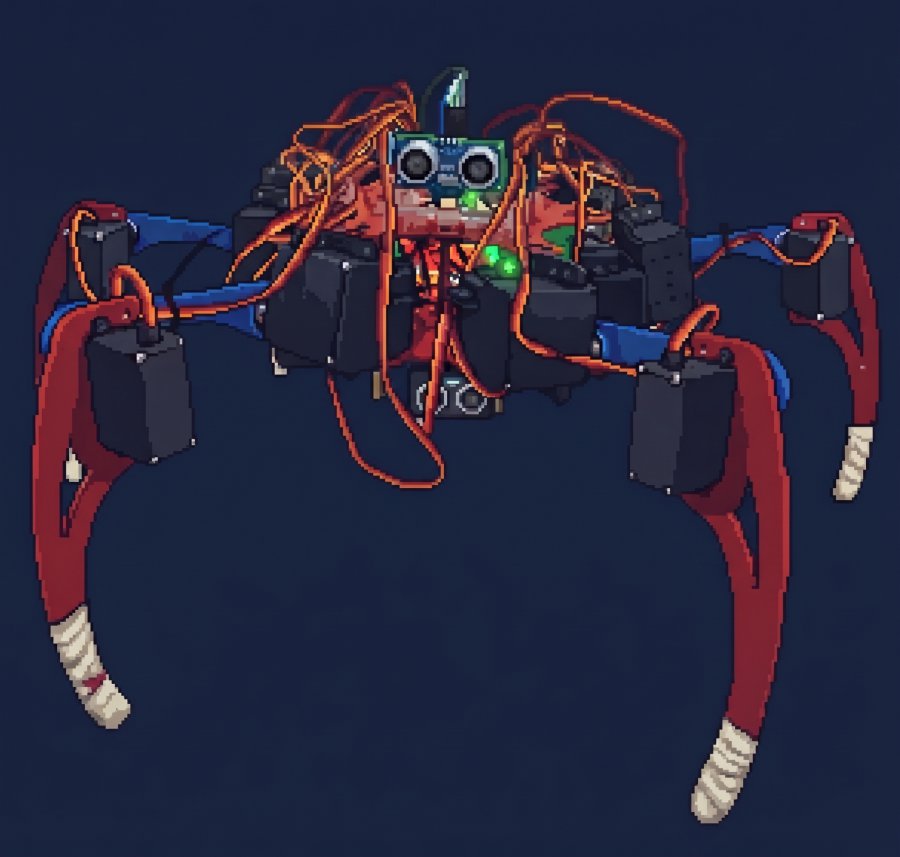
WHIP: his character, and the machine
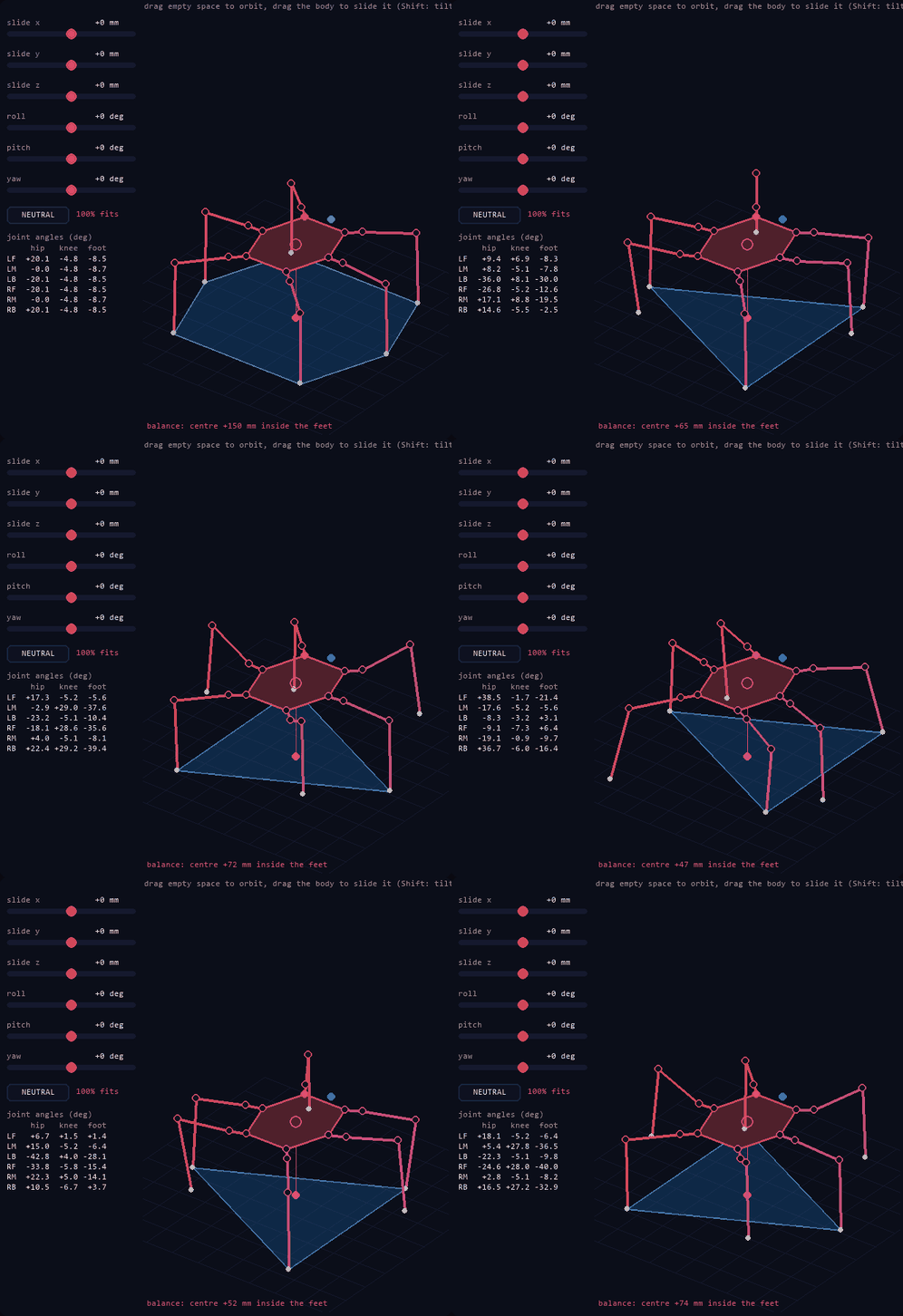
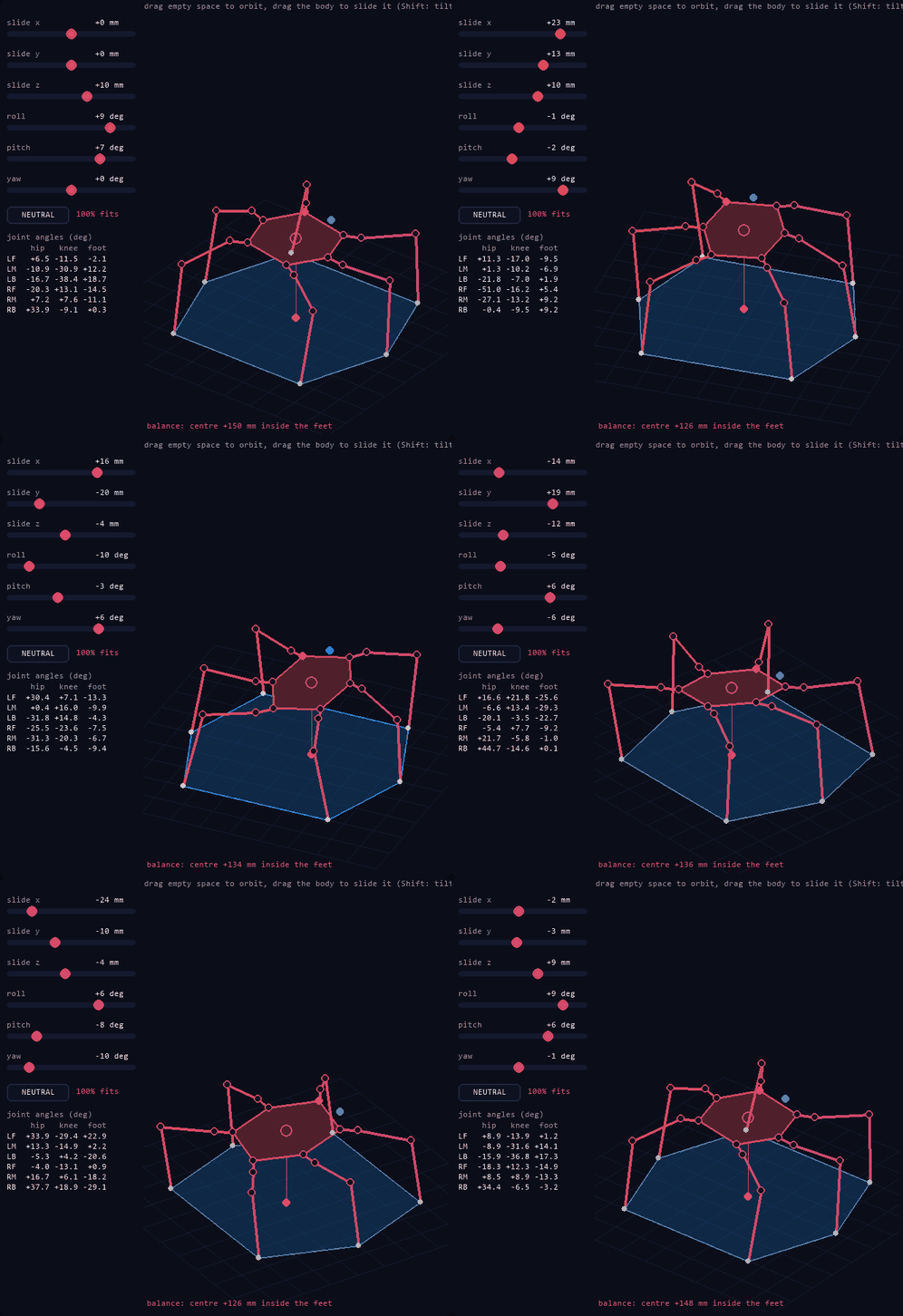
Walking (his Tripod Forward macro in Servo Studio's 3D view) and body IK (his body over planted feet)
Windows controller: builds/WHIP-Controller.exe shows WHIP's own web page in a window, so it always matches the page. Source: scripts/web_controller.
Servo Studio: builds/WHIP-Servo-Studio.exe is Servo Studio with no Python to install. Keep it in builds/: it runs scripts/servo_studio.py from the repo, so it can't fall behind it. Rebuild with scripts/build_servo_studio.bat.
STAY CLOSE: press STAY on RITA, or STAY CLOSE on his page, and he keeps near RITA in your hand, stopping about a metre away. RITA's signal shows how far, not which way, so he tries a direction, keeps going if the signal gets stronger and turns if it doesn't. His sensor still turns him away from walls. He stops if RITA goes quiet. Tested in simulation only so far. scripts/gait_test/stay_test.cpp is its test.
Other languages: scripts/controllers has this robot's controller in C#, F#, Rust, Go and Julia, all reading one robot.json: W A S D to drive, the mode buttons and the sensors. See its README for how to run each.
 ARIA |
 KIDA-01 |
 KIDA-00 |
 NORA |
 MILA |
 NIKA |
 IDA |
|
 ARM |
 DREAM |
 RIFT |
 RITA |
 NINA |
 TINA |
 AURA |
 FLORA |
Website: https://cursedprograms.github.io/WHIP-Robot-v00/
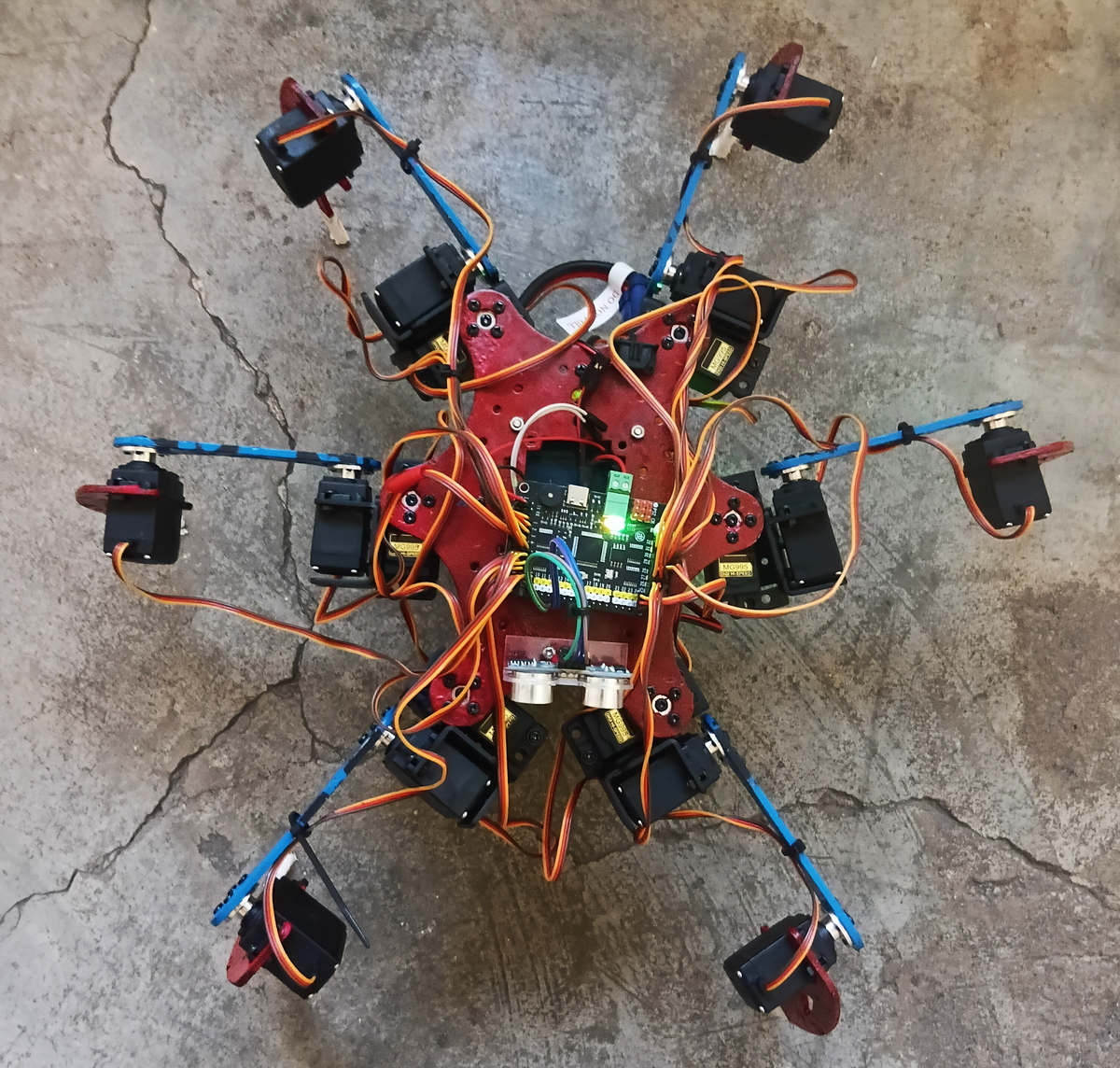
WHIP is an 18-servo hexapod. An ESP32 runs the behaviour, WiFi and a browser control page, and works out every joint by inverse kinematics, sending the angles to an RTrobot 32-channel servo controller that moves all the joints together. An MPU6050 watches for tipping and an HC-SR04 watches the way ahead.
scripts/macros/. Driving him or STOP ends one. They need the gaits firmware flashed for the web page.O) walks him by himself and turns him away from anything within 35 cm, as on the real WHIP, and it has his sonar reading; drive at any time to take over.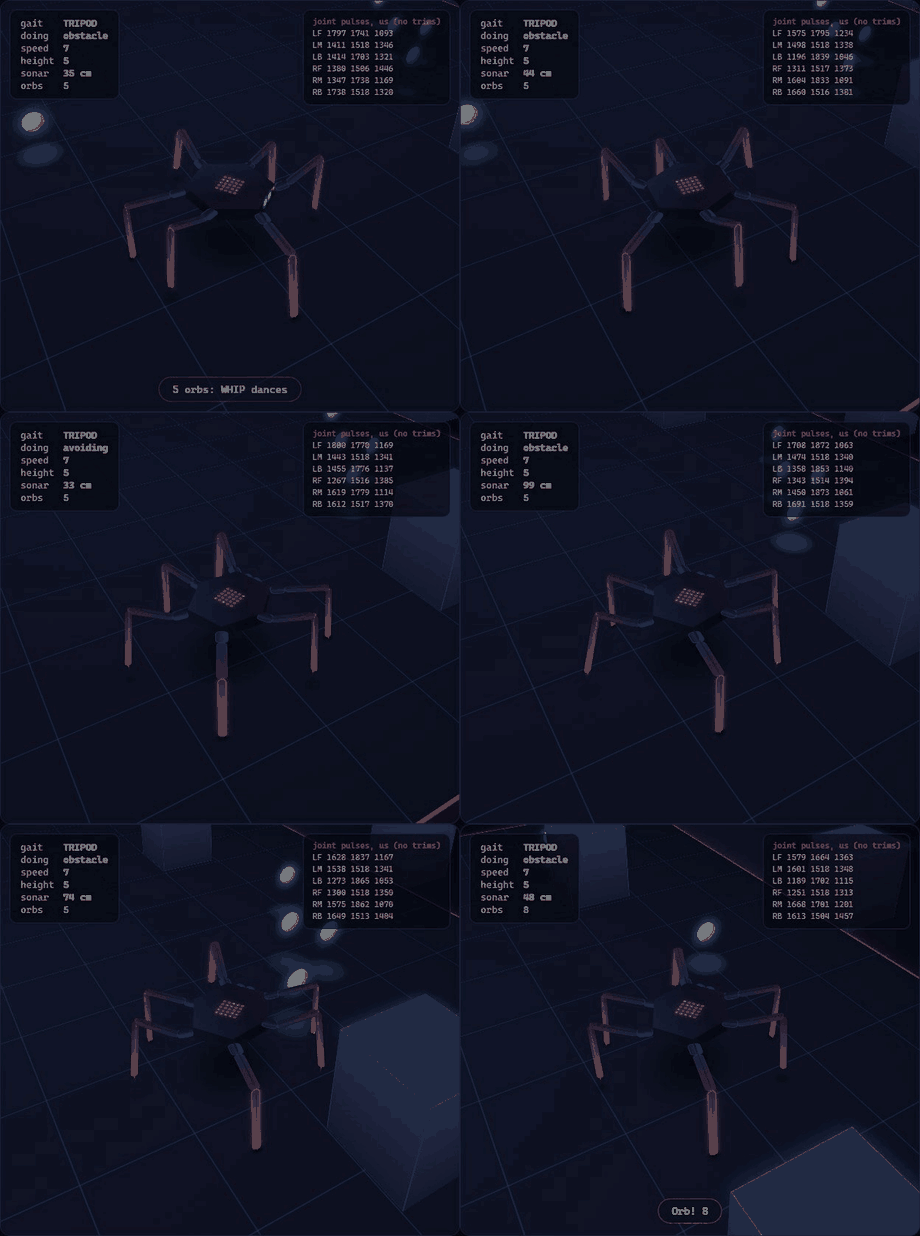
/body, the controller's BODY mode, the PS2 pad's BODY mode (R3), Servo Studio's 3D BODY.ps2.h), the sticks steering his gaits./pose), and in Servo Studio.servo_config.json (MG995 / MG996R / SG90 / DS3218 or your own), written into the firmware by APPLY TO FIRMWARE./calib): channel, direction and trim for all 18 servos, kept in flash.WHIP access point./status says blocked).IRremote 4.x (WiFi, WebServer, HTTPClient and Wire come with the ESP32 core)pygame and requests for the desktop controller (pip install -r requirements.txt)| Component | Details |
|---|---|
| Microcontroller | ESP32 (ACEBOTT QA007 ESP32 Max, the same board as NORA) |
| Servo controller | RTrobot 32-channel servo controller (UART, 115200 baud) |
| Chassis | 18-DOF hexapod chassis |
| Servos | 18 × MG995 180° |
| Battery | 3S LiPo |
| Regulator | UBEC set to 6 V |
| Distance | HC-SR04 ultrasonic sensor |
| Balance | MPU6050 gyro + accelerometer |
| Remote | NEC IR receiver + remote (the same remote as MILA and IDA) |
| Lights | 4x4 WS2812 RGB LED grid |
| Sound | Passive buzzer |
| Handheld pad | PS2 pad + its 9-pin receiver (the Arduino kind), read by ps2.h |
| Controllers | Browser, PS2-style USB gamepad (Python controller), IR remote |
CursedPrograms/WHIP-Robot-v00 is a public repo on GitHub by CursedPrograms. WHIP (Walking Hexapod Intelligence Platform): an 18-servo ESP32 hexapod with an RTrobot servo controller. Obstacle avoidance, MPU6050 tilt safety, IR remote, a browser control page and a PS2-style gamepad controller, part of the DREAM Robotics fleet.
It declares the MIT license on GitHub.
Its maker has not tagged a system, so it is unknown here. Its README says what it needs.
A hexapod robot simulator built from first principles
:house_with_garden: Open source home automation that puts local control and privacy first.
Open "Take it" on its page: Take My Repo writes an install plan for your machine and hands it to your AI agent (Claude Code, Codex or Cursor), which asks you before each step. Take My Repo has not tested it on any machine.
Its last change on GitHub was on 2026-11-08. Take My Repo does not judge from that whether it is maintained.
Nobody has reviewed it on Take My Repo yet, which says nothing about its quality.
Take My Repo cannot say: it does not audit code and has not run WHIP-Robot-v00. What is known comes from GitHub. It declares the MIT license on GitHub. Its last change was on 2026-11-08. It has 2 stars, which measure popularity, not safety. Nobody has reviewed it on Take My Repo yet, which says nothing about its quality. Read the source before you run it. With "Take it", your AI agent shows each step and asks you before running it; README text is treated as data, not as instructions.


