
da7em
Da7em — a living digital practice: a single-file WebGL2 + Web Audio particle organism. Zero dependencies, no build step. Open source under CC BY 4.0 — credit Da7_Tech.
- 24
- CC-BY-4.0
- 3 mo ago
Repo Da7-Tech/da7em, read from GitHub 2 d ago. Da7-Tech has not joined Take My Repo.
In short
Da7-Tech/da7em is a public repo on GitHub by Da7-Tech. Da7em — a living digital practice: a single-file WebGL2 + Web Audio particle organism. Zero dependencies, no build step. Open source under CC BY 4.0 — credit Da7_Tech. It declares the CC-BY-4.0 license on GitHub. It is written mainly in HTML, has 24 stars and last changed on 2026-08-18. Nobody has reviewed it on Take My Repo yet, which says nothing about its quality. Read from GitHub on 2026-11-22.
Da7em — a living digital practice
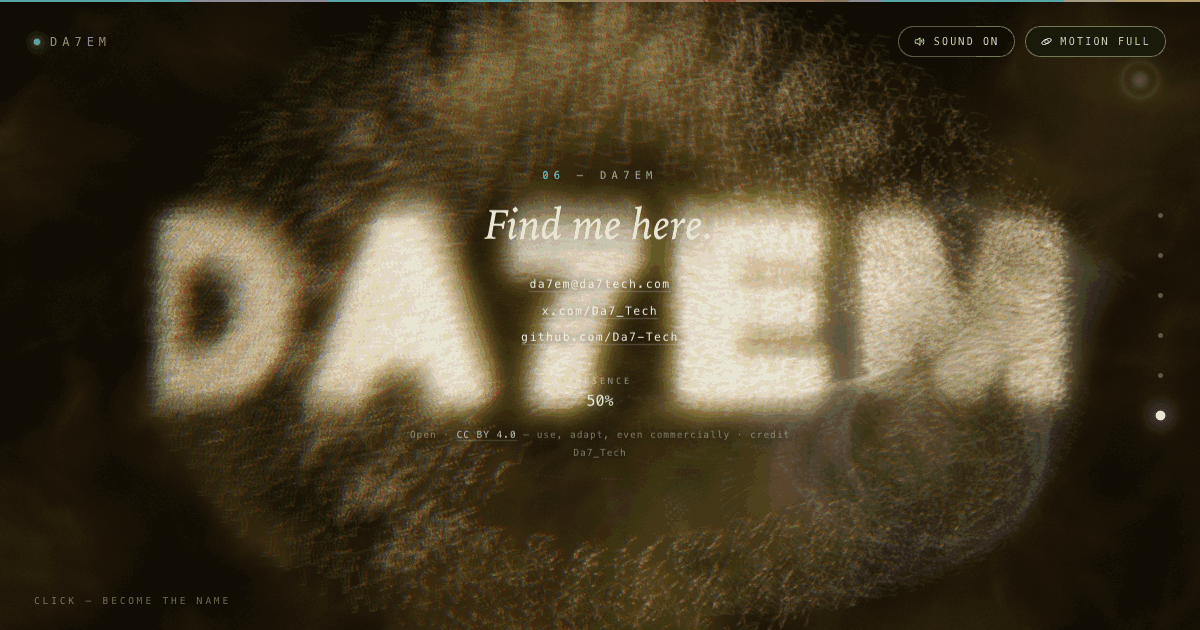
Live: https://da7-tech.github.io/da7em/
Da7em is a machine: a single-file WebGL2 + Web Audio organism. One swarm of particles begins as a signal, advises, evaluates, tests, leads, and finally becomes the name. You scroll; it morphs. You move; it reacts. You leave it alone; it dreams.
Everything you see and hear is computed at runtime inside one HTML file
(index.html — 1,902 lines, ~77 KiB) with zero dependencies:
- no libraries, no frameworks, no plugins
- no fetched fonts, no image files, no audio files
- no build step — open the file and it runs
Open source under CC BY 4.0 — free to use, adapt and build on, even commercially, with one condition: credit the source, Da7_Tech. See License.
Contents
- What this is
- Open source under CC BY 4.0
- How it works
- Zero dependencies, measured
- Particle counts — the honest numbers
- Running it
- Verifying it
- Deploying
- Repository layout
- License
- Engine credit
- Contact
What this is
A WebGL2 + Web Audio organism whose entire body is a particle swarm — up to 26,000 points simulated on the GPU. The piece unfolds in six chapters; scrolling drives the morph between them, and one shared "seam" value cross-fades physics, colors and sound together so image and audio never drift apart.
| # | Chapter | Formation | What the visitor meets |
|---|---|---|---|
| 01 | SIGNAL | the word DA7EM, particle-typography | the name, stretched by the viewport |
| 02 | SERVICES | an iris (it sees the problem) | signals circling a decision |
| 03 | EVALUATE | a neuron with random-walk dendrites | a system fraying under scrutiny |
| 04 | TEST | six concentric heartbeat rings | the answer arriving as its opposite |
| 05 | LEAD | a two-armed memory spiral | direction, replayed and felt |
| 06 | DA7EM | DA7EM sunburst with 26 rays | contact links and the license line |
Interaction summary: the cursor repels and swirls particles like a fluid; taps fire shockwaves — a tap is a press released within 12 px, so on touch devices a scroll-drag never detonates the swarm (every scroll begins with a pointer-down; feeding on pointer-down meant every scroll gesture exploded the word — the single biggest mobile bug); sustained presses soften the push; idling 4.5 s puts the organism into a self-playing dream; chapter 05 replays your recent pointer path as a light ghost that physically attracts the swarm; tapping in chapter 06 triggers a ~3.6 s transcendence (the spring is cut to 18 %, turbulence spikes, the word explodes into nebula and reassembles). Keyboard: arrows and PageUp/PageDown move between chapters. Sound and motion have independent, honest toggles.
Editorial note: the copy is deliberately headings-only — each chapter keeps only its heading and live readouts. That is a design decision, not missing content.
Open source under CC BY 4.0
The repository is public on purpose. The work is licensed CC BY 4.0: share it, adapt it, build products on it, use it commercially — provided you credit the source: Da7_Tech (da7tech.com), link the license, and indicate changes. The canonical text is in LICENSE; the short-form notice with the suggested attribution line is in NOTICE.
How it works
One file, no build. The <script> is inline; the shaders are inline; the CSS
is inline. What follows is the actual machinery, with the numbers.
The frame, in five stages
loop() runs five stages per frame, in order:
- Simulation —
RASTERIZER_DISCARDon, a points-only draw with a vertex shader (+ a dummy fragment shader writing zero) writes newv_pos/v_velthrough transform feedback into the other buffer of the ping-pong pair. Nothing reaches the screen here. - Trail — a persistent full-resolution FBO that is never cleared. A black
quad at alpha 0.26 fades the previous frame (0.34 in reduced-motion mode),
then the blend switches to additive
ONE, ONEand the freshly simulated particles are drawn in. The buffer is the memory of where light has been. - Flesh — one fullscreen quad of domain-warped FBM (below) into its own FBO at 0.34–0.5× screen resolution, bilinearly upsampled later.
- Bloom — bright-pass from the trail buffer (Rec.709 luminance, soft knee at threshold 0.42) into a quarter-res target, then a separable 5-tap Gaussian (step 1.4 px), 1–2 iterations depending on quality tier.
- Composite — straight to the default framebuffer: cursor lens
refraction, breathing chromatic aberration, flesh + trail + bloom, the
cursor orb, the memory ghost, vignette (0.42), film grain (±0.015),
pre-wake dimming, then an ACES filmic tonemap (Narkowicz approximation,
exposure 1.06, slight
pow(col, 0.94)lift).
Intermediate targets: trailFBO (full res, linear, never cleared), fleshFBO
(0.34/0.5×), bloomA/bloomB (quarter res, ping-pong). All are RGBA16F
when EXT_color_buffer_float is available, RGBA8 otherwise — the pipeline
degrades, it does not break. Fullscreen triangles are 3 vertices with no VBO
at all, positioned via gl_VertexID.
The simulation — GPU-resident, deterministic
Allocation cap MAXP = 26,000; the number actually drawn per frame is the
quality tier's count (9,000 / 16,000 / 26,000). Formations are built at the
live tier's count, not the cap: a phone on tier 0 gets a complete
8,010-body word plus its 990-particle halo — never the first 9,000 points of a
26,000-point layout. At the top tier: 23,140 body
particles + 2,860 ambient "stardust". The split is exact by construction: the
last 11 % of indices are the halo — the same indices carry a seed ≥ 0.9, so the
shader's ambient physics and the CPU's ambient home-targets always agree on
precisely the same set (spring ×0.22, turbulence ×2.6, dimmed color — a faint
halo ring at radius 0.92–1.34 around the body).
State lives entirely in GPU buffers: pos/vel pairs (DYNAMIC_COPY, two of
each for ping-pong), one static seed buffer, and one home buffer per chapter.
Two VAOs and two transform-feedback objects; on chapter change only the home
attribute pointers are re-bound (setHomeAttribs) — the current and next
formations sit in attribute slots 3 and 4, and the shader mixes them.
Everything is deterministic via mulberry32: seeds with key 777, start
positions 1000+i, velocities 5000+i. Same formation, same first frame,
every session and across window resizes.
Five forces per particle
Semi-implicit Euler (vel += f·dt, pos += vel·dt), then frame-rate-independent
damping pow(0.885, dt·60), speed cap 3.4, and a micro-jitter that keeps the
body shimmering at rest:
- Spring to home — where "home" itself is
mix(homeA, homeB, m)andmis a per-particle staggered smoothstep of the global morph value. Particles ripple into the next shape in seeding order, not as one block. - Curl-noise wander — finite-difference curl (ε = 0.35) of a time-scrolled value-noise field, per-particle amplitude, deliberately kept well below the spring at rest or the formation would dissolve into fog.
- Cursor — inside the cursor radius: fluid repulsion
(d/r)·k²plus an orthogonal swirl(−dy, dx)/r; holding the button softens repulsion to 0.4. - Memory-ghost attraction — toward the replay point, with exponential
falloff
exp(−|g|·3.4). - Click shockwave — radial impulse
exp(−|sd|·4.2).
Particle typography
Glyphs become point clouds without any font asset: an offscreen 1600×800
canvas (2D context, willReadFrequently) draws the word at weight 900 — plus
a thick stroke (lineWidth = px·0.085) so letters stay fat even where the
900 weight is silently ignored — after safeCanvasFont() walks a fallback
stack (Canvas2D reverts a whole declaration to 10 px if it contains one
unknown family). getImageData filters alpha > 140, then uniform-steps over
the candidates with a mulberry32(4242) jitter of ±0.9 px per axis, emitting
exactly the requested count — never more, never a truncated glyph. Used twice:
chapter 01 (the word DA7EM) and chapter 06 (the sunburst core).
The six formations
Each builder emits points; padFormation recycles them with ±0.012 jitter to
exactly the live tier's body count (23,140 at the top tier), then the home
buffer is assembled body + ambient halo. A mid-session tier switch rebuilds
and reseeds the swarm at the new density, so every formation stays complete at
any tier.
| Ch | Builder | Math |
|---|---|---|
| 01 SIGNAL | genText |
DA7EM glyph cloud, stretched min(2.7, aspect·1.62) |
| 02 SERVICES | genIris |
solid ring 26 % at r = 0.60 · radial fibers 42 % in r ∈ [0.30, 0.40] · limbal ring 6 % at 0.42 · pupil disc 14 % (r = √rng·0.10) · 9 ciliary processes in r ∈ [0.63, 0.80] |
| 03 EVALUATE | genNeuron |
soma disc 6 % (r ≤ 0.075) + 8 dendrites as random walks (step 0.0095, turn ±0.17 rad), branching at 5.5 % probability to depth 3, radius bound 0.88 |
| 04 TEST | genRings |
6 rings r = 0.15…0.80, weights [1.4, 1.5, 1.6, 1.6, 1.5, 1.4], radial jitter ±0.007 |
| 05 LEAD | genSpiral |
core 12 % + two arms (44 % each): r = 0.10 + t·0.78, t = rng^0.72, angular spread tightening outward (0.55 → 0.25) |
| 06 DA7EM | genBecome |
the word 76 % (82 % on lower tiers — legibility first) + 26 rays starting at r = 0.50 — deliberately outside the word belt so the letters own the center — + 5 % halo at 0.98 |
Chapter transitions: the last 16 % of each chapter is the seam window; its
smoothed value becomes state.morph (the per-particle stagger above) and
simultaneously cross-fades colors, spring, turbulence, bloom, vein intensity
and the audio mix. At the chapter boundary the homes re-bind and the new chord
arpeggiates.
The flesh layer — domain warping
A double domain-warped FBM in the classic two-warp structure:
q = vec2(fbm(p·1.1 + t), fbm(p·1.1 − t + off));   // first warp
r = vec2(fbm(p·1.7 + 2.2q + …), fbm(p·1.7 + 2.2q + …)); // second warp by q
v = fbm(p·1.9 + 2.4r);
fbm is 4 octaves of value noise with a mat2(0.8, −0.6, 0.6, 0.8) rotation
between octaves, lacunarity 2.03, gain 0.5. Color: background ×1.1 +
tintB·v²·0.65 + tintA·v³·0.85. On top: capillaries — a ridged
|fbm − 0.5| squeezed through smoothstep(0.055, 0) into thin, slowly
drifting threads; two Gaussian leans toward the cursor; and heartbeat
ripples sin(d·16 − beatT·7.5)·exp(−d·1.9)·exp(−beatT·1.1) — a ring that
expands from the cursor and fades with every beat (full strength in TEST,
0.12–0.2 elsewhere). The layer renders at 0.34–0.5× resolution because it is
low-frequency by design — the upsample is free quality.
The audio — fully synthesized
No samples anywhere. AudioEngine builds everything from oscillators and one
noise buffer (2 s of Math.random white noise, looped):
- Chain: master gain → compressor (threshold −18 dB, ratio 6:1, knee 18 dB) → destination. Start/stop ride 0.4 s time-constant fades — no clicks.
- Drone: two sines detuned by ×1.006 + 0.035 Hz, breathing, tuned to the chapter root.
- Pad: three saws (−6 / 0 / +6.2 cents) into a lowpass (Q = 7) sweeping 150 → 150 + speed·2400 + turbulence·900 Hz — the pad "opens" with motion.
- Air: the noise buffer through a bandpass wandering 700 → 2800 Hz with turbulence, gain 0.012 → 0.11 — wind during storms.
- Bells: triangle + a sine partial at 2.01× with 1.9 s exponential decay, fed into a feedback delay (0.38 s, feedback 0.34, 2600 Hz damping lowpass).
- One-shots: kick (sine swept 150 → 42 Hz — the heartbeat), tick (1900 Hz square, 30 ms), whoosh (noise through a bandpass sweeping 180 → 2600 Hz), supernova (whoosh + four bells of the final chord + kick).
- Harmony: each chapter declares an explicit chord and root — A, B, F, D, E, A majors with roots 110 → 123 → 87 → 73 → 82 → 110 Hz. On chapter change the chord arpeggiates at 60 ms per note. Scroll velocity raises the heart BPM from 56 up to ~186. The automatic heartbeat's kick is audible only in TEST and during the transcendence; a click's kick sounds in every chapter (gain 0.25 — 0.85 in TEST, folded into the supernova in chapter 06).
Audio resolves on the first click (browser autoplay policy) and suspends when the tab hides.
Adaptive quality
| Tier | Particles | dpr | Flesh res | Bloom passes |
|---|---|---|---|---|
| 0 | 9,000 | ×0.60 | 0.24 | 1 |
| 1 | 16,000 | ×0.85 | 0.50 | 1 |
| 2 | 26,000 | ×1.00 | 0.50 | 2 |
Initial pick: ?q=0..2 overrides everything; touch devices → 0;
devicePixelRatio > 1.6 → 1; otherwise 2. ?freeze
Questions
What is da7em?
Da7-Tech/da7em is a public repo on GitHub by Da7-Tech. Da7em — a living digital practice: a single-file WebGL2 + Web Audio particle organism. Zero dependencies, no build step. Open source under CC BY 4.0 — credit Da7_Tech.
Is da7em open source?
It declares the CC-BY-4.0 license on GitHub.
Does da7em run on macOS, Windows or Linux?
Its maker has not tagged a system, so it is unknown here. Its README says what it needs.
How do I install da7em?
Open "Take it" on its page: Take My Repo writes an install plan for your machine and hands it to your AI agent (Claude Code, Codex or Cursor), which asks you before each step. Take My Repo has not tested it on any machine.