books
A collection of Mathematics + CS + what have you related books collected over the years for school 🎓 and personal reading 📚.
- 859
- MIT
- 4 y ago
Official implementation of Graph Neural Network Query Executor (ICML 2022)
Repo DeepGraphLearning/GNN-QE, read from GitHub 12 h ago. DeepGraphLearning has not joined Take My Repo.
DeepGraphLearning/GNN-QE is a public repo on GitHub by DeepGraphLearning. Official implementation of Graph Neural Network Query Executor (ICML 2022). It declares the MIT license on GitHub. It is written mainly in Python, has 89 stars and last changed on 2023-09-05. Nobody has reviewed it on Take My Repo yet, which says nothing about its quality. Read from GitHub on 2026-11-21.

This is the official code base of the paper
Neural-Symbolic Models for Logical Queries on Knowledge Graphs
Zhaocheng Zhu, Mikhail Galkin, Zuobai Zhang, Jian Tang
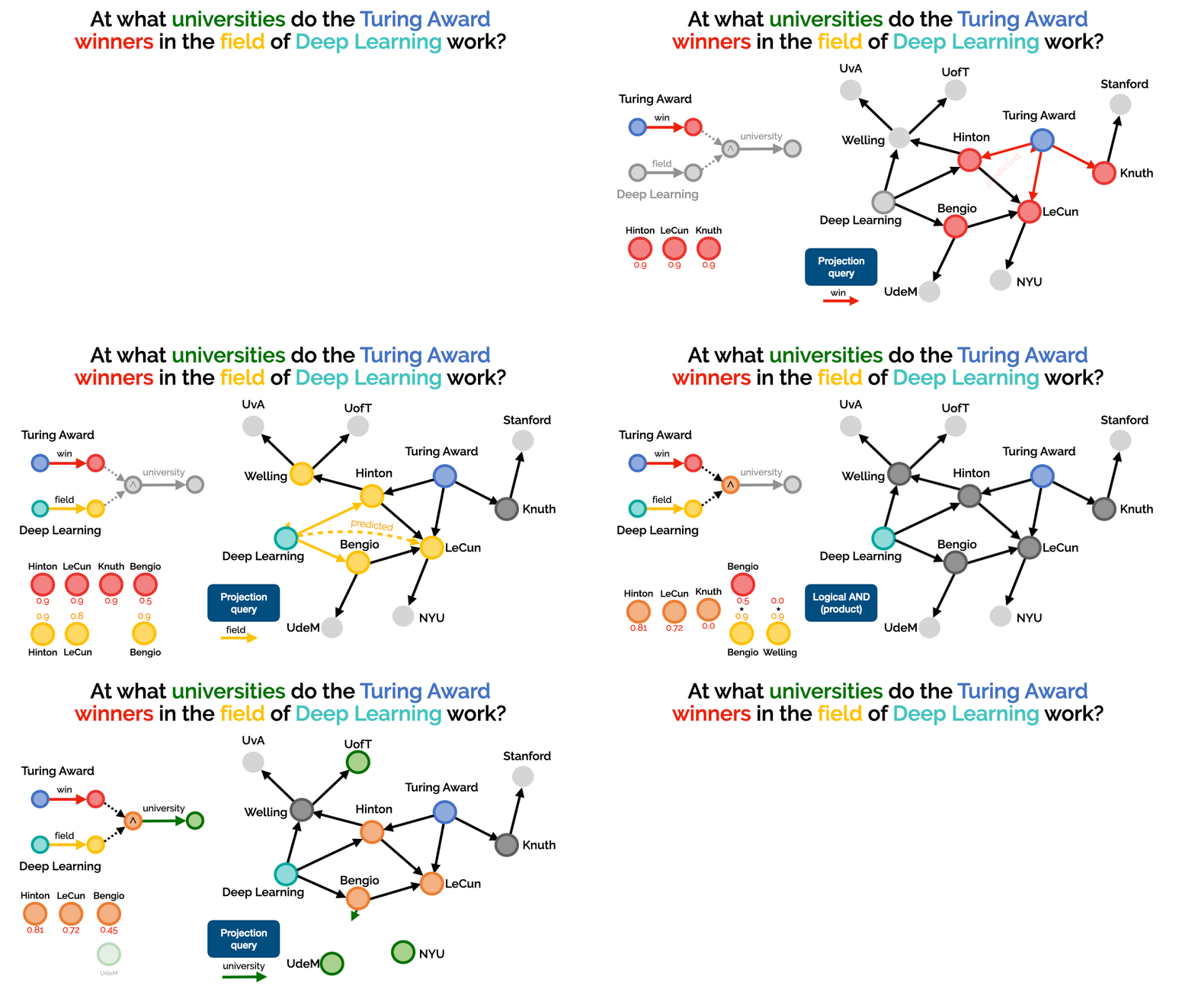
GNN-QE is a neural-symbolic model for answering multi-hop logical queries on knowledge graphs. Given a multi-hop logical query, GNN-QE first decomposes it into 4 basic operations over fuzzy sets, and then executes the operations with graph neural networks and fuzzy logic operations.
Additionally, the intermediate variables in GNN-QE are interpretable, and one can visualize them to better understand the multi-hop reasoning process.

The dependencies can be installed via either conda or pip. GNN-QE is compatible with Python 3.7/3.8/3.9 and PyTorch >= 1.8.0.
conda install torchdrug pytorch cudatoolkit -c milagraph -c pytorch -c pyg
conda install easydict pyyaml -c conda-forge
pip install torchdrug torch
pip install easydict pyyaml
To run GNN-QE, use the following command. Alternatively, you may specify
--gpus null to run GNN-QE on a CPU. All the datasets will be automatically
downloaded in the code.
python script/run.py -c config/fb15k237.yaml --gpus [0]
We provide the hyperparameters for each experiment in a separate configuration file.
The hyperparameters are designed for 32GB GPUs, but you may adjust the batch size
to fit a smaller GPU memory. All the configuration files can be found in
config/*.yaml.
To run GNN-QE with multiple GPUs or multiple machines, use the following commands
python -m torch.distributed.launch --nproc_per_node=4 script/run.py -c config/fb15k237.yaml --gpus [0,1,2,3]
python -m torch.distributed.launch --nnodes=4 --nproc_per_node=4 script/run.py -c config/fb15k237.yaml --gpus [0,1,2,3,0,1,2,3,0,1,2,3,0,1,2,3]
Once you have models trained on FB15k-237, you can visualize the intermediate
variables with the following line. The visualizations will be output in a new
experiment directory as png files. Please replace the checkpoint with your own
path.
python script/visualize.py -c config/fb15k237_visualize.yaml --checkpoint /path/to/gnn-qe/experiment/model_epoch_10.pth
Generally, GNN-QE is a GNN-agnostic framework for answering logical queries.
You may plug any GNN model into GNN-QE. To do so, just implement the convolution
layer in gnnqe/layer.py and the GNN model in gnnqe/gnn.py. The GNN model is
expected to have the following signature
def forward(self, graph, input, all_loss=None, metric=None):
    ...
    return {
        "node_feature": node_feature,
    }
where the arguments and the return value are
graph (data.Graph): the knowledge graph with graph.query being the query
embeddings of shape (batch_size, input_dim).input (Tensor): input tensor of shape (|V|, batch_size, input_dim)all_loss (Tensor): a scalar tensor that accumulates losses during trainingmetric (Tensor): a dict that stores any scalar information for logging during
trainingnode_feature (Tensor): node feature of shape (|V|, batch_size, output_dim)For how to implement GNN models in TorchDrug, please refer to these tutorials
The code is stuck at the beginning of epoch 0.
This is probably because the JIT cache is broken.
Try rm -r ~/.cache/torch_extensions/* and run the code again.
If you find this project useful in your research, please cite the following paper
@inproceedings{zhu2022neural,
  title={Neural-Symbolic Models for Logical Queries on Knowledge Graphs},
  author={Zhu, Zhaocheng and Galkin, Mikhail and Zhang, Zuobai and Tang, Jian},
  booktitle={Proceedings of the 39th International Conference on Machine Learning},
  pages={27454--27478},
  volume={162},
  year={2022},
}
DeepGraphLearning/GNN-QE is a public repo on GitHub by DeepGraphLearning. Official implementation of Graph Neural Network Query Executor (ICML 2022).
It declares the MIT license on GitHub.
Its maker has not tagged a system, so it is unknown here. Its README says what it needs.
Open "Take it" on its page: Take My Repo writes an install plan for your machine and hands it to your AI agent (Claude Code, Codex or Cursor), which asks you before each step. Take My Repo has not tested it on any machine.
Its last change on GitHub was on 2023-09-05. Take My Repo does not judge from that whether it is maintained.
Nobody has reviewed it on Take My Repo yet, which says nothing about its quality.
A collection of Mathematics + CS + what have you related books collected over the years for school 🎓 and personal reading 📚.
Turn any codebase, with its docs, SQL schemas, configs, and PDFs, into a queryable knowledge graph. A /graphify skill for Claude Code, Cursor, Codex, and Gemini CLI: local deterministic AST parsing, every edge explained, no vector store.
Python package built to ease deep learning on graph, on top of existing DL frameworks.
A powerful and flexible machine learning platform for drug discovery