torchadver
A PyTorch Toolbox for creating adversarial examples that fool neural networks.
- 87
- Python
- 7 y ago
Micro-State-Space is a research-driven collection of compact strategy environments featuring Hex-Line, Quantum Match, and Shift-3. It explores deterministic state spaces using MCTS, alpha-beta search, and tabular reinforcement learning, providing interactive Streamlit apps, visual analysis, and agent serialization.
Repo Devanik21/Micro-State-Space, read from GitHub 1 min ago. Devanik21 has not joined Take My Repo.
Devanik21/Micro-State-Space is a public repo on GitHub by Devanik21. Micro-State-Space is a research-driven collection of compact strategy environments featuring Hex-Line, Quantum Match, and Shift-3. It explores deterministic state spaces using MCTS, alpha-beta search, and tabular reinforcement learning, providing interactive Streamlit apps, visual analysis, and agent serialization. It declares the MIT license on GitHub. It is written mainly in Python, has 2 stars and last changed on 2026-07-09. Nobody has reviewed it on Take My Repo yet, which says nothing about its quality. Read from GitHub on 2026-11-24.
A PyTorch Toolbox for creating adversarial examples that fool neural networks.

A compact research and experimentation repository for micro-scale adversarial game environments built with Streamlit, Matplotlib, and lightweight search + learning agents.
This repository contains three standalone strategy arenas:
Each module is designed as a self-contained environment with:
Micro-State-Space explores how much strategic depth can be extracted from very small, fully specified game worlds.
The project is intentionally focused on micro state spaces rather than large-scale gameplay. That design choice makes the environments ideal for:
Although the boards are compact, the decision spaces are non-trivial. Each arena combines:
Each game can be run separately as its own Streamlit application.
The agents combine:
Each module includes visual tools such as:
Trained agents can be:
Hex-Line is a minimalist connection game played on a 7-hex cluster:
The game is deliberately small, but the geometry creates meaningful tactical tension.
A player wins by either:
forming a line through the center:
[1, 0, 4][2, 0, 5][3, 0, 6]controlling 4 or more outer hexes
This dual-win structure makes the game fast, decisive, and tie-free in spirit.
Hex-Line rewards:
The Hex-Line agent includes:
The module includes:
Quantum Match is a 2×2 grid token-control game with a shared pool of 4 tokens.
Each turn, a player may:
A player wins when they control all 4 squares after a move.
Quantum Match emphasizes:
Because every move can either expand presence or reverse control, the game has a compact but highly dynamic decision surface.
The Quantum Match agent includes:
The module includes:
Shift-3 is a 5-square linear sliding game where pieces do not merely get placed once; they can also be shifted left or right, which makes the board dynamic and potentially cyclical.
Each player can:
The primary winning pattern is:
[You, Opponent, You]This gives the game a positional, pattern-based identity rather than a pure occupancy identity.
Shift-3 is particularly useful for studying:
The Shift-3 agent includes:
The module includes:
The repository uses a layered decision stack that is intentionally lightweight, inspectable, and appropriate for tiny game spaces.
Used to explore candidate actions by simulating outcomes and accumulating visit/value statistics.
The tree policy uses a PUCT-style formulation to balance:
Used as a tactical search baseline to:
Each game includes game-specific evaluation terms, such as:
Agents maintain compact state-action or state-value tables, making the system:
The repository includes self-play training loops that can:
pip install streamlit matplotlib pandas numpy
If you are using a virtual environment:
python -m venv .venv
# Windows
.venv\Scripts\activate
# macOS / Linux
source .venv/bin/activate

pip install streamlit matplotlib pandas numpy
Each file is a standalone Streamlit app.
streamlit run hex_line.py
streamlit run quantum_match.py
streamlit run shift3.py
Each arena includes a self-play workflow in the sidebar.
Typical training flow:
During training, the agents may:
The repository surfaces trends such as:
The repository supports portable agent bundles.
Each ZIP archive contains:
agent1.jsonagent2.jsonconfig.jsonThe saved data typically includes:
This makes it easy to:
Devanik21/Micro-State-Space is a public repo on GitHub by Devanik21. Micro-State-Space is a research-driven collection of compact strategy environments featuring Hex-Line, Quantum Match, and Shift-3. It explores deterministic state spaces using MCTS, alpha-beta search, and tabular reinforcement learning, providing interactive Streamlit apps, visual analysis, and agent serialization.
It declares the MIT license on GitHub.
Highly cited and useful papers related to machine learning, deep learning, AI, game theory, reinforcement learning
pyHarmonySearch is a pure Python implementation of the harmony search (HS) global optimization algorithm.
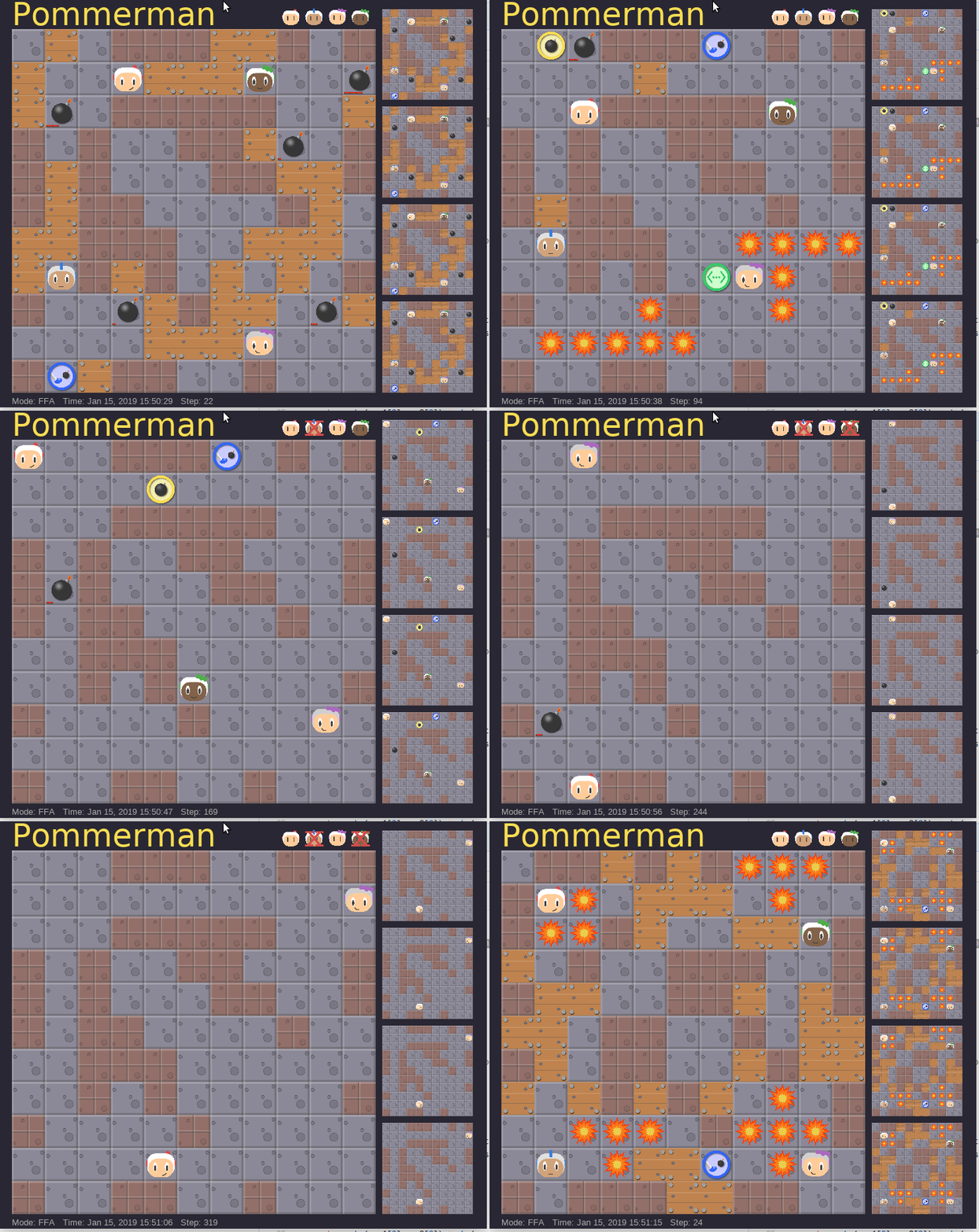
Code for the paper "Skynet: A Top Deep RL Agent in the Inaugural Pommerman Team Competition"
A collection of Mathematics + CS + what have you related books collected over the years for school 🎓 and personal reading 📚.
Its maker has not tagged a system, so it is unknown here. Its README says what it needs.
Open "Take it" on its page: Take My Repo writes an install plan for your machine and hands it to your AI agent (Claude Code, Codex or Cursor), which asks you before each step. Take My Repo has not tested it on any machine.
Its last change on GitHub was on 2026-07-09. GitHub counts 0 open issues and pull requests. Take My Repo does not judge from that whether it is maintained.
Nobody has reviewed it on Take My Repo yet, which says nothing about its quality.
Take My Repo cannot say: it does not audit code and has not run Micro-State-Space. What is known comes from GitHub. It declares the MIT license on GitHub. Its last change was on 2026-07-09. It has 2 stars, which measure popularity, not safety. Nobody has reviewed it on Take My Repo yet, which says nothing about its quality. Read the source before you run it. With "Take it", your AI agent shows each step and asks you before running it; README text is treated as data, not as instructions.