
GitHubDaily
坚持分享 GitHub 上高质量、有趣实用的开源技术教程、开发者工具、编程网站、技术资讯。A list cool, interesting projects of GitHub.
- 49k
- 11 mo ago
🟣 Queue Data Structure interview questions and answers to help you prepare for your next data structures and algorithms interview in 2026.
Repo Devinterview-io/queue-data-structure-interview-questions, read from GitHub 3 d ago. Devinterview-io has not joined Take My Repo.
Devinterview-io/queue-data-structure-interview-questions is a public repo on GitHub by Devinterview-io. 🟣 Queue Data Structure interview questions and answers to help you prepare for your next data structures and algorithms interview in 2026. It declares no license on GitHub. Public does not mean open source: without a license, nobody is granted the right to reuse it. It has 18 stars and last changed on 2026-01-04. Nobody has reviewed it on Take My Repo yet, which says nothing about its quality. Read from GitHub on 2026-11-19.

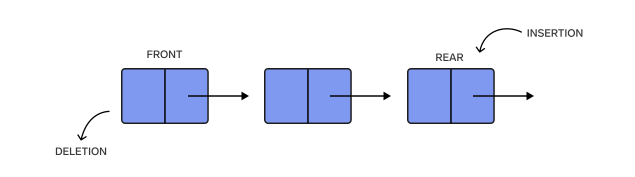
A queue is a data structure that adheres to the First-In-First-Out (FIFO) principle and is designed to hold a collection of elements.
All operations have a space complexity of $O(1)$ and time complexity of $O(1)$, except for Search, which has $O(n)$ time complexity.
Here is the Python code:
from collections import deque

class Queue:
    def __init__(self):
        self.queue = deque()

    def enqueue(self, item):
        self.queue.append(item)

    def dequeue(self):
        if not self.is_empty():
            return self.queue.popleft()
        raise Exception("Queue is empty.")

    def size(self):
        return len(self.queue)

    def is_empty(self):
        return len(self.queue) == 0

    def front(self):
        if not self.is_empty():
            return self.queue[0]
        raise Exception("Queue is empty.")

    def rear(self):
        if not self.is_empty():
            return self.queue[-1]
        raise Exception("Queue is empty.")

# Example Usage
q = Queue()
q.enqueue(5)
q.enqueue(6)
q.enqueue(3)
q.enqueue(2)
q.enqueue(7)
print("Queue:", list(q.queue))
print("Front:", q.front())
print("Rear:", q.rear())
q.dequeue()
print("After dequeue:", list(q.queue))
The FIFO (First-In-First-Out) policy governs the way Queues handle their elements. Elements are processed and removed from the queue in the same order in which they were added. The data structures responsible for adhering to this policy are specifically designed to optimize for this principle, making them ideal for a host of real-world applications.
Elements are typically added to the rear and removed from the front. This design choice ensures that the earliest elements, those closest to the front, are processed and eliminated first.
In the above diagram:
Queues are adaptable data structures with diverse types, each optimized for specific tasks. Let's explore the different forms of queues and their functionalities.
A Simple Queue follows the basic FIFO principle. This means items are added at the end and removed from the beginning.
Here is the Python code:
class SimpleQueue:
    def __init__(self):
        self.queue = []

    def enqueue(self, item):
        self.queue.append(item)

    def dequeue(self):
        if not self.is_empty():
            return self.queue.pop(0)

    def is_empty(self):
        return len(self.queue) == 0

    def size(self):
        return len(self.queue)
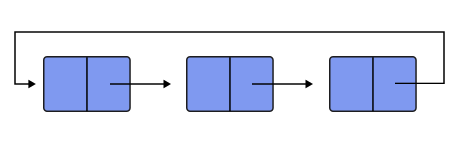
In a Circular Queue the last element points to the first element, making a circular link. This structure uses a fixed-size array and can wrap around upon reaching the end. It's more memory efficient than a Simple Queue, reusing positions at the front that are left empty by the dequeue operations.
Here is the Python code:
class CircularQueue:
    def __init__(self, k):
        self.queue = [None] * k
        self.size = k
        self.front = self.rear = -1

    def enqueue(self, item):
        if self.is_full():
            return "Queue is full"
        elif self.is_empty():
            self.front = self.rear = 0
        else:
            self.rear = (self.rear + 1) % self.size
        self.queue[self.rear] = item

    def dequeue(self):
        if self.is_empty():
            return "Queue is empty"
        elif self.front == self.rear:
            temp = self.queue[self.front]
            self.front = self.rear = -1
            return temp
        else:
            temp = self.queue[self.front]
            self.front = (self.front + 1) % self.size
            return temp

    def is_empty(self):
        return self.front == -1

    def is_full(self):
        return (self.rear + 1) % self.size == self.front
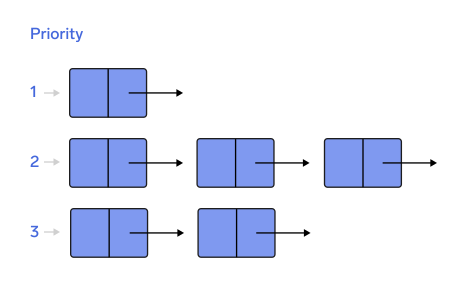
A Priority Queue gives each item a priority. Items with higher priorities are dequeued before those with lower priorities. This is useful in scenarios like task scheduling where some tasks need to be processed before others.
Here is the Python code:
class PriorityQueue:
    def __init__(self):
        self.queue = []

    def enqueue(self, item, priority):
        self.queue.append((item, priority))
        self.queue.sort(key=lambda x: x[1], reverse=True)

    def dequeue(self):
        if not self.is_empty():
            return self.queue.pop(0)[0]

    def is_empty(self):
        return len(self.queue) == 0
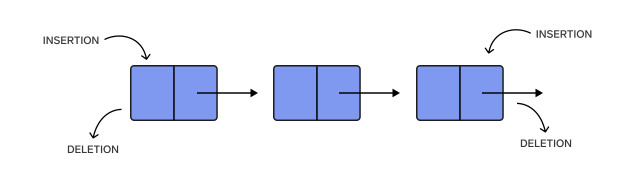
A Double-Ended Queue allows items to be added or removed from both ends, giving it more flexibility compared to a simple queue.
Here is the Python code:
from collections import deque

de_queue = deque()
de_queue.append(1)  # Add to rear
de_queue.appendleft(2)  # Add to front
de_queue.pop()  # Remove from rear
de_queue.popleft()  # Remove from front
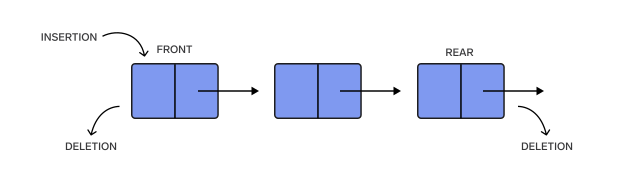
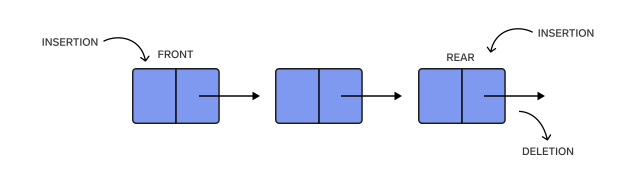
An Input-Restricted Deque only allows items to be added at one end, while an Output-Restricted Deque limits removals to one end.
Input-Restricted Deque
Output-Restricted Deque
Queues are data structures that follow a FIFO (First-In, First-Out) order, where elements are removed in the same sequence they were added.
Priority Queues, on the other hand, are more dynamic and cater to elements with varying priorities. A key distinction is that while queues prioritize the order in which items are processed, a priority queue dictates the sequence based on the priority assigned to each element.
Order: Queues ensure a consistent, predefined processing sequence, whereas priority queues handle items based on their assigned priority levels.
Elements Removal: Queues remove the oldest element, while priority queues remove the highest-priority item. This results in a different set of elements being dequeued in each case.
Queues: 1, 2, 3, 4, 5
Priority Queue: (assuming '4' has the highest priority): 4, 2, 6, 3, 1
Support Functions: Since queues rely on a standard FIFO flow, they present standard methods like enqueue and dequeue. In contrast, priority queues offer means to set priorities and locate/query elements based on their priority levels.
Queues: Not common but a viable approach using structures like Heaps.
Priority Queues: Specifically utilized for priority queues to ensure efficient operations based on priorities.
Queues and Stacks provide structured ways to handle data, offering distinct advantages over more generic structures like Lists or Arrays.
Reversing a queue can be accomplished using a single stack or recursively. Both methods ensure the first element in the input queue becomes the last in the resultant queue.
Here are the steps:
Here is the Python code:
def reverse_queue(q):
    if not q:  # Base case: queue is empty
        return
    stack = []
    while q:
        stack.append(q.pop(0))  # Transfer queue to stack
    while stack:
        q.append(stack.pop())  # Transfer stack back to queue
    return q

# Test
q = [1, 2, 3, 4, 5]
print(f"Original queue: {q}")
reverse_queue(q)
print(f"Reversed queue: {q}")
To reverse a queue recursively, you can follow this approach:
Here is the Python code:
def reverse_queue_recursively(q):
    if not q:
        return
    front = q.pop(0)  # Dequeue the first element
    reverse_queue_recursively(q)  # Recurse for the remaining queue
    q.append(front)  # Enqueue the previously dequeued element at the end
    return q

# Test
q = [1, 2, 3, 4, 5]
print(f"Original queue: {q}")
reverse_queue_recursively(q)
print(f"Reversed queue: {q}")
Static queues use a pre-defined amount of memory, typically an array, for efficient FIFO data handling.
Fixed Capacity: A static queue cannot dynamically adjust its size based on data volume or system requirements. As a result, it can become either underutilized or incapable of accommodating additional items.
Memory Fragmentation: If there's not enough contiguous memory to support queue expansion or changes, memory fragmentation occurs. This means that even if there's available memory in the system, it may not be usable by the static queue.
Memory fragmentation is more likely in long-running systems or when the queue has a high rate of enqueueing and dequeueing due to the "moving window" of occupied and freed space.
Potential for Data Loss: Enqueuing an item into a full static queue results in data loss. As there's no mechanism to signify that storage was exhausted, it's essential to maintain methods to keep track of the queue's status.
Time-Consuming Expansion: If the queue were to support expansion, it would require operations in $O(n)$ time - linear with the current size of the queue. This computational complexity is a significant downside compared to the $O(1)$ time complexity offered by dynamic queues.
Inefficient Memory Usage: A static queue reserved a set amount of memory for its potential max size, which can be a wasteful use of resources if the queue seldom reaches that max size.
The task is to write an algorithm to perform both enqueue (add an item) and dequeue (remove an item) operations on a queue.
A Queue, often used in real-world scenarios with first-in, first-out (FIFO) logic, can be implemented using an array (for fixed-size) or linked list (for dynamic size).
rear of the queue.front of the queue.Here is the Python code:
class Queue:
    def __init__(self):
        self.items = []

    def enqueue(self, item):
        self.items.append(item)

    def dequeue(self):
        if not self.is_empty():
            return self.items.pop(0)
        return "Queue is empty"

    def is_empty(self):
        return self.items == []

    def size(self):
        return len(self.items)

# Example
q = Queue()
q.enqueue(2)
q.enqueue(4)
q.enqueue(6)
print("Dequeued:", q.dequeue())  # Output: Dequeued: 2
In this Python implementation, the enqueue operation has a time complexity of $O(1)$ while the dequeue operation has a time complexity of $O(n)$.
One way to achieve $O(1)$ enqueue and $O(n)$ dequeue times is with a linked-list. You can keep the tail pointer always. Enqueues don't need to perform more than a couple of cheap link operations.
However, dequeue operations on a single-ended list are costly, potentially traversing the whole list. To keep dequeue times acceptable, you might want to limit the number of elements you enqueue before you're allowed to dequeue elements. You could define a fixed size for the list e.g. 100 or 1000, and after this limit, you would allow dequeueing. The key is to ensure the amortized time for the last operation is still $O(1)$ this way.
Here is a Python code:
class Node:
    def __init__(self, data=None):
        self.data = data
        self.next = None

class LimitedQueue:
    def __init__(self, max_size):
        self.head = None
        self.tail = None
        self.max_size = max_size
        self.count = 0

    def enqueue(self, data):
        if self.count < self.max_size:
            new_node = Node(data)
            if not self.head:
                self.head = new_node
            else:
                self.tail.next = new_node
            self.tail = new_node
            self.count += 1
        else:
            print("Queue is full. Dequeue before adding more.")

    def dequeue(self):
        if self.head:
            data = self.head.data
            self.head = self.head.next
            self.count -= 1
            if self.count == 0:
                self.tail = None
            return data
        else:
            print("Queue is empty. Nothing to dequeue.")

    def display(self):
        current = self.head
        while current:
            print(current.data, end=" ")
            current = current.next
        print()

# Let's test the Queue
limited_queue = LimitedQueue(3)
limited_queue.enqueue(10)
limited_queue.enqueue(20)
limited_queue.enqueue(30)
limited_queue.display()  # Should display 10 20 30
limited_queue.enqueue(40)  # Should display 'Queue is full. Dequeue before adding more.'
limited_queue.dequeue()
limited_queue.display()  # Should display 20 30
While enqueue typically takes $O(1)$ time and dequeue $O(1)$ or $O(n)$ time in a simple Queue, there are cases, like in stacks, where we prioritize one operation over the other.
In most traditional Queue implementations, enqueue and dequeue operate in $O(1)$ time.
However, you can design special queues, like priority queues, where one operation is optimized at the cost of the other. For instance, if you're using a binary heap.
The efficiency of both enqueue and dequeue is constrained by the binary heap's structure. A binary heap can be represented as a binary tree.
In a complete binary tree, most levels are fully occupied, and the last level is either partially or fully occupied from the left.
When the binary heap is visualized with the root at the top, the following rules are typically followed:
Suppose we represent such a binary heap using an array starting from index $1$. In that case, the children of a node at index $i$ can be located at indices $2i$ and $2i+1$ respectively.
Thus, both enqueue and dequeue rely on traversing the binary heap in a systematic manner. The following efficiencies are characteristic:
When enqueue is executed:
When dequeue is executed:
Using a singly linked list as a queue provides $O(1)$ time complexity for standard queue operations, but finding exact minimum and maximum can be $O(n)$. However, there are optimized methods for improving efficiency.
Here is the Python code:
class NaiveQueue:
    def __init__(self):
        self.queue = []

    def push(self, item):
        self.queue.append(item)

    def pop(self):
        return self.queue.pop(0)

    def min(self):
        return min(self.queue)

    def max(self):
        return max(self.queue)
This code has $O(n)$ time complexity for both min and max methods.
Here is the Python code:
from collections import Counter

class EfficientQueue:
    def __init__(self):
        self.queue = []
        self.element_count = Counter()
        self.minimum = float('inf')
        self.maximum = float('-inf')

    def push(self, item):
        self.queue.append(item)
        self.element_count[item] += 1
        self.update_min_max(item)

    def pop(self):
        item = self.queue.pop(0)
        self.element_count[item] -= 1
        if self.element_count[item] == 0:
            del self.element_count[item]
            if item == self.minimum:
                self.minimum = min(self.element_count.elements(), default=float('inf'))
            if item == self.maximum:
                self.maximum = max(self.element_count.elements(), default=float('-inf'))
        return item

    def min(self):
        return self.minimum

    def max(self):
        return self.maximum

    def update_min_max(self, item):
        self.minimum = min(self.minimum, item)
        self.maximum = max(self.maximum, item)
This code has $O(1)$ time complexity for both min and max methods.
Here is the Python code:
from queue import Queue
from collections import deque

class DualDataQueue:
    def __init__(self):
        self.queue = Queue()  # For standard queue operations
        self.max_queue = deque()  # To keep track of current maximum

    def push(self, item):
        self.queue.put(item)
        while len(self.max_queue) > 0 and self.max_queue[-1] < item:
            self.max_queue.pop()
        self.max_queue.append(item)

    def pop(self):
        item = self.queue.get()
        if item == self.max_queue[0]:
            self.max_queue.popleft()
        return item

    def max(self):
        return self.max_queue[0]
This code has $O(1)$ time complexity for max method and $O(1)$ time complexity for min method using the symmetric approach.
Merging multiple queues is conceptually similar to merging two lists. However, direct merging challenges efficiency as it enforces a $\mathcal{O}(n)$ operation for each item in the queues. Utilizing a secondary queue $\text{auxQueue}$ can provide a more efficient $\mathcal{O}(n + m)$ sequence.
Here is the Python code:
from queue import Queue

def merge_queues(q_list):
    auxQueue = Queue()

    # Step 1: Enqueue into Aux
    for q in q_list:
        while not q.empty():
            auxQueue.put(q.get())

    # Step 2: Move Everything Back
    for _ in range(auxQueue.qsize()):
        q.put(auxQueue.get())

    # Step 3: Return auxQueue
    return q
Here is the Python code with the test:
# Creating queues
q1 = Queue()
q2 = Queue()

# Enqueueing elements
for i in range(5):
    q1.put(i)

for i in range(5, 10):
    q2.put(i)

# Merging
merged = merge_queues([q1, q2])

# Dequeuing and printing
while not merged.empty():
    print(merged.get())
Here is the Python code if we merge it into single queue:
def merge_queue_multi(q_list):
    merged = Queue()

    # Merging the queues
    for q in q_list:
        while not q.empty():
            merged.put(q.get())

    return merged
The time complexity of this algorithm is not as optimal as the enqueuing to the auxiliary queue makes each item traverse more than once, increasing control time when an element is being dequeued.
For even activity, all enqueuing actions are executed approximately the same number of times, so there's still a linear-time bound.
Here is the Python code:
def merge_queues_on_visit_multi(q_list):
    def on_visit(visit_cb):
        for q in q_list:
            while not q.empty():
                visit_cb(q.get())

    merged = Queue()
    on_visit(merged.put)
    return merged
Queues can be built using various underlying structures, each with its trade-offs in efficiency and complexity.
Using a simple array for implementation requires shifting elements when adding or removing from the front. This makes operations linear time $O(n)$, which is inefficient and not suitable for large queues or real-time use.
class ArrayQueue:
    def __init__(self):
        self.queue = []

    def enqueue(self, item):
        self.queue.append(item)

    def dequeue(self):
        return self.queue.pop(0)
Using a singly-linked list allows $O(1)$ enqueue with a tail pointer but still $O(n)$ dequeue.
class Node:
    def __init__(self, data=None):
        self.data = data
        self.next = None

class LinkedListQueue:
    def __init__(self):
        self.head = None
        self.tail = None

    def enqueue(self, item):
        new_node = Node(item)
        if self.tail:
            self.tail.next = new_node
        else:
            self.head = new_node
        self.tail = new_node

    def dequeue(self):
        if self.head:
            data = self.head.data
            self.head = self.head.next
            if not self.head:
                self.tail = None
            return data
A doubly linked list enables $O(1)$ enqueue and dequeue by maintaining head and tail pointers, but it requires prev node management.
class DNode:
    def __init__(self, data=None):
        self.data = data
        self.next = None
        self.prev = None

class DoublyLinkedListQueue:
    def __init__(self):
        self.head = None
        self.tail = None

    def enqueue(self, item):
        new_node = DNode(item)
        if not self.head:
            self.head = new_node
        else:
            self.tail.next = new_node
            new_node.prev = self.tail
        self.tail = new_node

    def dequeue(self):
        if self.head:
            data = self.head.data
            self.head = self.head.next
            if self.head:
                self.head.prev = None
            else:
                self.tail = None
            return data
The collections.deque in Python is essentially a double-ended queue implemented using a doubly-linked list, providing $O(1)$ complexities for operations at both ends.
from collections import deque

class DequeQueue:
    def __init__(self):
        self.queue = deque()

    def enqueue(self, item):
        self.queue.append(item)

    def dequeue(self):
        return self.queue.popleft()
A binary heap with its binary tree structure is optimized for priority queues, achieving $O(\log n)$ for both enqueue and dequeue operations. This makes it useful for situations where you need to process elements in a particular order.
import heapq

class MinHeapQueue:
    def __init__(self):
        self.heap = []

    def enqueue(self, item):
        heapq.heappush(self.heap, item)

    def dequeue(self):
        return heapq.heappop(self.heap)
While array-based Queues are simple, they have inherent limitations.
Here is the Python code:
class ArrayQueue:
    def __init__(self, size):
        self.size = size
        self.queue = [None] * size
        self.front = self.rear = -1

    def is_full(self):
        return self.rear == self.size - 1

    def is_empty(self):
        return self.front == -1 or self.front > self.rear

    def enqueue(self, element):
        if self.is_full():
            print("Queue is full")
            return
        if self.front == -1:
            self.front = 0
        self.rear += 1
        self.queue[self.rear] = element

    def dequeue(self):
        if self.is_empty():
            print("Queue is empty")
            return
        item = self.queue[self.front]
        self.front += 1
        if self.front > self.rear:
            self.front = self.rear = -1
        return item
enqueue and dequeue can be $O(1)$ or $O(n)$, making computation times less predictable.Let's compare the benefits of implementing a Queue using both a Doubly Linked List and Singly Linked List.
Devinterview-io/queue-data-structure-interview-questions is a public repo on GitHub by Devinterview-io. 🟣 Queue Data Structure interview questions and answers to help you prepare for your next data structures and algorithms interview in 2026.
It declares no license on GitHub. Public does not mean open source: without a license, nobody is granted the right to reuse it.
Its maker has not tagged a system, so it is unknown here. Its README says what it needs.
Open "Take it" on its page: Take My Repo writes an install plan for your machine and hands it to your AI agent (Claude Code, Codex or Cursor), which asks you before each step. Take My Repo has not tested it on any machine.
坚持分享 GitHub 上高质量、有趣实用的开源技术教程、开发者工具、编程网站、技术资讯。A list cool, interesting projects of GitHub.
Its last change on GitHub was on 2026-01-04. Take My Repo does not judge from that whether it is maintained.
Nobody has reviewed it on Take My Repo yet, which says nothing about its quality.
AlgoPlus is a C++17 library with implemented data structures and algorithms for various topics(including machine learning)
《Hello 算法》:动画图解、一键运行的数据结构与算法教程。支持简中、繁中、English、日本語,提供 Python, Java, C++, C, C#, JS, Go, Swift, Rust, Ruby, Kotlin, TS, Dart 等代码实现
✅ Solutions to LeetCode by Go, 100% test coverage, runtime beats 100% | LeetCode 题解
🟣 LLMs interview questions and answers to help you prepare for your next machine learning and data science interview in 2026.
🟣 Python interview questions and answers to help you prepare for your next technical interview in 2026.
🟣 SQL interview questions and answers to help you prepare for your next machine learning and data science interview in 2026.
🟣 Pytorch interview questions and answers to help you prepare for your next machine learning and data science interview in 2026.
🟣 React interview questions and answers to help you prepare for your next technical interview in 2026.
🟣 API Design interview questions and answers to help you prepare for your next software architecture and design patterns interview in 2026.