Claude-Code-Game-Studios
Turn Claude Code into a full game dev studio — 49 AI agents, 75 workflow skills, and a complete coordination system mirroring real studio hierarchy.
- 41k
- Shell
- MIT
- 13 d ago
Generic MonoBehaviour singletons for Unity, including a runtime auto-creating singleton, a persistent (DontDestroyOnLoad) variant, and a regulator that keeps only the most recently initialized instance.
Repo EggyStudio/Unity.Systems.Singleton, read from GitHub 16 min ago. EggyStudio has not joined Take My Repo.
EggyStudio/Unity.Systems.Singleton is a public repo on GitHub by EggyStudio. Generic MonoBehaviour singletons for Unity, including a runtime auto-creating singleton, a persistent (DontDestroyOnLoad) variant, and a regulator that keeps only the most recently initialized instance. It declares the MPL-2.0 license on GitHub. It is written mainly in C#, has 1 stars and last changed on 2026-11-08. Nobody has reviewed it on Take My Repo yet, which says nothing about its quality. Read from GitHub on 2026-11-23.
This module is part of the Unity Essentials ecosystem and follows the same lightweight, editor-first approach. Unity Essentials is a lightweight, modular set of editor utilities and helpers that streamline Unity development. It focuses on clean, dependency-free tools that work well together.
All utilities are under the UnityEssentials namespace.
using UnityEssentials;
Install the Unity Essentials entry package via Unity's Package Manager, then install modules from the Tools menu.
Add the entry package (via Git URL)
https://github.com/EggyStudio/UnityEssentials.gitInstall or update Unity Essentials packages
Quick overview: Generic MonoBehaviour singletons for Unity, including a runtime auto-creating singleton, a persistent (DontDestroyOnLoad) variant, a regulator that keeps the newest initialized instance, and an editor/runtime "always available" global singleton.
Singleton components are provided to ensure at most one instance of a given MonoBehaviour exists at runtime. If no instance is present, one can be auto-created and hidden; a persistent variant survives scene loads and destroys duplicates, while a regulator variant keeps the newest instance and removes others. Accessors are exposed for safe checks and retrieval.

Singleton<T>Instance lazily returns the current instance, searching loaded objects (FindAnyObjectByType<T>()) or auto-creating a hidden object when none existsHasInstance, TryGetInstance(), and Current helpers for safe checks without side effectsAwake() (play mode) and clears in OnDestroy()Instance returns null instead of calling Find* / creating objectsPersistentSingleton<T>DontDestroyOnLoad, and destroys any duplicate instances detected laterRegulatorSingleton<T>DontDestroyOnLoad, and when the newest instance initializes it destroys all other RegulatorSingleton<T> instancesTime.time ordering)GlobalSingleton<T>HideFlags.HideAndDontSave and persists across Play Mode transitions without being saved into scenesT : Component)using UnityEngine;
using UnityEssentials;
public class GameServices : Singleton<GameServices>
{
public int Score { get; private set; }
public void AddScore(int amount) => Score += amount;
}
// From any script at runtime
GameServices.Instance.AddScore(10);
using UnityEngine;
using UnityEssentials;

public class AudioManager : PersistentSingleton<AudioManager>
{
    protected override void Awake()
    {
        base.Awake(); // ensures persistence and duplicate destruction
        // Initialize audio here
    }
}
using UnityEngine;
using UnityEssentials;

public class SessionController : RegulatorSingleton<SessionController>
{
    // The most recently initialized instance will survive.
    // When it initializes, all other regulators of this type are destroyed.
}
// Avoid creating a new instance inadvertently
if (GameServices.HasInstance)
{
    var svc = GameServices.TryGetInstance();
    // use svc
}
using UnityEngine;
using UnityEssentials;

public class GlobalServices : GlobalSingleton<GlobalServices>
{
    public void DoSomething() { }
}

// Works in Edit Mode and Play Mode.
GlobalServices.Instance?.DoSomething();
Singleton<T>s_instance and assigns it during Awake() (play mode)Instance returns s_instance, or finds one with FindAnyObjectByType, or auto-creates a hidden GameObject (HideAndDontSave) and adds Tnull instead of calling Unity object APIss_instance in OnDestroy() if it points to the current objectPersistentSingleton<T>DontDestroyOnLoad, sets s_instanceRegulatorSingleton<T>DontDestroyOnLoadGlobalSingleton<T>HideFlags.HideAndDontSave so it isn’t saved into scenes and is hidden from the hierarchyInstance can create a hidden GameObject when none exists; use HasInstance/TryGetInstance to avoid implicit creationInstance may return null during editor import/serialization or off the main threadAwake() sets up the singleton only when Application.isPlaying is trueHideFlags.HideAndDontSave and are not part of saved scenesRuntime/Singleton.cs – Singleton<T> implementationRuntime/PersistentSingleton.cs – PersistentSingleton<T> implementationRuntime/RegulatorSingleton.cs – RegulatorSingleton<T> implementationRuntime/GlobalSingleton.cs – GlobalSingleton<T> implementationRuntime/UnityEssentials.Singleton.asmdef – Runtime assembly definitionunity, singleton, pattern, monoBehaviour, lifecycle, dontdestroyonload, manager, services, runtime
EggyStudio/Unity.Systems.Singleton is a public repo on GitHub by EggyStudio. Generic MonoBehaviour singletons for Unity, including a runtime auto-creating singleton, a persistent (DontDestroyOnLoad) variant, and a regulator that keeps only the most recently initialized instance.
It declares the MPL-2.0 license on GitHub.
Its maker has not tagged a system, so it is unknown here. Its README says what it needs.
Open "Take it" on its page: Take My Repo writes an install plan for your machine and hands it to your AI agent (Claude Code, Codex or Cursor), which asks you before each step. Take My Repo has not tested it on any machine.
Its last change on GitHub was on 2026-11-08. Take My Repo does not judge from that whether it is maintained.
Turn Claude Code into a full game dev studio — 49 AI agents, 75 workflow skills, and a complete coordination system mirroring real studio hierarchy.
Nobody has reviewed it on Take My Repo yet, which says nothing about its quality.
.NET Decompiler with support for PDB generation, ReadyToRun, Metadata (&more) - cross-platform!
🎮 A step-by-step guide to implementing SSAO, depth of field, lighting, normal mapping, and more for your 3D game.
The Unity Machine Learning Agents Toolkit (ML-Agents) is an open-source project that enables games and simulations to serve as environments for training intelligent agents using deep reinforcement learning and imitation learning.
Unity MCP acts as a bridge between AI assistants and your Unity Editor. Give your LLM tools to manage assets, control scenes, edit scripts, and automate tasks within Unity.
Scalable open-source game backend server: multiplayer, matchmaking, leaderboards, chat, and social features for games.
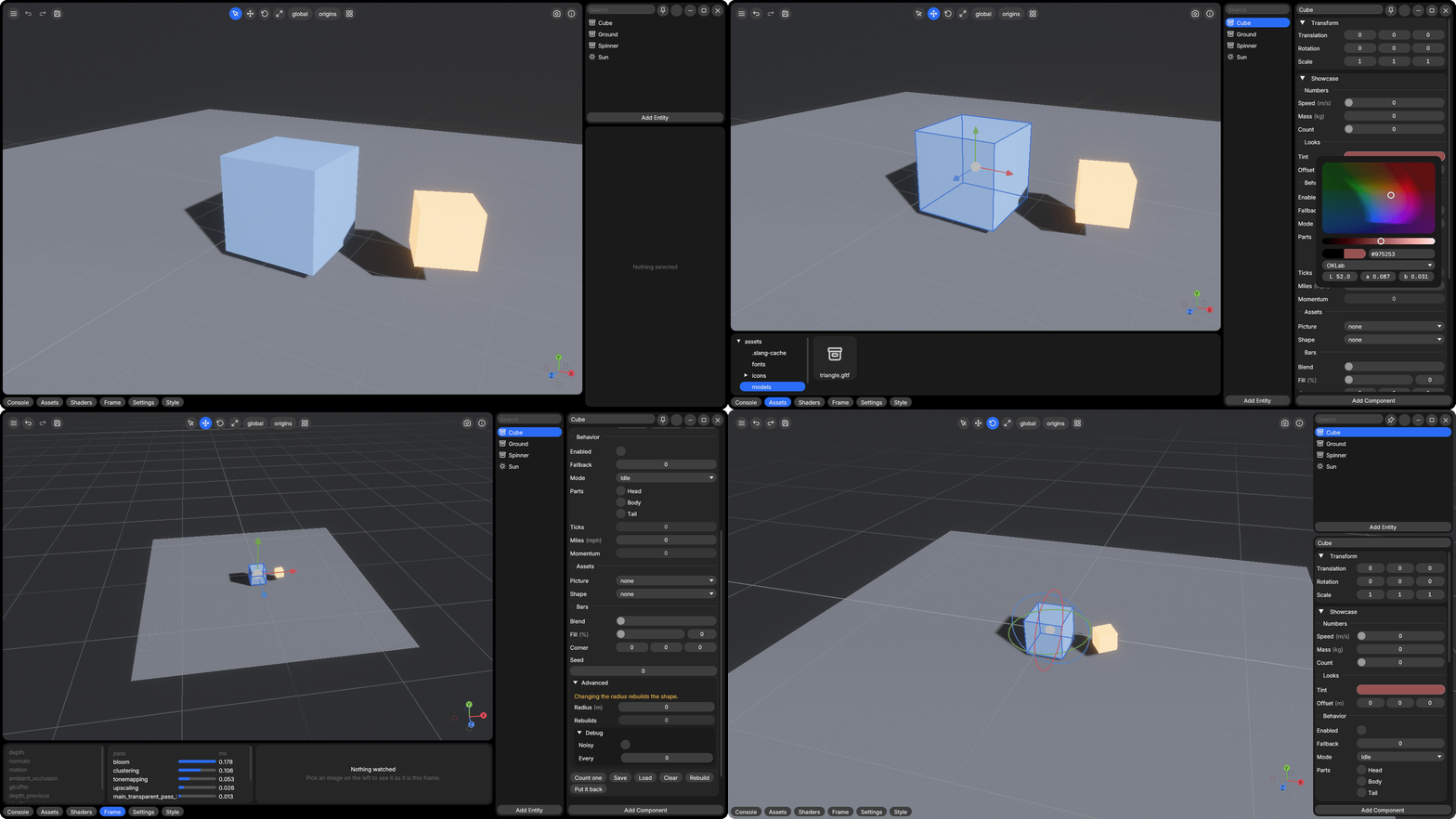
A C# engine on SDL3, Vulkan, ImGui and Slang. Raylib's design over a Bevy-style ECS and scheduler, scripted with its own Unity-style behaviors. Implementing Radiance Cascades. [e3d.cs]
GAME | A Minecraft/Cubeworld-like WebGL-Game on HTML5 created with Unity 2020.3 URP. Accessible on http://www.Voxeland.xyz (hosted via Hostinger) you can join a Server (running via Amazon AWS Lightsail) using the Network-API from Mirror.
Bevy C# [Behavior] on a struct are component & systems, generated at compile or runtime and wired straight into Bevy's ECS. Implementing Radiance Cascades. [bcs]
Physics-driven “active ragdoll” that follows an animation using a simple PD controller and ConfigurableJoints. It can temporarily weaken on collisions and then recover, giving natural, reactive motion.
A modular, production-ready ecosystem of game development building blocks with automated dependency management.