
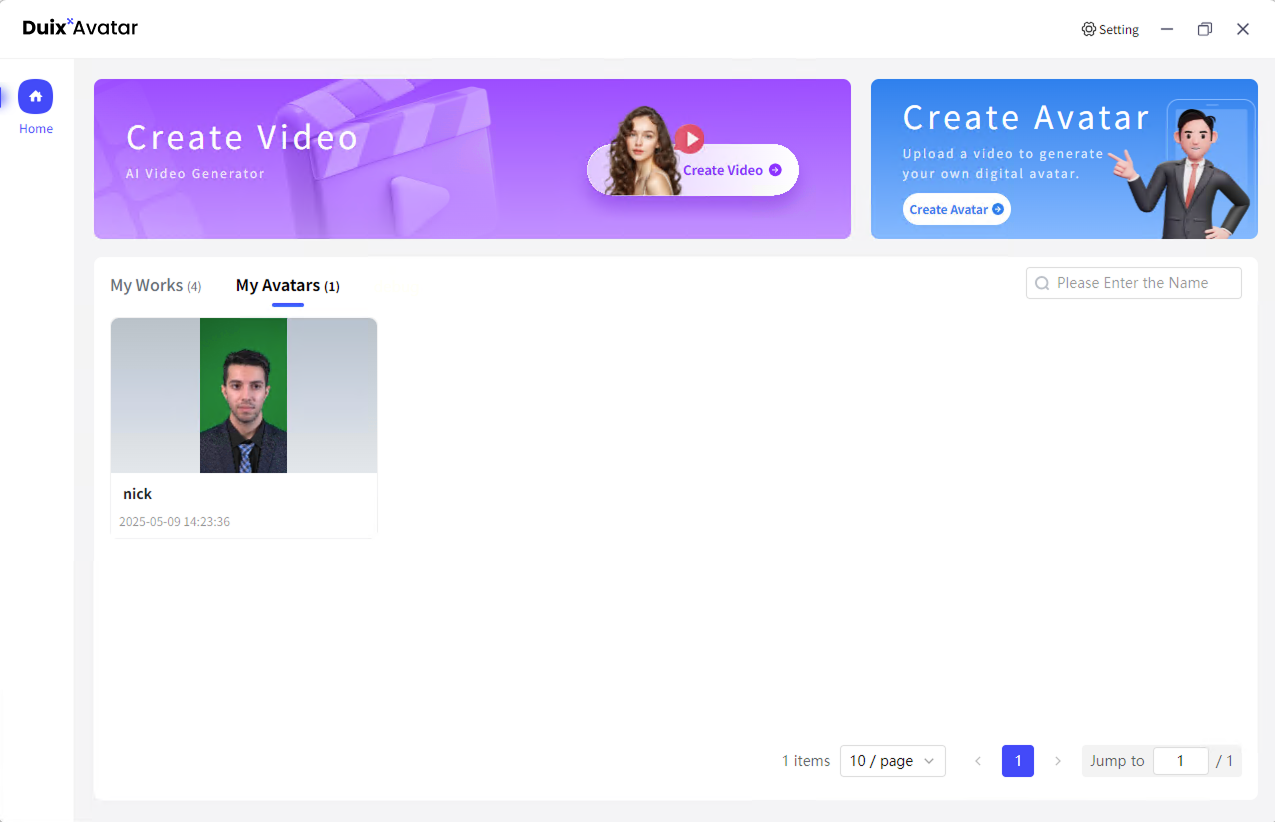
Duix-Avatar
🚀 Truly open-source AI avatar(digital human) toolkit for offline video generation and digital human cloning.
- 16k
- C
- 7 mo ago
Java binary serialization and cloning: fast, efficient, automatic
Repo EsotericSoftware/kryo, read from GitHub 1 min ago. EsotericSoftware has not joined Take My Repo.
EsotericSoftware/kryo is a public repo on GitHub by EsotericSoftware. Java binary serialization and cloning: fast, efficient, automatic. It declares the BSD-3-Clause license on GitHub. It is written mainly in HTML, has 6,551 stars and last changed on 2026-11-16. Nobody has reviewed it on Take My Repo yet, which says nothing about its quality. Read from GitHub on 2026-11-24.
🚀 Truly open-source AI avatar(digital human) toolkit for offline video generation and digital human cloning.
Reverse engineer anything with agents, from app behavior down to native binaries.
Kryo is a fast and efficient binary object graph serialization framework for Java. The goals of the project are high speed, low size, and an easy to use API. The project is useful any time objects need to be persisted, whether to a file, database, or over the network.
Kryo can also perform automatic deep and shallow copying/cloning. This is direct copying from object to object, not object to bytes to object.
This documentation is for Kryo version 5.x. See the Wiki for version 4.x.
Please use the Kryo mailing list for questions, discussions, and support. Please limit use of the Kryo issue tracker to bugs and enhancements, not questions, discussions, or support.
Kryo maintenance and development is sponsored by the Gecko fund, which is powered by EXANTE.
Kryo requires Java 8 or later.
Kryo publishes two kinds of artifacts/jars:
The two jars differ as follows:
| Default jar | Versioned jar | |
|---|---|---|
| Maven coordinates | com.esotericsoftware:kryo |
com.esotericsoftware.kryo:kryo5 |
| Package | com.esotericsoftware.kryo |
com.esotericsoftware.kryo.kryo5 |
| Dependencies | ReflectASM, Objenesis, MinLog | None (bundled and relocated into com.esotericsoftware.kryo.kryo5) |
| Java module name | com.esotericsoftware.kryo |
com.esotericsoftware.kryo.kryo5 |
| OSGi bundle symbolic name | com.esotericsoftware.kryo |
com.esotericsoftware.kryo.5 |
Both jars are OSGi bundles and declare an automatic module name, so they can be used on the Java module path. When using the versioned jar, all Kryo classes must be imported from the relocated package, for example com.esotericsoftware.kryo.kryo5.Kryo.
Kryo JARs are available on the releases page and at Maven Central. The latest snapshots of Kryo, including snapshot builds of master, are in the Maven Central snapshot repository.
To use the latest Kryo release in your application, use this dependency entry in your pom.xml:
<dependency>
   <groupId>com.esotericsoftware</groupId>
   <artifactId>kryo</artifactId>
   <version>5.7.1</version>
</dependency>
To use the latest Kryo release in a library you want to publish, use this dependency entry in your pom.xml:
<dependency>
   <groupId>com.esotericsoftware.kryo</groupId>
   <artifactId>kryo5</artifactId>
   <version>5.7.1</version>
</dependency>
To use the latest Kryo snapshot, use:
<repository>
   <id>central-snapshots</id>
   <name>Maven Central snapshots repo</name>
   <url>https://central.sonatype.com/repository/maven-snapshots/</url>
</repository>

<!-- for usage in an application: -->
<dependency>
   <groupId>com.esotericsoftware</groupId>
   <artifactId>kryo</artifactId>
   <version>5.8.0-SNAPSHOT</version>
</dependency>
<!-- for usage in a library that should be published: -->
<dependency>
   <groupId>com.esotericsoftware.kryo</groupId>
   <artifactId>kryo5</artifactId>
   <version>5.8.0-SNAPSHOT</version>
</dependency>
Not everyone is a Maven fan. Using Kryo without Maven requires placing the Kryo JAR on your classpath along with the dependency JARs found in lib.
Building Kryo from source requires JDK11+ and Maven. To build all artifacts, run:
mvn clean && mvn install
Jumping ahead to show how the library can be used:
import com.esotericsoftware.kryo.Kryo;
import com.esotericsoftware.kryo.io.Input;
import com.esotericsoftware.kryo.io.Output;
import java.io.*;

public class HelloKryo {
   static public void main (String[] args) throws Exception {
      Kryo kryo = new Kryo();
      kryo.register(SomeClass.class);

      SomeClass object = new SomeClass();
      object.value = "Hello Kryo!";

      Output output = new Output(new FileOutputStream("file.bin"));
      kryo.writeObject(output, object);
      output.close();

      Input input = new Input(new FileInputStream("file.bin"));
      SomeClass object2 = kryo.readObject(input, SomeClass.class);
      input.close();
   }
   static public class SomeClass {
      String value;
   }
}
The Kryo class performs the serialization automatically. The Output and Input classes handle buffering bytes and optionally flushing to a stream.
The rest of this document details how this works and advanced usage of the library.
Getting data in and out of Kryo is done using the Input and Output classes. These classes are not thread safe.
EsotericSoftware/kryo is a public repo on GitHub by EsotericSoftware. Java binary serialization and cloning: fast, efficient, automatic.
It declares the BSD-3-Clause license on GitHub.
Its maker has not tagged a system, so it is unknown here. Its README says what it needs.
Open "Take it" on its page: Take My Repo writes an install plan for your machine and hands it to your AI agent (Claude Code, Codex or Cursor), which asks you before each step. Take My Repo has not tested it on any machine.
Its last change on GitHub was on 2026-11-16. GitHub counts 7 open issues and pull requests. Take My Repo does not judge from that whether it is maintained.
Nobody has reviewed it on Take My Repo yet, which says nothing about its quality.
Take My Repo cannot say: it does not audit code and has not run kryo. What is known comes from GitHub. It declares the BSD-3-Clause license on GitHub. Its last change was on 2026-11-16. It has 6,551 stars, which measure popularity, not safety. Nobody has reviewed it on Take My Repo yet, which says nothing about its quality. Read the source before you run it. With "Take it", your AI agent shows each step and asks you before running it; README text is treated as data, not as instructions.


