ECC
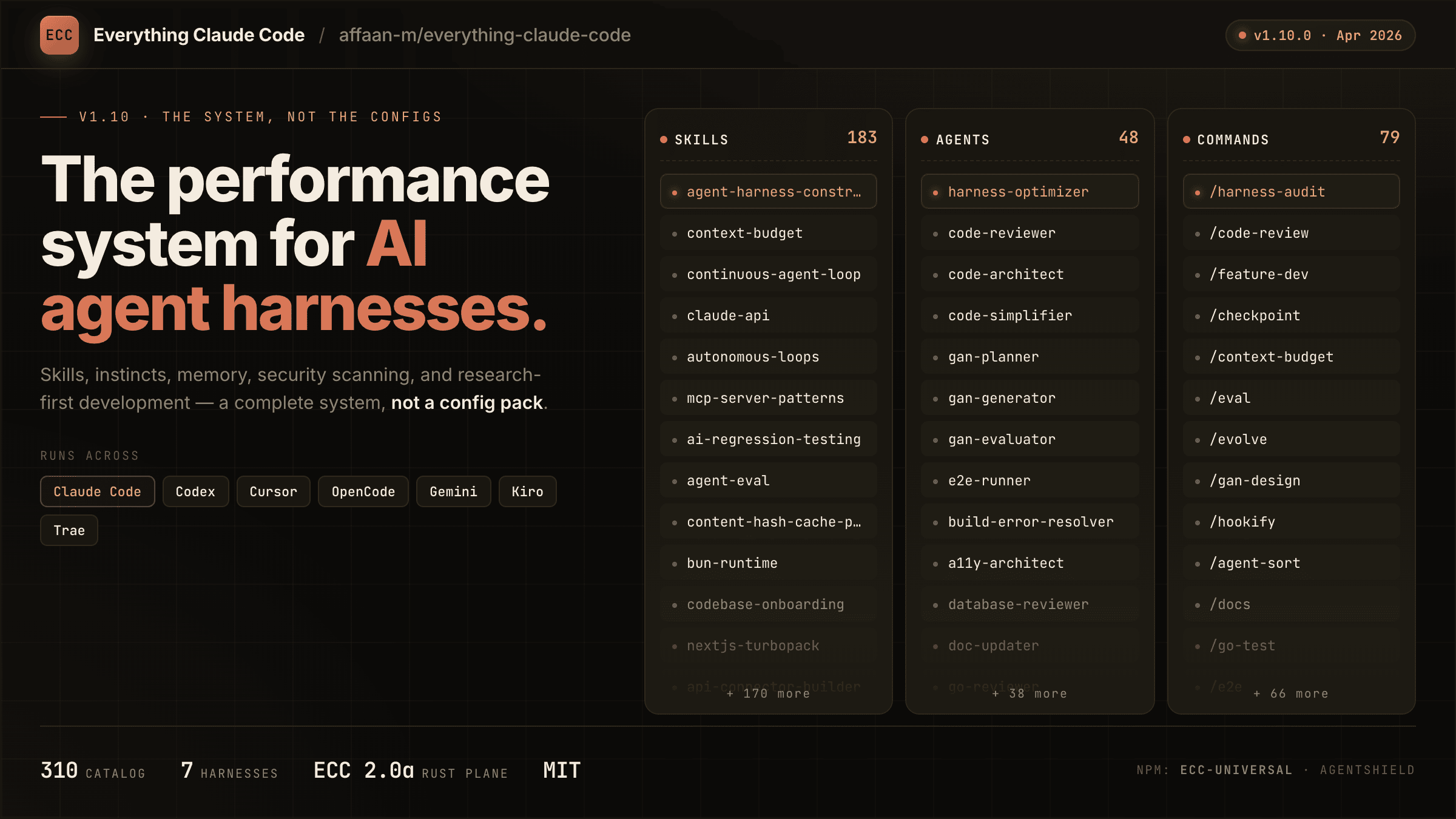
The agent harness performance optimization system. Skills, instincts, memory, security, and research-first development for Claude Code, Codex, Opencode, Cursor and beyond.
- 307k
- JavaScript
- MIT
- 9 h ago
One Evolver plugin for AI agent hosts: hooks-only strategy recall, reuse reports and distillation. Claude Code first.
Repo EvoMap/evolver-agent-plugin, read from GitHub 1 min ago. EvoMap has not joined Take My Repo.
EvoMap/evolver-agent-plugin is a public repo on GitHub by EvoMap. One Evolver plugin for AI agent hosts: hooks-only strategy recall, reuse reports and distillation. Claude Code first. It declares the MIT license on GitHub. It is written mainly in JavaScript, has 1 stars and last changed on 2026-11-20. Nobody has reviewed it on Take My Repo yet, which says nothing about its quality. Read from GitHub on 2026-11-20.

evolver-plugin connects AI agents to Evolver: one plugin, the same on every agent, that gives
it a persistent evolution memory and a live link to the EvoMap network, with
no tools for the model to call. Evolver ships as two projects for now, which will merge into one:
evolver (@evomap/evolver): the engine, with the local Proxy, the memory graph and the Hub
link. The plugin installs it, starts its Proxy and keeps it at a supported version by itself.evolver-plugin (this repository, EvoMap/evolver-agent-plugin): every agent's adapter.Everything runs from the host's hooks or plugin API:
/evolver-status names the last
distillation's outcome, including why the Proxy refused one.Publishing execution-backed drafts requires a trusted Proxy verifier and its publish receipt.
When you publish a draft marked publishable: false, or a legacy draft without a receipt, the plugin first asks POST /asset/reverify
to run trusted verification. If the verifier is unavailable or rejects the draft, it stays local
with the reason shown. HTTP execution traces alone cannot authorize publication. A successful
reverification saves the new bundle and receipt before submission, so a failed submission can
be retried. The Proxy validates the exact receipt and Gene/Capsule/Event bundle when you publish.
This plugin does not configure or enable a trusted verifier; the Proxy's platform and isolation
requirements and validation-command policy still apply. Automatic distillation never calls
reverification or publication.
The plugin is the access layer: shared logic lives in lib/, and each host is a profile in
hosts/<host>/ that says where it differs, plus what the host installs.
| Host | Status | Adapter |
|---|---|---|
| Claude Code 2.1.286+ | Supported | hosts/claude-code, a hooks module relaying to a Node process; installs dist/claude-code |
| WorkBuddy / CodeBuddy | Supported | hosts/workbuddy, command hooks; installs dist/workbuddy |
| Cursor | Supported | hosts/cursor, command hooks; installs the repo root |
| Antigravity | Supported | hosts/antigravity, command hooks; installs dist/antigravity |
| OpenCode 1.19.4+ | Supported | hosts/opencode, an in-process plugin; installs dist/opencode |
| Any MCP client without hooks (Kiro, openclaw, …) | Supported | hosts/mcp-generic, node bin/mcp.mjs mcp-generic over stdio |
| Codex | Supported | hosts/codex, command hooks; installs dist/codex |
| DeepSeek Harness (dsh) | Supported | hosts/dsh, an in-process cordis plugin; installs dist/dsh |
| Grok CLI 1.0.70+ | Supported | hosts/grok, command hooks; the strategy reaches the model at the turn's first tool result; installs dist/grok |
Qoder CLI (qodercli) 1.1.79+ |
Supported | hosts/qoder, command hooks; installs dist/qoder |
| Kimi Code CLI 2.4.1+ and Desktop 1.2.1 | Supported | hosts/kimi, native hooks and isolated ACP distillation; installs dist/kimi |
| MiniMax Code CLI 0.7.4+ / Desktop 3.1.6 | Supported | hosts/minimax, native hooks; installs dist/minimax |
| ZCode Desktop 3.18.2 / CLI 0.17.1 | Supported | hosts/zcode, native hooks; installs dist/zcode |
| Step Code CLI 0.1.7 | Draft | hosts/stepcode, a native resident extension; installs dist/stepcode; paid-provider and real Hub acceptance pending |
| Muse Code | Not yet | No reviewed adapter yet |
| OpenAI Dots, Claude Duet, Grok Bot, Meta Muse | Not yet | Cloud agents without hooks; need Evolver's remote MCP and routines |
Every host runs on one stack (lib/channels, lib/agent, lib/app, lib/runtime), described in
docs/architecture.md; hosts/README.md lists how each host differs.
In Claude Code:
/plugin marketplace add EvoMap/evolver-agent-plugin
/plugin install evolver-plugin@evolver-agent-plugin
The marketplace installs dist/claude-code from the release branch, which CI moves only when a
release tag is pushed; Node.js 22.13+ must be on the PATH (or set node_path in
/config). Restart Claude Code afterwards. To update, refresh the marketplace first, then the
plugin, and restart:
claude plugin marketplace update evolver-agent-plugin && claude plugin update evolver-plugin@evolver-agent-pluginClaude Code updates an installed plugin only when its version changes. A release is one tag on main,
git tag vX.Y.Z && git push origin vX.Y.Z, with no file to edit: CI tests, packs with that version stamped into
every host's manifest, moves release one commit on, points the tag there, publishes the dsh npm package and opens
a GitHub Release. These are separate publication stages. The publish job's summary reports each stage's result, and
completed stages remain available if a later stage fails. Fix the reported failure and rerun the failed workflow
jobs on the same tag while it is the current release. The Git stage reuses its published commit; npm and GitHub
skip releases they already hold. A newer release stops older tags from resuming and replacing npm latest.
A source fix for an npm version already published needs a new version. To try a local build, npm run pack and
add <checkout>/dist/claude-code as the marketplace.
Every host installs the plugin as evolver-plugin. WorkBuddy, Codex, Grok, Qoder, Antigravity, OpenCode and DeepSeek Harness
install a folder packed for them (npm run pack, into dist/<host>), from the release branch. Remove the host's standalone Evolver
plugin first, or every reuse is reported twice; the new one adopts what the old one left (turn counters, open
injections, undelivered reports), so nothing is lost on the way over.
WorkBuddy / CodeBuddy: keep the old plugin's data when you remove it (WorkBuddy deletes a plugin's data folder on uninstall otherwise), then replace its marketplace, which has the same name:
/plugin uninstall evolver@evomap-workbuddy --keep-data   # again with --scope project where it was installed in a project
/plugin marketplace remove evomap-workbuddy
/plugin marketplace add EvoMap/evolver-agent-plugin
/plugin install evolver-plugin@evomap-workbuddy
The marketplace installs dist/workbuddy from the release branch, and the first session moves the old data
folder's files (evolver-evomap-workbuddy) into the new one. WorkBuddy updates an installed plugin only
when its version changes, which the release tag stamps into the packed folder. To try a local
build, npm run pack and add <checkout>/dist/workbuddy as the marketplace instead: the packed folder is a
marketplace of its own.
Qoder CLI: add this repository as a marketplace and install the plugin:
qodercli plugins marketplace add EvoMap/evolver-agent-plugin
qodercli plugins install evolver-plugin@evomap
The marketplace (.qoder-plugin/marketplace.json) installs dist/qoder from the release branch; start a new
session or run /plugins reload. Commands are typed as /evolver-status and answered as a blocked prompt.
Codex: remove the standalone plugin and its marketplace, then add this one:
codex plugin remove evolver@evomap && codex plugin marketplace remove evomap
codex plugin marketplace add EvoMap/evolver-agent-plugin
codex plugin add evolver-plugin@evomap
Then open /hooks in Codex, trust the Evolver hooks, and start a new thread.
Grok CLI: add this repository as a marketplace and install the plugin, trusting its hooks:
grok plugin marketplace add EvoMap/evolver-agent-plugin
grok plugin install evolver-plugin --trust
The marketplace (.grok-plugin/marketplace.json) installs dist/grok from the release branch; start a new
session afterwards. Grok's prompt hooks cannot add context, so the recalled strategy reaches the model at the
turn's first tool result, and a turn answered without any tool call does without it. Commands are typed into the
prompt box (evolver-status, with or without its /) and answered as a blocked prompt; /evolver-evolve is a
Grok command. Each release tag stamps its version into the packed folder; grok plugin update evolver-plugin fetches it.
Cursor: add this repository as a plugin marketplace and install evolver-plugin; it installs the repo itself.
Kimi Code on Windows and macOS: close Kimi, run node scripts/install-kimi.mjs install from a checkout, then start a new CLI or Desktop session. Desktop uses the installed Kimi CLI to create drafts.
--home PATH selects the profile root; use the same absolute KIMI_CODE_HOME when starting Kimi. Close Kimi before
install/update/remove. The installer stages dist/kimi, registers its native kimi.plugin.json bundle and
preserves account config, other plugins, preferences and drafts. A release bundle keeps its bytes and version.
Default install/update refuses to replace a newer managed package. --version X.Y.Z explicitly builds
current sources at the requested version. remove unregisters the plugin while retaining managed bytes.
V1 targets the main agent in local CLI and Desktop sessions on Windows with an API/BYOK provider. Commands run from the terminal:
node <Kimi-home>/plugins/managed/evolver-plugin/bin/command.mjs kimi evolver-status.
Other OAuth regions, web/VS Code, subagents and parallel prompts have separate acceptance gates. This local installer
does not establish support in the external Evolver CLI installer or a Marketplace.
The Kimi adapter guide explains evidence, route identity and isolation.
MiniMax Code: run node scripts/install-minimax.mjs install from a checkout,
then run mcode plugin enable evolver-plugin@local --json and start a
new task. The data root defaults to ~/.minimax; keep the same MINIMAX_DATA_DIR for a separate profile.
A release checkout installs its versioned dist/minimax bundle; --version X.Y.Z builds the current sources explicitly.
The checkout's manifest is .minimax-plugin/plugin.json; source stays in hosts/minimax/.
This is a local installation: MiniMax's current public Marketplace submission format excludes hooks.
Use evolver-status, evolver-drafts and evolver-evolve in chat; evolver-config recall off and
evolver-config auto-distill off save preferences. Longer commands run as background jobs; use
evolver-jobs, evolver-jobs job <id> or evolver-jobs cancel <id> to inspect or cancel them.
The MiniMax adapter guide covers updates, session-model distillation, private
configuration copies and recovery when a host exits without SessionEnd.
ZCode CLI on Windows and macOS: add the marketplace
https://raw.githubusercontent.com/EvoMap/evolver-agent-plugin/main/.zcode-plugin/marketplace.json with
plugins marketplace add, then plugins install evolver-plugin@evomap --scope user. Enable plugins and hooks, then
start a new session. The ZCode adapter guide covers native verification and private
distillation with a standalone CLI bundle.
ZCode Desktop on Windows and macOS: add the same marketplace URL in Settings → Plugins, install and enable
evolver-plugin, then start a new session.
Step Code CLI 0.1.7 on Windows and macOS (draft): build dist/stepcode with npm run pack, then run
step install ./dist/stepcode and start a new session. This uses Step's native extension interface.
Read the Step Code adapter guide for foreground verification requirements
and the native double Ctrl-C cleanup limitation before trying this draft.
Antigravity: agy plugin uninstall evolver-antigravity-plugin, then from the release branch,
git clone --depth 1 --branch release https://github.com/EvoMap/evolver-agent-plugin.git and
agy plugin install evolver-agent-plugin/dist/antigravity.
Its commands run from a terminal: node <installed plugin>/bin/command.mjs antigravity evolver-status (or
evolver-search <text>, evolver-distill, evolver-drafts publish 1, …).
OpenCode: opencode plugin <release clone>/dist/opencode (the folder is the @evomap/evolver-opencode
package, not published to npm yet); remove the old evolver-opencode-plugin first, or every reuse is reported
twice.
DeepSeek Harness: each dsh profile loads its own plugins; for every profile you use (dsh-tui, web,
headless), remove the standalone @evomap/dsh-evolver first, then add the new one from npm, and
restart dsh:
dsh plugin --profile dsh-tui remove @evomap/dsh-evolver
dsh plugin --profile dsh-tui add -w @evomap/dsh-evolver@latest
Each release publishes dist/dsh to npm as @evomap/dsh-evolver (shown in dsh as evolver-plugin), replacing
the standalone plugin of that name.
An MCP client without hooks: in a checkout, npm ci (the server needs the MCP SDK), then register
node <checkout>/bin/mcp.mjs mcp-generic as an stdio MCP server.
| Command | What it does |
|---|---|
/evolver-status |
Proxy state, engine setup, Hub sign-in, the work waiting to be distilled, the last distillation's outcome and waiting drafts |
/evolver-login |
Signs you in to the EvoMap Hub with a device code (setting Evolver up first when needed) and shows the registered node |
/evolver-search <task or error text> |
Finds the best matching network strategy |
/evolver-distill [focus] |
Distills the session's work since its last distillation into drafts now, even below the three-turn threshold |
/evolver-drafts [publish|discard <number>] |
Lists drafts; publishes one for Hub review or drops it |
/evolver-evolve [focus] |
An evolution checkpoint the agent answers |
/evolver-run, /evolver-review, /evolver-solidify and /evolver-sync drive the Evolver CLI. How each host
reaches the commands is in hosts/README.md.
Local memory works without an account. To reuse strategies from the network, sign in from your agent:
/evolver-login. When Evolver is missing, the plugin installs it and starts its Proxy first; then it starts
Evolver's own sign-in (evolver login) in the background and answers a link and a code./evolver-login again: it names the node the Proxy registered. Evolver answers this at once only within about
an hour of an approval, while its stored token has more than five minutes left; later, /evolver-login asks you to
approve a new code, although Evolver's other commands keep using the sign-in./evolver-status shows a sign-in still waiting for approval, with its link and code.
Network recall needs @evomap/evolver 2.0.39 or newer.
Node.js 22.13+, plus a supported host from the table above.
Commands, settings and troubleshooting are in docs/architecture.md.
npm ci
npm test
npm run pack
claude --plugin-dir dist/claude-code
Packing follows each entry's module imports. The Kimi pack manifest opts in to the pinned smol-toml@1.9.1
ESM closure and its BSD-3-Clause license. Its static import points to a relative file in the installed bundle.
Run npm ci before packing Kimi from source.
MIT © EvoMap.
EvoMap/evolver-agent-plugin is a public repo on GitHub by EvoMap. One Evolver plugin for AI agent hosts: hooks-only strategy recall, reuse reports and distillation. Claude Code first.
It declares the MIT license on GitHub.
Its maker has not tagged a system, so it is unknown here. Its README says what it needs.
Open "Take it" on its page: Take My Repo writes an install plan for your machine and hands it to your AI agent (Claude Code, Codex or Cursor), which asks you before each step. Take My Repo has not tested it on any machine.
Its last change on GitHub was on 2026-11-20. Take My Repo does not judge from that whether it is maintained.
Nobody has reviewed it on Take My Repo yet, which says nothing about its quality.
The agent harness performance optimization system. Skills, instincts, memory, security, and research-first development for Claude Code, Codex, Opencode, Cursor and beyond.
Reverse engineer anything with agents, from app behavior down to native binaries.
Fair-code workflow automation platform with native AI capabilities. Combine visual building with custom code, self-host or cloud, 400+ integrations.
Knowledge infrastructure to make your agents smarter. Search, scrape and 550+ data providers through one API.
The GEP-powered self-evolving engine for AI agents. Auditable evolution with Genes, Capsules, and Events. | evomap.ai
AI/ML research agents from idea to paper-ready evidence. An EvoMap open-source project.
A curated list of AI Agent evolution, memory systems, multi-agent architectures, and self-improvement projects. | evomap.ai
A curated list of AI Agent Swarm frameworks, multi-agent orchestration, swarm intelligence, and collaborative agent systems.
Official Claude Code plugin for Evolver — GEP-powered self-evolution for AI agents. Part of EvoMap.