MiroFish
A Simple and Universal Swarm Intelligence Engine, Predicting Anything. 简洁通用的群体智能引擎,预测万物
- 87k
- Python
- AGPL-3.0
- 6 wk ago
Turn isolated Claude sessions into a continuous working relationship
Repo Facets-cloud/flow, read from GitHub 2 d ago. Facets-cloud has not joined Take My Repo.
Facets-cloud/flow is a public repo on GitHub by Facets-cloud. Turn isolated Claude sessions into a continuous working relationship. It declares the MIT license on GitHub. It is written mainly in Go, has 109 stars and last changed on 2026-11-24. Nobody has reviewed it on Take My Repo yet, which says nothing about its quality. Read from GitHub on 2026-11-24.
A Simple and Universal Swarm Intelligence Engine, Predicting Anything. 简洁通用的群体智能引擎,预测万物
Website · Install · Demo · Changelog
You run Claude Code or Codex. You say "let's pick up the billing migration"
and the session for that work opens where it stopped, with its notes read.
You say "pick up issue 59, I'm going to sleep, find me on Slack if you need a
decision" and go to sleep. flow is the small local CLI underneath that makes
those sentences work: each piece of work gets a name, a session, a brief,
dated notes and a mailbox. SQLite and markdown in ~/.flow. You talk to the
agent; the agent runs flow.
If you run three or more agent sessions a day and lose track of them, keep reading. If one session at a time works for you, you do not need this.
Skip everything below and try it for a week. It makes the AI you already use
better and more predictable: your work gets names, your sessions stop
forgetting, and you ask one place what happened instead of rereading ten
chats. The first two days are irritating, because it asks you to name
things and interviews you about them. Around day three it becomes the thing
you would not give back. If that is not true for you after a week, delete
~/.flow and nothing is left behind.
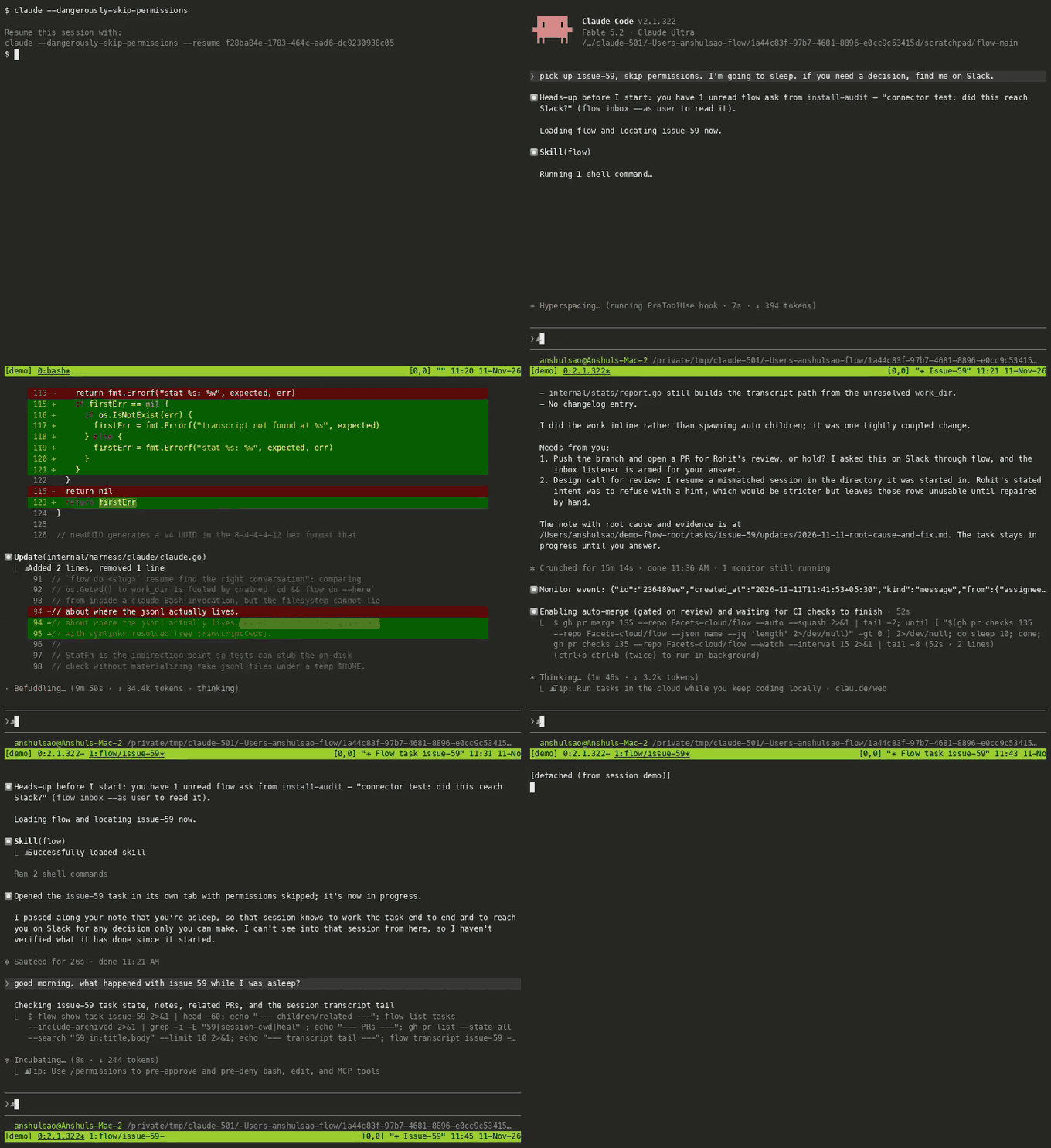
One take, unedited except for speed. Recorded 11 November 2026 on a clean flow root, with a real open issue on this repo.
 the sentence   "pick up issue-59, skip permissions. I'm going to sleep. if you need
                 a decision, find me on Slack."
 25 minutes     the task reads the issue, reproduces it, writes 8 failing tests, fixes,
 (shown at 10x) runs the suite. Nobody told it how. The brief was eight lines.
 the question   on its own it asks, over Slack: "fixed + tested on a local branch,
                 nothing pushed. Push and open a PR?  Push + open PR | Hold"
 the reply      typed in Slack: "push and open PR". It reaches the task in seconds.
 the morning    "what happened with issue 59 while I was asleep?" answered from the
                 task's note, including two things it could not verify.
 the result     PR #135 (https://github.com/Facets-cloud/flow/pull/135), CI green,
                 waiting for a human review. Nothing merged by an agent.
Two honest notes on that take. The task could have split the work into headless children and chose not to; it judged the fix small. And the Slack reply was typed at the top level, not in the thread, which the connector did not expect; it does now.
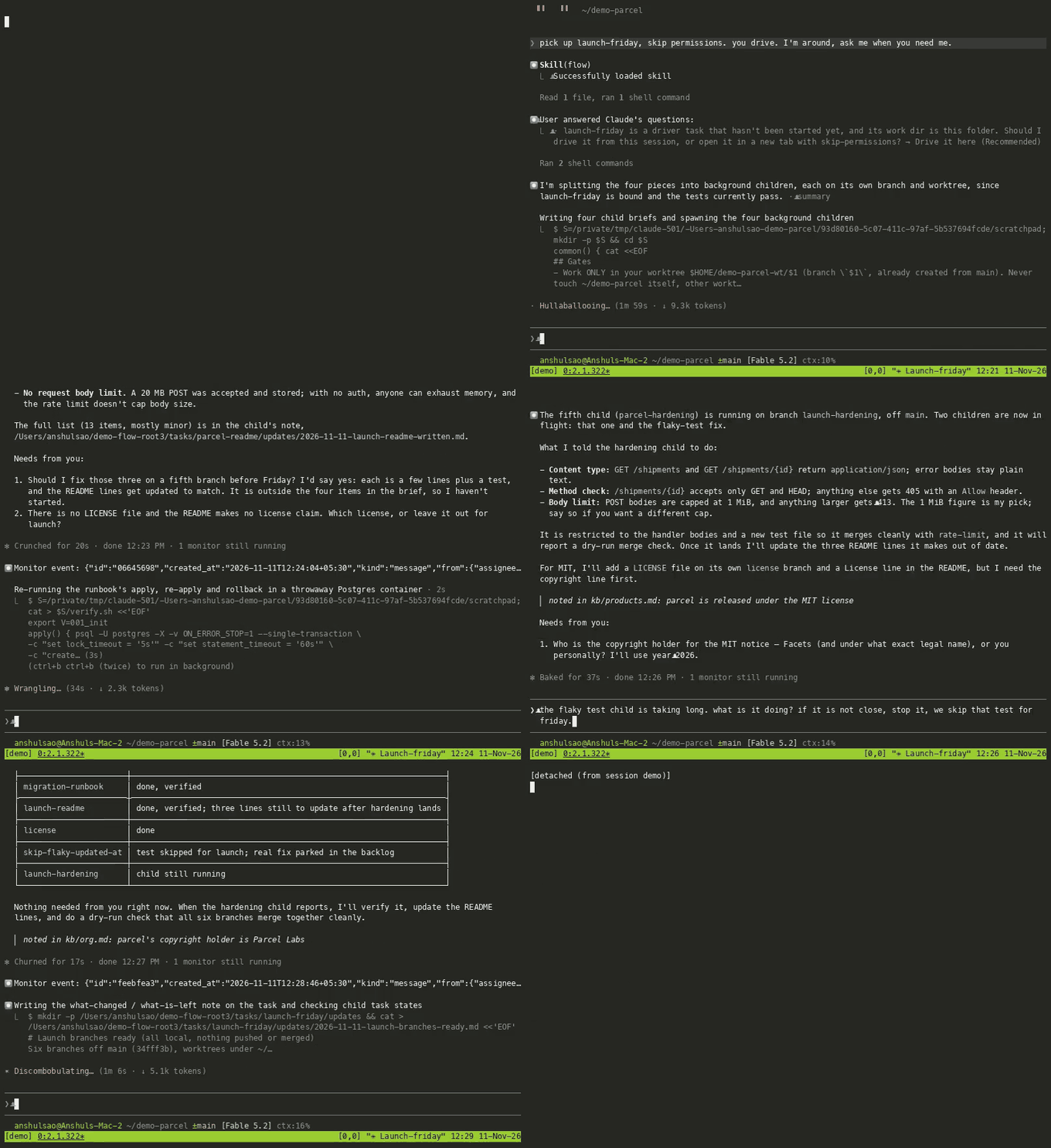
A fictional Go service with four things left before a Friday launch. One sentence binds the session as the driver. On its own it splits the work into four headless children, asks five questions in one batch with defaults if you stay silent, verifies each child's branch before trusting it, spawns a fifth child for bugs it found on the way, stops a slow child when told to and parks the real fix in the backlog, dry-merges all six branches in a scratch worktree, and closes the task with a note. Nothing pushed. Real time 11 minutes; the working stretches run at 30x.
Rohit Raveendran started flow in April 2026 at Facets. He and I (Anshul Sao) maintain it now, with contributors. I am its heaviest user, so this README is the user's account, not the maker's: the numbers come from my laptop, the messages are real, and the rough edges are ones I hit.
The problem, in the words people use for it: you run several sessions and keep losing track of them. One sits idle for an hour on a "Should I proceed?" you cannot see. Another compacts and asks what you want to work on, so you re-explain the task and pay again for the same discovery. Background work says "running" until a human notices it died. Overnight runs come back half-finished, and the only record is a transcript nobody reads.
claude --resume gets one conversation back. It does not give the work a
name, tell the session where its notes are, let it hand work to another
session, tell you which one needs you, or reach you when you are not looking.
That is the part flow adds.
level 1   names and notes                    nothing runs unattended, nothing is skipped
  "add a task for the billing migration"     a brief, a folder, a session with a name
  "let's pick up the billing migration"      the session opens where it stopped, notes read
  "note that the token expiry is 900s"       a dated note the next session will read
  "what happened on billing while I was out" answered from the notes, not your memory
  "what's on my plate"                       every task, which is waiting on whom

level 2   playbooks                          a brief that reruns, and gets better
  "make this a nightly playbook"             each run is a task with its own session and note
  a run that learns something proposes an edit to the brief; you approve; the
  next run starts smarter. Mine today: a daily cloud-cost diff, a Slack channel
  watch, a nightly production release with a before and after health check,
  a daily post draft. The post draft has been rewritten five times in a week.
  The channel watch has run 138 times and never needed a change.

level 3   children and the bus               sessions that work for your session
  "drive this end to end, use children"      one task you talk to runs several you do not
  "I'm asleep, find me on Slack"             the task asks when it must; you answer from
                                             Slack, a dialog, or any session
  "spawn a child to re-test risk 2"          when you want to decide the split yourself
  children run with permissions skipped. Brief them with gates.
Most people install for level 1. Level 3 is where my days now happen.
Real messages from my logs, 10 November, names changed. Everything I typed is a sentence to Claude Code.
10:18  me: "drive this end to end. use children."
       by 10:22 five children are reading, each with a brief the driver wrote

16:34  child -> driver  "gateway wedged, all calls timing out. My parallel scans
                         likely saturated it. Stopped them, backing off."
       driver -> others "Hold ALL gateway calls until I message you."

16:41  child -> driver  "done: PR #133, trust work_dir before launch, tests green"
       a flow bug I had hit at 11:04, fixed while the day's work kept running

20:14  dialog on my Mac: "OK for the regression check to send 1 real sign-in
                          link per run? Reply with the recipient address."
22:07  me:               "go ahead"
What came out of the day: a proposal corrected by mid-afternoon because a child found the kickoff assumption was wrong, one flow PR merged, one regression check shipped that night, five analysis notes on disk.
day 1    "add a task for the thing I'm mid-way on". Close the tab. That is all.
day 2    "let's pick up <that thing>". It opens where you left it, notes read.
         This is where it clicks or does not.
week 1   a second task, a third. "what happened on X" becomes a question you
         ask the task, not your memory. First playbook if you have a chore.
week 3   "drive this, use children". One task you talk to runs three you do
         not. You start writing briefs instead of prompts.
month 1  something runs while you sleep and asks you one question in the
         morning, with its notes attached. Or it does not, and you are still
         happy at level 1.
From my logs this month, names changed. I cannot link private logs; where a public pull request documents the behaviour, it is linked.
Two siblings settled a schema in one minute, with nobody watching.
worker-a -> worker-b  "I'll add FixNote{Change,Note,By,At} as Finding.FixNotes,
                       bson 'fix_notes', array, $push. Please use the same so
                       the UI reads it. OK?"
worker-b -> worker-a  "OK. I'll define the identical struct in my branch too,
                       same text so the rebase is trivial."
worker-a -> worker-b  "FYI: detector/judge/sweeper ReplaceOne whole docs and
                       would wipe fix_notes. I'm switching to $set; you only
                       need $push."
A one-line steer reached a running child in five minutes.
me:              "dont sequencilize work merging deployment u can"
driver -> child  "CHANGE (from the human: don't sequence): release main NOW,
                  don't wait for #10. Keep polling main and release again
                  whenever it moves. Report each release."
Four releases followed in the next hour. Driver tasks exist because I typed "status" about sixty times on an earlier 42-child task (#117).
An owner called a production incident correctly.
For 52 days this summer an owner swept one production service roughly hourly: 460 graded sweeps, 161 issues and PRs filed, 71 fix tasks of which 51 closed. How many of the 161 were noise I cannot tell you from the record. On 30 July its sweep read: "MongoDB lost quorum at 14:49:42Z and writes were blocked for 6m34s. For the first time in this ledger's history the replica set fell to 1 of 3 with no PRIMARY." It was right. I paused it on 31 July and never wrote down why.
Isn't this just claude --resume? For level 1, mostly, plus a name, a
brief, notes the next session reads, and a record that outlives the
transcript. Levels 2 and 3 are the part resume does not have.
Isn't this just subagents? Subagents live inside one chat and die with it. flow tasks outlive the chat, have names, and talk to each other.
Isn't this a memory product? No. Memory tools write facts behind your back and you cannot see what loaded. flow keeps work: a brief you wrote, notes you can read, a transcript you can open. When a session says it knows where you left off, you can see the note it read.
Isn't this Jira for agents? No. Nothing here is for a team. It is one person's laptop. Some people stretch it across a team and the issues show it. It is not built for that, and I will not pretend it is.
Do I have to learn a CLI? No. The agent runs it. The commands exist for scripts and for the curious; I use two of them a month.
Will it nag me? Once. When you cross 25 closed tasks, flow done prints
one note with your real count asking for a GitHub star and your agent relays
it, then never again; FLOW_QUIET=1 turns even that off.
Why is there a flow line on my PRs? Sessions bound to a flow task are told
to end a PR description with "Shipped from a flow task." It is an instruction
to the agent, not a rewrite of your command; FLOW_PR_TRAILER=off drops it.
Why should I believe you? You should not. Read the next two sections.
works with      Claude Code and Codex as the session harness. Terminals: iTerm,
                Terminal.app, Warp, kitty, Ghostty, zellij, tmux. No terminal:
                headless, resume by name.
Codex           parity shipped in alpha.35. Honesty: all 479 of my tasks in the
                last fortnight ran on Claude. The Codex path is tested by
                contributors, not by my daily use.
a colleague     an opt-in peer link lets your flow message a colleague's flow
                and their human. Mail between two laptops, not a shared board.
does not        Jira, Linear, GitHub Issues: no integration, none planned.
                Teams: no shared state. Windows: no.
scheduling      not in flow today. My playbooks fire from launchd plists I
                copied by hand. flow schedule (launchd, systemd, cron) is in
                review ([#130](https://github.com/Facets-cloud/flow/pull/130)).
reaching you    connectors are small scripts: a macOS dialog ships with flow, the
                Slack one in the video is 60 lines of bash and will ship as a
                sample. Without one, asks wait in your inbox until you look.
As of 11 November 2026, on the current alpha.
~/.flow.Facets-cloud/flow is a public repo on GitHub by Facets-cloud. Turn isolated Claude sessions into a continuous working relationship.
It declares the MIT license on GitHub.
Its maker tagged it for macOS. That is declared by the maker; Take My Repo has not tested it.
Open "Take it" on its page: Take My Repo writes an install plan for your machine and hands it to your AI agent (Claude Code, Codex or Cursor), which asks you before each step. Take My Repo has not tested it on any machine.
Its last change on GitHub was on 2026-11-24. Take My Repo does not judge from that whether it is maintained.
The agent harness performance optimization system. Skills, instincts, memory, security, and research-first development for Claude Code, Codex, Opencode, Cursor and beyond.
CLI proxy that reduces LLM token consumption by 60-90% on common dev commands. Single Rust binary, zero dependencies
Reverse engineer anything with agents, from app behavior down to native binaries.
🌊 The original agent harness. Deploy intelligent multi-player swarms, coordinate autonomous workflows, and build conversational AI systems. Features adaptive memory, self-learning intelligence, federation, vector RAG integration, and native Claude Code / Codex / Hermes and many more Integrated
Nobody has reviewed it on Take My Repo yet, which says nothing about its quality.
Take My Repo cannot say: it does not audit code and has not run flow. What is known comes from GitHub. It declares the MIT license on GitHub. Its last change was on 2026-11-24. It has 109 stars, which measure popularity, not safety. Nobody has reviewed it on Take My Repo yet, which says nothing about its quality. Read the source before you run it. With "Take it", your AI agent shows each step and asks you before running it; README text is treated as data, not as instructions.