
SimWAM
SimWAM: A Simple World Action Model for End-to-End Autonomous Driving.
- 212
- 8 wk ago
Repo H-EmbodVis/SimWAM, read from GitHub 9 min ago. H-EmbodVis has not joined Take My Repo.
In short
H-EmbodVis/SimWAM is a public repo on GitHub by H-EmbodVis. SimWAM: A Simple World Action Model for End-to-End Autonomous Driving. It declares no license on GitHub. Public does not mean open source: without a license, nobody is granted the right to reuse it. It is written mainly in Python, has 212 stars and last changed on 2026-09-28. Nobody has reviewed it on Take My Repo yet, which says nothing about its quality. Read from GitHub on 2026-11-25.
AI models this project points to
SimWAM: A Simple World Action Model for End-to-End Autonomous Driving
Zongchuang Zhao1, Xin Zhou1, Tianyang Xu1, Zhengyang Sun1, Kaixuan Zhou2, Honglin Li2, Dingkang Liang1†, Xiang Bai1
1 Huazhong University of Science & Technology
2 Dongfeng Research & Development Institute
† Project leader.
This repository provides the official implementation of SimWAM for the paper A Simple World Action Model for End-to-End Autonomous Driving, including supervised training and action-only reinforcement learning on NAVSIM.
📣 News
2026.08.19: Released the SimWAM code and weight on the PhysicalAI-AV dataset.2026.08.07: Released the SimWAM paper, code and weight.
📄 Abstract
In autonomous driving, World-Action Models (WAMs) have improved end-to-end planning by transferring video dynamics priors to action prediction, but many still couple planning with future-video generation at inference, incurring substantial computational overhead. We present SimWAM, a simple yet effective WAM that leverages future-video prediction solely as a training-time supervision signal. It co-trains a pretrained video expert and a lightweight action expert with joint flow matching. An isolated attention mask keeps action prediction independent of future frames, allowing trajectory prediction without future-frame generation at inference. This design supports multiple pretrained video backbones and independent action-expert scaling within a shared attention interface, while preserving the joint learning objective. Moreover, we apply reinforcement learning to optimize a compositional driving reward beyond trajectory imitation. Experiments show that SimWAM achieves 91.9 PDMS on NAVSIM with a favorable trade-off between accuracy and latency among world-model-based planners, while transferring zero-shot to nuScenes. It also achieves competitive planning accuracy on WOD-E2E and PhysicalAI-Autonomous-Vehicles. These results position SimWAM as a plain yet solid baseline for efficient autonomous driving.
🔍 Overview

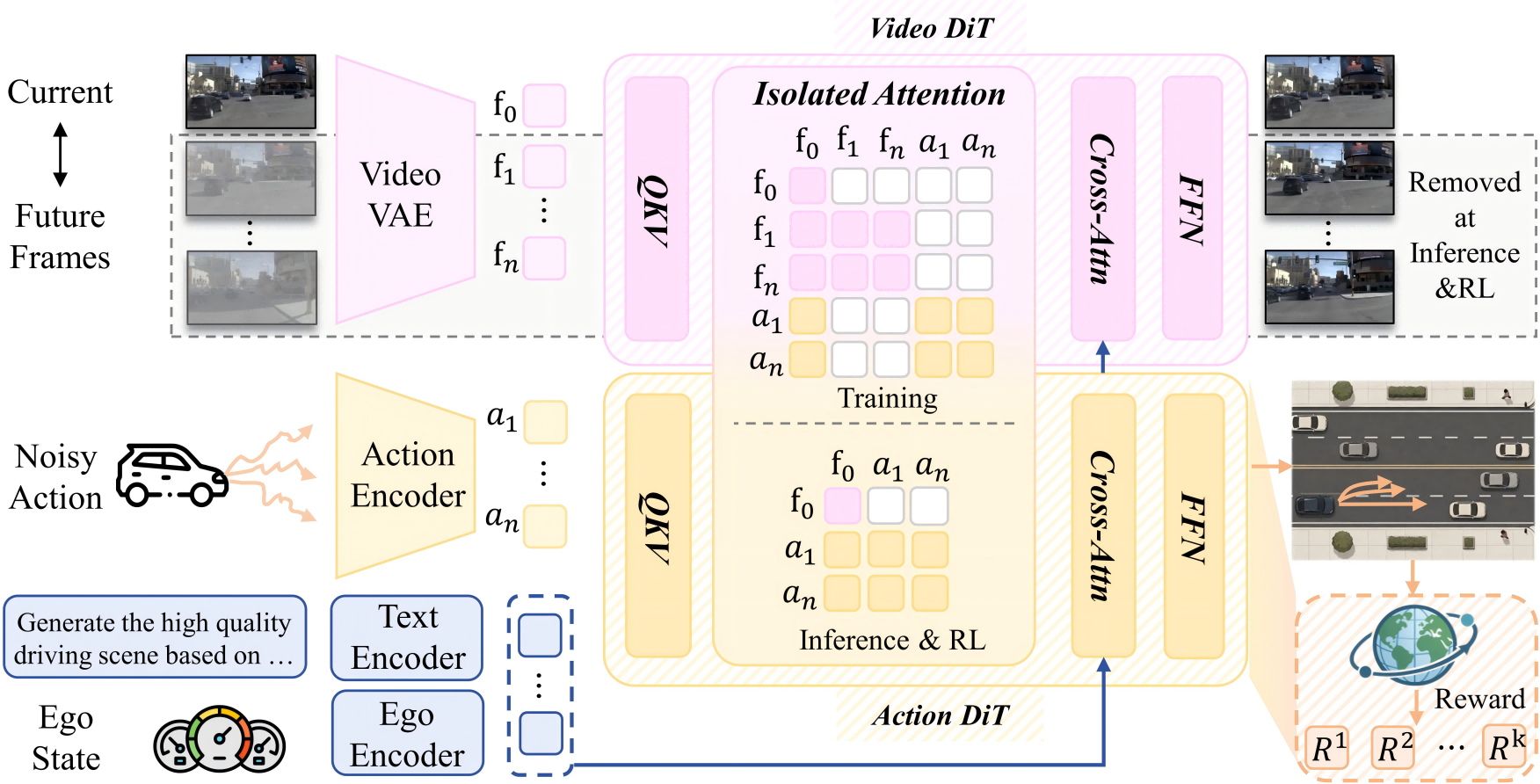
Overview of SimWAM. During training, the video and action DiTs are jointly optimized for future-frame generation and trajectory prediction via shared attention, while the isolated mask prevents the action tokens from accessing future-frame tokens. During inference and reinforcement learning, the model directly predicts trajectories without explicitly predicting future frames.
- Joint flow-matching co-training. The video expert — a video Diffusion Transformer initialized from Wan2.2-5B together with its video VAE and T5 text encoder — and a lightweight action DiT (hidden size 1024) are co-trained with joint flow matching over future-frame latents and trajectories. Future-video prediction serves as a training-time supervision signal that transfers a traffic-aware dynamics prior into the shared observation representation used for planning.
- Isolated attention mask. Future-frame tokens and action tokens both attend to the current observation latents while remaining mutually invisible, keeping action prediction independent of future frames. This mask is the only structural modification required to isolate the action tokens from future-frame information.
- Direct trajectory prediction at inference. Because the action expert never depends on future-frame tokens, explicit future-frame generation is omitted at deployment: the standalone action DiT directly predicts trajectories without auxiliary motion modules, substantially reducing inference latency.
- Reinforcement learning. The deterministic flow ODE is reformulated as a marginal-preserving SDE, and a group of candidate trajectories per scenario is optimized with FlowGRPO against the compositional NAVSIM PDM reward. RL focuses on the hard
navtrainscenarios with the lowest PDMS after imitation learning and updates only the LoRA adapters of the action expert. The same recipe transfers to the Waymo Open Dataset E2E benchmark with the official Rater Feedback Score as the reward. - Flexibility. The two experts share no weights and interact only through the unified attention interface: the video backbone is replaceable (e.g., LTX-Video, Wan2.1-1.3B, Cosmos2.5, Wan2.2-5B) and the action expert is independently scalable (0.21B–1.02B) without modifying the learning objective or inference pipeline.
📈 Performance

SimWAM achieves the best PDMS among world-model-based planners, with a favorable trade-off between accuracy and latency on one A100 GPU.
NAVSIM navtest
Using only a single front camera at 384×672, SimWAM establishes a new state of the art on NAVSIM navtest, surpassing the strongest VLM-based planner SGDrive by 0.8 points and ExploreVLA, which explicitly incorporates future image prediction, by 1.5 points. It further outperforms the imagine-then-act WAMs DriveLaW and DriveVA by 2.8 and 1.0 points, respectively. Moreover, the co-trained video expert achieves the lowest FVD of 36.3, compared with 53.6 for the next-best method.
| Method | Reference | Sensors | NC↑ | DAC↑ | EP↑ | TTC↑ | C↑ | PDMS↑ |
|---|---|---|---|---|---|---|---|---|
| Human Agent | - | - | 100.0 | 100.0 | 87.5 | 100.0 | 99.9 | 94.8 |
| Traditional E2E planners | ||||||||
| UniAD | CVPR'23 | 6×C | 97.8 | 91.9 | 78.8 | 92.9 | 100.0 | 83.4 |
| TransFuser | TPAMI'22 | 3×C+L | 97.7 | 92.8 | 79.2 | 92.8 | 100.0 | 84.0 |
| DiffusionDrive | CVPR'25 | 3×C+L | 98.2 | 96.2 | 82.2 | 94.7 | 100.0 | 88.1 |
| WoTE | ICCV'25 | 3×C+L | 98.5 | 96.8 | 81.9 | 94.9 | 99.9 | 88.3 |
| SeerDrive | NeurIPS'25 | 3×C+L | 98.4 | 97.0 | 83.2 | 94.9 | 99.9 | 88.9 |
| VLM-based planners | ||||||||
| AutoVLA | NeurIPS'25 | 3×C | 98.4 | 95.6 | 81.9 | 98.0 | 99.9 | 89.1 |
| ReCogDrive | ICLR'26 | 1×C | 97.9 | 97.3 | 87.3 | 94.9 | 100.0 | 90.8 |
| DriveVLA-W0 (Flow-Matching) | ICLR'26 | 1×C | 98.4 | 95.3 | 80.9 | 95.2 | 100.0 | 87.2 |
| DriveVLA-W0 (Query-Base) | ICLR'26 | 1×C | 98.7 | 99.1 | 83.3 | 95.3 | 99.3 | 90.2 |
| ExploreVLA | ECCV'26 | 1×C | 98.8 | 98.4 | 83.5 | 96.5 | 99.9 | 90.4 |
| SGDrive | CVPR'26 | 1×C | 98.6 | 97.8 | 85.8 | 96.2 | 100.0 | 91.1 |
| World-model-based planners | ||||||||
| Epona | ICCV'25 | 1×C | 97.9 | 95.1 | 80.4 | 93.8 | 99.9 | 86.2 |
| PWM | NeurIPS'25 | 1×C | 98.6 | 95.9 | 81.8 | 95.4 | 100.0 | 88.1 |
| DriveLaW | CVPR'26 | 1×C | 99.0 | 97.1 | 81.3 | 96.7 | 100.0 | 89.1 |
| DriveVA | ECCV'26 | 1×C | 99.2 | 97.5 | 83.5 | 98.7 | 100.0 | 90.9 |
| DriveWAM | arXiv'26 | 1×C | 98.3 | 98.1 | 84.3 | 95.2 | 100.0 | 90.1 |
| SimWAM (Ours) | - | 1×C | 98.5 | 99.1 | 86.5 | 96.1 | 99.8 | 91.9 |
Future-video generation quality
All methods use a 4 s horizon at 2 Hz on navtest.
| Metric | SVD | DrivingGPT | Uni-World VLA | PWM | ForgeDrive | DriveDreamer-Policy | SimWAM (Ours) |
|---|---|---|---|---|---|---|---|
| FVD↓ | 227.5 | 142.6 | 141.8 | 86.0 | 69.2 | 53.6 | 36.3 |
Component analysis
Video-expert fine-tuning, future-video supervision, and reinforcement learning contribute complementary gains, improving PDMS by 5.4 points while preserving the simplicity and efficient inference of the standalone action expert.
| Configuration | NC | DAC | EP | TTC | PDMS |
|---|---|---|---|---|---|
| Action expert only | 98.0 | 95.2 | 81.0 | 93.8 | 86.5 |
| + Video expert fine-tuning | 98.2 | 96.8 | 82.6 | 94.5 | 88.4 |
| + Future-video supervision | 98.6 | 98.0 | 84.0 | 95.8 | 90.3 |
| + RL | 98.5 | 99.1 | 86.5 | 96.1 | 91.9 |
Qualitative results

Qualitative comparison on two
navtest scenarios. After reinforcement learning, the ego commits further along the route while staying collision-free within the drivable area.
NAVSIM v2 (navtest)
We further evaluate SimWAM on NAVSIM-v2, which adopts a reactive simulation protocol and the unified EPDMS metric. In addition to the original PDMS terms, EPDMS considers Driving Direction Compliance (DDC), Traffic Light Compliance (TLC), Lane Keeping (LK), History Comfort (HC), and Extended Comfort (EC). All NAVSIM-v2 experiments are conducted without reinforcement learning, where SimWAM attains the highest EPDMS of 90.2, surpassing DriveLaW by 1.6 points.
Questions
What is SimWAM?
H-EmbodVis/SimWAM is a public repo on GitHub by H-EmbodVis. SimWAM: A Simple World Action Model for End-to-End Autonomous Driving.
Is SimWAM open source?
It declares no license on GitHub. Public does not mean open source: without a license, nobody is granted the right to reuse it.
Does SimWAM run on macOS, Windows or Linux?
Its maker has not tagged a system, so it is unknown here. Its README says what it needs.
How do I install SimWAM?
Open "Take it" on its page: Take My Repo writes an install plan for your machine and hands it to your AI agent (Claude Code, Codex or Cursor), which asks you before each step. Take My Repo has not tested it on any machine.