delly
DELLY2: Structural variant discovery by integrated paired-end and split-read analysis
- 543
- C++
- BSD-3-Clause
- 10 d ago
A Python toolkit for bulk RNA-seq analysis of the tumor microenvironment and immunity, transforming raw sequencing data into comprehensive microenvironment insights.
Repo IOBR/IOBRpy, read from GitHub 19 h ago. IOBR has not joined Take My Repo.
IOBR/IOBRpy is a public repo on GitHub by IOBR. A Python toolkit for bulk RNA-seq analysis of the tumor microenvironment and immunity, transforming raw sequencing data into comprehensive microenvironment insights. It declares the MIT license on GitHub. It is written mainly in C++, has 23 stars and last changed on 2026-11-17. Nobody has reviewed it on Take My Repo yet, which says nothing about its quality. Read from GitHub on 2026-11-24.
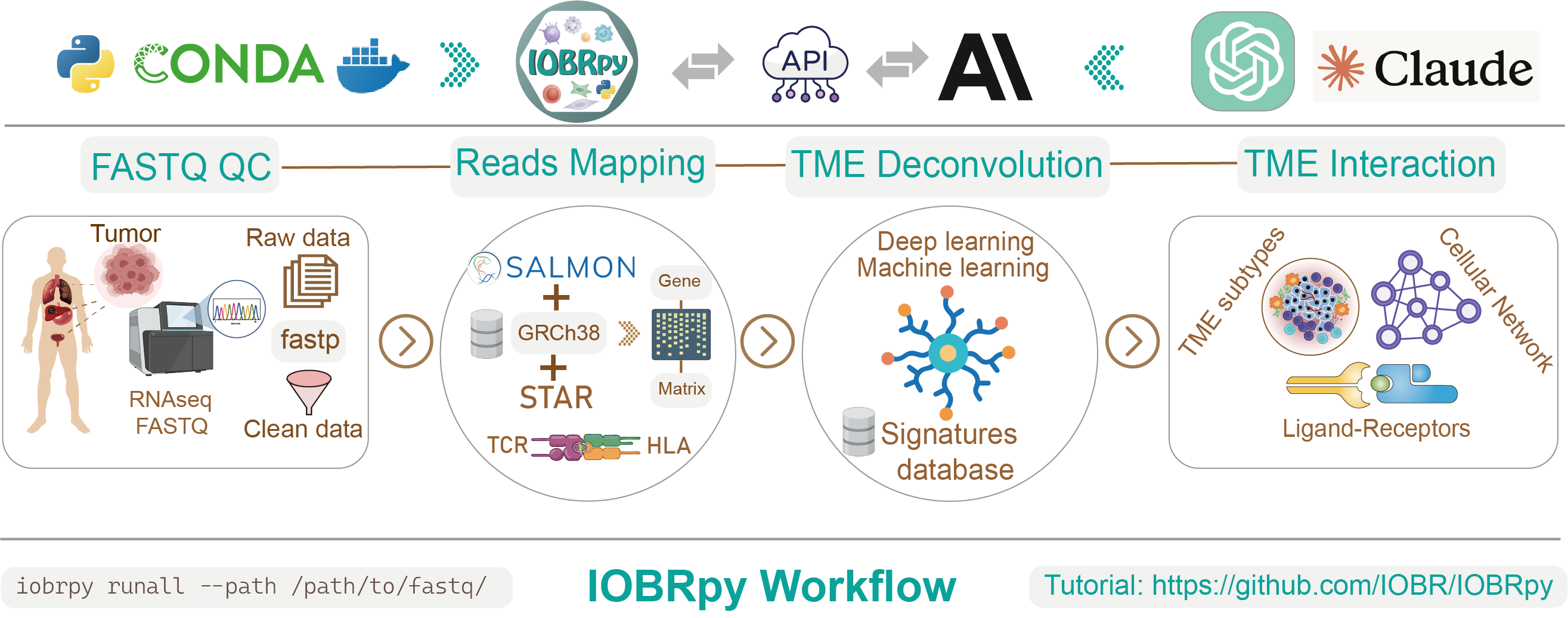
IOBRpy is a command-line toolkit for bulk RNA-seq analysis, including tumor microenvironment (TME) profiling. It combines FASTQ QC, quantification (Salmon or STAR), matrix assembly, signature scoring, immune deconvolution, clustering, and ligand-receptor scoring. It also supports HLA typing, TCR/BCR repertoire analysis, and alternative splicing analysis.
A complete documentation for IOBRpy can be found at https://iobr.github.io/IOBRpy/.
Preprint: The preprint of this work is now available on bioRxiv.
For a complete FASTQ-to-TME example, see the IOBRpy online tutorial.
IOBRpy can be installed from PyPI, Bioconda, or Docker. Choose one method; you do not need to install all three.
# Method 1: PyPI
pip install iobrpy

# Method 2: Bioconda
conda install -c conda-forge -c bioconda iobrpy

# Method 3: Docker
docker pull hhn123123/iobrpy:latest
# Creating a virtual environment is recommended
conda create -n iobrpy python=3.11 pip -y
conda activate iobrpy
# Update pip
python -m pip install --upgrade pip
# Install iobrpy
pip install iobrpy
# Install fastp, salmon, STAR, MultiQC and samtools
# Recommended: use mamba for faster solves (if available)
mamba install -y -c conda-forge -c bioconda \
  fastp \
  salmon \
  star \
  trust4 \
  samtools=1.21

# If you don't have mamba, use conda instead
conda install -y -c conda-forge -c bioconda \
  fastp \
  salmon \
  star \
  trust4 \
  samtools=1.21
Prerequisite (Conda): Please install Miniconda or Anaconda first. We recommend Miniconda.
# Creating a virtual environment is recommended
conda create -n iobrpy python=3.11 -y
conda activate iobrpy
# Install iobrpy from bioconda via conda-forge + bioconda
# Recommended: use mamba for faster solves (if available)
mamba install -y -c conda-forge -c bioconda iobrpy

# If you don't have mamba, use conda instead
conda install -y -c conda-forge -c bioconda iobrpy
#Pull the published image:
docker pull hhn123123/iobrpy:latest
If you want coding agents to discover iobrpy-cli and the result-visualization skill without repeating them in every prompt, install the packaged agent integrations once:
# Claude Code: install `/iobrpy`, `/iobrpy-result`, and MCP registration
iobrpy-cli agent install --client claude-code

# Codex: install both skills, both plugins, and MCP registration
iobrpy-cli agent install --client codex

# Configure every supported client in one pass
iobrpy-cli agent install --client all

# Inspect what is already installed without changing anything
iobrpy-cli agent status
After installing the Claude Code/Codex integration, restart Claude Code/Codex once so the slash-command list refreshes.
IOBRpy provides two agent entrypoints:
/iobrpy helps you inspect input data, choose the right IOBRpy workflow, and prepare or run commands./iobrpy-result is for finished outputs. It helps summarize, audit, interpret, compare, and visualize IOBRpy result directories or result tables.In short, use /iobrpy before or during analysis, and use /iobrpy-result after results have been generated.
Examples:
/iobrpy please scan path/to/your/target/directory
/iobrpy-result visualize and interpret path/to/iobrpy/result/directory
End-to-End Pipeline Runner
runall — A single command that wires the full Salmon or STAR pipeline end-to-end and writes the standardized layout:
The pipeline creates the following directories, in order: 01-qc/, 02-salmon/ or 02-star/, 03-tpm/, 04-signatures/, 05-tme/, 06-LR_cal/, and 07-TCRBCR/.All-in-one TME profiling
tme_profile - A single command that inputs a TPM (genes×samples) matrix, performs signature scoring, runs six immune deconvolution methods, merges their outputs, and computes ligand–receptor scores, using the functions calculate_sig_score, cibersort, IPS, estimate, mcpcounter, quantiseq, epic, and LR_cal.Preprocessing
fastq_qc — Parallel FASTQ QC/trimming via fastp, with per-sample HTML/JSON and an optional MultiQC summary report under 01-qc/multiqc_report/. Resume-friendly and prints output paths first.Salmon submodule (quantification, merge, and TPM)
batch_salmon — Batch salmon quant on paired-end FASTQs; safe R1/R2 inference; per-sample quant.sf; progress and preflight checks (salmon version, index meta). merge_salmon — Recursively collect per-sample quant.sf and produce two matrices: TPM and NumReads. prepare_salmon — Clean up Salmon outputs into a TPM matrix; strip version suffixes; keep symbol/ENSG/ENST identifiers.STAR submodule (alignment, counts, and TPM)
batch_star_count — Batch STAR alignment with --quantMode GeneCounts, sorted BAM + _ReadsPerGene.out.tab; resume-friendly summary. merge_star_count — Merge multiple _ReadsPerGene.out.tab into one wide count matrix. count2tpm — Convert counts to TPM (supports Ensembl/Entrez/Symbol/MGI; optional effective length CSV).Expression Annotation & Mouse to Human Mapping & log2(x+1) (Optional)
anno_eset — Harmonize/annotate an expression matrix (choose symbol/probe columns; deduplicate; aggregation method).mouse2human_eset — Convert mouse gene symbols to human gene symbols. Supports two modes: matrix mode (rows = genes) or table mode (input contains a symbol column). log2_eset — Apply log2(x+1) to a genes × samples expression matrix.Pathway / signature scoring
calculate_sig_score — Sample‑level signature scores via pca, zscore, ssgsea, or integration.
Supports the following signature groups (space‑ or comma‑separated), or all to merge them:go_bp, go_cc, go_mfsignature_collection, signature_tme, signature_sc, signature_tumor, signature_metabolismkegg, hallmark, reactomeImmune deconvolution and scoring
cibersort — CIBERSORT wrapper/implementation with permutations, quantile normalization, absolute mode.quantiseq — quanTIseq deconvolution with lsei or robust norms (hampel, huber, bisquare); tumor‑gene filtering; mRNA scaling.epic — EPIC cell fractions using TRef/BRef references.estimate — ESTIMATE immune/stromal/tumor purity scores.mcpcounter — MCPcounter infiltration scores.IPS — Immunophenoscore (AZ/SC/CP/EC + total).bayesprism — Bayesian deconvolution with a single-cell reference; standalone optional workflow outside the default tme_profile / runall six-method bundle.Clustering / decomposition
tme_cluster — k‑means with automatic k via KL index (Hartigan–Wong), feature selection and standardization.nmf — NMF‑based clustering (auto‑selects k) with PCA plot and top features.Ligand–receptor
LR_cal — Ligand–receptor interaction scoring using cancer‑type specific networks.HLA typing
hla_typing - Batch HLA typing from a BAM directory: extract HLA reads, run SpecHLA per sample, and merge HLA genotype results.extract_hla_read - Extract HLA-related reads from BAM/CRAM into FASTQ files for downstream typing.spechla - High-resolution HLA typing from paired HLA FASTQ reads using SpecHLA.TCR/BCR repertoire
trust4 — TRUST4-based TCR/BCR repertoire reconstruction. In runall, Salmon mode uses the cleaned FASTQs from 01-qc/, while STAR mode uses the BAM files from 02-star/; results are written to 07-TCRBCR/.Alternative splicing
suppa - Export human event PSI matrices from Salmon outputs, with optional isoform PSI when a matching GTF is supplied.*_1.fastq.gz / *_2.fastq.gz (configurable via --suffix1).runallrunall passes optionsrunall defines a small set of top-level options (e.g., --mode/--outdir/--fastq/--threads/--batch_size). Any unrecognized options are forwarded to the corresponding sub-steps. This keeps runall flexible as sub-commands evolve.
Below are two fully wired workflows handled by iobrpy runall.
iobrpy runall \
  --mode salmon \
  --outdir "/path/to/outdir" \
  --fastq "/path/to/fastq" \
  --threads 8 \
  --batch_size 1 \
  --index "/path/to/salmon/index" \
  --project MyProj
iobrpy runall \
  --mode star \
  --outdir "/path/to/outdir" \
  --fastq "/path/to/fastq" \
  --threads 8 \
  --batch_size 1 \
  --index "/path/to/star/index" \
  --project MyProj
runall examples| Flag | Purpose |
|---|---|
--mode {salmon / star} |
Select backend (Salmon quant vs. STAR align+count) |
--outdir <DIR> |
Root output directory (creates the standardized layout) |
--fastq <DIR> |
Raw FASTQ dir |
--index <DIR> |
Salmon : path to Salmon index; STAR : path to STAR index |
--project <STR> |
Prefix for merged outputs |
--threads <INT> / --batch_size <INT> |
Global concurrency/batching |
# Salmon mode:
/path/to/outdir
|-- 01-qc
|   |-- <sample>_1.fastq.gz
|   |-- <sample>_2.fastq.gz
|   |-- <sample>_fastp.html
|   |-- <sample>_fastp.json
|   |-- <sample>.task.complete
|   `-- multiqc_report
|       `-- multiqc_fastp_report.html
|-- 02-salmon
|   |-- <sample>
|   |   `-- quant.sf
|   |-- MyProj_salmon_count.tsv.gz
|   `-- MyProj_salmon_tpm.tsv.gz
|-- 03-tpm
|   |-- prepare_salmon.csv
|   `-- tpm_matrix.csv
|-- 04-signatures
|   `-- calculate_sig_score.csv
|-- 05-tme
|   |-- cibersort_results.csv
|   |-- epic_results.csv
|   |-- quantiseq_results.csv
|   |-- IPS_results.csv
|   |-- estimate_results.csv
|   |-- mcpcounter_results.csv
|   `-- deconvo_merged.csv
|-- 06-LR_cal
|   `-- lr_cal.csv
`-- 07-TCRBCR
    |-- <sample>/
    |   |-- TRUST_<sample-prefix>_report.tsv
    |   `-- <sample>.TRUST4.done
    |-- trust4_immdata.csv
    |-- trust4_immune_indices.csv
    `-- .trust4.done

# STAR mode:
/path/to/outdir
|-- 01-qc
|   |-- <sample>_1.fastq.gz
|   |-- <sample>_2.fastq.gz
|   |-- <sample>_fastp.html
|   |-- <sample>_fastp.json
|   |-- <sample>.task.complete
|   `-- multiqc_report
|       `-- multiqc_fastp_report.html
|-- 02-star
|   |-- <sample>/
|   |-- <sample>__STARgenome/
|   |-- <sample>__STARpass1/
|   |-- <sample>_STARtmp/
|   |-- <sample>_Aligned.sortedByCoord.out.bam
|   |-- <sample>_Log.final.out
|   |-- <sample>_Log.out
|   |-- <sample>_Log.progress.out
|   |-- <sample>_ReadsPerGene.out.tab
|   |-- <sample>_SJ.out.tab
|   |-- <sample>.task.complete
|   |-- .batch_star_count.done
|   |-- .merge_star_count.done
|   `-- MyProj.STAR.count.tsv.gz
|-- 03-tpm
|   |-- count2tpm.csv
|   `-- tpm_matrix.csv
|-- 04-signatures
|   `-- calculate_sig_score.csv
|-- 05-tme
|   |-- cibersort_results.csv
|   |-- epic_results.csv
|   |-- quantiseq_results.csv
|   |-- IPS_results.csv
|   |-- estimate_results.csv
|   |-- mcpcounter_results.csv
|   `-- deconvo_merged.csv
|-- 06-LR_cal
|   `-- lr_cal.csv
`-- 07-TCRBCR
    |-- <sample>/
    |   |-- TRUST_<sample-prefix>_report.tsv
    |   `-- <sample>.TRUST4.done
    |-- trust4_immdata.csv
    |-- trust4_immune_indices.csv
    `-- .trust4.done
iobrpy runall)01-qc/ — fastp outputs; a resume flag .fastq_qc.done is written when the step completes.02-salmon/ or 02-star/ — quantification/alignment + merged matrices; resume flags like .batch_salmon.done, .merge_salmon.done, or .merge_star_count.done.03-tpm/tpm_matrix.csv — log2(x+1) matrix produced from the upstream TPM matrix (prepare_salmon.csvIOBR/IOBRpy is a public repo on GitHub by IOBR. A Python toolkit for bulk RNA-seq analysis of the tumor microenvironment and immunity, transforming raw sequencing data into comprehensive microenvironment insights.
It declares the MIT license on GitHub.
Its maker has not tagged a system, so it is unknown here. Its README says what it needs.
Open "Take it" on its page: Take My Repo writes an install plan for your machine and hands it to your AI agent (Claude Code, Codex or Cursor), which asks you before each step. Take My Repo has not tested it on any machine.
I very recently lost my amazing Mom to Pancreatic Cancer and this repository shares my story. I also will be writing stories about her and daily journal entries on how I'm feeling after the painful loss.
Extract and evaluate radiomics for liver cancer tumors from DICOM segmentation masks. Using SimpleITK, PyRadiomics and PyDicom.
Its last change on GitHub was on 2026-11-17. Take My Repo does not judge from that whether it is maintained.
Nobody has reviewed it on Take My Repo yet, which says nothing about its quality.
Take My Repo cannot say: it does not audit code and has not run IOBRpy. What is known comes from GitHub. It declares the MIT license on GitHub. Its last change was on 2026-11-17. It has 23 stars, which measure popularity, not safety. Nobody has reviewed it on Take My Repo yet, which says nothing about its quality. Read the source before you run it. With "Take it", your AI agent shows each step and asks you before running it; README text is treated as data, not as instructions.