k8s-overcommit-operator
A Kubernetes operator designed to intelligently manage resource overcommit on pod resource requests.
- 152
- Apache-2.0
- 12 h ago
Repo InditexTech/k8s-overcommit-operator, read from GitHub 5 h ago. InditexTech has not joined Take My Repo.
In short
InditexTech/k8s-overcommit-operator is a public repo on GitHub by InditexTech. A Kubernetes operator designed to intelligently manage resource overcommit on pod resource requests. It declares the Apache-2.0 license on GitHub. It is written mainly in Go, has 152 stars and last changed on 2026-11-23. Nobody has reviewed it on Take My Repo yet, which says nothing about its quality. Read from GitHub on 2026-11-23.
🚀 k8s-overcommit Operator
Intelligent resource overcommit management for Kubernetes clusters
🚀 Quick Start • 📖 Documentation • 🤝 Contributing • 📝 License
🎯 Overview
The k8s-overcommit Operator is a Kubernetes operator designed to intelligently manage resource overcommit on pod resource requests. It automatically adjusts CPU and memory requests based on configurable overcommit classes, enabling better cluster resource utilization while maintaining workload performance.
✨ Key Features
- 🎛️ Flexible Overcommit Classes: Define different overcommit policies for different workload types
- 🏷️ Label-Based Configuration: Apply overcommit using pod or namespace labels
- 🛡️ Namespace Exclusions: Protect critical namespaces from overcommit policies
- 📊 Default Policies: Fallback overcommit values when no specific class is defined
- 🔒 Admission Webhooks: Seamless integration with Kubernetes admission controllers
- 📈 Resource Optimization: Improve cluster resource utilization efficiency
📦 Where to find it
The operator is published in the community OLM catalogs, so it can be installed without cloning this repository:
| Catalog | Where it is available | Package | Channels |
|---|---|---|---|
| OperatorHub.io | Any Kubernetes cluster running OLM | k8s-overcommit |
stable (default), alpha |
| OpenShift community operators | OpenShift 4.15 and later, through the embedded OperatorHub | k8s-overcommit |
stable (default), alpha |
| Project catalog | Any Kubernetes cluster running OLM, catalog published from this repository | k8s-overcommit |
stable (default), alpha |
On a disconnected cluster, mirror the catalog image into your own registry before installing; the operator image and cert-manager have to be mirrored as well.
🚀 Quick Start
🎯 Method 1: Helm Installation (Recommended)
1️⃣ Clone the Repository
Clone the repository to your local machine:
git clone https://github.com/InditexTech/k8s-overcommit-operator.git
cd k8s-overcommit-operator
2️⃣ Configure Values
Edit the values.yaml file to customize your deployment. Below is an example configuration:
# Example configuration
deployment:
  image:
    registry: ghcr.io
    image: inditextech/k8s-overcommit-operator
    tag: 1.3.6
3️⃣ Install with Helm
Install the operator using Helm:
helm install k8s-overcommit-operator chart
🔧 Method 2: OLM Installation
Option A: From the community catalogs (recommended)
The operator is published in the community OLM catalogs, so there is nothing to clone: on OpenShift 4.15 or later it is part of the embedded OperatorHub, and on upstream OLM clusters it comes from OperatorHub.io.
Create the Subscription:
apiVersion: operators.coreos.com/v1alpha1
kind: Subscription
metadata:
  name: k8s-overcommit
  namespace: openshift-operators
spec:
  channel: stable
  name: k8s-overcommit
  source: community-operators
  sourceNamespace: openshift-marketplace
community-operators in openshift-marketplace is the OpenShift catalog. On clusters that
consume OperatorHub.io instead, use source: operatorhubio-catalog and
sourceNamespace: olm. In the web console it is the same thing through
Operators → OperatorHub, searching for "K8s Overcommit".
Option B: From this repository's own catalog
Use this when you want the catalog published by this project instead of the community one.
1. Install the CatalogSource
kubectl apply -f https://raw.githubusercontent.com/InditexTech/k8s-overcommit-operator/refs/heads/main/deploy/catalog_source.yaml
2. Apply the OperatorGroup
kubectl apply -f https://raw.githubusercontent.com/InditexTech/k8s-overcommit-operator/refs/heads/main/deploy/operator_group.yaml
3. Create the Subscription
The repository ships a working Subscription in
deploy/subscription.yaml; apply it with:
kubectl apply -f https://raw.githubusercontent.com/InditexTech/k8s-overcommit-operator/refs/heads/main/deploy/subscription.yaml
Validation
After installation, check that the CSV reached Succeeded and that the operator pod is
running (the namespace is openshift-operators with Option A and k8s-overcommit with
Option B):
kubectl get csv -A | grep k8s-overcommit
kubectl get pods -A | grep k8s-overcommit
📝 Configuration
🎯 Overcommit Resource
[!IMPORTANT] It's a singleton CRD: only can exist one, and it has to be called cluster
First, deploy the main Overcommit resource named "cluster":
apiVersion: overcommit.inditex.dev/v1alphav1
kind: Overcommit
metadata:
  name: cluster
spec:
  overcommitLabel: inditex.com/overcommit-class
  labels:
    environment: production
  annotations:
    description: "Main overcommit configuration"
🏷️ OvercommitClass Resource
Define overcommit classes for different workload types:
apiVersion: overcommit.inditex.dev/v1alphav1
kind: OvercommitClass
metadata:
  name: high
spec:
  cpuOvercommit: 0.2        # 20% of limits as requests
  memoryOvercommit: 0.8     # 80% of limits as requests
  excludedNamespaces: ".*(^(openshift|k8s-overcommit|kube).*).*"
  isDefault: true
  failurePolicy: Fail       # Fail (default) | Ignore
  labels:
    workload-type: batch
  annotations:
    description: "High-density workloads with aggressive overcommit"
💡 How It Works
🔍 Label Resolution Priority
- Pod Level: Check if pod has the overcommit class label
- Namespace Level: If not found, check namespace labels
- Default Class: Apply default overcommit class if configured
📊 Calculation Example
Original Pod Specification:
apiVersion: v1
kind: Pod
metadata:
  name: test
  labels:
    inditex.com/overcommit-class: high
spec:
  resources:
    limits:
      cpu: "2"
      memory: "2Gi"
With OvercommitClass (cpuOvercommit: 0.2, memoryOvercommit: 0.8):
apiVersion: v1
kind: Pod
metadata:
  name: test
  labels:
    inditex.com/overcommit-class: high
spec:
  resources:
    limits:
      cpu: "2"           # Unchanged
      memory: "2Gi"      # Unchanged
    requests:
      cpu: "400m"        # 2 * 0.2 = 0.4 cores
      memory: "1638Mi"   # 2Gi * 0.8 = 1.6GiB
🛡️ Namespace Exclusions
Protect critical namespaces using regex patterns:
excludedNamespaces: ".*(^(openshift|k8s-overcommit|kube).*).*"
This excludes:
openshift-*k8s-overcommit-*kube-*
🚦 Webhook Failure Policy
failurePolicy decides what happens to a pod when the mutating webhook cannot be
reached (timeout, network error, 5xx):
| Value | Behaviour |
|---|---|
Fail (default) |
The pod creation is rejected until the webhook answers again. Loud, and it can block workloads cluster-wide during an operator outage. |
Ignore |
The pod is admitted without the overcommit mutation. Scheduling never blocks, but pods created during the outage get no overcommit applied. |
The value is per OvercommitClass and is reconciled into the
MutatingWebhookConfiguration the operator generates for that class, so editing it
on a running cluster takes effect without reinstalling anything.
spec:
  failurePolicy: Ignore   # keep the cluster schedulable if the webhook goes down
Only Fail and Ignore are valid; the CRD enforces the enum, so a typo such as
fail fails on kubectl apply instead of at reconcile time.
📚 Documentation
| Topic | Description | Link |
|---|---|---|
| 🏗️ Architecture | Detailed architecture overview | Architecture Guide |
| 🧪 E2E Testing | End-to-end testing guide | E2E Testing |
| 🎯 Helm Configuration | Helm chart configuration options | Helm Values |
| 🤝 Contributing | How to contribute to the project | Contributing Guide |
| 📋 Code of Conduct | Community guidelines | Code of Conduct |
🤝 Contributing
We welcome contributions! Please see our Contributing Guide for details on how to:
- 🐛 Report bugs
- 💡 Request features
- 🔧 Submit pull requests
- 📝 Improve documentation
🚀 Development Quick Start
# Generate the manifests
make generate manifests

# Install the CRDs
make install

# Run locally
make run

# Run tests
make test

# Build image
make docker-build
🚀 Develop with Tilt
Tilt is a tool that streamlines Kubernetes development by automating build, deploy, and live-update workflows.
./hack/tilt/run_tilt.sh
📄 License
This project is licensed under the Apache License 2.0 - see the LICENSE file for details.
🙏 Acknowledgments
- Built with ❤️ by the Inditex Tech team
- Powered by Operator SDK
- Inspired by Kubernetes community best practices
⭐ Star this project if you find it useful!
Made with ❤️ for the Kubernetes community
🏗️ Architecture
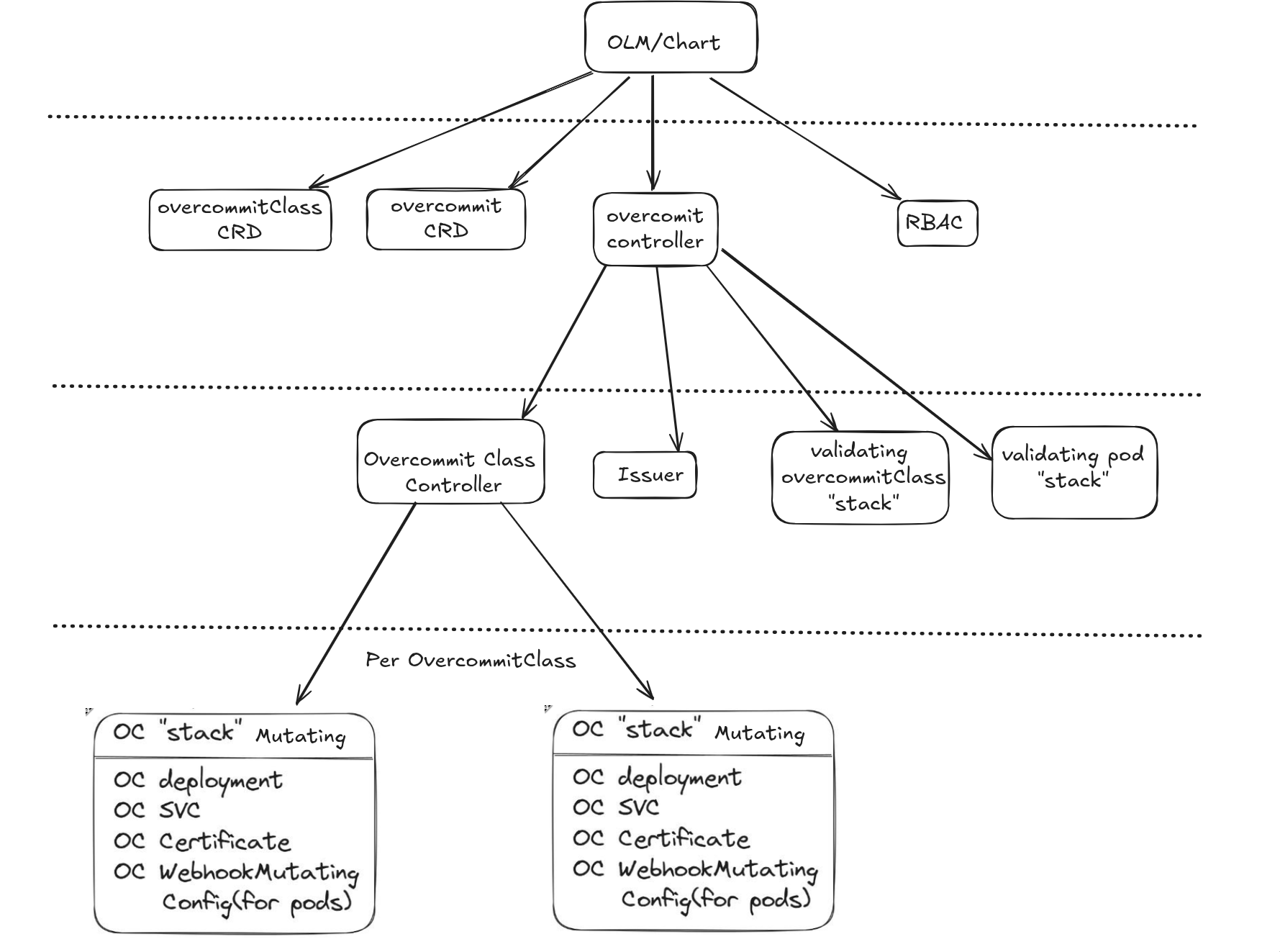
🔄 Kubernetes API Flow
flowchart LR
    subgraph "Main Flow"
    A[📝 API Request] --> B[🔧 API HTTP Handler]
    B --> C[🔐 Authentication & Authorization]
    C --> D[🔄 Mutating Admission]
    D --> E[✅ Object Schema Validation]
    E --> F[🛡️ Validating Admission]
    F --> G[💾 Persisted to etcd]
    end

    subgraph "Mutating Webhooks"
    direction LR
    D --> MW1[🔄 Overcommit Webhook]
    D --> MW2[🔄 Other Webhooks]
    end

    subgraph "Validating Webhooks"
    direction LR
    F --> VW1[✅ Validation Webhook 1]
    F --> VW2[✅ Validation Webhook 2]
    F --> VW3[✅ Validation Webhook 3]
    end
Questions
What is k8s-overcommit-operator?
InditexTech/k8s-overcommit-operator is a public repo on GitHub by InditexTech. A Kubernetes operator designed to intelligently manage resource overcommit on pod resource requests.
Is k8s-overcommit-operator open source?
It declares the Apache-2.0 license on GitHub.
Does k8s-overcommit-operator run on macOS, Windows or Linux?
Its maker has not tagged a system, so it is unknown here. Its README says what it needs.
How do I install k8s-overcommit-operator?
Open "Take it" on its page: Take My Repo writes an install plan for your machine and hands it to your AI agent (Claude Code, Codex or Cursor), which asks you before each step. Take My Repo has not tested it on any machine.
Is k8s-overcommit-operator still maintained?
Its last change on GitHub was on 2026-11-23. Take My Repo does not judge from that whether it is maintained.