n8n
Fair-code workflow automation platform with native AI capabilities. Combine visual building with custom code, self-host or cloud, 400+ integrations.
- 212k
- TypeScript
- 2 h ago
The loop never sleeps — you finally can. Agents automate the entire development lifecycle (write, review, merge, learn) end to end, with a published safety record. Self-host today; rentable hosted loops in development. Any GitHub repo; Gittensor-native intelligence built in.
Repo JSONbored/loopover, read from GitHub 2 h ago. JSONbored has not joined Take My Repo.
JSONbored/loopover is a public repo on GitHub by JSONbored. The loop never sleeps — you finally can. Agents automate the entire development lifecycle (write, review, merge, learn) end to end, with a published safety record. Self-host today; rentable hosted loops in development. Any GitHub repo; Gittensor-native intelligence built in. It declares the AGPL-3.0 license on GitHub. It is written mainly in TypeScript, has 22 stars and last changed on 2026-11-03. Nobody has reviewed it on Take My Repo yet, which says nothing about its quality. Read from GitHub on 2026-11-24.
Fair-code workflow automation platform with native AI capabilities. Combine visual building with custom code, self-host or cloud, 400+ integrations.
AutoGPT is the vision of accessible AI for everyone, to use and to build on. Our mission is to provide the tools, so that you can focus on what matters.
Formerly Gittensory.
The loop never sleeps. You finally can.
LoopOver automates the entire development lifecycle — write, review, merge, learn — end to end, with agents on both sides and a published safety record. The good kind of infinite loop, on any GitHub repo.
@loopover/mcp copilot brings predicted gate verdicts, branch preflight, duplicate detection, and cross-repo opportunity discovery into your own AI harness; the autonomous miner runtime (@loopover/miner) runs unattended across a fleet of repos, respecting each target repo's .loopover-miner.yml goal spec.Self-hosting the whole stack is the path available today — and it doubles as the trust story: audit the algorithm, run it on your own infra, replay the published numbers yourself. A hosted plane is in open development on the public milestones (ORB Cloud Readiness, Rent-a-Loop): rentable, metered loops you point at a repo — and, further out, at nothing more than an idea.
It is the single converged home of the native review system; the legacy separate reviewbot repo/runtime is not part of the active architecture described here.
It is not a Gittensor explorer, public leaderboard, reward-farming bot, or wallet dashboard.
LoopOver keeps sensitive context private by default.
A recorded MCP tool call carries exactly four fields, and there is no fifth: the tool name, which surface
dispatched it (remote or local), whether it succeeded, and a coarse duration in milliseconds. The
allowlist is the event shape itself rather than a filter over a richer one, so there is nowhere to put anything
else.
Never tracked: tool arguments, source contents, repository or issue text, and wallet, hotkey, coldkey, reward, private ranking, or raw trust-score data. Events also carry no per-actor identity — every event shares one constant, anonymous handle, so there is no per-user profile to accumulate — and IP-based geo enrichment is disabled.
Each surface is controlled separately, and they differ in who holds the switch:
@loopover/mcp) — opt-in, OFF by default. Nothing is recorded unless you have run
loopover-mcp telemetry enable; an API key alone is not enough. loopover-mcp telemetry status reports the
current state, and disable removes the flag entirely.POSTHOG_API_KEY, which the hosted service does. A self-hosted deployment that leaves it unset records nothing.See Privacy and security for the full boundary.
LoopOver CI and LoopOver review score, gate, and comment on pull requests. The review algorithm is open-source; operators tune behavior through per-repo settings and the LOOPOVER_REVIEW_* feature flags, every one of which ships OFF and is opt-in per repo.
secret_leak blocker..loopover.yml's review.changed_files_summary also on (off by default), it gains a deterministic, no-AI "Changed files" collapsible: one row per file category (source/test/docs/config/generated), with file counts and +/- totals.LOOPOVER_REVIEW_REPOS allowlist.Check-run and comment surfaces, disambiguated (a common point of confusion — these are three independent, separately-configured things, not layers of the same feature):
LoopOver Orb Review Agent (gate.* / settings.reviewCheckMode, off by default) — the authoritative GitHub Check Run carrying the gate's pass/fail verdict. This is the one worth making a required status check.LoopOver Context (settings.checkRunMode / settings.checkRunDetailLevel, off by default) — a separate, purely advisory Check Run. At its default checkRunDetailLevel: minimal it publishes no findings at all; even at standard/deep it only re-renders content already shown elsewhere. Never make this one required.LOOPOVER_REVIEW_INLINE_COMMENTS + .loopover.yml's review.inline_comments, off by both by default) — real, reply-able line-anchored PR review comment threads (CodeRabbit-style). This is the ONLY one of the three that posts an interactive per-line thread; the two check runs above never do. With .loopover.yml's review.suggestions also on, a precise line-anchored fix is additionally rendered as a one-click, committable GitHub suggested-change block. With review.finding_categories also on (off by default), each finding is additionally tagged with a category — security/correctness/performance/maintainability/tests/style — in both the inline comment label and the unified comment's "Finding categories" collapsible; a deterministic path/keyword fallback covers whatever the model omits.See Tuning your reviews for the full flag, setting, and .loopover.yml reference.
| Audience | Start | Useful next links |
|---|---|---|
| Miners and contributors | Quickstart | MCP client setup, Miner workflow, Scoreability |
| Maintainers | GitHub App | Maintainer workflow, Self-host reviews, Privacy and security |
| Repo owners and operators | Beta onboarding | Upstream drift, Troubleshooting, Roadmap |
| Agent authors | Agents | API browser, MCP client setup |
| Surface | Link |
|---|---|
| Website | loopover.ai |
| Docs | loopover.ai/docs |
| MCP package | @loopover/mcp |
| Engine package | @loopover/engine — shared deterministic logic for the review stack and miner |
| Miner package | @loopover/miner — local foundation CLI for the autonomous miner runtime |
| API | API browser and OpenAPI JSON |
| GitHub App | Setup docs — self-hosting is the only currently available path |
npm install -g @loopover/mcp@latest
loopover-mcp login
loopover-mcp doctor
loopover-mcp --stdio
Print editor/client snippets:
loopover-mcp init-client --print codex
loopover-mcp init-client --print claude
loopover-mcp init-client --print cursor
For full editor setup and stdio configuration, use MCP client setup.
Run base-agent commands:
loopover-mcp agent plan --login jsonbored --json
loopover-mcp agent packet --login jsonbored --json
loopover-mcp agent status <run-id> --json
npm install
npm run cf-typegen
npm run db:migrate:local
npm run dev
npm run test:ci
Release-only validation:
npm run test:release
npm run test:release:mcp
Frontend:
npm run ui:dev
npm run ui:build
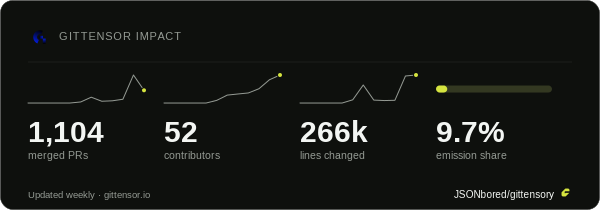
Refreshed weekly by .github/workflows/gittensor-impact.yml.
| Need | Link |
|---|---|
| Contributing | CONTRIBUTING.md |
| Security | SECURITY.md |
| Support | SUPPORT.md |
| Changelog | CHANGELOG.md |
Normal feature/fix PRs do not edit changelogs. Changelogs are release-prep artifacts.
JSONbored/loopover is a public repo on GitHub by JSONbored. The loop never sleeps — you finally can. Agents automate the entire development lifecycle (write, review, merge, learn) end to end, with a published safety record. Self-host today; rentable hosted loops in development. Any GitHub repo; Gittensor-native intelligence built in.
It declares the AGPL-3.0 license on GitHub.
Its maker tagged it for macOS, Windows and Linux, or as Docker or cross-platform. That is declared by the maker; Take My Repo has not tested it.
🐳 | Dockerfiles for the Runpod container images used for our official templates.
The agent harness performance optimization system. Skills, instincts, memory, security, and research-first development for Claude Code, Codex, Opencode, Cursor and beyond.
Reverse engineer anything with agents, from app behavior down to native binaries.
Build Agentic workflows, RAG pipelines, with rich AI model and tool support on one collaborative workspace. Deploy on cloud, VPC, or self-hosted, so teams move from prototype to production without rebuilding the stack.
Open "Take it" on its page: Take My Repo writes an install plan for your machine and hands it to your AI agent (Claude Code, Codex or Cursor), which asks you before each step. Take My Repo has not tested it on any machine.
Its last change on GitHub was on 2026-11-03. Take My Repo does not judge from that whether it is maintained.
Nobody has reviewed it on Take My Repo yet, which says nothing about its quality.
Take My Repo cannot say: it does not audit code and has not run loopover. What is known comes from GitHub. It declares the AGPL-3.0 license on GitHub. Its last change was on 2026-11-03. It has 22 stars, which measure popularity, not safety. Nobody has reviewed it on Take My Repo yet, which says nothing about its quality. Read the source before you run it. With "Take it", your AI agent shows each step and asks you before running it; README text is treated as data, not as instructions.