
python_tradingbot_framework
Python algorithmic trading bot framework for Kubernetes: backtesting, hyperparameter optimization, 150+ technical analysis indicators (RSI, MACD, Bollinger Bands, ADX), portfolio management, PostgreSQL integration, Helm deployment, CronJob scheduling. Minimal overhead, production-ready, Yahoo Finance data.
- 41
- MIT
- 11 h ago
Repo JustinGuese/python_tradingbot_framework, read from GitHub 1 min ago. JustinGuese has not joined Take My Repo.
In short
JustinGuese/python_tradingbot_framework is a public repo on GitHub by JustinGuese. Python algorithmic trading bot framework for Kubernetes: backtesting, hyperparameter optimization, 150+ technical analysis indicators (RSI, MACD, Bollinger Bands, ADX), portfolio management, PostgreSQL integration, Helm deployment, CronJob scheduling. Minimal overhead, production-ready, Yahoo Finance data. It declares the MIT license on GitHub. It is written mainly in Python, has 41 stars and last changed on 2026-11-20. Nobody has reviewed it on Take My Repo yet, which says nothing about its quality. Read from GitHub on 2026-11-20.
🤖 Trading Bot Framework
A Production-Ready, Kubernetes-Native Algorithmic Trading System
kubectl create secret generic tradingbot-secrets --from-env-file=.env --namespace=tradingbots-2025 --dry-run=client -o yaml | kubectl apply -f -

This framework allows developers to build, backtest, and deploy automated trading strategies as Kubernetes CronJobs. It handles the "boring stuff"—data ingestion, technical analysis, database persistence, and portfolio tracking—so you can focus on the alpha.
🚀 Why this Framework?
- Batteries Included: 150+ Technical Indicators (RSI, MACD, etc.) ready out of the box.
- Infrastructure as Code: Native Helm charts for easy scaling on K8s.
- Data Consistency: Built-in caching and PostgreSQL persistence for trade history and market data.
- Backtesting to Production: One class handles local testing, hyperparameter optimization, and live execution.
🎯 The Target: Alpha vs QQQ, Not Return
Bots are judged by their annualised alpha against QQQ: the daily return left over after removing the bot's QQQ exposure (beta), along with that alpha's t-stat. Raw return and Sharpe alone are not the target.
Why: QQQ exposure costs nothing, since you can just buy QQQ. In a bull market, raw return rewards bots that merely are QQQ, or leveraged QQQ, and punishes low-beta bots that are doing exactly their job. A bot with beta ≈ 1 and zero alpha adds nothing to a portfolio that already holds QQQ. A low-correlation bot with positive alpha is the only kind that makes the whole book better.
Rules of thumb:
beta = cov(bot, QQQ) / var(QQQ),alpha = mean(bot − beta·QQQ) × 252, computed on weekdayportfolio_worthreturns.- t-stat ≥ 2 before calling an edge real. A few months of live data rarely gets there, so treat anything less as unproven.
- Prefer beta / correlation < 0.5. A high-beta, zero-alpha bot should be replaced with QQQ itself.
- Pause bots whose alpha is significantly negative (t ≤ −2).
See CLAUDE.md for the full method and the latest fleet snapshot.
Reading the numbers
- Beta is how much of QQQ the bot carries. Beta 1.0 moves like QQQ, 0.25 moves a quarter as much, 0 is independent. Return that comes from beta is not skill, because you can buy QQQ for free.
- Alpha is the return left over after removing
beta × QQQeach day, annualised. Alpha of +5% means the bot added about 5 points a year on top of its market exposure. It can exceed the bot's own return when QQQ fell over the window: the beta part is then negative and removing it adds back. On a short window the annualisation also inflates it (a month of data scaled ×252). - t-stat is alpha divided by its noise, scaled by days observed. It says how sure we are that alpha is not luck. t ≥ 2 is the bar; below that it is unproven, and a big alpha with a small t on a short window is usually luck.
- CAGR below is each bot's own live return annualised. It is not reliable under about 100 days, and a high CAGR can just be beta.
Live fleet snapshot (2026-11-07)
Live paper bots with at least 4 weeks of history, sorted by CAGR, from the
bot_alpha_report table. Alpha, t and beta are vs QQQ over each bot's own window. The
57 quantsmd_* bots are left out (3 live days). Nothing has t ≥ 2 on the positive side.
| Bot | Days | Return | CAGR | Alpha/yr | t | Beta | Max DD | Verdict |
|---|---|---|---|---|---|---|---|---|
| AIHedgeFundBot | 305 | +23.7% | 29% | +0.9% | 0.03 | 0.72 | −15.3% | unproven |
| XAUZenCarryBot | 88 | +5.7% | 26% | +32.8% | 0.88 | 0.20 | −2.2% | too short |
| option_PMCCBot | 39 | +2.3% | 24% | +48.8% | 0.56 | 0.26 | −4.3% | too short |
| XAUSyntheticMetalTreeBot | 330 | +19.4% | 22% | +5.1% | 0.17 | 0.32 | −12.5% | unproven |
| TelegramSignalsBankBot | 241 | +13.8% | 22% | +10.1% | 0.45 | 0.22 | −7.3% | unproven |
| XAUZenbotTreeBot | 330 | +16.3% | 18% | +25.6% | 1.32 | 0.04 | −4.5% | unproven |
| EarningsInsiderTiltBot | 254 | +10.6% | 16% | +6.6% | 0.52 | 0.48 | −4.8% | unproven |
| option_CollarBot | 39 | +1.2% | 12% | +17.6% | 0.36 | 0.06 | −3.5% | too short |
| option_WheelBot | 39 | +1.1% | 11% | +23.1% | 0.76 | 0.13 | −1.9% | too short |
| option_LeapCallBot | 42 | +1.2% | 11% | +45.2% | 0.53 | 0.30 | −5.9% | too short |
| AdaptiveMeanReversionBot | 228 | +6.6% | 11% | −2.2% | −0.62 | 0.99 | −14.6% | QQQ clone |
| TARegimeAdaptiveBot | 254 | +5.8% | 8% | +8.0% | 0.84 | 0.41 | −8.0% | unproven |
| RegimeAdaptiveBot | 254 | +4.5% | 7% | +2.5% | 0.40 | 0.23 | −2.3% | unproven |
| DeepSeekToolBot | 254 | +4.8% | 7% | −3.1% | −0.24 | 0.63 | −7.7% | unproven |
| FearGreedBotQQQInverse | 330 | +5.8% | 6% | +2.1% | 0.32 | 0.94 | −14.7% | QQQ clone |
| KronosTraderBot | 206 | +1.3% | 2% | −1.1% | −0.18 | 0.15 | −2.7% | unproven |
| GoldenButterflyMomBot | 228 | +0.9% | 1% | −3.3% | −0.54 | 0.20 | −2.6% | unproven |
| option_DispersionBot | 39 | 0.0% | 0% | 0.0% | 0.00 | 0.00 | 0.0% | too short |
| InstitutionalFlowBot | 42 | 0.0% | 0% | +9.7% | 0.22 | 0.09 | −5.6% | too short |
| SwingTitaniumBot | 333 | +0.4% | 0% | +0.9% | 0.09 | 0.01 | −4.4% | unproven |
| option_CatalystCallBot | 42 | 0.0% | 0% | 0.0% | 0.00 | 0.00 | 0.0% | too short |
| option_CreditSpreadBot | 42 | 0.0% | 0% | 0.0% | 0.00 | 0.00 | 0.0% | too short |
| option_CrossVolBot | 39 | 0.0% | 0% | 0.0% | 0.00 | 0.00 | 0.0% | too short |
| option_EarningsCalendarBot | 39 | 0.0% | 0% | 0.0% | 0.00 | 0.00 | 0.0% | too short |
| option_IndexVolBot | 39 | 0.0% | 0% | 0.0% | 0.00 | 0.00 | 0.0% | too short |
| option_MispricingScanBot | 39 | 0.0% | 0% | 0.0% | 0.00 | 0.00 | 0.0% | too short |
| BuybackHedgedBot | 0 | 0.0% | 0% | 0.0% | 0.00 | 0.00 | 0.0% | too short |
| SharpePortfolioOptWeeklyBot | 330 | +0.3% | 0% | −7.8% | −1.12 | 0.13 | −6.8% | unproven |
| EURUSDTreeBot | 333 | −3.5% | −4% | −8.8% | −2.35 | 0.01 | −4.6% | pause candidate |
| option_MispricingBot | 39 | −0.5% | −4% | −9.2% | −1.24 | −0.05 | −0.8% | too short |
| FearGreedBotQQQ | 333 | −6.8% | −7% | −18.0% | −1.56 | 0.75 | −23.0% | unproven |
| StockNewsSentimentBot | 228 | −4.1% | −7% | −13.3% | −0.74 | 0.26 | −8.4% | unproven |
| SqueezeMomentumBot | 206 | −6.6% | −11% | −16.1% | −1.18 | 0.06 | −8.0% | unproven |
| SynthesizedHyperConvexityBot | 228 | −7.5% | −12% | −24.9% | −1.35 | 0.69 | −24.6% | unproven |
| TARegimeMultiAssetBot | 46 | −1.7% | −13% | −3.7% | −0.56 | 0.11 | −2.1% | too short |
| option_IronCondorBot | 42 | −1.8% | −14% | −10.6% | −0.78 | 0.04 | −2.4% | too short |
| AdaptiveMeanReversionBTCBot | 87 | −3.9% | −15% | +12.6% | 0.23 | 1.05 | −12.5% | too short |
| GptBasedStrategyBTCTabased | 330 | −16.5% | −18% | +6.9% | 0.31 | 0.12 | −18.9% | unproven |
| RecursiveDecayHarvestBot | 228 | −18.9% | −29% | −65.3% | −2.33 | 2.75 | −45.9% | pause candidate |
| TSMOMTrendBot | 46 | −5.8% | −38% | −22.1% | −1.38 | 0.25 | −5.8% | too short |
| option_EarningsCrushBot | 39 | −6.1% | −44% | −38.3% | −1.15 | 0.16 | −6.1% | too short |
🛠 System Architecture
The system is designed to be lightweight and stateless. Each "Bot" is a containerized instance triggered by a schedule.
- Ingestion: Fetches data from Yahoo Finance (with DB caching).
- Analysis: Enriches data with the
talibrary (Technical Analysis). - Execution:
BotClassmanages the state of your portfolio in PostgreSQL. - Monitoring: Real-time performance tracking via the included Dashboard.
⚡ Quick Start
1. Requirements
- Python 3.12+ (We recommend uv for speed)
- Docker (for local DB)
2. Launch Local Environment
# Start PostgreSQL
docker run -d --name pg-trading -e POSTGRES_PASSWORD=pass -e POSTGRES_DB=tradingbot -p 5432:5432 postgres:17-alpine

# Install project
uv sync
export POSTGRES_URI="postgresql://postgres:pass@localhost:5432/tradingbot"
3. Your First Strategy
Create a simple RSI Mean Reversion bot in seconds:
from tradingbot.utils.botclass import Bot


class RSIBot(Bot):
    def __init__(self):
        super().__init__("RSIBot", "AAPL", interval="1m", period="1d")

    def decisionFunction(self, row):
        if row["momentum_rsi"] < 30:
            return 1  # Buy
        if row["momentum_rsi"] > 70:
            return -1  # Sell
        return 0


if __name__ == "__main__":
    bot = RSIBot()
    bot.run()  # Single iteration
4. Local Development & Testing
Backtest your strategy before going live:
bot = RSIBot()
results = bot.local_backtest(initial_capital=10000.0)
print(f"Sharpe Ratio: {results['sharpe_ratio']:.2f}")
print(f"Yearly Return: {results['yearly_return']:.2%}")
Optimize hyperparameters automatically:
class RSIBot(Bot):
    # Define search space
    param_grid = {
        "rsi_buy": [25, 30, 35],
        "rsi_sell": [65, 70, 75],
    }

    def __init__(self, rsi_buy=30.0, rsi_sell=70.0, **kwargs):
        super().__init__("RSIBot", "AAPL", interval="1m", period="1d", **kwargs)
        self.rsi_buy = rsi_buy
        self.rsi_sell = rsi_sell

    def decisionFunction(self, row):
        if row["momentum_rsi"] < self.rsi_buy:
            return 1
        if row["momentum_rsi"] > self.rsi_sell:
            return -1
        return 0


# Optimize and backtest
bot = RSIBot()
bot.local_development()  # Finds best params (by alpha t-stat vs QQQ), then backtests
Every backtest reports alpha, alpha_t, beta and benchmark_corr against QQQ.
The optimizer ranks by alpha_t by default. Pass objective="sharpe_ratio" or
"yearly_return" to rank the old way, but in a bull market both of those favour
bots that are just QQQ.
Key Features:
- Data pre-fetching: Historical data fetched once, reused for all parameter combinations
- Database caching: Data persisted to DB, subsequent runs are instant
- Parallel execution: Uses multiple CPU cores automatically
- Automatic QuantStats reports: Generated and uploaded to Google Cloud Storage with Sharpe/return optimizations and drawdown analysis
📈 Dashboard & Monitoring
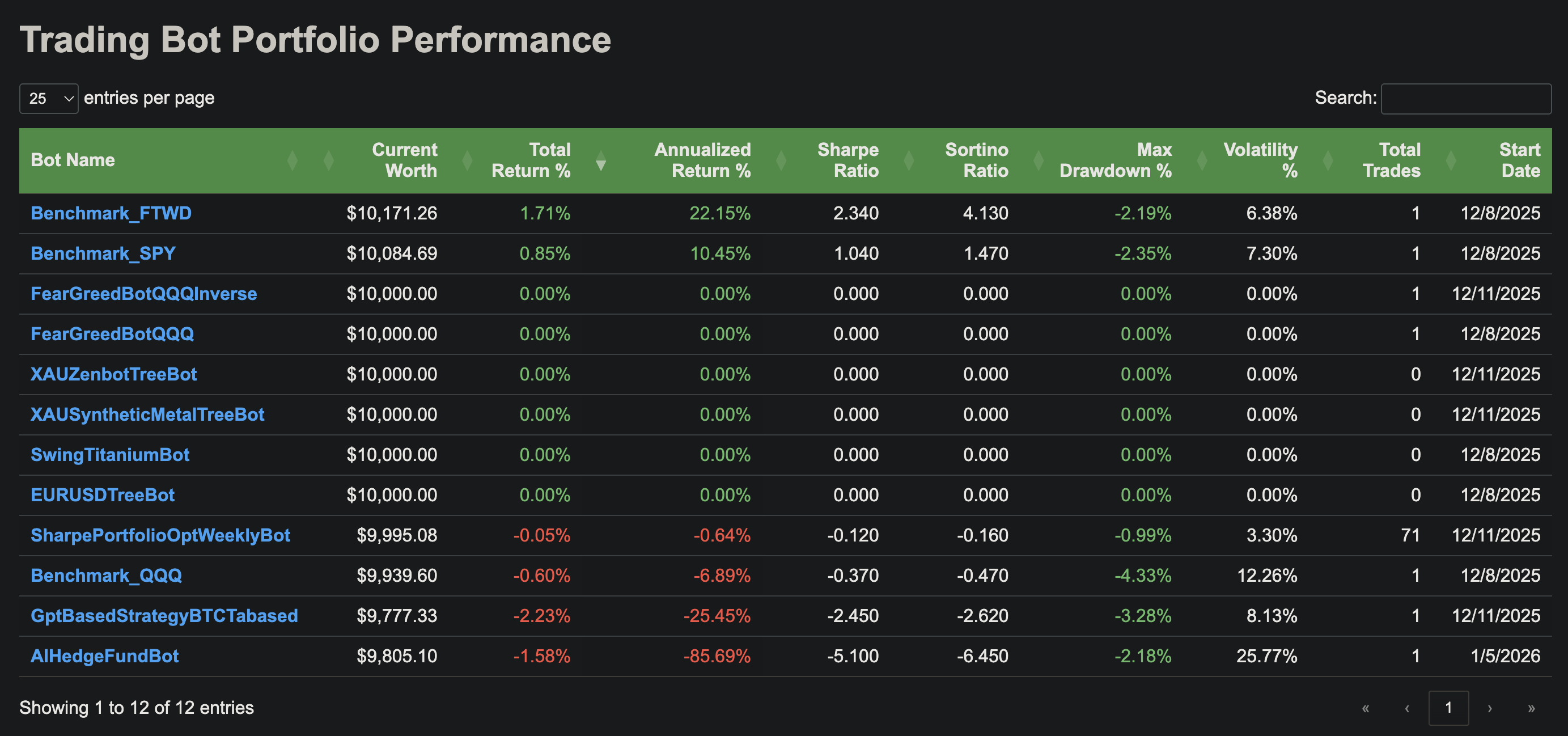
The framework includes a built-in visualization suite to track your bots' performance. Each backtest generates a professional QuantStats report with cumulative returns, drawdown analysis, monthly heatmaps, and more (see example).
Overview Dashboard shows:
- Current Worth, Total Return %, Annualized Return %
- Sharpe Ratio, Sortino Ratio, Max Drawdown %
- Volatility, Total Trades, Start Date

Bot Detail Page includes:
- Portfolio value charts, daily returns distribution
- Monthly returns heatmap, drawdown visualization
- Current holdings table, complete trade history
The dashboard is deployed automatically with the Helm chart. See Deployment for setup.
🏗 Deployment
Production (Kubernetes)
The system treats every bot as a CronJob. Define your schedule in values.yaml and deploy:
1. Create Kubernetes Secret:
# Create .env file with:
# POSTGRES_PASSWORD=yourpassword
# POSTGRES_URI=postgresql://postgres:yourpassword@psql-service:5432/postgres
# OPENROUTER_API_KEY=yourkey (if using AI bots)
# BASIC_AUTH_PASSWORD=yourpassword (for dashboard)

# Create namespace
kubectl create namespace tradingbots-2025

# Create secret
kubectl create secret generic tradingbot-secrets \
  --from-env-file=.env \
  --namespace=tradingbots-2025
2. Configure Bots:
# helm/tradingbots/values.yaml
bots:
  - name: rsibot
    schedule: '*/5 * * * 1-5' # Every 5 mins, Mon-Fri
3. Deploy:
helm upgrade --install tradingbots \
  ./helm/tradingbots \
  --create-namespace \
  --namespace tradingbots-2025
PostgreSQL is automatically deployed via Helm (if postgresql.enabled: true in values.yaml).
For detailed guides, see:
- Deployment Overview - Complete deployment options
- Kubernetes Deployment - Cluster setup
- Helm Charts - Configuration details
🧰 Developer Reference
Bot Implementation Levels
See the comprehensive Bot Implementation Levels guide for detailed explanations, examples, trade-offs, and pitfalls for each pattern.
Quick summary:
1. Simple (Recommended): decisionFunction(row)
For single-row TA signals. The base class handles data fetching, self.data (full history slice), and buy/sell execution automatically — no makeOneIteration needed:
def decisionFunction(self, row):
    if row["momentum_rsi"] < 30:
        return 1
    if row["momentum_rsi"] > 70:
        return -1
    return 0
If your signal needs the full historical DataFrame (e.g. Hurst exponent, rolling z-scores), use self.data — the base class sets it automatically before calling decisionFunction:
def decisionFunction(self, row):
    lookback = self.data.tail(50)  # self.data is always the slice up to current bar
    zscore = (row["close"] - lookback["close"].mean()) / lookback["close"].std()
    return 1 if zscore < -2 else (-1 if zscore > 2 else 0)
1b. Multi-Asset: tickers=[...] + decisionFunction(row)
For strategies that trade multiple instruments. The framework calls decisionFunction once per ticker per bar, sets self._current_ticker and populates self.datas with all tickers' history up to the current bar:
def __init__(self):
    super().__init__("MyBot", tickers=["QQQ", "GLD", "TLT"], interval="1d", period="1y")


def decisionFunction(self, row):
    ticker = self._current_ticker
    # self.datas[ticker] has history up to current bar for all tickers
    ...
    return 1  # -1 or 0
2. Override makeOneIteration() — only when you need external APIs or portfolio-weight rebalancing that can't map to -1/0/1 signals:
def makeOneIteration(self):
    fear_greed = get_fear_greed_index()  # External API — not backtestable
    if fear_greed >= 70:
        self.buy("QQQ")
    return 1
def makeOneIteration(self):
    data = self.getYFDataMultiple(["QQQ", "GLD", "TLT"])
    weights = optimize_portfolio(data)  # Portfolio optimizer — outputs weights, not signals
    self.rebalancePortfolio(weights)
    return 0
Backtesting: Only bots using
decisionFunction()(Levels 1 and 1b) are backtestable vialocal_backtest(). Bots that overridemakeOneIteration()with external API calls, AI models, or portfolio-weight optimizers cannot be replayed on historical data and must be validated via live runs. If your strategy is yfinance-only, preferdecisionFunction.
Key Methods
| Method | Description |
|---|---|
getYFDataWithTA() |
Fetches OHLCV + 150 indicators. |
decisionFunction(row) |
Logic applied to every candle. Return -1, 0, 1. |
makeOneIteration() |
Override for custom logic. |
local_backtest() |
Simulates strategy performance on historical data. |
local_development() |
Optimize hyperparameters + backtest. |
buy(symbol) / sell(symbol) |
Automated portfolio and DB logging (long positions). |
short(symbol) / cover(symbol) |
Short selling and covering for opted-in bots (ALLOW_SHORT=True). |
rebalancePortfolio(weights) |
Rebalance to target weights (supports signed weights when ALLOW_SHORT=True). |
run_ai(system_prompt, user_message) |
Runs AI with tools (main LLM); returns model response. Requires OPENROUTER_API_KEY. |
run_ai_simple(system_prompt, user_message) |
Single-turn, no tools (cheap LLM); for summarization, extraction, classification. |
run_ai_simple_with_fallback(system_prompt, user_message, sanity_check=..., fallback_to_main=True) |
Cheap LLM first; validates output; retries with main LLM if sanity check fails. |
AI Tools (LangChain + OpenRouter)
Two LLMs: main (OPENROUTER_MAIN_MODEL, default deepseek/deepseek-v3.2) for tool-using flows; cheap (OPENROUTER_CHEAP_MODEL, default openrouter/free) for simple single-turn text tasks. Set OPENROUTER_API_KEY (required); optionally set the two model env vars.
With tools (main LLM):
response = bot.run_ai(
    system_prompt="You are a trading assistant.", user_message="Summarize my recent trades and portfolio."
)
print(response)  # Model response as string
Simple tasks, no tools (cheap LLM): summarization, extraction, classification, rewriting:
summary = bot.run_ai_simple(system_prompt="You summarize in one sentence.", user_message="Summarize: ...")
Cheap-first with fallback: Try cheap LLM first, validate output for sanity, and retry with main LLM if the result fails. Use for simple tasks when you want to save cost but guarantee sane results:
result = bot.run_ai_simple_with_fallback(
    system_prompt="You classify sentiment.",
    user_message="Classify as buy/hold/sell: ...",
    sanity_check=None,  # optional; default rejects empty/refusal/error prefix
    fallback_to_main=True,
)
Tools available to the model (when using run_ai):
- get_market_data(symbol, period) – Market data (OHLCV), default last two weeks.
- get_portfolio_status() – Current portfolio worth (USD) and holdings.
- get_recent_trades(limit) – Recent trades; for sells, profit of the closed trade is shown.
- get_stock_news(symbol, limit) – Recent news for a symbol (title, link, publisher, published_at) from the database.
- get_stock_earnings(symbol, limit) – Recent earnings dates and EPS (estimate, reported, surprise %) for a symbol from the database.
- get_stock_insider_trades(symbol, limit) – Recent insider transactions (insider, type, shares, value) for a symbol from the database.
See AI Tools Guide and AITools API for details.
Portfolio Structure
Portfolio is stored as JSON in the database (negative quantities represent short positions):
portfolio = {
    "USD": 10000.0,  # Cash (including short sale proceeds held as collateral)
    "QQQ": -5.0,  # Short position (negative quantity)
    "AAPL": 10.0,  # Long position
}
Access via: bot.dbBot.portfolio.get("USD", 0)
Available Indicators
Access over 150 indicators via the row object:
- Trend:
trend_macd,trend_adx,trend_ichimoku_a,trend_sma_fast,trend_sma_slow - Momentum:
momentum_rsi,momentum_stoch,momentum_ao,momentum_roc,momentum_ppo - Volatility:
volatility_bbh(Bollinger High),volatility_bbl(Bollinger Low),volatility_atr - Volume:
volume_vwap,volume_obv,volume_mfi
See Technical Analysis Guide for complete list.
📖 Documentation
Online Documentation: justinguese.github.io/python_tradingbot_framework/
Getting Started
- Quick Start Guide - Complete local development workflow with PostgreSQL setup, bot creation at different abstraction levels, backtesting, and hyperparameter tuning
- Installation - System requirements and dependency installation
- Creating a Bot - Detailed bot creation patterns and examples
Architecture
- Architecture Overview - System components and data flow
- Bot Class System - Class hierarchy, lifecycle, and controls
- Database Models - PostgreSQL schema and tables
- Short Selling - Reg T margin model, borrow fees, and broker execution
Deployment
- Deployment Overview - Kubernetes vs local deployment options
- Kubernetes Deployment - Cluster setup and configuration
- Helm Charts - Bot scheduling and Helm configuration
Guides
- Technical Analysis - Complete indicator reference
- Portfolio Management - Advanced portfolio operations
- Local Development - Development workflows
- AI Tools - LangChain + OpenRouter tools; cheap-first with fallback and sanity checks
- Telegram Monitor - Channel monitoring, AI summarization, ticker extraction
API Reference
- Bot API - Complete Bot class documentation
- Data Service - Data fetching and caching
- Portfolio Manager - Trading operations
- AITools API -
run_ai_with_tools,run_ai_simple,run_ai_simple_with_fallback
📡 Telegram Channel Monitor
The framework includes an optional Telegram channel monitor that polls channels for new messages, summarizes them with AI, extracts the primary asset ticker, and writes results to the database.
# helm/tradingbots/values.yaml
telegramMonitor:
  enabled: true
  schedule: '*/30 * * * *' # Every 30 minutes
  channels: 'some_news_channel,-1001234567890'
  fetchLimit: '50'
How it works: Runs as a CronJob — connects via a Telethon StringSession (no persistent process), fetches recent messages, skips already-stored ones, summarizes each with the cheap LLM, and persists to telegram_messages table with channel, text, summary, symbol, and published_at.
Required secrets: TELEGRAM_API_ID, TELEGRAM_API_HASH, TELEGRAM_SESSION_STRING (from my.telegram.org).
See Telegram Monitor Guide for full setup instructions.
🧪 quants.md Strategy Bots (quantsmd_*)
45 re-implementations of the quants.md (QuantJourney) example strategies plus 10 v2
variants, all tradingbot/quantsmd_*.py, all paper CronJobs, none wired into a live copier. Each file has a pure
compute_weights(...) and a targetWeights bot; shared helpers are in tradingbot/utils/quantsmd_common.py
(universes, rebalance gates), quantsmd_orders.py (OHLC fill model for order-style bots) and quantsmd_v2.py
(hysteresis, minimum hold, vol targeting, SHV cash parking, SPY SMA200 regime gate).
Backtest them with uv run python scripts/onetime_quantsmd_backtest.py [module ...]; results are judged on alpha vs
QQQ and t-stat, not return:
- Top 10 and the other 35: nothing has real edge (t >= 2 in both halves). Most bots are under-invested (beta 0.03-0.3), so their small positive alpha is a low-beta artefact. FX and intraday bots lose.
- v2 variants:
quantsmd_sma_daily_gated(SPY below SMA200 -> cash) is the first to clear t >= 2 with both halves positive (t 3.08, beta 0.16), still a watch-list candidate. Hysteresis, rank buffers, currency-ETF carry, a pairs basket and a 12-bot order ensemble did not help.
📈 Live Trading (Collective2, Interactive Brokers, eToro, Darwinex, MT5/MQL5 & Numerai)
Warning
DISCLAIMER: This software is for educational and research purposes only. Trading involves significant risk of loss and is not suitable for all investors. Use of "Live Trading" features is strictly at your own risk. The authors and contributors are not liable for any financial losses, damages, or unintended trades incurred. Always test strategies thoroughly in a paper-trading environment before deploying real capital.
The framework can mirror your paper-bot portfolios to a live brokerage account. Supported brokers and venues: Collective2 (World API v4), Interactive Brokers (IB Gateway socket API via ib_async), eToro (Public REST API), Darwinex (DXtrade API), MetaTrader 5 / MQL5 (RPyC bridge to MT5 terminal for MQL5 signal publishing), and Numerai Signals (tournament signal submissions).
1. Configure Environment
Add these to your .env or Kubernetes secrets:
# Collective2
COLLECTIVE2_API_KEY=your_api_key
COLLECTIVE2_SYSTEM_ID=12345678

# Interactive Brokers (IB Gateway socket API; the gateway holds the IBKR login)
IB_ACCOUNT_ID=DU1234567   # paper accounts start with DU; live with U
IB_GATEWAY_HOST=127.0.0.1 # in-cluster: ib-gateway-service.interactivebrokersgateway
IB_GATEWAY_PORT=4002
IB_CLIENT_ID=17           # keep stable: cancel_open_orders only sees this clientId's orders

# eToro (Public REST API)
ETORO_API_KEY=your_public_key
ETORO_USER_KEY=your_user_key
ETORO_DEMO=true             # true for demo/paper, false for live

# Darwinex (DXtrade API)
DARWINEX_USERNAME=your_username
DARWINEX_PASSWORD=your_password
DARWINEX_ACCOUNT_ID=12345   # optional
DARWINEX_DEMO=true          # true for demo/paper, false for live

# Shared
LIVETRADE_BOT_WEIGHTS='{"adaptivemeanreversionbot": 1.0}'
LIVETRADE_DRY_RUN=false
Interactive Brokers gateway
The CronJob talks to the IB Gateway deployed in the interactivebrokersgateway namespace
(gnzsnz/ib-gateway, paper). The gateway owns the IBKR login, 2FA and daily restart, so the
job needs no credentials. Its NetworkPolicy only admits pods labelled ib-gateway-client=true
(the Helm template adds the label); Service port 4002 maps to pod port 4004.
liveTrade:
  interactiveBrokers:
    enabled: true
    accountId: "DU6347896"
To test locally, port-forward the gateway and run the module directly:
kubectl -n interactivebrokersgateway port-forward svc/ib-gateway-service 4002:4002
IB_GATEWAY_PORT=4002 uv run python -m tradingbot.livetrade.interactive_brokers
Full runbook: docs/guides/live-trading.md.
Inspect Account & Portfolio
Each broker module is runnable directly to print the account summary and current positions — useful for sanity-checking credentials, account IDs, and mappings before running the copier:
# Collective2
uv run python -m tradingbot.livetrade.collective2

# Interactive Brokers (IB Gateway socket; reads IB_GATEWAY_HOST/PORT + IB_ACCOUNT_ID from .env)
uv run python -m tradingbot.livetrade.interactive_brokers

# eToro (reads ETORO_API_KEY, ETORO_USER_KEY, ETORO_DEMO from .env)
uv run python -m tradingbot.livetrade.etoro

# Darwinex (reads DARWINEX_USERNAME, DARWINEX_PASSWORD, DARWINEX_DEMO from .env)
uv run python -m tradingbot.livetrade.darwinex
2. Map Your Tickers
Yfinance symbols often differ from broker symbols (e.g., EURUSD=X vs EURUSD). The framework includes an Assisted Ticker Discovery script to help you map them:
# 1. Discover unmapped tickers from your bots and trades
uv run python -m tradingbot.livetrade.discover_symbols

# 2. Edit symbol_map.review.json in your editor
#    Add "selected_symbol" and "selected_type" for the tickers you want to map.

# 3. Apply the approved mappings to the master symbol_map.json
uv run python -m tradingbot.livetrade.discover_symbols --apply
3. Deploy the Copier
The copier runs as a standalone script per broker. Deploy as a CronJob to run shortly after your trading bots:
# Collective2
uv run python -m tradingbot.livetrade_collective2

# Interactive Brokers
uv run python -m tradingbot.livetrade_interactive_brokers

# eToro
uv run python -m tradingbot.livetrade_etoro

# Darwinex
uv run python -m tradingbot.livetrade_darwinex
Each broker is its own Helm CronJob gated by an independent flag in values.yaml — enable them separately (liveTrade.collective2.enabled, liveTrade.interactiveBrokers.enabled, liveTrade.etoro.enabled, liveTrade.darwinex.enabled), so you can run any combination or none. All default to false. You can also cap how much of the account each broker mirrors via LIVETRADE_PORTFOLIO_FRACTION (default 1.0 = full account; e.g. 0.5 = half).
See the Live Trading Guide for advanced configuration and mapping rules.
Collective2 status and C2 blend review (2026-10-26)
Collective2 does not work right now: every order is rejected. The CronJob
(livetrade-collective2-xauzerifine, strategy 155809898) completes green, which
hides it. Each NewStrategyOrder returns HTTP 400, error 1020: "A paid Trade
Leader plan is required". Evidence from the last three runs (2026-10-21 to 10-23):
- All ten target legs (DBC, DBA, UUP, GLD, EFA, SPY, IWM, SLV, EEM, ...) failed.
live_equityshows $60,152 equity, all cash,positions = {}. It has not moved since 2026-09-22. The blend has never been live in the broker.- The earlier
get_cash()bug (cash read as $0) is fixed: cash now reads $60,152 from 2026-10-19. That was a separate problem. - Nothing in the code can fix this. It is an account-plan restriction.
livetrade-ibis also failing on every run (the knownssodh/init500), so there is no working live broker at the moment. eToro and Darwinex are not scheduled, and Darwinex has no equities.
Decision needed (yours): buy the C2 Trade Leader plan, or move the blend to a broker that can take the orders (unblock IBKR, or enable eToro). Until then the live track record is zero. The paper sleeves below are the only evidence.
How the blend is done today
liveTrade.collective2XauZerifine.botWeightsinhelm/tradingbots/values.yaml: TARegimeMultiAssetBot 0.39 / GoldenButterflyMomBot 0.37 / TSMOMTrendBot 0.24.- Weights are inverse volatility, fit on 2019-01..2023-06 only. Idle weight is parked in SHV. Legs C2 cannot trade are dropped to cash, not redistributed.
- The copier reads each sleeve's paper portfolio from
bots.portfolio, scales by weight, and reconciles the whole C2 strategy to that target (full sync, so it liquidates anything not in the target). - Backtest (
docs/backtests/c2-blend-2026-09.md): alpha +3.5%/yr, t 2.02, beta 0.13, max DD -8.5%, CAGR 6.6% at 5.7% vol.
Live paper sleeves since 2026-09-21 (4.5 weeks, far too short to judge):
| Sleeve | Return | Weight |
|---|---|---|
| TARegimeMultiAssetBot | -0.6% | 0.39 |
| TSMOMTrendBot | -1.9% | 0.24 |
| GoldenButterflyMomBot | -0.4% | 0.37 |
| Weighted blend | about -0.9% | |
| QQQ | -5.0% |
The blend held up in a down tape, as a beta 0.13 book should. That says nothing about alpha. The weekly report gives TARegimeMultiAsset and TSMOM only 19 observations, and GoldenButterfly has alpha -7%/yr at t -1.13 over 101 days (backtest: +2.7%, t 1.43).
What I would do instead. None of this has been backtested; these are proposals to test, not changes to ship.
- Fix execution before touching weights. A blend that places no orders cannot be improved by re-weighting. Pick the broker first.
- Do not re-fit now. There are 4.5 weeks of live data. The doc's own plan
(re-score on
portfolio_worthafter ~6 months, about March 2027) stands. Re-weighting on a month of noise is how a t of 2.02 becomes a t of 0. - Treat the three sleeves as about 1.5 independent bets, not 3. Pairwise correlation is 0.58-0.67, and the blend's t (2.02) barely beats TARegimeMultiAsset alone (1.94). Inverse-vol ignores correlation. Test covariance-aware weights (equal risk contribution or min-variance, fit on H1 only) against the current ones on the same H2 window.
- Add a sleeve that is actually uncorrelated, not another trend ETF book. The candidates are weak: FearGreedInverse is a QQQ clone, IndexVolBot's edge is gone on real SPY prices, and the option bots have under 15 live days. Without one, the honest ceiling is about +3.5%/yr alpha.
- If the live record confirms it, scale instead of adding. At beta 0.13 the book is too small to matter next to QQQ. Vol-target the blend to ~10% (about 1.7x) rather than adding weaker sleeves. The blend doc already says this is only defensible after the live record confirms the backtest.
- Keep GoldenButterfly under review, but do not drop it yet. Its live t is -1.13 on 101 days against a positive backtest. That is not significant. If it is still negative in March, drop it and re-weight the other two.
🎯 Example Bots
- eurusdtreebot.py - Decision tree-based strategy for EUR/USD
- feargreedbot.py - Uses Fear & Greed Index API for market sentiment
- swingtitaniumbot.py - Swing trading strategy
- xauzenbot.py - Gold (XAU) trading bot
- sharpeportfoliooptweekly.py - Portfolio optimization with Sharpe ratio
- aihedgefundbot.py - AI-driven portfolio rebalancing
- deepseektoolbot.py - AI with tools (research + submit weights); cheap LLM sanity-check and main-LLM retry
- gptbasedstrategytabased.py - GPT-based strategy with technical analysis
- buybackhedgedbot.py - Market-neutral buyback drift sleeve hedged with short QQQ (
ALLOW_SHORT=True,MAX_GROSS=2.0)
See Example Bots for implementation details.
🧭 Next Steps
Options
Parked on purpose, as of 2026-09-29:
- LEAP / PMCC on real quotes: not possible with the current data. The DoltHub
SPY/AAPL backfill in
option_quotesholds only ~3 expiries a day, the longest about 65 days out. A real-quote test ofoption_LeapCallBotandoption_PMCCBotneeds a source with long-dated history. Until then their synthetic results indocs/backtests/option-bots-2026-09.mdare all there is. - Dispersion backtest: needs member chains. DoltHub has SPY and AAPL only.
Our own
optionchainsnapshotcapture of 52 names started 2026-09-28. Revisit onceimplied_correlationholds 60+ days, around January 2027. That is also whenoption_DispersionBot's own history gate opens. - The other round-3 bots (CrossVol, MispricingScan, EarningsCrush): wait for
the capture.
scripts/onetime_option_replay_backtest.pyworks on the captured full chains as it is. Allow about 60–80 sessions before reading a t-stat. - Round 4 option bots (2026-11): PutWrite (live paper as a data-gathering run, negative OOS), FOMCVol (paper,
inconclusive), ImpliedSignal (paper, unproven vs equal-weight universe); CrossVol rank
filters failed the kill-gate and it stays paused. See
docs/backtests/*-2026-11.md. - SVI fitter iteration cap: low value.
svi.fit_svistops at scipy's default 500 evaluations and treats that as a failed fit (about 15 of 52 names on a typical day). Raisingmax_nfevonly takes the usable fits from 30/52 to 33/52. Most rejections are butterfly arbitrage in the extrapolated wings, so the better fix is to run the arbitrage check only over the quoted strike range.smile_outlierscovers for it in the meantime.
Questions
What is python_tradingbot_framework?
JustinGuese/python_tradingbot_framework is a public repo on GitHub by JustinGuese. Python algorithmic trading bot framework for Kubernetes: backtesting, hyperparameter optimization, 150+ technical analysis indicators (RSI, MACD, Bollinger Bands, ADX), portfolio management, PostgreSQL integration, Helm deployment, CronJob scheduling. Minimal overhead, production-ready, Yahoo Finance data.
Is python_tradingbot_framework open source?
It declares the MIT license on GitHub.
Does python_tradingbot_framework run on macOS, Windows or Linux?
Its maker has not tagged a system, so it is unknown here. Its README says what it needs.
How do I install python_tradingbot_framework?
Open "Take it" on its page: Take My Repo writes an install plan for your machine and hands it to your AI agent (Claude Code, Codex or Cursor), which asks you before each step. Take My Repo has not tested it on any machine.


