Python Library for FNIRSI DPS-150
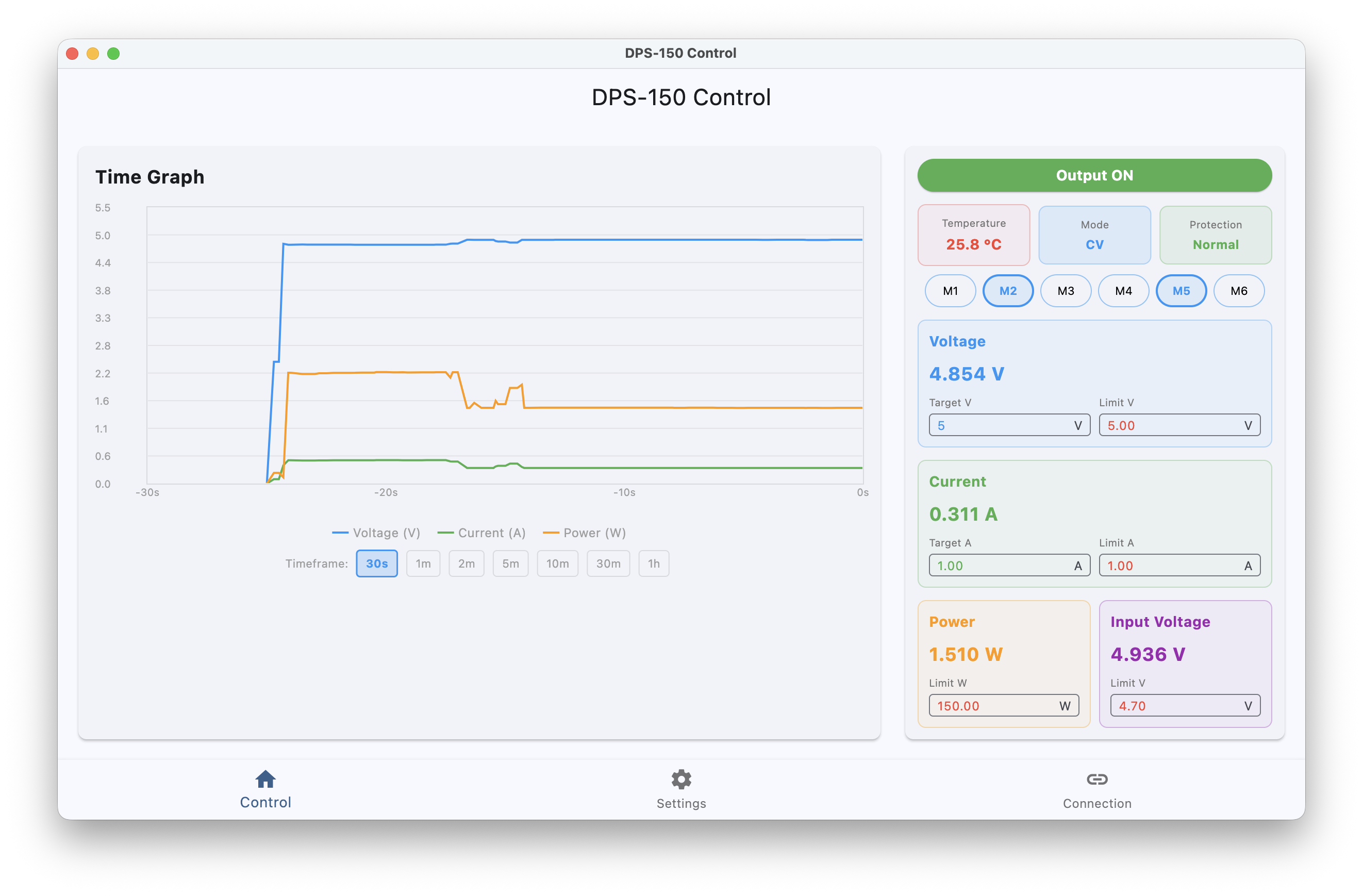
A pure Python library for controlling the FNIRSI DPS-150 programmable power supply via serial communication. This library provides a clean async/await API for all device operations without any UI dependencies.
Features
- Async/await support - Non-blocking operations for efficient device control
- Complete protocol implementation - Based on the JavaScript reference implementation
- Full device control - All device features accessible via Python
- State monitoring - Real-time state updates with callback support
- Type hints - Full type annotations for better IDE support
- Comprehensive examples - Jupyter notebook with practical examples
Supported Features
- ✅ Voltage and current control (0-30V, 0-5A typical)
- ✅ Protection settings (OVP, OCP, OPP, OTP, LVP)
- ✅ Preset groups (6 configurable presets)
- ✅ Energy metering (capacity in Ah, energy in Wh)
- ✅ Device information (model, firmware, hardware versions)
- ✅ Display and audio settings (brightness, volume)
- ✅ Real-time monitoring (voltage, current, power, temperature)
Installation
From Source
git clone <repository-url>
cd DPS-150
pip install -r requirements.txt
Or install as a package:
pip install .
Requirements
- Python 3.9 or higher
- pyserial-asyncio >= 0.6
- pyserial >= 3.5
Quick Start
Basic Usage
import asyncio
from dps150 import DPS150

async def main():
    # Connect to device
    async with DPS150(port="/dev/ttyUSB0") as device:  # or "COM3" on Windows
        # Get device information
        info = await device.get_info()
        print(f"Model: {info.model_name}")
        print(f"Firmware: {info.firmware_version}")

        # Set voltage and current
        await device.set_voltage(12.0)
        await device.set_current(1.0)

        # Enable output
        await device.enable_output()

        # Read current state
        state = await device.get_all()
        print(f"Output: {state.output_voltage:.3f}V @ {state.output_current:.3f}A")

        # Disable output
        await device.disable_output()

if __name__ == "__main__":
    asyncio.run(main())
Finding Your Serial Port
from dps150 import list_serial_ports

# List all available serial ports
ports = list_serial_ports()
for port in ports:
    print(f"Device: {port['device']}")
    print(f"  Description: {port['description']}")
    print(f"  VID: {port['vid']}, PID: {port['pid']}")
Examples
Voltage Sweep
import asyncio
from dps150 import DPS150

async def main():
    async with DPS150(port="/dev/ttyUSB0") as device:
        await device.set_current(1.0)  # Set current limit
        await device.enable_output()

        # Sweep voltage from 0 to 12V
        for voltage in range(0, 13):
            await device.set_voltage(float(voltage))
            await asyncio.sleep(0.5)  # Wait at each voltage
            state = await device.get_all()
            print(f"{voltage}V: {state.output_voltage:.3f}V, "
                  f"{state.output_current:.3f}A, {state.output_power:.3f}W")

        await device.disable_output()

asyncio.run(main())
Setting Protection Limits
import asyncio
from dps150 import DPS150

async def main():
    async with DPS150(port="/dev/ttyUSB0") as device:
        # Set protection limits
        await device.set_ovp(15.0)  # Over-voltage protection at 15V
        await device.set_ocp(2.0)   # Over-current protection at 2A
        await device.set_opp(20.0)  # Over-power protection at 20W

        # Verify settings
        state = await device.get_all()
        print(f"OVP: {state.over_voltage_protection:.2f}V")
        print(f"OCP: {state.over_current_protection:.2f}A")
        print(f"OPP: {state.over_power_protection:.2f}W")

asyncio.run(main())
State Monitoring with Callbacks
import asyncio
from dps150 import DPS150

async def main():
    async with DPS150(port="/dev/ttyUSB0") as device:
        # Register callback for state updates
        def on_update(state):
            print(f"V: {state.output_voltage:.3f}V, "
                  f"I: {state.output_current:.3f}A, "
                  f"P: {state.output_power:.3f}W")
            if state.protection_state.value:
                print(f"⚠ Protection: {state.protection_state.value}")

        device.on_state_update(on_update)

        await device.set_voltage(10.0)
        await device.set_current(1.0)
        await device.enable_output()

        # Monitor for 10 seconds
        await asyncio.sleep(10)

        await device.disable_output()

asyncio.run(main())
Using Preset Groups
import asyncio
from dps150 import DPS150

async def main():
    async with DPS150(port="/dev/ttyUSB0") as device:
        # Configure preset groups
        await device.set_group(1, 5.0, 0.5)   # Group 1: 5V @ 0.5A
        await device.set_group(2, 12.0, 1.0)  # Group 2: 12V @ 1.0A

        # Load and use group 1
        await device.load_group(1)
        await device.enable_output()
        await asyncio.sleep(2)

        # Switch to group 2
        await device.load_group(2)
        await asyncio.sleep(2)

        await device.disable_output()

asyncio.run(main())
API Reference
Connection Management
DPS150(port: Optional[str] = None)
Create a DPS150 device instance.
Parameters:
port (str, optional): Serial port path (e.g., /dev/ttyUSB0 on Linux/Mac, COM3 on Windows). If None, attempts auto-detection.
Example:
device = DPS150(port="/dev/ttyUSB0")
async connect(port: Optional[str] = None) -> None
Connect to the device and initialize communication.
Raises:
DPS150ConnectionError: If connection fails
async disconnect() -> None
Disconnect from the device and clean up resources.
Context Manager Support
The DPS150 class supports async context manager for automatic connection management:
async with DPS150(port="/dev/ttyUSB0") as device:
    # Device is automatically connected
    await device.set_voltage(12.0)
# Device is automatically disconnected
Reading Device State
async get_all() -> DeviceState
Get complete device state including all measurements and settings.
Returns:
DeviceState: Complete device state object
async get_voltage() -> float
Get current output voltage.
Returns:
float: Output voltage in volts
async get_current() -> float
Get current output current.
Returns:
float: Output current in amperes
async get_power() -> float
Get current output power.
Returns:
float: Output power in watts
async get_temperature() -> float
Get device temperature.
Returns:
float: Temperature in degrees Celsius
async get_info() -> DeviceInfo
Get device information (model name, firmware version, hardware version).
Returns:
DeviceInfo: Device information object
Setting Output Values
async set_voltage(value: float) -> None
Set target output voltage.
Parameters:
value (float): Voltage in volts (typically 0-30V)
async set_current(value: float) -> None
Set target output current (current limit).
Parameters:
value (float): Current in amperes (typically 0-5A)
async enable_output() -> None
Enable the output (turn on power supply).
async disable_output() -> None
Disable the output (turn off power supply).
Protection Settings
async set_ovp(value: float) -> None
Set over-voltage protection threshold.
Parameters:
value (float): Voltage threshold in volts
async set_ocp(value: float) -> None
Set over-current protection threshold.
Parameters:
value (float): Current threshold in amperes
async set_opp(value: float) -> None
Set over-power protection threshold.
Parameters:
value (float): Power threshold in watts
async set_otp(value: float) -> None
Set over-temperature protection threshold.
Parameters:
value (float): Temperature threshold in degrees Celsius
async set_lvp(value: float) -> None
Set low-voltage protection threshold.
Parameters:
value (float): Voltage threshold in volts
Preset Groups
async set_group(group: int, voltage: float, current: float) -> None
Set preset group values.
Parameters:
group (int): Group number (1-6)voltage (float): Voltage in voltscurrent (float): Current in amperes
Raises:
ValueError: If group number is not 1-6
async load_group(group: int) -> None
Load preset group values as current settings.
Parameters:
group (int): Group number (1-6)
Raises:
ValueError: If group number is not 1-6
Energy Metering
async start_metering() -> None
Start energy metering (accumulates capacity and energy).
async stop_metering() -> None
Stop energy metering.
Display and Audio
async set_brightness(value: int) -> None
Set display brightness.
Parameters:
value (int): Brightness level (0-10)
Raises:
ValueError: If value is not 0-10
async set_volume(value: int) -> None
Set beep volume.
Parameters:
value (int): Volume level (0-10)
Raises:
ValueError: If value is not 0-10
State Monitoring
on_state_update(callback: Callable[[DeviceState], None]) -> None
Register a callback function for state updates. The callback will be called whenever the device state changes.
Parameters:
callback (Callable): Function that takes a DeviceState parameter
Example:
def my_callback(state: DeviceState):
    print(f"Voltage: {state.output_voltage}V")
    print(f"Current: {state.output_current}A")
    if state.protection_state != ProtectionState.NORMAL:
        print(f"⚠ Protection: {state.protection_state.value}")

device.on_state_update(my_callback)
Data Models
DeviceState
Complete device state dataclass containing all measurements and settings.
Key Fields:
output_voltage (float): Current output voltageoutput_current (float): Current output currentoutput_power (float): Current output powertemperature (float): Device temperatureset_voltage (float): Set voltage valueset_current (float): Set current valueover_voltage_protection (float): OVP thresholdover_current_protection (float): OCP thresholdover_power_protection (float): OPP thresholdoutput_capacity (float): Energy capacity in Ahoutput_energy (float): Energy in Whoutput_closed (bool): Output enabled/disabledprotection_state (ProtectionState): Current protection statemode (Mode): Output mode (CC or CV)
DeviceInfo
Device information dataclass.
Fields:
model_name (str): Model namehardware_version (str): Hardware versionfirmware_version (str): Firmware version
ProtectionState (Enum)
Protection state enumeration.
Values:
NORMAL: Normal operationOVP: Over Voltage Protection triggeredOCP: Over Current Protection triggeredOPP: Over Power Protection triggeredOTP: Over Temperature Protection triggeredLVP: Low Voltage Protection triggeredREP: Reverse Connection Protection triggered
Mode (Enum)
Output mode enumeration.
Values:
CC: Constant Current modeCV: Constant Voltage mode
Exceptions
DPS150Error
Base exception for all DPS-150 errors.
DPS150ConnectionError
Raised when there are connection issues with the device.
DPS150ProtocolError
Raised when there are protocol errors (bad checksum, malformed packet, etc.).
DPS150TimeoutError
Raised when a communication timeout occurs.
DPS150ProtectionError
Raised when a protection state is triggered.
Attributes:
protection_state (str): The protection state that was triggered
Protocol Details
The library implements the DPS-150 serial communication protocol:
Serial Settings
- Baud Rate: 115200
- Data Bits: 8
- Stop Bits: 1
- Parity: None
- Flow Control: Hardware (RTS/CTS)
Packet Format
Outgoing packets:
[0xF1, command, type, length, data..., checksum]
Incoming packets:
[0xF0, command, type, length, data..., checksum]
Checksum calculation:
checksum = (type + length + sum(data_bytes)) % 256
Data encoding:
- Float values: Little-endian 32-bit IEEE 754 format
- String values: UTF-8 encoded, null-terminated
- Byte values: Single byte (0-255)
Command Codes
0xA1: GET - Request value from device0xB1: SET - Set value on device0xC1: Connection/initialization command
Project Structure
DPS-150/
├── dps150/              # Main package
│   ├── __init__.py      # Package exports
│   ├── device.py        # Main DPS150 class
│   ├── protocol.py      # Packet encoding/decoding
│   ├── transport.py       # Serial communication layer
│   ├── models.py        # Data models (DeviceState, DeviceInfo)
│   ├── constants.py    # Protocol constants
│   ├── exceptions.py   # Custom exceptions
│   └── utils.py        # Utility functions
├── tests/               # Test suite
├── example.ipynb        # Jupyter notebook examples
├── setup.py            # Package setup
├── requirements.txt    # Dependencies
└── README.md           # This file
Testing
Run the test suite:
pytest
For coverage:
pytest --cov=dps150 --cov-report=html
Contributing
Contributions are welcome! Please feel free to submit a Pull Request.
License
MIT License - see LICENSE file for details.
Acknowledgments
This library is based on the JavaScript implementation by cho45. Special thanks for reverse-engineering the protocol and providing the reference implementation.
Related Projects
Support
For issues, questions, or feature requests, please open an issue on GitHub.