
kolosal-cli
Super lightweight Ollama + Qwen Code alternative to run Llama 3.3, DeepSeek-R1, Phi-4, Gemma 3, Mistral Small 3.1 and other large language models.
- 465
- TypeScript
- Apache-2.0
- 11 mo ago

Simple tiktoken implementation in C++
Repo KolosalAI/tiktoken.cpp, read from GitHub 9 min ago. KolosalAI has not joined Take My Repo.
KolosalAI/tiktoken.cpp is a public repo on GitHub by KolosalAI. Simple tiktoken implementation in C++. It declares the MIT license on GitHub. It is written mainly in C++, has 4 stars and last changed on 2025-12-14. Nobody has reviewed it on Take My Repo yet, which says nothing about its quality. Read from GitHub on 2026-11-22.
High-performance, header-only tiktoken implementation in C++ with a small wrapper API and examples. It mirrors the behavior of OpenAI's tiktoken for common operations and supports custom encodings via local .tiktoken BPE files.
Highlights
src/_tiktoken.hpp and friendly API in src/tiktoken.hppmacOS quick tips
pipx install conan or pip install --user conanxcode-select --installThis project uses Conan to fetch PCRE2 and utfcpp and generates a CMake preset that wires everything for you.
Detect a profile (first time only):
conan profile detect -fInstall deps and generate presets into the project root (toolchain/presets go under build/Release/):
conan install . --output-folder=. --build=missing -s build_type=ReleaseConfigure and build (flat preset writes build files to build/):
cmake --preset conan-release-flatcmake --build --preset conan-release-flat -jAlternative: plain CMake (if you already have PCRE2 + utfcpp)
CMAKE_PREFIX_PATH to point to your PCRE2/utfcpp install roots so find_package(PCRE2) and find_package(utf8cpp) succeed.tiktoken (header-only)cpp_basictiktoken_benchmarkDefaults can be toggled in CMakeLists.txt:
TIKTOKEN_BUILD_EXAMPLES (ON)TIKTOKEN_BUILD_BENCHMARKS (ON)The public API is in src/tiktoken.hpp. Minimal example:
#include "tiktoken.hpp"
using namespace tiktoken;

int main() {
	// Build a tiny demo encoding (bytes 0..255 map to ids 0..255; a single special token)
	EncodingDefinition def;
	def.name = "minimal_demo";
	def.pat_str = R"('(?:[sdmt]|ll|ve|re)| ?\p{L}++| ?\p{N}++| ?[^\s\p{L}\p{N}]++|\s++$|\s+(?!\S)|\s)";
	for (int b = 0; b < 256; ++b) def.mergeable_ranks.push_back({U8Vec{static_cast<U8>(b)}, static_cast<Rank>(b)});
	def.special_tokens = {{"<|endoftext|>", 256}};
	def.explicit_n_vocab = 257;

	register_encoding(def);
	auto enc = get_encoding(def.name);

	auto tokens = enc->encode("hello world");
	auto bytes = enc->decode_bytes(tokens);
	auto text = std::string(reinterpret_cast<const char*>(bytes.data()), bytes.size());
}
Or load a real BPE file (.tiktoken) and run cl100k-style encoding:
auto ranks = tiktoken::load_tiktoken_bpe_from_file("cl100k_base.tiktoken");
tiktoken::EncodingDefinition def;
def.name = "cl100k_base";
def.pat_str = R"('(?i:[sdmt]|ll|ve|re)|[^\r\n\p{L}\p{N}]?+\p{L}++|\p{N}{1,3}+| ?[^\s\p{L}\p{N}]++[\r\n]*+|\s++$|\s*[\r\n]|\s+(?!\S)|\s)";
def.mergeable_ranks = std::move(ranks);
def.special_tokens = {{"<|endoftext|>", 100257}, {"<|fim_prefix|>", 100258}, {"<|fim_middle|>", 100259}, {"<|fim_suffix|>", 100260}, {"<|endofprompt|>", 100276}};
tiktoken::register_encoding(def);
auto enc = tiktoken::get_encoding(def.name);
auto toks = enc->encode("hello world");
cpp_basic demonstrates loading a .tiktoken file or using a minimal demo:
./build/cpp_basic build/cl100k_base.tiktoken "hello world"./build/cpp_basicSimple CLI to loop on encode(text) and report throughput:
Demo mode (no BPE):
./build/tiktoken_benchmark --iters 200 --progressWith a BPE and input file:
./build/tiktoken_benchmark --bpe build/cl100k_base.tiktoken --file build/bench.txt --iters 1000 --progressFlags
--bpe <path>: .tiktoken file (base64 bytes + rank per line)--file <path>: text to encode (raw text)--iters N (default 1000)--progress: prints progress dots to stderrNotes on performance
The following chart compares the encoding throughput of tiktoken.cpp (C++), tiktoken (Python), and Hugging Face tokenizers (Rust/Python bindings) across different text sizes.
Legend:
tiktoken.cpp (Optimized C++)tiktoken (Original Python/Rust)tokenizers| Text Size | tiktoken.cpp (C++) | tiktoken (Python) | HF Tokenizers | Speedup (C++ vs Py) |
|---|---|---|---|---|
| 1KB | ~4.8M | ~2.5M | ~0.9M | 1.9x |
| 4KB | ~1.7M | ~3.8M | ~0.9M | 0.45x |
| 16KB | ~3.2M | ~4.1M | ~0.9M | 0.8x |
| 64KB | ~4.3M | ~3.7M | ~0.8M | 1.2x |
| 256KB | ~8.0M | ~4.3M | ~0.7M | 1.9x |
| 1MB | ~9.0M | ~4.2M | ~0.7M | 2.1x |
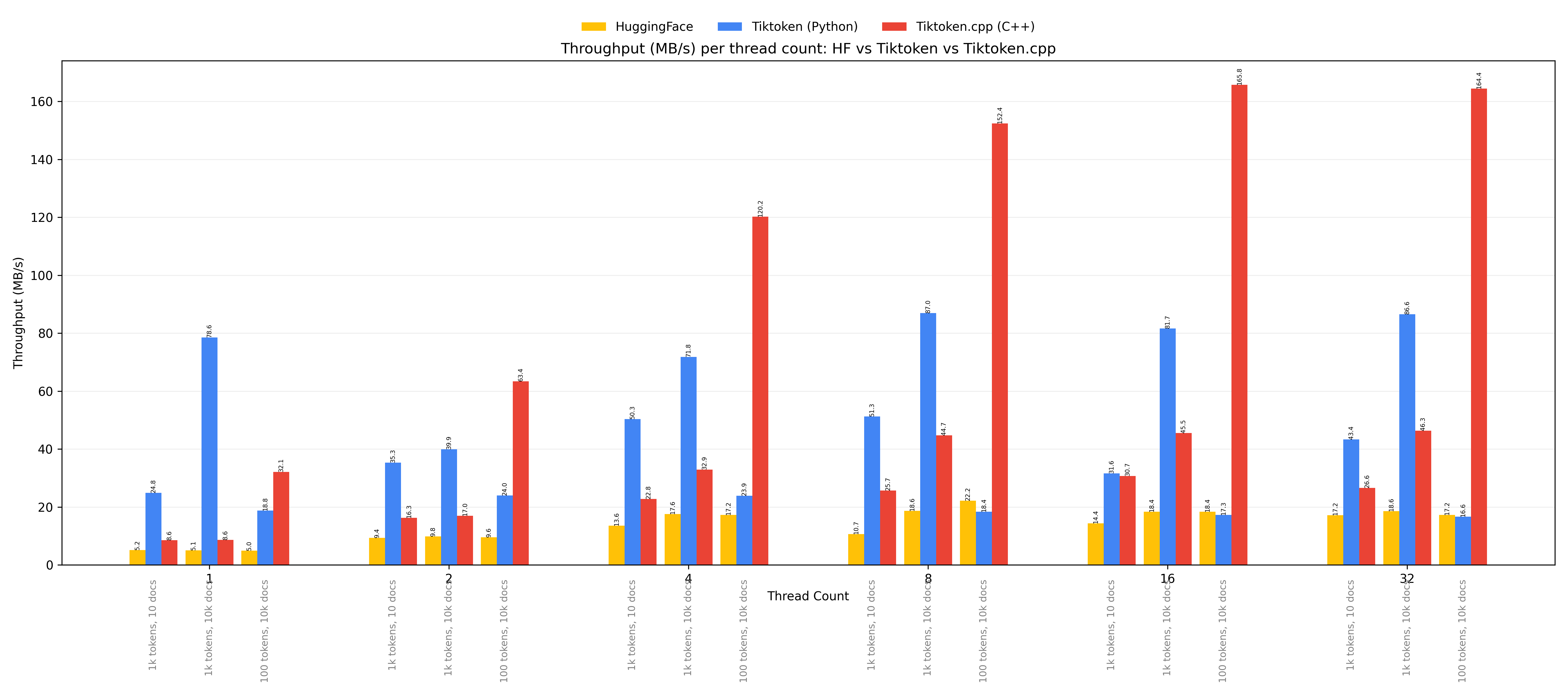
The following chart shows the throughput in MB/s for different batch scenarios across thread counts, comparing tiktoken.cpp (C++), tiktoken (Python), and Hugging Face tokenizers.
| Threads | tiktoken.cpp (Tokens/sec) |
|---|---|
| 1 | ~4.3M |
| 4 | ~12.2M |
| 8 | ~13.2M |
| 16 | ~13.0M |
tiktoken.cpp achieves ~13M tokens/sec in batch mode, effectively saturating the CPU.
CMake can’t find PCRE2/utf8cpp
CMAKE_PREFIX_PATH to where these packages are installed.-DCMAKE_PREFIX_PATH="/opt/homebrew/opt/pcre2;/opt/homebrew/opt/utf8cpp"Preset not found / toolchain warnings
conan install . --output-folder=build --build=missing -s build_type=Releasecmake --preset conan-release && cmake --build --preset conan-release -j (nested build dirs)cmake --preset conan-release-flat && cmake --build --preset conan-release-flat -j (flat build dir)Xcode/Clang issues
xcode-select --installSlow debug builds
-DCMAKE_BUILD_TYPE=Release or the conan-release preset. Regex JIT and hot paths shine in Release.MIT. See LICENSE.
Inspired by OpenAI’s tiktoken and Rust implementations of BPE tokenizers.
KolosalAI/tiktoken.cpp is a public repo on GitHub by KolosalAI. Simple tiktoken implementation in C++.
It declares the MIT license on GitHub.
Its maker has not tagged a system, so it is unknown here. Its README says what it needs.
Open "Take it" on its page: Take My Repo writes an install plan for your machine and hands it to your AI agent (Claude Code, Codex or Cursor), which asks you before each step. Take My Repo has not tested it on any machine.
Its last change on GitHub was on 2025-12-14. Take My Repo does not judge from that whether it is maintained.
Nobody has reviewed it on Take My Repo yet, which says nothing about its quality.
Super lightweight Ollama + Qwen Code alternative to run Llama 3.3, DeepSeek-R1, Phi-4, Gemma 3, Mistral Small 3.1 and other large language models.
Kolosal AI is an OpenSource and Lightweight alternative to LM Studio to run LLMs 100% offline on your device.
Kolosal AI is an OpenSource and Lightweight alternative to Ollama to run LLMs 100% offline on your device.
Genta Academic Assistant, an AI powered assistant to help you on your academic research
