
PyCIL
PyCIL: A Python Toolbox for Class-Incremental Learning
- 1.1k
- 10 mo ago
Repo LAMDA-CL/PyCIL, read from GitHub 1 min ago. LAMDA-CL has not joined Take My Repo.
In short
LAMDA-CL/PyCIL is a public repo on GitHub by LAMDA-CL. PyCIL: A Python Toolbox for Class-Incremental Learning. It declares no license on GitHub. Public does not mean open source: without a license, nobody is granted the right to reuse it. It is written mainly in Python, has 1,124 stars and last changed on 2026-01-29. Nobody has reviewed it on Take My Repo yet, which says nothing about its quality. Read from GitHub on 2026-11-22.
PyCIL: A Python Toolbox for Class-Incremental Learning
Introduction • Methods Reproduced • Reproduced Results • How To Use • License • Acknowledgments • Contact

Welcome to PyCIL, perhaps the toolbox for class-incremental learning with the most implemented methods. This is the code repository for "PyCIL: A Python Toolbox for Class-Incremental Learning" [paper] in PyTorch. If you use any content of this repo for your work, please cite the following bib entries:
@article{zhou2023pycil,
    author = {Da-Wei Zhou and Fu-Yun Wang and Han-Jia Ye and De-Chuan Zhan},
    title = {PyCIL: a Python toolbox for class-incremental learning},
    journal = {SCIENCE CHINA Information Sciences},
    year = {2023},
    volume = {66},
    number = {9},
    pages = {197101},
    doi = {https://doi.org/10.1007/s11432-022-3600-y}
  }

@article{zhou2024class,
    author = {Zhou, Da-Wei and Wang, Qi-Wei and Qi, Zhi-Hong and Ye, Han-Jia and Zhan, De-Chuan and Liu, Ziwei},
    title = {Class-Incremental Learning: A Survey},
    journal={IEEE Transactions on Pattern Analysis and Machine Intelligence},
    volume={46},
    number={12},
    pages={9851--9873},
    year = {2024}
}

@inproceedings{zhou2024continual,
    title={Continual learning with pre-trained models: A survey},
    author={Zhou, Da-Wei and Sun, Hai-Long and Ning, Jingyi and Ye, Han-Jia and Zhan, De-Chuan},
    booktitle={IJCAI},
    pages={8363-8371},
    year={2024}
}
What's New
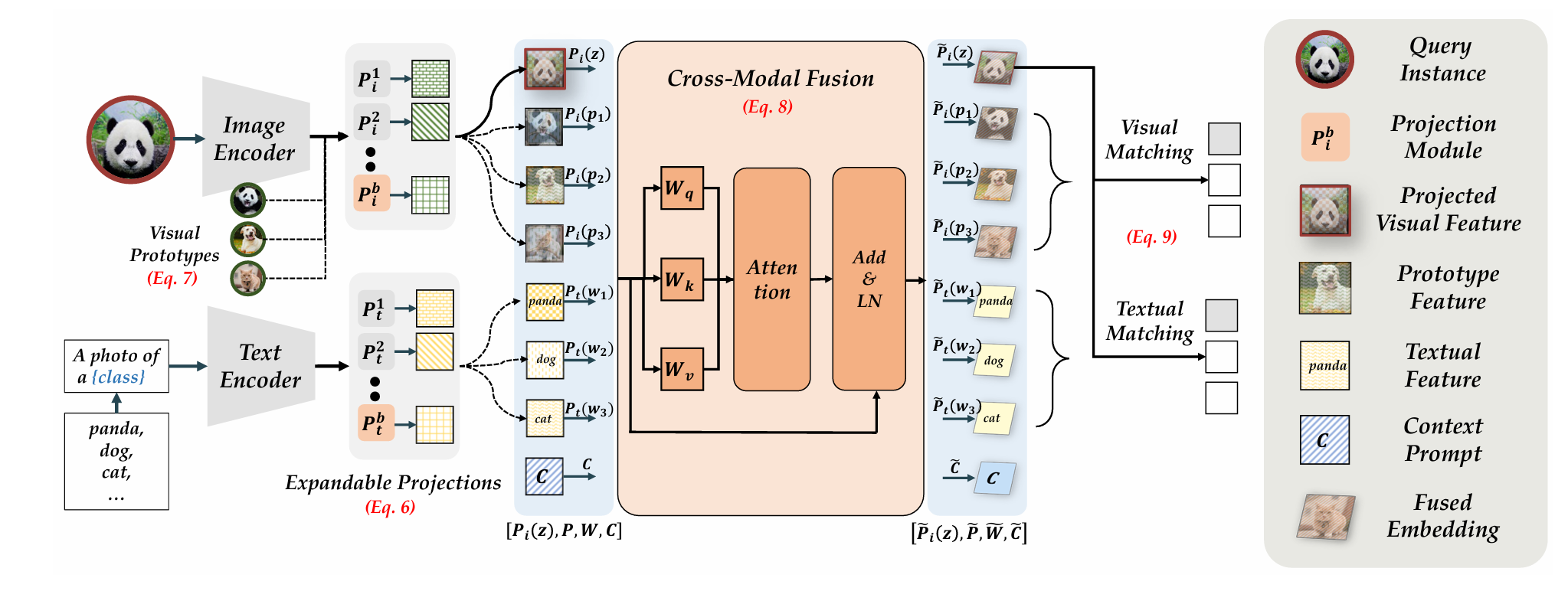
- [2026-01]🌟 We have released C3Box, a CLIP-based Class-Incremental Learning Toolbox. Have a try!
- [2025-07]🌟 Check out our latest work on class-incremental learning with CLIP (ICCV 2025)!
- [2025-07]🌟 Check out our latest work on pre-trained model-based class-incremental learning (ICCV 2025)!
- [2025-07]🌟 Check out our latest work on domain-incremental learning with PTM (ICML 2025)!
- [2025-04]🌟 Add TagFex. State-of-the-art method of 2025!
- [2025-03]🌟 Check out our latest work on class-incremental learning (CVPR 2025)!
- [2025-02]🌟 Check out our latest work on pre-trained model-based domain-incremental learning (CVPR 2025)!
- [2025-02]🌟 Check out our latest work on class-incremental learning with vision-language models (TPAMI 2025)!
- [2024-12]🌟 Check out our latest work on pre-trained model-based class-incremental learning (AAAI 2025)!
- [2024-08]🌟 Check out our latest work on pre-trained model-based class-incremental learning (IJCV 2024)!
- [2024-07]🌟 Check out our rigorous and unified survey about class-incremental learning, which introduces some memory-agnostic measures with holistic evaluations from multiple aspects (TPAMI 2024)!
- [2024-06]🌟 Check out our work about all-layer margin in class-incremental learning (ICML 2024)!
- [2024-03]🌟 Check out our latest work on pre-trained model-based class-incremental learning (CVPR 2024)!
- [2024-01]🌟 Check out our latest survey on pre-trained model-based continual learning (IJCAI 2024)!
- [2023-09]🌟 We have released PILOT toolbox for class-incremental learning with pre-trained models. Have a try!
- [2023-07]🌟 Add MEMO, BEEF, and SimpleCIL. State-of-the-art methods of 2023!
- [2022-12]🌟 Add FrTrIL, PASS, IL2A, and SSRE.
- [2022-10]🌟 PyCIL has been published in SCIENCE CHINA Information Sciences. Check out the official introduction!
- [2022-08]🌟 Add RMM.
- [2022-07]🌟 Add FOSTER. State-of-the-art method with a single backbone!
- [2021-12]🌟 Call For Feedback: We add a section to introduce awesome works using PyCIL. If you are using PyCIL to publish your work in top-tier conferences/journals, feel free to contact us for details!
- [2021-12]🌟 As team members are committed to other projects and in light of the intense demands of code reviews, we will prioritize reviewing algorithms that have explicitly cited and implemented methods from our toolbox paper in their publications. Please read the PR policy before submitting your code.
Introduction
Traditional machine learning systems are deployed under the closed-world setting, which requires the entire training data before the offline training process. However, real-world applications often face the incoming new classes, and a model should incorporate them continually. The learning paradigm is called Class-Incremental Learning (CIL). We propose a Python toolbox that implements several key algorithms for class-incremental learning to ease the burden of researchers in the machine learning community. The toolbox contains implementations of a number of founding works of CIL, such as EWC and iCaRL, but also provides current state-of-the-art algorithms that can be used for conducting novel fundamental research. This toolbox, named PyCIL for Python Class-Incremental Learning, is open source with an MIT license.
For more information about incremental learning, you can refer to these reading materials:
- A brief introduction (in Chinese) about CIL is available here.
- A PyTorch Tutorial to Class-Incremental Learning (with explicit codes and detailed explanations) is available here.
Methods Reproduced
FineTune: Baseline method which simply updates parameters on new tasks.EWC: Overcoming catastrophic forgetting in neural networks. PNAS2017 [paper]LwF: Learning without Forgetting. ECCV2016 [paper]Replay: Baseline method with exemplar replay.GEM: Gradient Episodic Memory for Continual Learning. NIPS2017 [paper]iCaRL: Incremental Classifier and Representation Learning. CVPR2017 [paper]BiC: Large Scale Incremental Learning. CVPR2019 [paper]WA: Maintaining Discrimination and Fairness in Class Incremental Learning. CVPR2020 [paper]PODNet: PODNet: Pooled Outputs Distillation for Small-Tasks Incremental Learning. ECCV2020 [paper]DER: DER: Dynamically Expandable Representation for Class Incremental Learning. CVPR2021 [paper]PASS: Prototype Augmentation and Self-Supervision for Incremental Learning. CVPR2021 [paper]RMM: RMM: Reinforced Memory Management for Class-Incremental Learning. NeurIPS2021 [paper]IL2A: Class-Incremental Learning via Dual Augmentation. NeurIPS2021 [paper]ACIL: Analytic Class-Incremental Learning with Absolute Memorization and Privacy Protection. NeurIPS 2022 [paper]SSRE: Self-Sustaining Representation Expansion for Non-Exemplar Class-Incremental Learning. CVPR2022 [paper]FeTrIL: Feature Translation for Exemplar-Free Class-Incremental Learning. WACV2023 [paper]Coil: Co-Transport for Class-Incremental Learning. ACM MM2021 [paper]FOSTER: Feature Boosting and Compression for Class-incremental Learning. ECCV 2022 [paper]MEMO: A Model or 603 Exemplars: Towards Memory-Efficient Class-Incremental Learning. ICLR 2023 Spotlight [paper]BEEF: BEEF: Bi-Compatible Class-Incremental Learning via Energy-Based Expansion and Fusion. ICLR 2023 [paper]DS-AL: A Dual-Stream Analytic Learning for Exemplar-Free Class-Incremental Learning. AAAI 2024 [paper]SimpleCIL: Revisiting Class-Incremental Learning with Pre-Trained Models: Generalizability and Adaptivity are All You Need. IJCV 2024 [paper]Aper: Revisiting Class-Incremental Learning with Pre-Trained Models: Generalizability and Adaptivity are All You Need. IJCV 2024 [paper]TagFex: Task-Agnostic Guided Feature Expansion for Class-Incremental Learning. CVPR 2025 [paper]
Reproduced Results
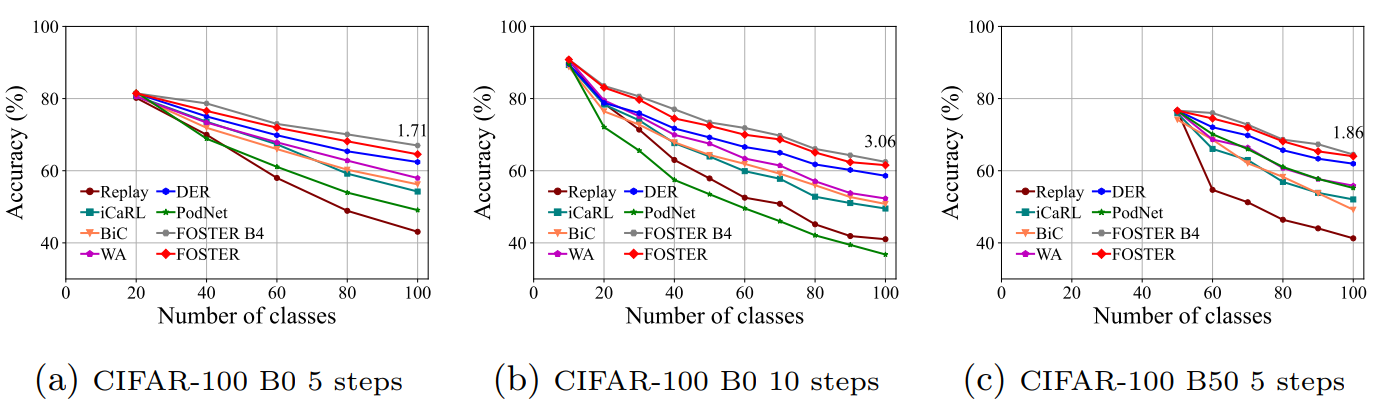
CIFAR-100

ImageNet-100

ImageNet-100 (Top-5 Accuracy)

More experimental details and results can be found in our survey.
How To Use
Clone
Clone this GitHub repository:
git clone https://github.com/G-U-N/PyCIL.git
cd PyCIL
Dependencies
Run experiment
- Edit the
[MODEL NAME].jsonfile for global settings. - Edit the hyperparameters in the corresponding
[MODEL NAME].pyfile (e.g.,models/icarl.py). - Run:
python main.py --config=./exps/[MODEL NAME].json
where [MODEL NAME] should be chosen from finetune, ewc, lwf, replay, gem, icarl, bic, wa, podnet, der, etc.
hyper-parameters
When using PyCIL, you can edit the global parameters and algorithm-specific hyper-parameter in the corresponding json file.
These parameters include:
- memory-size: The total exemplar number in the incremental learning process. Assuming there are $K$ classes at the current stage, the model will preserve $\left[\frac{memory-size}{K}\right]$ exemplar per class.
- init-cls: The number of classes in the first incremental stage. Since there are different settings in CIL with a different number of classes in the first stage, our framework enables different choices to define the initial stage.
- increment: The number of classes in each incremental stage $i$, $i$ > 1. By default, the number of classes per incremental stage is equivalent per stage.
-
convnet-type: The backbone network for the incremental model. According to the benchmark setting,
ResNet32is utilized forCIFAR100, andResNet18is used forImageNet. - seed: The random seed adopted for shuffling the class order. According to the benchmark setting, it is set to 1993 by default.
Other parameters in terms of model optimization, e.g., batch size, optimization epoch, learning rate, learning rate decay, weight decay, milestone, and temperature, can be modified in the corresponding Python file.
Datasets
We have implemented the pre-processing of CIFAR100, imagenet100, and imagenet1000. When training on CIFAR100, this framework will automatically download it. When training on imagenet100/1000, you should specify the folder of your dataset in utils/data.py.
    def download_data(self):
        assert 0,"You should specify the folder of your dataset"
        train_dir = '[DATA-PATH]/train/'
        test_dir = '[DATA-PATH]/val/'
Here is the file list of ImageNet100 (or say ImageNet-Sub).
Awesome Papers using PyCIL
Our Papers
-
External Knowledge Injection for CLIP-Based Class-Incremental Learning (ICCV 2025) [paper] [code]
-
Integrating Task-Specific and Universal Adapters for Pre-Trained Model-based Class-Incremental Learning (ICCV 2025) [paper] [code]
-
Addressing Imbalanced Domain-Incremental Learning through Dual-Balance Collaborative Experts (ICML 2025) [paper] [code]
-
Dual Consolidation for Pre-Trained Model-Based Domain-Incremental Learning (CVPR 2025) [paper] [code]
-
Task-Agnostic Guided Feature Expansion for Class-Incremental Learning (CVPR 2025) [paper] [code]
-
Learning without Forgetting for Vision-Language Models (TPAMI 2025) [paper] [code]
-
Revisiting Class-Incremental Learning with Pre-Trained Models: Generalizability and Adaptivity are All You Need (IJCV 2025) [paper] [code]
-
PILOT: A Pre-Trained Model-Based Continual Learning Toolbox (SCIS 2025) [paper] [code]
-
Class-Incremental Learning: A Survey (TPAMI 2024) [paper] [code]
-
Expandable Subspace Ensemble for Pre-Trained Model-Based Class-Incremental Learning (CVPR 2024) [paper] [code]
-
Multi-layer Rehearsal Feature Augmentation for Class-Incremental Learning (ICML 2024) [paper] [code]
-
Continual Learning with Pre-Trained Models: A Survey (IJCAI 2024) [paper] [code]
-
Adaptive Adapter Routing for Long-Tailed Class-Incremental Learning (Machine Learning 2024) [paper] [code]
-
Few-Shot Class-Incremental Learning via Training-Free Prototype Calibration (NeurIPS 2023)[paper] [Code]
-
BEEF: Bi-Compatible Class-Incremental Learning via Energy-Based Expansion and Fusion (ICLR 2023) [paper] [code]
-
A model or 603 exemplars: Towards memory-efficient class-incremental learning (ICLR 2023) [paper] [code]
-
Few-shot class-incremental learning by sampling multi-phase tasks (TPAMI 2022) [paper] [code]
-
Foster: Feature Boosting and Compression for Class-incremental Learning (ECCV 2022) [paper] [code]
-
Forward compatible few-shot class-incremental learning (CVPR 2022) [paper] [code]
-
Co-Transport for Class-Incremental Learning (ACM MM 2021) [paper] [code]
Other Awesome Works
-
Towards Realistic Evaluation of Industrial Continual Learning Scenarios with an Emphasis on Energy Consumption and Computational Footprint (ICCV 2023) [paper][code]
-
Dynamic Residual Classifier for Class Incremental Learning (ICCV 2023) [paper][code]
-
S-Prompts Learning with Pre-trained Transformers: An Occam's Razor for Domain Incremental Learning (NeurIPS 2022) [paper] [code]
-
...
License
Please check the MIT license that is listed in this repository.
Acknowledgments
We thank the following repos providing helpful components/functions in our work.
The training flow and data configurations are based on Continual-Learning-Reproduce. The original information of the repo is available in the base branch.
Contact
If there are any questions, please feel free to propose new features by opening an issue or contact with the author: Da-Wei Zhou(zhoudw@lamda.nju.edu.cn) and Fu-Yun Wang(wangfuyun@smail.nju.edu.cn). Enjoy the code.
Star History 🚀
Questions
What is PyCIL?
LAMDA-CL/PyCIL is a public repo on GitHub by LAMDA-CL. PyCIL: A Python Toolbox for Class-Incremental Learning.
Is PyCIL open source?
It declares no license on GitHub. Public does not mean open source: without a license, nobody is granted the right to reuse it.
Does PyCIL run on macOS, Windows or Linux?
Its maker has not tagged a system, so it is unknown here. Its README says what it needs.
How do I install PyCIL?
Open "Take it" on its page: Take My Repo writes an install plan for your machine and hands it to your AI agent (Claude Code, Codex or Cursor), which asks you before each step. Take My Repo has not tested it on any machine.
Is PyCIL still maintained?
Its last change on GitHub was on 2026-01-29. GitHub counts 10 open issues and pull requests. Take My Repo does not judge from that whether it is maintained.
What do people who ran PyCIL say?
Nobody has reviewed it on Take My Repo yet, which says nothing about its quality.