infracost
Cloud cost intelligence for engineers, AI coding agents, and CI/CD 💰📉 Shift FinOps Left!
- 13k
- Go
- Apache-2.0
- 20 h ago
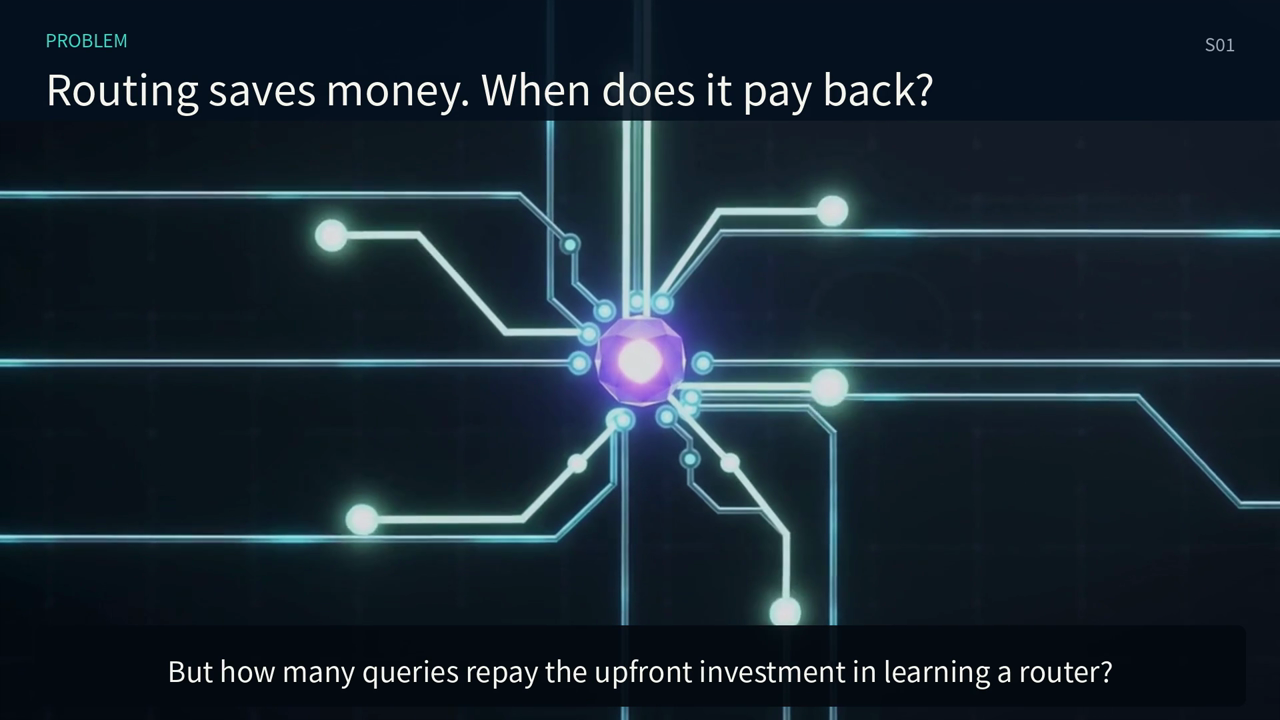
Sparse-supervision LLM routing that accounts for upfront feedback acquisition and deployment payback.
Repo LAMDA-Model-Reuse/SaveRouter, read from GitHub 1 d ago. LAMDA-Model-Reuse has not joined Take My Repo.
LAMDA-Model-Reuse/SaveRouter is a public repo on GitHub by LAMDA-Model-Reuse. Sparse-supervision LLM routing that accounts for upfront feedback acquisition and deployment payback. It declares the MIT license on GitHub. It is written mainly in Python, has 26 stars and last changed on 2026-10-14. Nobody has reviewed it on Take My Repo yet, which says nothing about its quality. Read from GitHub on 2026-11-24.
Cloud cost intelligence for engineers, AI coding agents, and CI/CD 💰📉 Shift FinOps Left!

A research collaboration between SinapisAI and LAMDA.
Guannan Lai · Gelin Bian · Hao-Xuan Ma · Jun-Peng Jiang · Long Chen · Jian-Dong Liu · Zhi-Hao Tan · Han-Jia Ye
Nanjing University · The Hong Kong University of Science and Technology · SinapisAI
Watch the motivation, method, and key results in 90 seconds. Each version has matching narration, on-screen text, and captions.
Watch in English · 观看中文版 · Download MP4s and subtitles
LLM routing can reduce serving cost, but training a router often requires executing many candidate models on historical queries first. SAVERouter treats this supervision expenditure as part of the routing problem. It adaptively acquires a small, informative subset of query-model feedback, shares capability information across related queries, and retains query-level corrections for fine-grained routing.
Across four routing benchmarks, SAVERouter uses roughly 33–41% of the available training feedback while preserving competitive routing quality. The paper introduces two metrics that account for both the upfront investment and the subsequent serving-time savings:
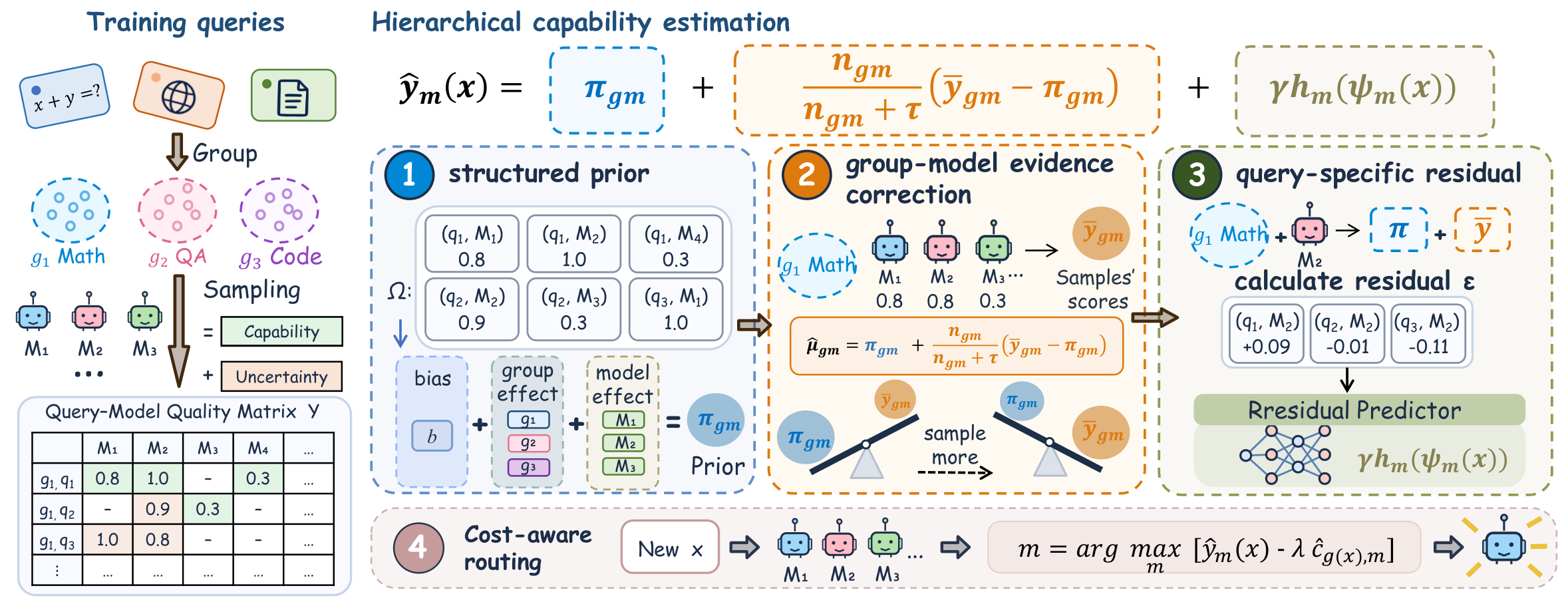
Overview of SAVERouter.
SAVERouter has three main stages:
K candidate models per training
query using grouped empirical-Bayes UCB.The sparse supervision artifact contains only acquired (query, model, quality, cost) tuples. Router fitting never receives a dense outcome matrix.
Install the core package and run the download-free smoke test:
python -m pip install saverouter
saverouter smoke-test
For paper reproduction, clone the repository and create the complete benchmark environment:
git clone https://github.com/LAMDA-Model-Reuse/SaveRouter.git
cd SaveRouter
bash scripts/setup.sh
Run the unit tests:
.venv/bin/python -m pytest
Run one benchmark or the complete four-benchmark suite:
bash scripts/reproduce.sh llmrouterbench
bash scripts/reproduce.sh all
The reproduction script downloads the original benchmark data and frozen
encoders, uses the paper profiles under configs/paper/, and writes results to
outputs/. A fresh full run requires approximately 12–15 GB of free disk
space. CUDA is recommended for MMR-Bench and first-time feature extraction;
CPU execution is supported.
After installation, the equivalent CLI command is:
saverouter reproduce --benchmark all --device auto --verify
The paper's main comparison is shown below. Small numerical differences can
occur across BLAS, CUDA, and encoder environments; --verify checks all
metrics under the repository's declared tolerances.
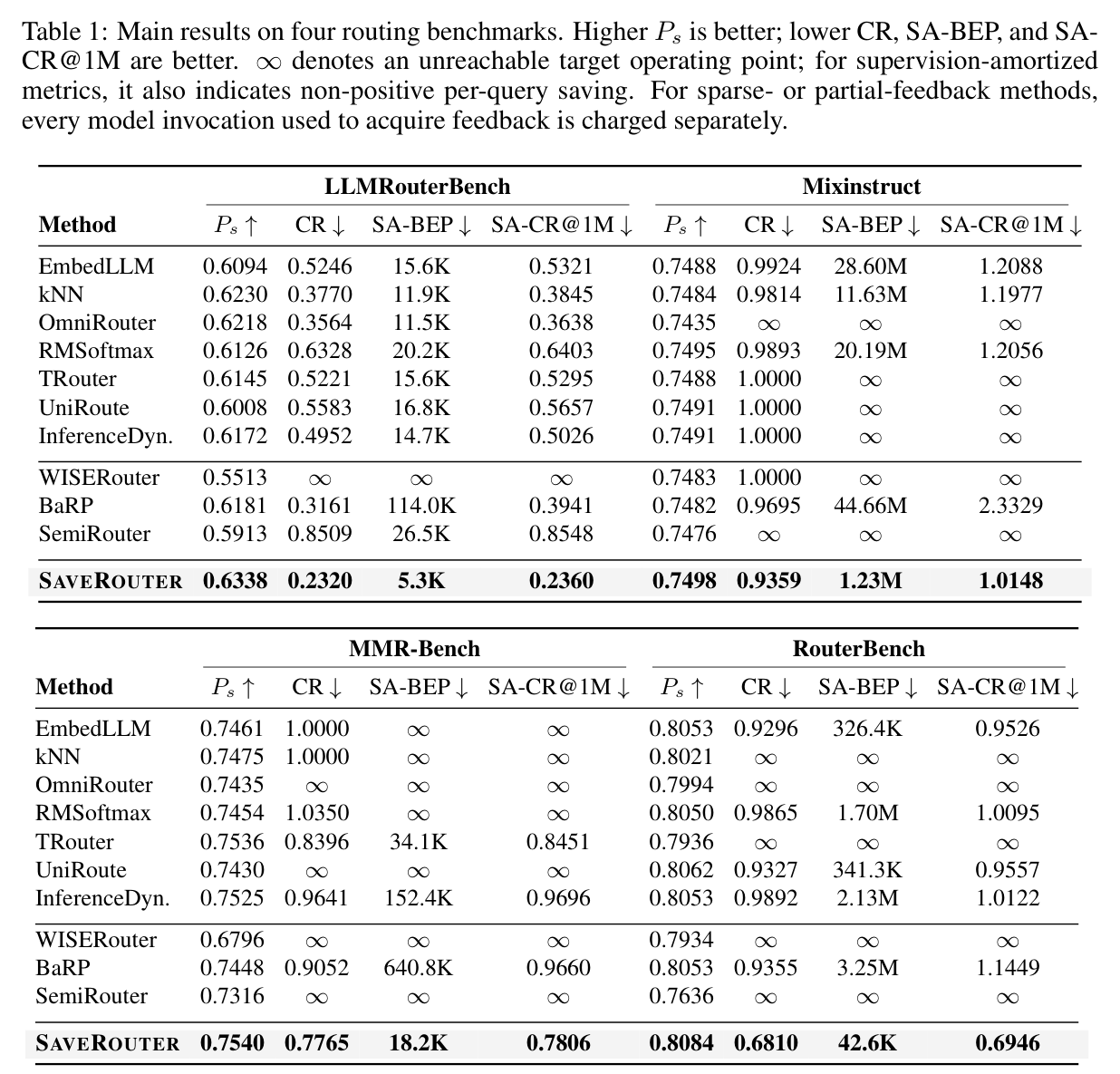
Main results on four routing benchmarks.
The evaluator constructs the complete policy family used in the paper: 201 cost-weight policies, cost-threshold policies, and incremental predicted-quality-gain per predicted-cost gates.
outputs/<benchmark>/result.json       # profile, metrics, and metadata
outputs/<benchmark>/pareto.csv        # physical routing frontier
outputs/<benchmark>/supervision.npz   # exact sparse observations
outputs/main_results.csv              # four-benchmark summary
Dataset revisions, model order, query order, split, seed, grouping profile, and acquisition mask are recorded for reproducibility. Dataset and encoder artifacts are downloaded from their publishers at pinned revisions.
from saverouter import FixedKSparseRouter, simulate_fixed_k_supervision

feedback = simulate_fixed_k_supervision(
    rewards_train,
    group_ids,
    costs=costs_train,
    k=4,
    seed=42,
)

router = FixedKSparseRouter().fit(query_features, feedback)
choices = router.route(
    test_features,
    max_cost=0.01,
    group_ids=test_group_ids,
)
For live feedback acquisition, use collect_fixed_k_supervision with a callback
that invokes a model only after it is selected. See
examples/online_feedback.py.
Let C0 be upfront supervision expenditure, Cb the serving cost of the best
single model, Cr routed serving cost at the quality target, and Co online
routing overhead:
SA-BEP = ceil(C0 / (Cb - Cr - Co))
SA-CR@H = (C0 + H * (Cr + Co)) / (H * Cb)
SA-CR@H < 1 indicates that routing has paid back its upfront supervision cost
by deployment horizon H. The experiments use H = 1,000,000.
configs/paper/       frozen benchmark profiles
examples/            custom and online-feedback examples
results/reference/   numerical reproduction references
saverouter/           method, benchmark adapters, and CLI
scripts/              setup and reproduction entry points
site/                 static project page and payback explorer
tests/                unit and leakage-regression tests
If you find SAVERouter useful, please cite:
@article{lai2026routing,
  title   = {Routing Should Pay for Itself: Sparse Supervision for Economical LLM Routing},
  author  = {Lai, Guannan and Bian, Gelin and Ma, Hao-Xuan and Jiang, Jun-Peng and Chen, Long and Liu, Jian-Dong and Tan, Zhi-Hao and Ye, Han-Jia},
  journal = {arXiv preprint arXiv:2609.37402},
  year    = {2026},
  url     = {https://arxiv.org/abs/2609.37402}
}
This repository adapts benchmark loaders and evaluation conventions from ORBIT. Benchmark datasets and pretrained encoders retain their respective licenses and terms.
SAVERouter is released under the MIT License.
LAMDA-Model-Reuse/SaveRouter is a public repo on GitHub by LAMDA-Model-Reuse. Sparse-supervision LLM routing that accounts for upfront feedback acquisition and deployment payback.
It declares the MIT license on GitHub.
Its maker has not tagged a system, so it is unknown here. Its README says what it needs.
Open "Take it" on its page: Take My Repo writes an install plan for your machine and hands it to your AI agent (Claude Code, Codex or Cursor), which asks you before each step. Take My Repo has not tested it on any machine.
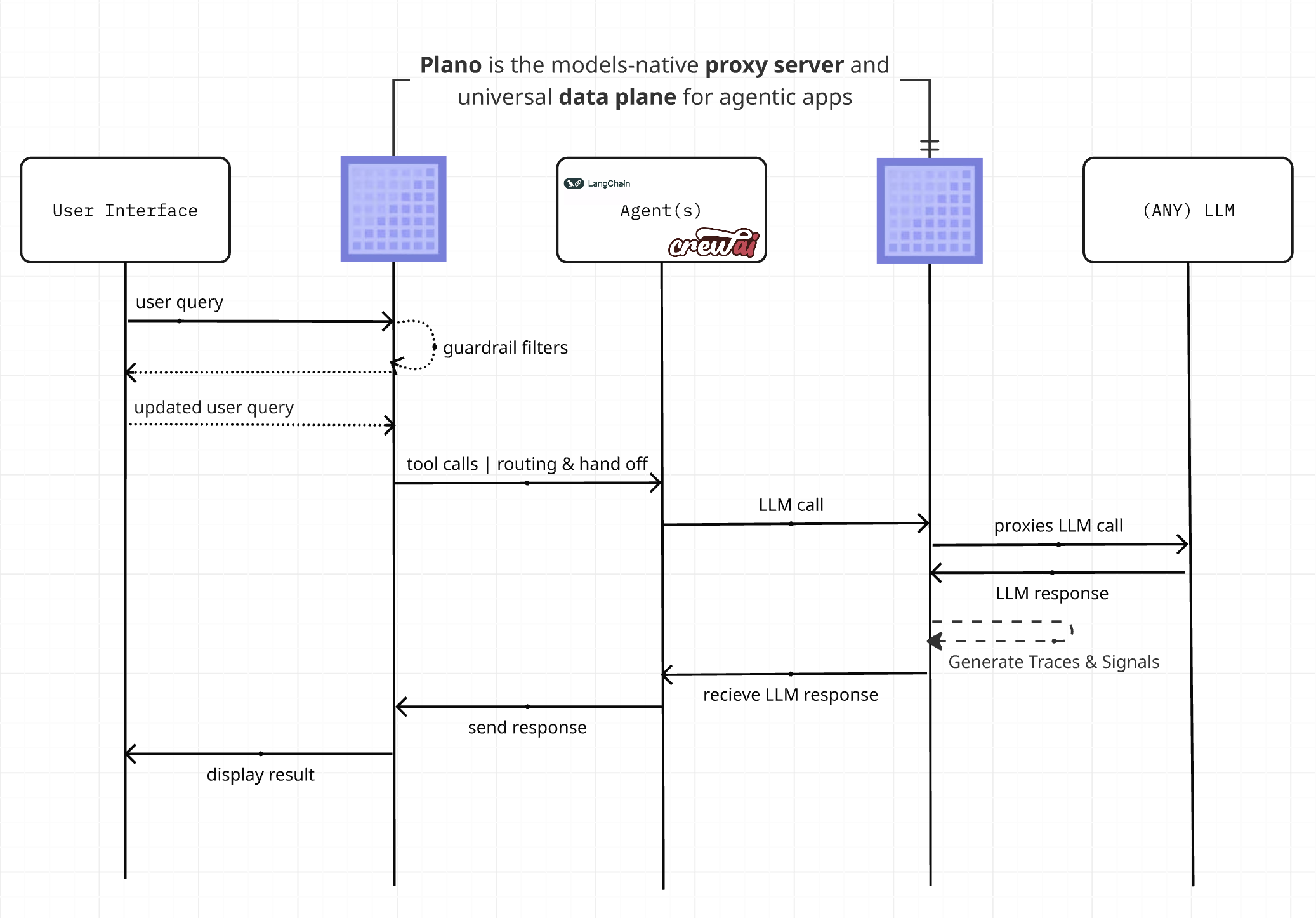
Plano is an AI-native proxy server and data plane for agentic apps. Smart LLM routing, observability, agent orchestration, and guardrails so you stay focused on your agents core logic.
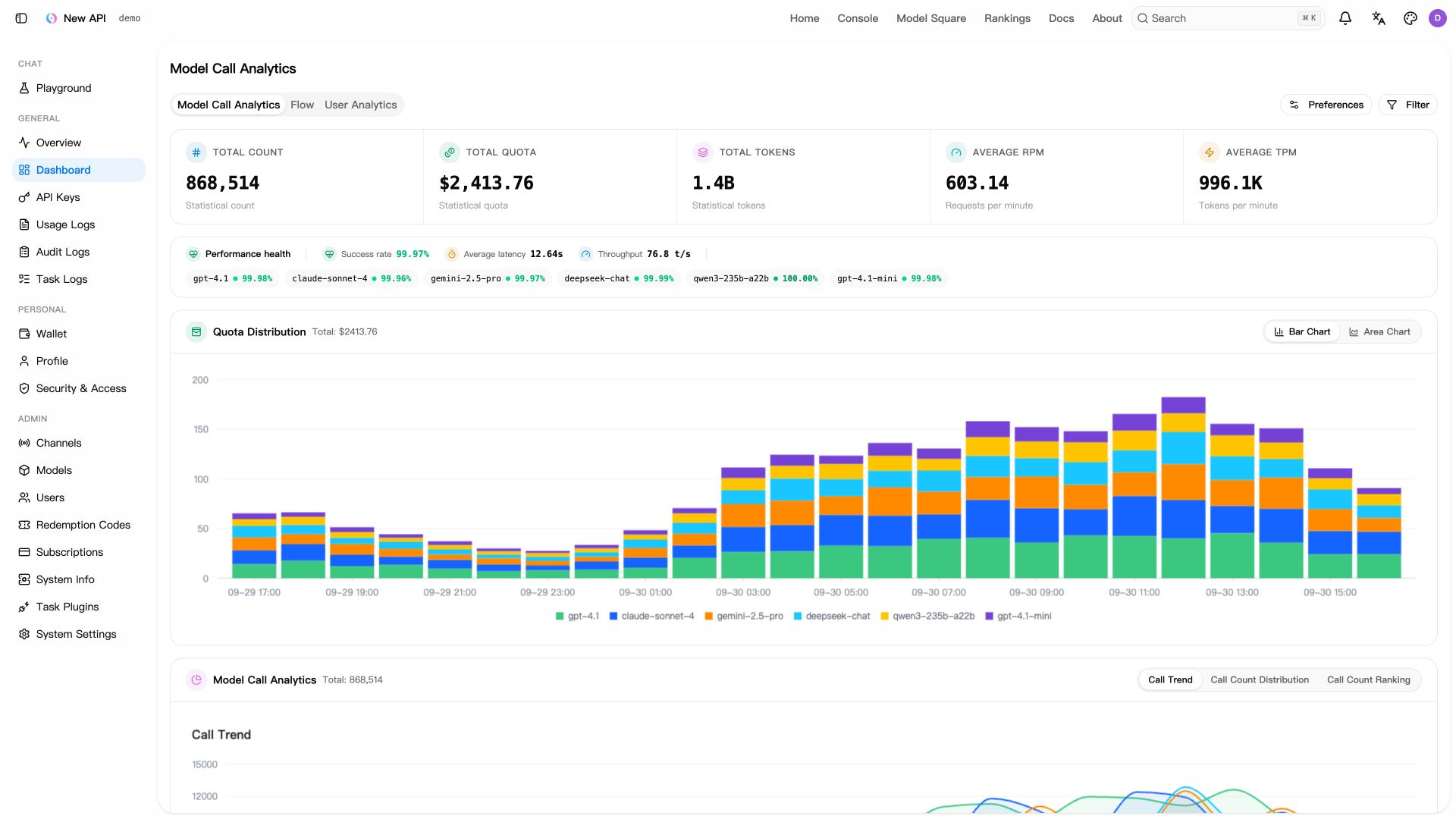
Open-source AI gateway. Self-hosted LLM gateway with OpenAI-, Claude- and Gemini-compatible APIs, model routing, access control, usage tracking and cost accounting.
The AI Compute Platform for frontier teams. SkyPilot turns fragmented AI compute into one AI supercomputer, so frontier AI teams build custom intelligence faster.
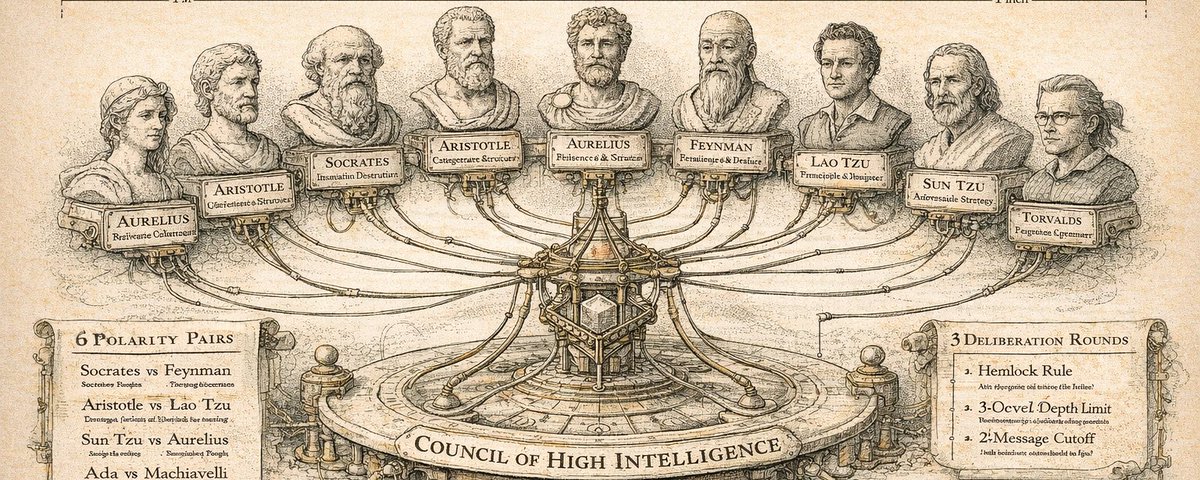
Structured multi-perspective deliberation for hard decisions. Run full councils, focused triads, or duo debates across Claude Code, Codex, Gemini CLI, and OpenCode.
Its last change on GitHub was on 2026-10-14. GitHub counts 0 open issues and pull requests. Take My Repo does not judge from that whether it is maintained.
Nobody has reviewed it on Take My Repo yet, which says nothing about its quality.
Take My Repo cannot say: it does not audit code and has not run SaveRouter. What is known comes from GitHub. It declares the MIT license on GitHub. Its last change was on 2026-10-14. It has 26 stars, which measure popularity, not safety. Nobody has reviewed it on Take My Repo yet, which says nothing about its quality. Read the source before you run it. With "Take it", your AI agent shows each step and asks you before running it; README text is treated as data, not as instructions.