dify
Build Agentic workflows, RAG pipelines, with rich AI model and tool support on one collaborative workspace. Deploy on cloud, VPC, or self-hosted, so teams move from prototype to production without rebuilding the stack.
- 162k
- Python
- 48 min ago
Can Agents Generalize to the Open World? Unveiling the Fragility of Static Training in Tool Use
Repo LAMDA-NeSy/OpenAgent, read from GitHub 17 h ago. LAMDA-NeSy has not joined Take My Repo.
LAMDA-NeSy/OpenAgent is a public repo on GitHub by LAMDA-NeSy. Can Agents Generalize to the Open World? Unveiling the Fragility of Static Training in Tool Use. It declares the MIT license on GitHub. It is written mainly in Python, has 14 stars and last changed on 2026-06-03. Nobody has reviewed it on Take My Repo yet, which says nothing about its quality. Read from GitHub on 2026-11-23.
Build Agentic workflows, RAG pipelines, with rich AI model and tool support on one collaborative workspace. Deploy on cloud, VPC, or self-hosted, so teams move from prototype to production without rebuilding the stack.

Unveiling the Fragility of Static Training in Tool Use
Weiming Wu* · Song-Lin Lv* · Rui Zhu · Zi-Jian Cheng · Lan-Zhe Guo
Nanjing University · National Key Laboratory for Novel Software Technology
* Equal contribution
Official implementation of OpenAgent, a controlled sandbox benchmark for testing whether tool-use agents trained in a static environment can generalize when user queries, tool schemas, observations, and task domains change at inference time.
| Shift | What changes at inference time | What it probes |
|---|---|---|
| Query shift | Rewritten, ambiguous, underspecified, or redundant user requests | Intent abstraction beyond surface phrasing |
| Action shift | Renamed tools, noisy schemas, distractor tools, and changed verification codes | Tool grounding beyond memorized names |
| Observation shift | Missing values, non-standard feedback, runtime errors, and tool redirection | Feedback parsing and recovery |
| Domain shift | Transfer from the POI sandbox to an unseen medical-domain tool environment | Structural transfer across domains |
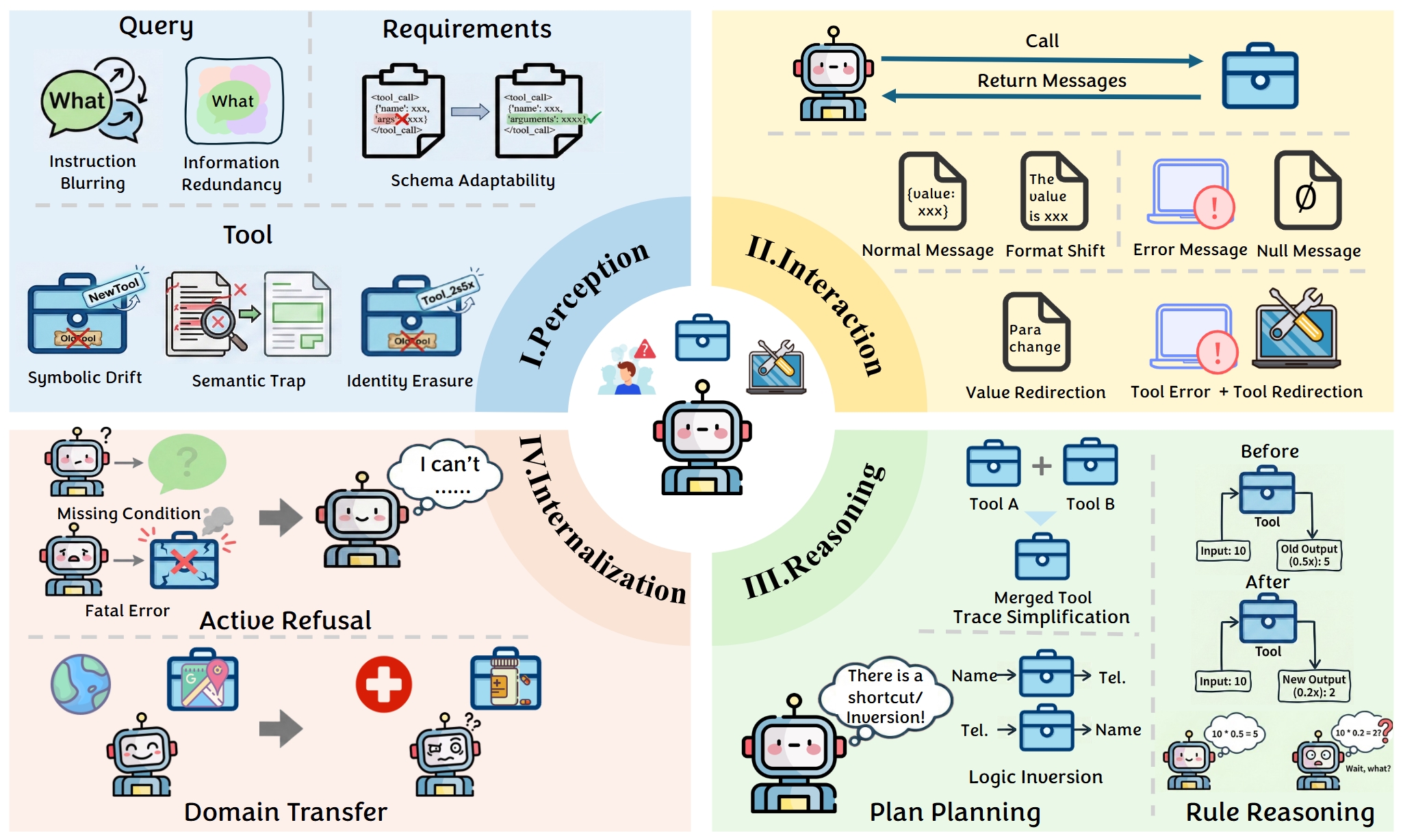
OpenAgent groups the shifts into a reusable four-tier diagnostic hierarchy:
| Tier | Focus | Representative scenarios |
|---|---|---|
| Perception | Parse user intent and tool semantics | query rewrite, tool-name noise, semantic renaming, distractor tools |
| Interaction | React to environment feedback | missing information, mode changes, tool errors, redirection |
| Reasoning | Adapt the execution graph and calculation rules | unavailable tools, altered tool logic |
| Internalization | Transfer the learned task structure | domain transfer to medical tools |
| Module | Purpose |
|---|---|
datagen/ |
Build POI tool-use training and test trajectories |
eval/ |
Run configurable four-tier open-world evaluation scenarios |
tools/ |
Execute POI and medical-domain sandbox tools |
examples/ |
Provide a tiny local CSV for smoke checks |
scripts/ |
Provide simple command-line entry points |
tests/ |
Run model-free checks for the data and tool pipeline |
git clone https://github.com/LAMDA-NeSy/OpenAgent.git
cd OpenAgent

python -m venv .venv
source .venv/bin/activate
pip install -r requirements.txt
On Windows PowerShell, activate the environment with:
.\.venv\Scripts\Activate.ps1
If you want to use LLM-based query rewriting during data generation:
cp .env.example .env
# Fill OPENAI_API_KEY, OPENAI_BASE_URL, and REWRITE_MODELS if needed.
Run the smoke test first. It generates a small dataset from examples/sample_database.csv and checks that the sandbox
tools can execute the generated calls.
python tests/smoke_test.py
Generate a demo test set:
bash scripts/generate_sample_data.sh
The output is written to:
outputs/demo/demo_test.json
Generate test data from a POI CSV:
python datagen/generate.py \
  --split test \
  --csv data/database_test_en.csv \
  --output data/testset/baseline.json \
  --samples 50 \
  --single-samples 20 \
  --seed 7
Generate training data with optional LLM rewriting:
python datagen/generate.py \
  --split train \
  --csv data/database_en.csv \
  --output data/train.json \
  --samples 800 \
  --rewrite
Expected CSV columns:
name,location,type,adname,tel,cost1,cost2
location should use longitude,latitude format. Telephone numbers are normalized to eight digits.
Run one scenario:
python eval/run_eval.py \
  --model_path /path/to/model \
  --scenario layer1_name_noise \
  --variant 1 \
  --data_root data \
  --output_root outputs
Run multiple scenarios across GPUs:
python eval/run_all.py \
  --models /path/to/model1 /path/to/model2 \
  --scenarios layer1_name_noise layer2_tool_error layer3_error_tool layer4_domain_medical \
  --variants 1 2 3 \
  --data_root data \
  --output_root outputs \
  --gpu_ids 0 1 2 3 \
  --min_memory_mb 50000
Available scenario configs live in eval/configs/:
| Config | Tier | Shift |
|---|---|---|
layer1_name_noise |
Perception | Syntactic tool-name noise |
layer1_name_semantic |
Perception | Semantic tool-name paraphrase |
layer1_name_wo_semantic |
Perception | Non-semantic tool rename |
layer1_query_rewrite |
Perception | User-query rewrite |
layer1_add_related |
Perception | Related tool distractors |
layer1_mode_change |
Perception | Verification-code change |
layer2_information_loss |
Interaction | Missing values |
layer2_mode_change |
Interaction | Parameter-mode change |
layer2_query_condition |
Interaction | Query-condition change |
layer2_tool_error |
Interaction | Tool execution error |
layer3_error_tool |
Reasoning | Required tool unavailable |
layer4_domain_medical |
Internalization | Domain transfer |
Outputs are saved as:
outputs/
  results/<scenario>/<model>_<scenario>_<variant>.json
  metrics/<scenario>/<model>_<scenario>_<variant>.json
Each generated example has this structure:
{
  "id": 0,
  "source": "distance",
  "conversations": [
    {"from": "human", "value": "Please calculate the distance ..."},
    {"from": "gpt", "value": "<tool_call>{\"tool\": \"search_map_coordinates\", \"args\": {\"name\": \"alpha_cafe\"}}</tool_call>"},
    {"from": "observation", "value": "{\"location\": \"116.300100,39.900100\"}"},
    {"from": "gpt", "value": "<answer>123.4</answer>"}
  ],
  "tools": "[...]",
  "gt_tools": ["search_map_coordinates"],
  "ground_truth": "123.4",
  "meta": {"total_steps": 2}
}
@inproceedings{wu2026openagent,
  title     = {Can Agents Generalize to the Open World? Unveiling the Fragility of Static Training in Tool Use},
  author    = {Wu, Weiming and Lv, Song-Lin and Zhu, Rui and Cheng, Zi-Jian and Guo, Lan-Zhe},
  booktitle = {Proceedings of the 43rd International Conference on Machine Learning},
  year      = {2026}
}
LAMDA-NeSy/OpenAgent is a public repo on GitHub by LAMDA-NeSy. Can Agents Generalize to the Open World? Unveiling the Fragility of Static Training in Tool Use.
It declares the MIT license on GitHub.
Its maker has not tagged a system, so it is unknown here. Its README says what it needs.
Open "Take it" on its page: Take My Repo writes an install plan for your machine and hands it to your AI agent (Claude Code, Codex or Cursor), which asks you before each step. Take My Repo has not tested it on any machine.
Transfer learning / domain adaptation / domain generalization / multi-task learning etc. Papers, codes, datasets, applications, tutorials.-迁移学习
The agent harness performance optimization system. Skills, instincts, memory, security, and research-first development for Claude Code, Codex, Opencode, Cursor and beyond.
🤗 Transformers: the model-definition framework for state-of-the-art machine learning models in text, vision, audio, and multimodal models, for both inference and training.
Reverse engineer anything with agents, from app behavior down to native binaries.
Its last change on GitHub was on 2026-06-03. Take My Repo does not judge from that whether it is maintained.
Nobody has reviewed it on Take My Repo yet, which says nothing about its quality.
Take My Repo cannot say: it does not audit code and has not run OpenAgent. What is known comes from GitHub. It declares the MIT license on GitHub. Its last change was on 2026-06-03. It has 14 stars, which measure popularity, not safety. Nobody has reviewed it on Take My Repo yet, which says nothing about its quality. Read the source before you run it. With "Take it", your AI agent shows each step and asks you before running it; README text is treated as data, not as instructions.