
VT-Bench
The maintainer has not written a description at the source.
- 8
- 6 mo ago
Repo LAMDA-NeSy/VT-Bench, read from GitHub 15 min ago. LAMDA-NeSy has not joined Take My Repo.
In short
LAMDA-NeSy/VT-Bench is a public repo on GitHub by LAMDA-NeSy. It declares no license on GitHub. Public does not mean open source: without a license, nobody is granted the right to reuse it. It is written mainly in Python, has 8 stars and last changed on 2026-05-23. Nobody has reviewed it on Take My Repo yet, which says nothing about its quality. Read from GitHub on 2026-11-24.
VT-Bench: A Unified Benchmark for Visual-Tabular Multi-Modal Learning
Introduction
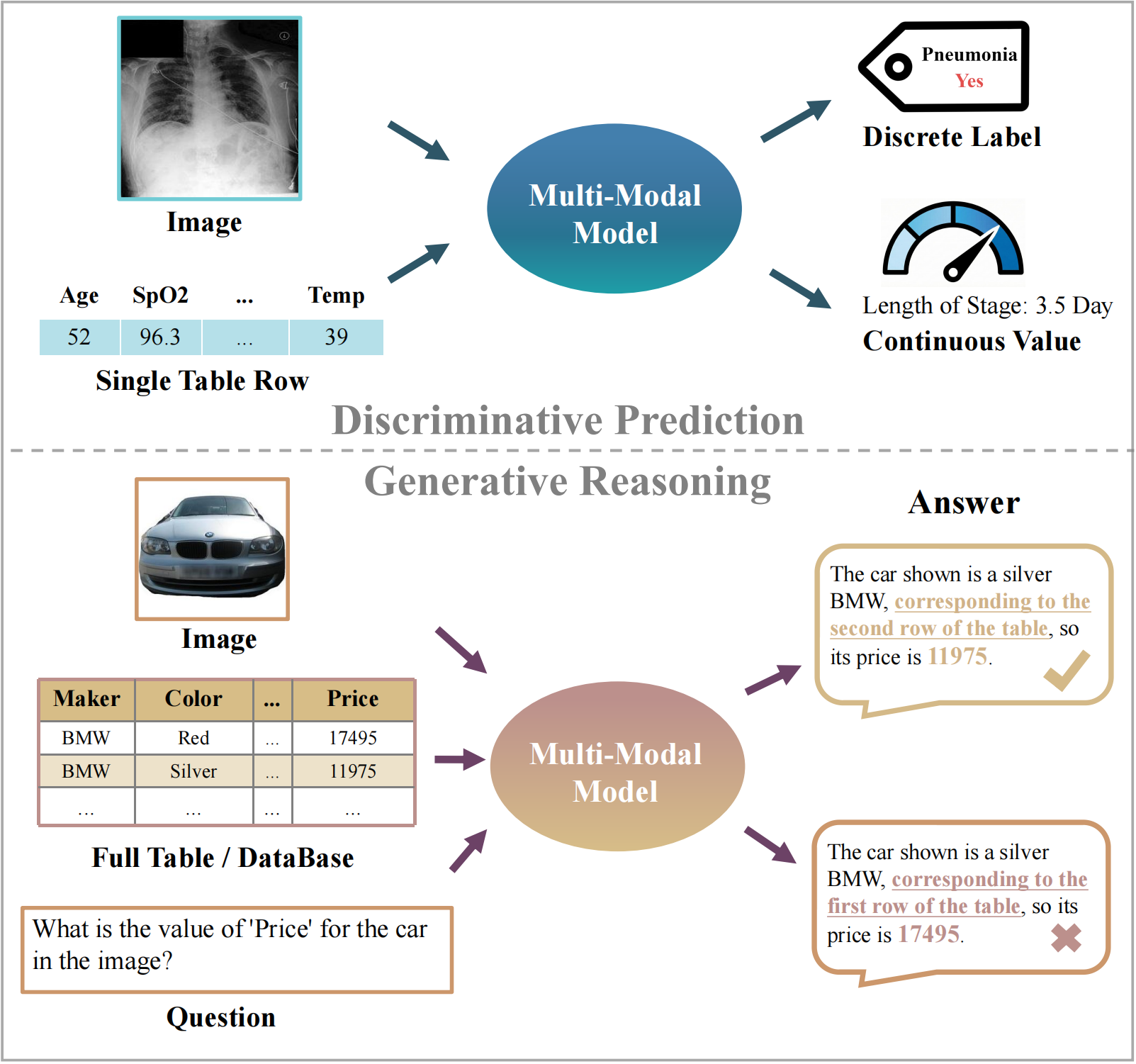
VT-Bench is a unified benchmark for vision–tabular multimodal learning, designed to evaluate multimodal models under two major paradigms:
- Discriminative prediction: image + tabular record → class / value
- Generative reasoning: image + table/database + question → free-form answer
Two paradigms in vision–tabular multi-modal learning and the cross-modal grounding challenge in generative reasoning.
VT-Bench provides:
- Broad model coverage: vision-only models, tabular-only models, vision–tabular fusion models, and general-purpose VLMs
- Diverse real-world scenarios: 756K paired samples spanning 9 domains, covering both prediction and reasoning tasks
- Unified evaluation: consistent preprocessing, standardized interfaces, and optional modality diagnostic metrics for prediction
Quickstart
1) Download
Clone the repository:
git clone https://anonymous.4open.science/r/VT-Bench-13C2.git
cd VT-Bench
2) Environment Setup
Create and activate the conda environment:
conda env create --file environment.yaml
conda activate vt_bench
Due to version incompatibilities, if you want to fine-tune Vision-Language Models, please use environment_vlm.yaml instead:
conda env create --file environment_vlm.yaml
conda activate vt_bench_vlm
Additionally, you need to download LLaMA-Factory:
git clone https://github.com/hiyouga/LLaMA-Factory.git
3) Run Evaluation
You need to specify five arguments: task, dataset, model, setting, and diagnostics.
task:
predictionorreasoningdataset: choose a dataset identifier from the Datasets section
model: choose a model name from the Models section
- For VLMs, use the Hugging Face full identifier, e.g.
Qwen/Qwen3-VL-8B-Instruct
- For VLMs, use the Hugging Face full identifier, e.g.
setting: controls evaluation configuration (varies across datasets; see Datasets)
diagnostics: whether to compute additional modality diagnostic metrics for prediction tasks
- options:
none/mcr/mir/full - we also support computing MCR for a specified checkpoint
- options:
Example: Discriminative Prediction
python run.py --task prediction --dataset skin --model TIP --setting none --diagnostics mcr
Compute MCR for a specific checkpoint:
python run.py --task prediction --dataset skin --model TIP --setting none --diagnostics mcr --checkpoint {YOUR_PRETRAINED_CKPT_PATH}
Example: Generative Reasoning
python run.py --task reasoning --dataset ehrxqa --model Qwen/Qwen3-VL-8B-Instruct --setting full --diagnostics none
For API Models (GPT-4.1 / Gemini-3-Flash-Preview), please export API keys before running:
export OPENAI_API_KEY='your_openai_api_key'
export GOOGLE_API_KEY='your_google_api_key'
Datasets
Discriminative Prediction Dataset
Public Dataset
| Dataset | String Identifier | Availability | Source |
|---|---|---|---|
| Skin Cancer | skin |
Public | kaggle |
| Breast Cancer | breast |
Public | kaggle |
| Adoption | adoption |
Public | kaggle |
| CelebA | celebA |
Public | kaggle |
| DVM-Car | dvm |
Public | DVM-Car |
| Pawpularity | pawpularity |
Public | kaggle |
| Anime | anime |
Public | kaggle |
| Pneumonia | pneumonia |
Constructed | MIMIC-IV & MIMIC-CXR |
| Los | los |
Constructed | MIMIC-IV & MIMIC-CXR |
| Respiratory Rat | rr |
Constructed | MIMIC-IV & MIMIC-CXR |
Constructed Datasets
The three constructed datasets (pneumonia, los, rr) are built from MIMIC-CXR-JPG (v2.0.0) and MIMIC-IV (v2.2). These source datasets require a credentialed PhysioNet license. Due to the Data Use Agreement (DUA), only credentialed users can access the source data.
To access the source datasets, you must:
- Become a credentialed PhysioNet user
- If you do not have a PhysioNet account, register for one here.
- Follow these instructions for credentialing on PhysioNet.
- Complete the "CITI Data or Specimens Only Research" training course.
- Sign the data use agreement (DUA) for each project
After obtaining access:
- The construction code is under: dataset/Constructed_datasets/
- Update the file paths in built_classification.py and built_regression.py
- Download images via download_newdataset_image.sh
Preprocessing Scripts
All preprocessing scripts for prediction datasets are under dataset/.
- Processing steps for the DVM dataset can be found here.
Generative Reasoning Datasets
| Dataset | String Identifier | Availability | Source |
|---|---|---|---|
| DVM-Car QA | dvm |
Constructed | kaggle |
| MMQA | mmqa |
Public | MMQA |
| EHRXQA | ehrxqa |
Public Credentialized Access | EHRXQA |
DVM-Car QA
Generation script: reasoning/DVM_QA/generate_qa.py.
settingfor DVM-Car QA should be a list specifying the tasks to evaluate:"loc": Row Localization"attr": Attribute Retrieval"count": Constrained Counting"mean": Conditional Mean
Example:
--setting '["loc","attr","count","mean"]'
MMQA
- See the official project page: MMQA
- Only supports full evaluation.
EHRXQA
- See the official repo: EHRXQA
- Supported settings:
full/stage1/stage2
How to Add New Datasets
To integrate a new dataset, please provide a custom script that follows VT-Bench’s standard preprocessing pipeline:
Filter samples with missing labels or images, then split into train/val/test
Process tabular features:
- impute missing values (mean for numeric;
"MISSING"for categorical) - encode categorical features
- normalize/standardize numeric features
- impute missing values (mean for numeric;
Process images:
- resize to 224 × 224
- store as
.npy
Export model-ready files:
.csvfeature files.pttensor files following the naming conventions used in existing datasets
A runnable example is provided here: dataset/skin_cancer.ipynb
Models
VT-Bench supports comprehensive evaluation of vision-tabular multi-modal learning models, including vision unimodal models, tabular unimodal models, vision-tabular multi-modal fusion models, and general-purpose vision-language models (VLMs). For discriminative prediction tasks, we implement adaptive hyperparameter optimization based on the Optuna framework. For generative reasoning tasks, VLMs are evaluated in a zero-shot setting using their official pretrained checkpoints.
Vision Unimodal Models
ResNet-50: A 50-layer deep residual learning architecture that introduces identity skip connections to ease optimization and improve accuracy for large-scale visual recognition.
ViT-B/16: A pure Transformer architecture for vision that represents images as sequences of fixed-size patches and applies self-attention directly over patch tokens, achieving strong image classification performance with compute-efficient training.
Tabular Unimodal Models
LightGBM: An efficient Gradient Boosting Decision Tree implementation optimized for large-scale, high-dimensional data, using Gradient-based One-Side Sampling and Exclusive Feature Bundling to improve training speed and scalability.
TabTransformer: A Transformer-based architecture that contextualizes categorical feature embeddings via self-attention, producing more informative and robust representations for tabular learning.
TabPFN v2: A tabular foundation model trained on millions of synthetic datasets to perform general-purpose inference for supervised prediction on tables, frequently outperforming heavily tuned gradient-boosted tree ensembles with lower training overhead.
Vision-Tabular Multi-Modal Models
Concat: A parameter-efficient multi-task deep model that integrates structural imaging with demographic and clinical features through simple feature concatenation.
MAX: A multi-modal deep learning framework that learns modality-specific representations from clinical variables and imaging data, then fuses them using element-wise maximum operation.
Questions
What is VT-Bench?
LAMDA-NeSy/VT-Bench is a public repo on GitHub by LAMDA-NeSy. Its maker has not written a description.
Is VT-Bench open source?
It declares no license on GitHub. Public does not mean open source: without a license, nobody is granted the right to reuse it.
Does VT-Bench run on macOS, Windows or Linux?
Its maker has not tagged a system, so it is unknown here. Its README says what it needs.
How do I install VT-Bench?
Open "Take it" on its page: Take My Repo writes an install plan for your machine and hands it to your AI agent (Claude Code, Codex or Cursor), which asks you before each step. Take My Repo has not tested it on any machine.