cactus
Sub-50mb agentic, voice and vision intelligence for consumer devices.
- 15k
- Python
- Apache-2.0
- 1 d ago
Retro: retrospective inference for tabular foundation models
Repo LAMDA-Tabular/Retro, read from GitHub 18 min ago. LAMDA-Tabular has not joined Take My Repo.
LAMDA-Tabular/Retro is a public repo on GitHub by LAMDA-Tabular. Retro: retrospective inference for tabular foundation models. It declares no license on GitHub. Public does not mean open source: without a license, nobody is granted the right to reuse it. It is written mainly in Python, has 1 stars and last changed on 2026-11-21. Nobody has reviewed it on Take My Repo yet, which says nothing about its quality. Read from GitHub on 2026-11-25.
Sub-50mb agentic, voice and vision intelligence for consumer devices.
Retro is a tabular foundation model that makes predictions in context, without any fine-tuning. Rather than only stacking forward transformations, later stages revisit and recombine representations built by earlier layers, so that predictive refinement is allocated across depth instead of concentrated in the last layers. This repository ships the Fourier-hybrid Attn-Res architecture, the two released checkpoints, and the scikit-learn style API needed to run them.
Paper: arXiv:2610.10317 · PDF
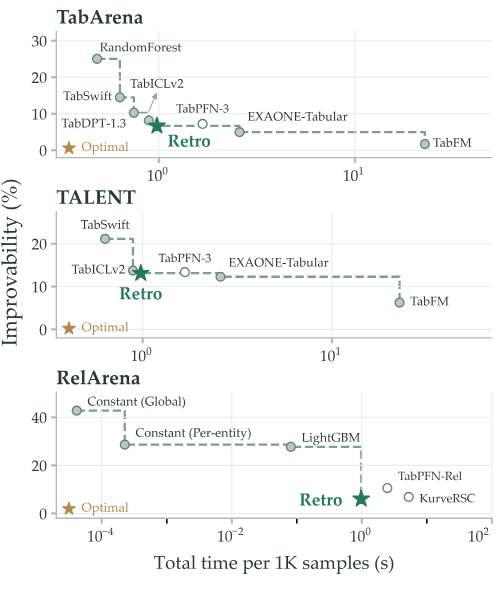
Retro lies on the Pareto frontier of TabArena, TALENT and RelArena.
pip install -e .
# CSV command line interface
pip install -e ".[cli]"
Python >= 3.10 and PyTorch >= 2.4 are required.
from retro import RetroClassifier, RetroRegressor

clf = RetroClassifier()          # downloads retro_cls.ckpt from Hugging Face Hub
clf.fit(X_train, y_train)
pred = clf.predict(X_test)
proba = clf.predict_proba(X_test)

reg = RetroRegressor()           # downloads retro_reg.ckpt from Hugging Face Hub
reg.fit(X_train, y_train)
pred = reg.predict(X_test)
Pass model_path="retro_cls.ckpt" to load a local checkpoint, device="cpu" to
force CPU inference, or n_estimators=... / batch_size=... to override the
defaults below.
python infer.py --task cls \
    --train train.csv --test test.csv --target label \
    --output predictions.csv

python infer.py --task reg \
    --train train.csv --test test.csv --target target \
    --model-path /path/to/retro_reg.ckpt
--test must contain the same features as --train but not the target column.
For classification the output also holds one proba_<label> column per class.
A plain RetroClassifier() or RetroRegressor() runs 32 ensemble members with
the settings used for the released checkpoints.
| Setting | Classification | Regression |
|---|---|---|
n_estimators |
32 | 32 |
ensemble_mode |
global |
global |
norm_methods |
none, power, quantile, asinh (diverse) |
none, power |
batch_size |
8 | 8 |
feat_shuffle_method |
latin |
latin |
class_shuffle_method |
shift |
— |
use_amp |
True |
True |
ensemble_mode="legacy" restores the older cross-branch reuse policy.
| Task | File | URL |
|---|---|---|
| Classification | retro_cls.ckpt |
https://huggingface.co/LAMDA-Tabular/Retro/blob/main/retro_cls.ckpt |
| Regression | retro_reg.ckpt |
https://huggingface.co/LAMDA-Tabular/Retro/blob/main/retro_reg.ckpt |
Checkpoints are downloaded automatically and cached by huggingface_hub when
model_path is omitted. The architecture is fixed by this package, so the
model_impl label stored inside a checkpoint is read for diagnostics only;
weights are loaded with strict=True and any structural mismatch raises an
error.
When downloading a checkpoint, Retro also requests config.json for Hugging
Face download statistics. The count includes HTTP requests, not unique users;
cached or locally supplied checkpoints and older versions may not be counted.
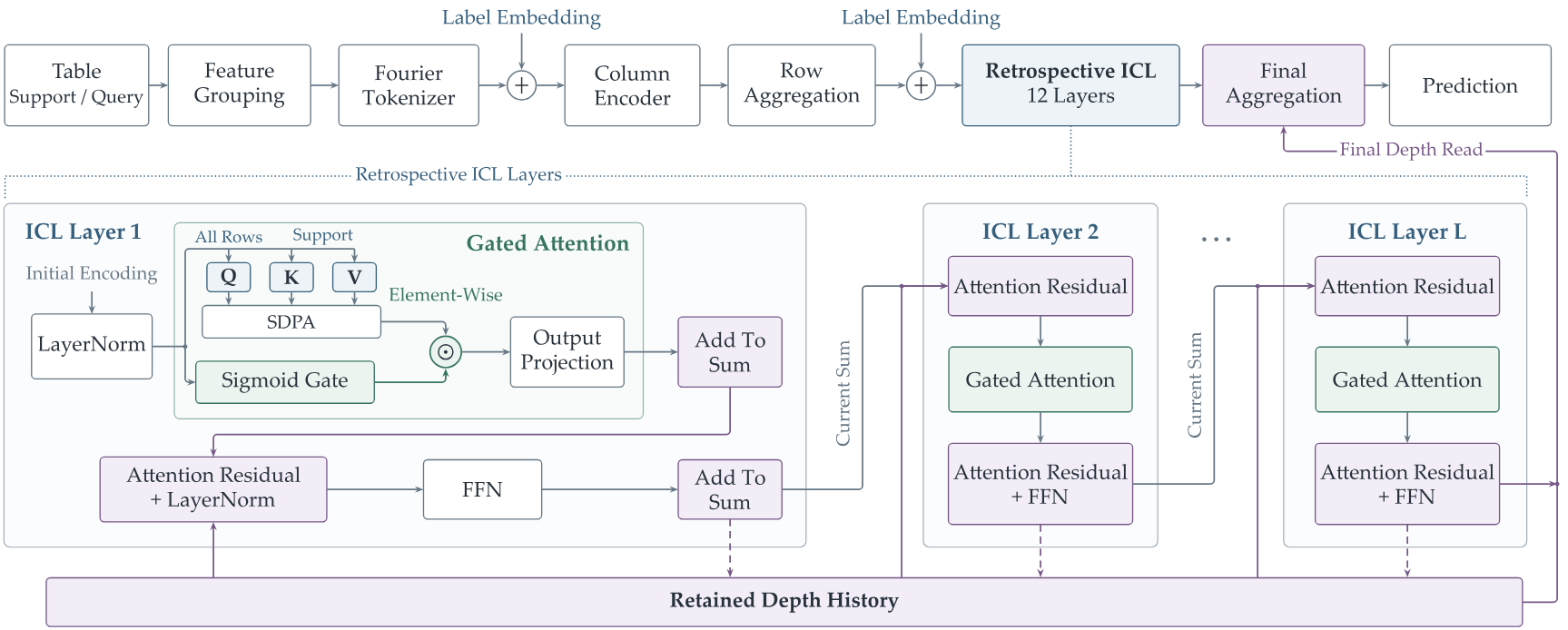
The Retro architecture. A table encoder produces row representations for a
retrospective ICL stack, whose layers revisit a retained depth history.
The table encoder applies three column-processing blocks and three row-processing blocks (hidden size 128, eight attention heads). The column stage uses 128 inducing vectors, the row stage aggregates with four CLS tokens, and their outputs are concatenated into a 512-dimensional representation per row. The encoder keeps the repeated feature grouping, target-aware embeddings and query-aware scalable softmax (QASSMax) of the base table encoder.
Row representations, augmented with observed support labels, enter a 12-layer ICL stack with eight attention heads and a feed-forward expansion ratio of two. Inside the stack, retrospective aggregation constructs the inputs to the attention and feed-forward sublayers, gated attention modulates contextual outputs before projection, and residual updates are grouped over pairs of layers. The final aggregation combines the initial encoding with six completed update groups, and a two-layer MLP with hidden dimension 1,024 produces query predictions. Classification and regression use separately trained models with task-specific target embeddings and output heads.
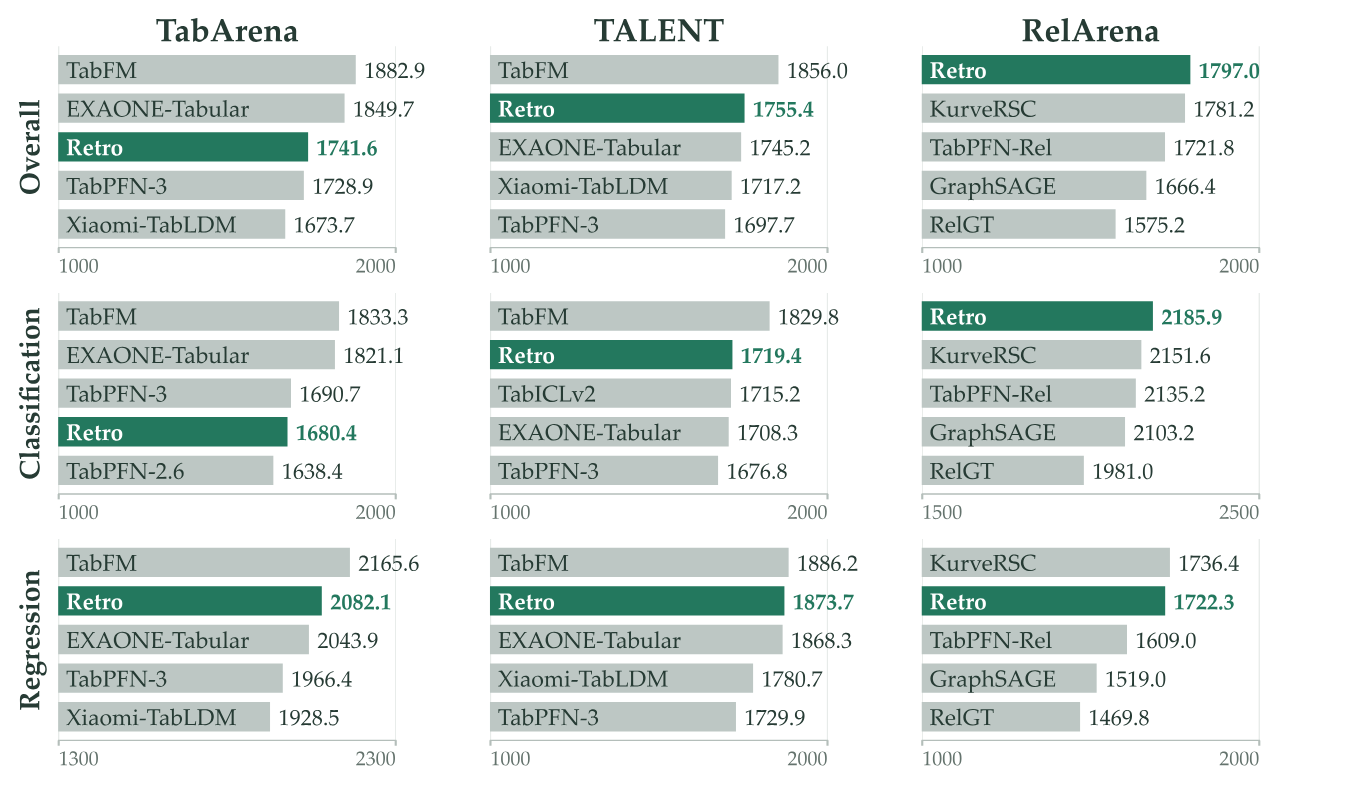
Elo rankings across three benchmarks. Each panel shows the five
highest-rated methods; candidate sets and scoring protocols differ, so ratings
should be compared within panels.
Complete rankings, ablations and analyses are reported in the paper.
src/retro/
  _model/                          column embedding, row interaction, ICL stack
  _model_attn_res/                 Attn-Res residual routing
  _model_fourier_hybrid/           hybrid raw + Fourier cell embedding
  _model_gated/                    element-wise gated ICL attention
  _model_fourier_hybrid_attn_res/  the Retro architecture used by both checkpoints
  _sklearn/                        sklearn estimators, ensemble/multiview logic
infer.py                           CSV command line entry point
@misc{cai2026retro,
  title         = {Thinking in Depth: Retrospective Inference for Tabular Foundation Models},
  author        = {Cai, Hao-Run and Liu, Si-Yang and Cheng, Zi-Jian and Yu, Kun-Yang
                   and Sheng, Jin-Hao and Yu, Guo and Liu, Chonghan and Zhou, Zhi
                   and Jiang, Jun-Peng and Guo, Lan-Zhe and Ye, Han-Jia},
  year          = {2026},
  eprint        = {2610.10317},
  archivePrefix = {arXiv},
  primaryClass  = {cs.LG},
  url           = {https://arxiv.org/abs/2610.10317}
}
We thank the authors of TabICL, TabArena, TALENT and RelArena for their open-source models, benchmarks and evaluation tools.
LAMDA-Tabular/Retro is a public repo on GitHub by LAMDA-Tabular. Retro: retrospective inference for tabular foundation models.
It declares no license on GitHub. Public does not mean open source: without a license, nobody is granted the right to reuse it.
Its maker has not tagged a system, so it is unknown here. Its README says what it needs.
Open "Take it" on its page: Take My Repo writes an install plan for your machine and hands it to your AI agent (Claude Code, Codex or Cursor), which asks you before each step. Take My Repo has not tested it on any machine.
:sparkles::sparkles:Latest Advances on Multimodal Large Language Models
React components for efficiently rendering large lists and tabular data
Device-native foundation models: 145B on a laptop, 35B on a phone. Latent MoE, SSD-streamed weights, a router that predicts loads a step ahead. Mac, iPhone, Android, Windows.
The official GitHub page for the survey paper "A Survey of Large Language Models".
Its last change on GitHub was on 2026-11-21. Take My Repo does not judge from that whether it is maintained.
Nobody has reviewed it on Take My Repo yet, which says nothing about its quality.
Take My Repo cannot say: it does not audit code and has not run Retro. What is known comes from GitHub. It declares no license on GitHub. Public does not mean open source: without a license, nobody is granted the right to reuse it. Its last change was on 2026-11-21. It has 1 stars, which measure popularity, not safety. Nobody has reviewed it on Take My Repo yet, which says nothing about its quality. Read the source before you run it. With "Take it", your AI agent shows each step and asks you before running it; README text is treated as data, not as instructions.