
forestplot
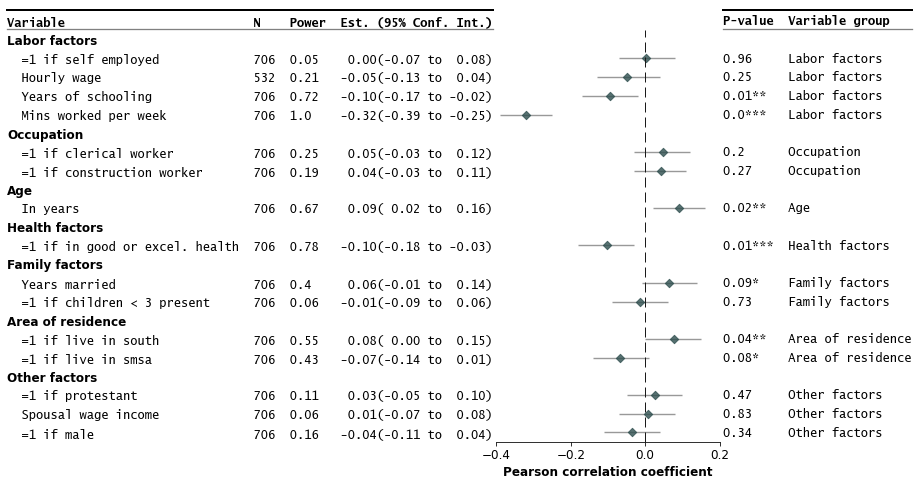
A Python package to make publication-ready but customizable coefficient plots.
- 141
- Jupyter Notebook
- MIT
- 2 y ago
Code and data for "Deconstructing the MeToo Movement and the Blue Wave in the 2018 House Elections"
Repo LSYS/deconstruct, read from GitHub 1 min ago. LSYS has not joined Take My Repo.
LSYS/deconstruct is a public repo on GitHub by LSYS. Code and data for "Deconstructing the MeToo Movement and the Blue Wave in the 2018 House Elections". It declares no license on GitHub. Public does not mean open source: without a license, nobody is granted the right to reuse it. It is written mainly in Jupyter Notebook, has 0 stars and last changed on 2026-10-22. Nobody has reviewed it on Take My Repo yet, which says nothing about its quality. Read from GitHub on 2026-11-20.
At the peak of the #MeToo movement in 2018 is the historical performance of women candidates in the 2018 midterm elections. I examine three ways in which the movement could have an electoral impact using geocoded #MeToo tweets that text analyses show engage core movement discourse and figures, and that geographically predict individual attitudes. I find no credible evidence that the movement increased Democratic vote shares or turnout. Instead, I find that in districts with a stronger movement, Democratic women are more likely to challenge their co-partisan male incumbents, a pattern absent in the Republican Party and in 2016. Hence, the more likely channel is the rise of new Democratic women through a weakening of party norms against same-party challenges.
Shen, Lucas. 2026. "Deconstructing the MeToo Movement and the Blue Wave in the 2018 House Elections." Computational Communication Research 8 (3): 1–33. https://doi.org/10.5117/CCR2026.3.4.SHEN
.
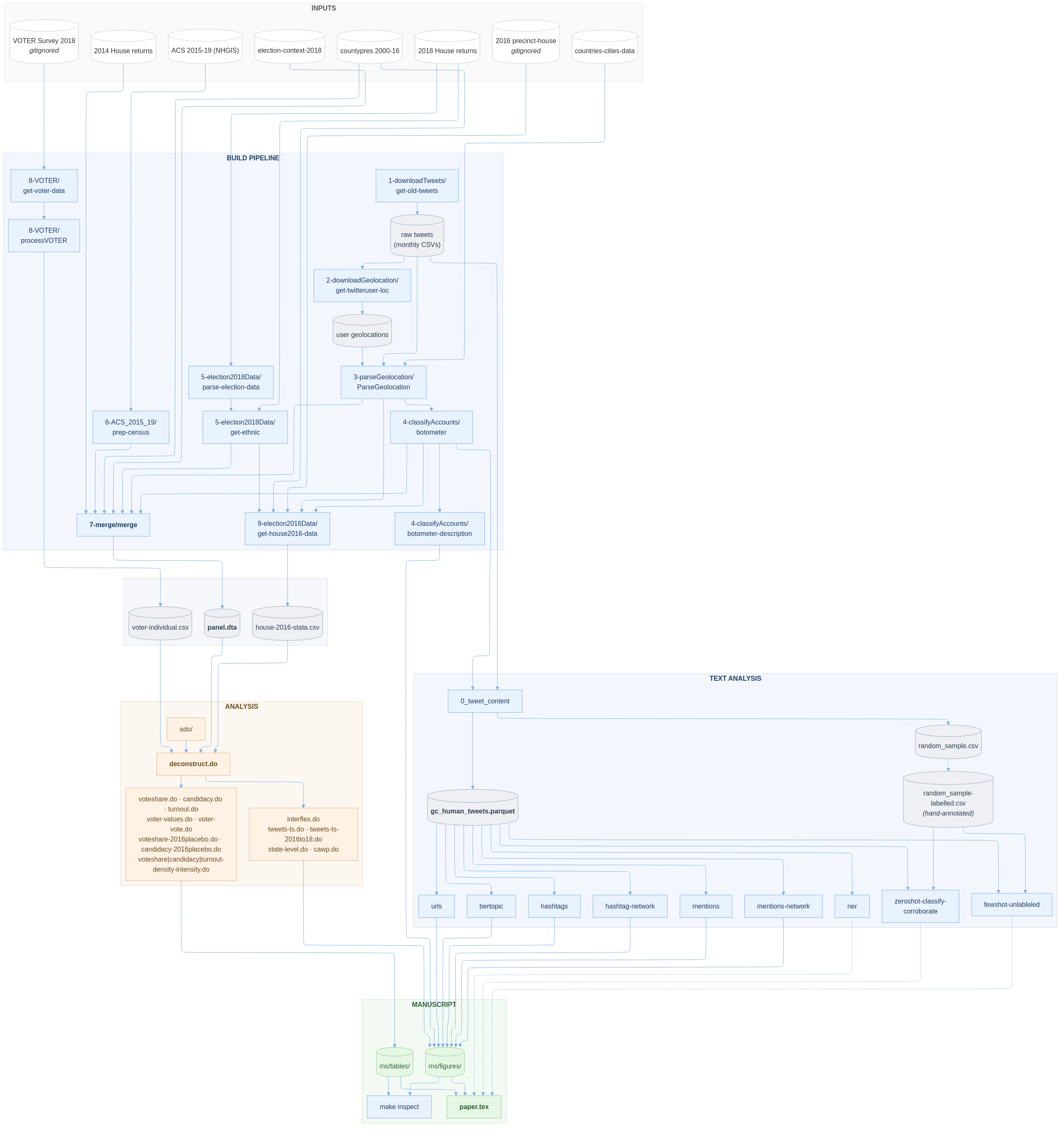
├── build/                      # Python data pipeline
│   ├── 1-downloadTweets/         # raw tweet collection (GetOldTweets-python)
│   ├── 2-downloadGeolocation/    # Twitter user profile locations (Tweepy)
│   ├── 3-parseGeolocation/       # parse user locations to US counties
│   ├── 4-classifyAccounts/       # Botometer bot/human classification
│   ├── 5-election2018Data/       # 2018 House results + candidate ethnicity
│   ├── 6-ACS_2015_19/            # ACS 5-year demographics
│   ├── 7-merge/                  # → panel.dta (master analysis input)
│   ├── 8-VOTER/                  # VOTER survey processing
│   ├── 9-election2016Data/       # 2016 House placebo data
│   └── Makefile                  # `make data`
│
├── text/                       # Python computational text analysis
│   ├── 0_tweet_content.ipynb     # entry point → gc_human_tweets.parquet
│   ├── bertopic.ipynb            # topic modeling
│   ├── hashtags.ipynb            # hashtag tabulation + ECDF
│   ├── hashtag-network.ipynb     # hashtag co-occurrence network
│   ├── mentions.ipynb            # mention tabulation
│   ├── mentions-network.ipynb    # mention network
│   ├── urls.ipynb                # domain tabulation
│   ├── ner.ipynb                 # named-entity counts
│   ├── zeroshot-classify-corroborate.ipynb   # GPT-4o validation vs manual labels
│   ├── fewshot-unlableled.ipynb  # GPT-4o few-shot classification (5000 tweets)
│   └── helpers.py
│
├── analysis/                   # Stata regression analysis
│   ├── ado/                      # custom Stata commands
│   ├── data/                     # static input CSVs (cawp, tweets-ts)
│   ├── set_environment.do        # env + load panel.dta
│   ├── preamble.do               # data prep + variable definitions
│   ├── deconstruct.do            # orchestrator (all tables/figures)
│   └── ...                       # do files
│
├── ms/                         # LaTeX manuscript
│
├── assets/
│
├── Makefile                    # `make setup` creates venv
└── readme.md

pandas==2.2.3, pyjanitor==0.27.0 — full list in assets/requirements.txt. Bootstrap with make setup.ms/Makefile use LSYS/texCheckmate, my shell/Make utilities for LaTeX manuscript hygiene (word counts, acronym tally, repeated-word checks, hardcoded-number finder, textidote, etc.).| Script | Output |
|---|---|
build/1-downloadTweets/get-old-tweets.ipynb |
tweets-data/*.csv (raw monthly #metoo tweets, one-time scrape) |
build/2-downloadGeolocation/get-twitteruser-loc.ipynb |
out-userGeolocations/twitter-users-*.csv (Tweepy, one-time) |
build/3-parseGeolocation/ParseGeolocation.ipynb |
parsed-geoloc.csv (county-level user location) |
build/4-classifyAccounts/botometer.ipynb |
bot-classification.csv (Botometer scores) |
build/4-classifyAccounts/botometer-description.ipynb |
botometer_score_distribution.pdf (cited figure) |
build/5-election2018Data/parse-election-data.ipynb |
counties-election-results.csv, politicians.csv |
build/5-election2018Data/get-ethnic.ipynb |
politicians-with-raceindicators.csv |
build/6-ACS_2015_19/prep-census.ipynb |
acs_2015_2019.csv |
build/7-merge/merge.ipynb |
panel.dta (master analysis input) |
build/8-VOTER/get-voter-data.ipynb + processVOTER.ipynb |
voter-individual.csv |
build/9-election2016Data/get-house2016-data.ipynb |
house-2016-stata.csv (2016 placebo) |
cd build
make data
make data runs the 3 terminal notebooks (7-merge/merge, 8-VOTER/processVOTER, 9-election2016Data/get-house2016-data). Steps 1–6 are one-time fetches whose outputs are committed — Twitter, Botometer, and Census API access are not needed to rebuild panel.dta.
text/0_tweet_content.ipynb reads raw tweets from build/1-downloadTweets/ and bot scores from build/4-classifyAccounts/, filters to geocoded human tweets, and writes text/gc_human_tweets.parquet. The other 9 notebooks consume that parquet and produce the appendix figures (topic map, hashtag/mention/URL tabulations, networks, NER counts) and the GPT-4o classification artifacts.
Run notebooks individually in Jupyter as needed.
📊 Interactive topic map of #MeToo tweets — hover for tweet text, zoom into clusters.
cd analysis
do deconstruct.do
deconstruct.do calls each producer script in paper-exhibit order, wrapped in preserve/restore. Outputs go directly to ms/tables/ and ms/figures/.
If this work is useful to you, please consider citing:
Shen, Lucas. 2026. "Deconstructing the MeToo Movement and the Blue Wave in the 2018 House Elections." Computational Communication Research 8 (3): 1–33. https://doi.org/10.5117/CCR2026.3.4.SHEN
BibTeX:
@article{deconstruct,
  author  = {Shen, Lucas},
  title   = {Deconstructing the MeToo Movement and the Blue Wave in the 2018 House Elections},
  journal = {Computational Communication Research},
  year    = {2026},
  volume  = {8},
  number  = {3},
  pages   = {1--33},
  doi     = {10.5117/CCR2026.3.4.SHEN},
  url     = {https://www.aup-online.com/content/journals/10.5117/CCR2026.3.4.SHEN},
  issn    = {2665-9085}
}
LSYS/deconstruct is a public repo on GitHub by LSYS. Code and data for "Deconstructing the MeToo Movement and the Blue Wave in the 2018 House Elections".
It declares no license on GitHub. Public does not mean open source: without a license, nobody is granted the right to reuse it.
Its maker has not tagged a system, so it is unknown here. Its README says what it needs.
Open "Take it" on its page: Take My Repo writes an install plan for your machine and hands it to your AI agent (Claude Code, Codex or Cursor), which asks you before each step. Take My Repo has not tested it on any machine.
Its last change on GitHub was on 2026-10-22. Take My Repo does not judge from that whether it is maintained.
Nobody has reviewed it on Take My Repo yet, which says nothing about its quality.
A Python package to make publication-ready but customizable coefficient plots.
:smile_cat: :speech_balloon: A module to compute textual lexical richness (aka lexical diversity).