
spotatui
Open-source music player for the desktop and the terminal. Spotify with one sign-in and no developer app, plus YouTube, local files, Subsonic/Navidrome, radio and Qobuz in one queue. Written in Rust.
- 1.8k
- Rust
- MIT
- 16 h ago
The maintainer has not written a description at the source.
Repo LargeModGames/chess, read from GitHub 1 min ago. LargeModGames has not joined Take My Repo.
LargeModGames/chess is a public repo on GitHub by LargeModGames. It declares no license on GitHub. Public does not mean open source: without a license, nobody is granted the right to reuse it. It is written mainly in TypeScript, has 0 stars and last changed on 2026-10-21. Nobody has reviewed it on Take My Repo yet, which says nothing about its quality. Read from GitHub on 2026-11-19.
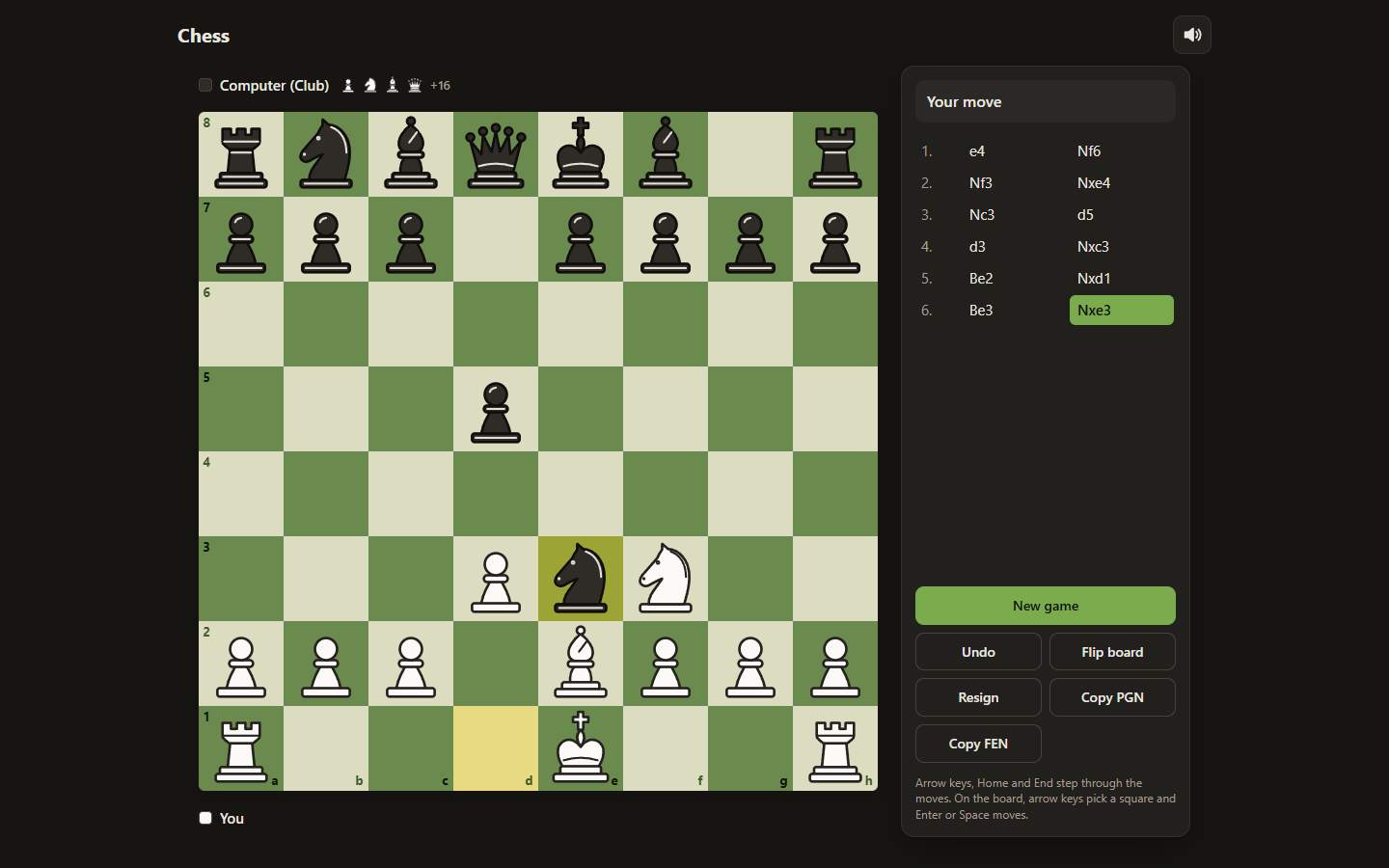
A complete chess game for the browser: play a friend on the same device or take on a built-in computer opponent at five strength levels. Written in TypeScript with no runtime dependencies; the rules engine and the AI are both implemented from scratch.

Requires Node.js 22.12 or newer (the test runner supports Node 22, 24 and 26+).
npm install
npm run dev
Open the URL Vite prints (usually http://localhost:5173).
To build a static site into dist/:
npm run build
npm run preview
The build uses relative paths, so dist/ can be hosted from any folder or static host.
Rules
Playing
Around the board
| Level | Search depth | Time per move | Character |
|---|---|---|---|
| Beginner | 1 | 0.3 s | Plays loose and blunders often |
| Casual | 2 | 0.5 s | Sees simple tactics |
| Club | 4 | 1 s | Solid, occasionally imprecise |
| Expert | 6 | 2 s | Strong tactical play |
| Master | unlimited | 4 s | Searches as deep as time allows |
The computer runs in a Web Worker, so the page stays responsive while it thinks. With a clock running, it spends less time per move as its own clock runs low.
| Input | Action |
|---|---|
| Click a piece, then a square | Move |
| Drag a piece | Move |
Right-click or Esc |
Cancel the current selection or promotion |
← → |
Step back and forward through the moves |
Home / End |
Go to the start / back to the current position |
Tab to the board, arrow keys |
Choose a square |
Enter or Space |
Pick up or drop the piece on the chosen square |
You cannot move while reviewing an earlier position. Press End or Back to game to return.
src/
  engine/   rules: board, move generation, SAN, game state and result detection
  ai/       evaluation, search, the Web Worker and its client, difficulty levels
  ui/       board rendering, input, panel, dialogs, clocks, sounds, persistence
  main.ts   entry point
Engine (src/engine). The board is a 64-square array (a1 = 0, h8 = 63) with an incremental 64-bit Zobrist hash for fast repetition checks. Moves are generated pseudo-legally and then checked for legality. Game adds the move history, SAN, PGN export, undo and result detection on top of Position. Correctness is checked with perft: the tests count every reachable position in six standard positions (millions of nodes) and compare against the published results.
AI (src/ai). The search is a negamax alpha-beta search with iterative deepening. On top of that it uses:
The evaluation uses tapered PeSTO piece-square tables, a bishop pair bonus and a mop-up term that drives a lone king to the edge, so the engine converts won endgames. Lower levels add random noise to the scores at the root, but never enough to miss a mate in one.
UI (src/ui). Plain DOM and CSS, no framework. controller.ts holds all game state and redraws the board and panel from it. Pieces are original inline SVGs, so the game makes no network requests.
| Command | What it does |
|---|---|
npm run dev |
Start the dev server with hot reload |
npm test |
Run the test suite (Vitest) |
npm run typecheck |
Type-check with strict TypeScript |
npm run build |
Type-check and build to dist/ |
npm run check |
Everything: type-check, tests and build |
The AI speed benchmark is opt-in:
# bash
AI_BENCH=1 npx vitest run src/ai/bench.test.ts
# PowerShell $env:AI_BENCH = '1'; npx vitest run src/ai/bench.test.ts
It reports nodes per second and the depth reached in two seconds. It searches about 1.6 million nodes per second on a desktop CPU.
LargeModGames/chess is a public repo on GitHub by LargeModGames. Its maker has not written a description.
It declares no license on GitHub. Public does not mean open source: without a license, nobody is granted the right to reuse it.
Its maker has not tagged a system, so it is unknown here. Its README says what it needs.
Open "Take it" on its page: Take My Repo writes an install plan for your machine and hands it to your AI agent (Claude Code, Codex or Cursor), which asks you before each step. Take My Repo has not tested it on any machine.
Its last change on GitHub was on 2026-10-21. Take My Repo does not judge from that whether it is maintained.
Nobody has reviewed it on Take My Repo yet, which says nothing about its quality.
Open-source music player for the desktop and the terminal. Spotify with one sign-in and no developer app, plus YouTube, local files, Subsonic/Navidrome, radio and Qobuz in one queue. Written in Rust.

Automatically detect and download missing LoRAs for ComfyUI workflows
