
leanmeancleanapps.github.io
The Lean Mean Clean Apps website
- 0
- MIT
- 21 h ago
Repo LeanMeanCleanApps/leanmeancleanapps.github.io, read from GitHub 1 min ago. LeanMeanCleanApps has not joined Take My Repo.
In short
LeanMeanCleanApps/leanmeancleanapps.github.io is a public repo on GitHub by LeanMeanCleanApps. The Lean Mean Clean Apps website. It declares the MIT license on GitHub. It is written mainly in MDX, has 0 stars and last changed on 2026-11-18. Nobody has reviewed it on Take My Repo yet, which says nothing about its quality. Read from GitHub on 2026-11-19.
Lean Mean Clean Apps – Website
The website for Lean Mean Clean Apps, published at leanmeanclean.dev. It's a home page that points people at the templates and the people behind them, plus the docs for every template and the brand. One site, no framework drama, no cookie banner.
| Template | Home page |
|---|---|
| Clean Minimal API | /minimalapi/ |
| Clean Model Context Protocol | /mcp/ |
| Clean GraphQL API | /graphql/ |
| Clean Web API | /webapi/ |
| Clean Lambda Function | /lambda/ |
| The brand | /brand/ |
Running it locally
You need Node 24 and a checkout of the brand repository in .brand or next to this one (see The brand files).
npm ci
npm run dev
The home page is src/pages/index.astro, the templates it lists are in src/data/templates.ts, and its styles are in src/styles/site.css.
The docs
The template docs are built with Starlight. Each template has a folder in src/content/docs named after its key, and its index.mdx is the template's home page, the one its repository links to. Each template also gets its own sidebar, set in astro.config.mjs, and its own colour, which src/components/docs/Head.astro picks from the first part of the page's path. Same site, five outfits.
Page titles are written for search, so src/routeData.ts turns "Work with the database" into "Work with the database | Clean Minimal API for .NET" in the browser tab, and leaves the heading alone. src/data/structured-data.ts adds the JSON-LD that tells search engines and LLMs what each template is. Give every page a short, plain title and a description and they do the rest.
To add a page, drop a Markdown or MDX file in the template's folder and add it to that template's sidebar. npm run build checks every internal link and heading anchor across the docs and fails if one is broken.
The build also writes the docs out for LLMs: llms.txt lists the templates and their key pages, llms-full.txt and llms-small.txt hold everything, and _llms-txt/ has one file per template and one for the brand, so a model asked about one template only has to read that one. A new template's file appears once it's in src/data/templates.ts.
The brand pages
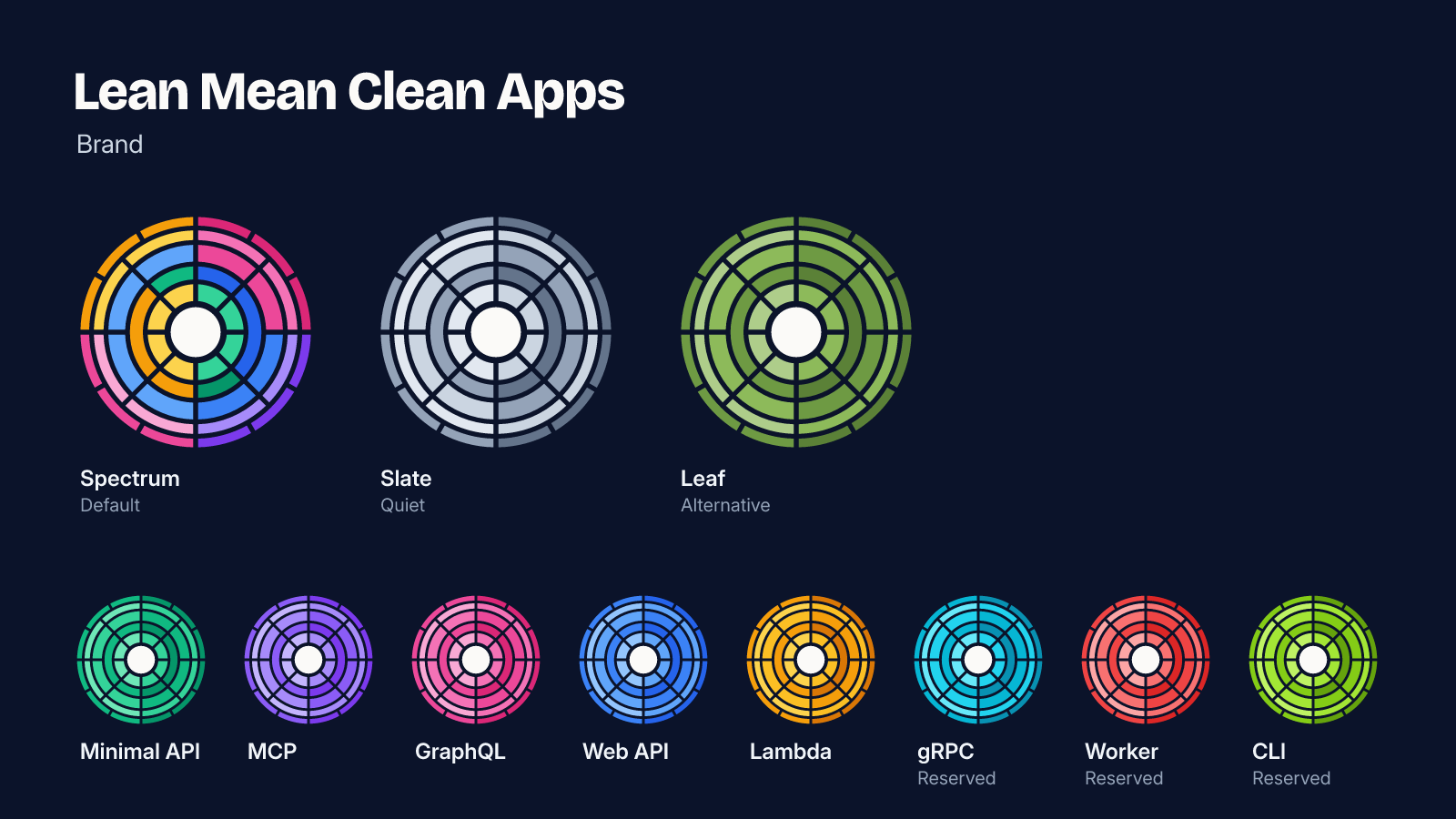
The brand pages at /brand/ live in src/content/docs/brand, with their components in src/components/brand and their styles in src/styles/docs/brand.css. They're a sidebar topic like the templates, dressed in the organisation's colours.
The brand files
The logos, icons, link previews, colour tokens and every file on the brand pages come from the brand repository, and none of them are committed here. npm run dev and npm run build copy them in first with scripts/sync-brand.mjs, which looks for a checkout of brand in .brand and then ../brand. If you haven't got one yet:
git clone --depth 1 https://github.com/LeanMeanCleanApps/brand .brand
CI checks out the newest brand release into .brand on every build, and builds the site every morning, so a brand release shows up here by the next day. Can't wait that long? Run the Site workflow by hand. Changes merged into brand but not released yet stay on the cutting-room floor until they are. To add a template, add it to src/data/templates.ts with the same key it has in the brand repository.
Publishing
Every push to main, and every morning, builds the site and publishes it to GitHub Pages. Pull requests build it without publishing, so you can break things in private.
After each publish, the site tells Bing which pages changed through IndexNow, going by each page's lastmod in the sitemap, which comes from its last commit. Run the Site workflow by hand to resubmit every page. The key in public/ isn't a secret; publishing it is how IndexNow knows the site is ours.
The published site counts visits with PostHog. It doesn't set cookies, so there's no banner to click through. The build only adds it when the POSTHOG_KEY repository variable or secret is set, so forks and local builds count nobody. POSTHOG_HOST points it at the reverse proxy on our own subdomain, which ad blockers leave alone, and POSTHOG_UI_HOST is only needed if the project lives in PostHog's EU cloud.
Contributing and support
Spotted a typo, a broken link or a template we forgot? Open an issue or a pull request. Branch from main as feature/, fix/ or chore/, run npm run build before you push, and keep each change to one thing. The organisation's contributing guide, code of conduct and security policy apply here too.
The site aims for WCAG 2.2 AA in both themes. The accessibility statement says what we've checked and what isn't right yet. Barrier reports land here through the accessibility barrier form, so if you change a page, keep it usable with a keyboard and a screen reader, and check it in light and dark.
The site, like everything behind it, is built and maintained by the Lean Mean Clean Apps team, which is Stephen Walsh for now, with strong coffee and a healthy disregard for pomp and ceremony. If the templates save you some time, you can sponsor the work.
Licence
MIT.
Questions
What is leanmeancleanapps.github.io?
LeanMeanCleanApps/leanmeancleanapps.github.io is a public repo on GitHub by LeanMeanCleanApps. The Lean Mean Clean Apps website.
Is leanmeancleanapps.github.io open source?
It declares the MIT license on GitHub.
Does leanmeancleanapps.github.io run on macOS, Windows or Linux?
Its maker has not tagged a system, so it is unknown here. Its README says what it needs.
How do I install leanmeancleanapps.github.io?
Open "Take it" on its page: Take My Repo writes an install plan for your machine and hands it to your AI agent (Claude Code, Codex or Cursor), which asks you before each step. Take My Repo has not tested it on any machine.
Is leanmeancleanapps.github.io still maintained?
Its last change on GitHub was on 2026-11-18. Take My Repo does not judge from that whether it is maintained.
What do people who ran leanmeancleanapps.github.io say?
Nobody has reviewed it on Take My Repo yet, which says nothing about its quality.