FastAPIQuickCRUD
Generate CRUD methods in FastApi from an SQLAlchemy schema
- 270
- MIT
- 3 y ago
Repo LuisLuii/FastAPIQuickCRUD, read from GitHub 21 h ago. LuisLuii has not joined Take My Repo.
In short
LuisLuii/FastAPIQuickCRUD is a public repo on GitHub by LuisLuii. Generate CRUD methods in FastApi from an SQLAlchemy schema. It declares the MIT license on GitHub. It is written mainly in Python, has 270 stars and last changed on 2024-01-07. Nobody has reviewed it on Take My Repo yet, which says nothing about its quality. Read from GitHub on 2026-11-20.
FastAPI Quick CRUD
Introduction
I believe that many people who work with FastApi to build RESTful CRUD services end up wasting time writing repitive boilerplate code.
FastAPI Quick CRUD can generate CRUD methods in FastApi from an SQLAlchemy schema:
- Get one
- Get one with foreign key
- Get many
- Get many with foreign key
- Update one
- Update many
- Patch one
- Patch many
- Create/Upsert one
- Create/Upsert many
- Delete One
- Delete Many
- Post Redirect Get
FastAPI Quick CRUDis developed based on SQLAlchemy 1.4.23 version and supports sync and async.
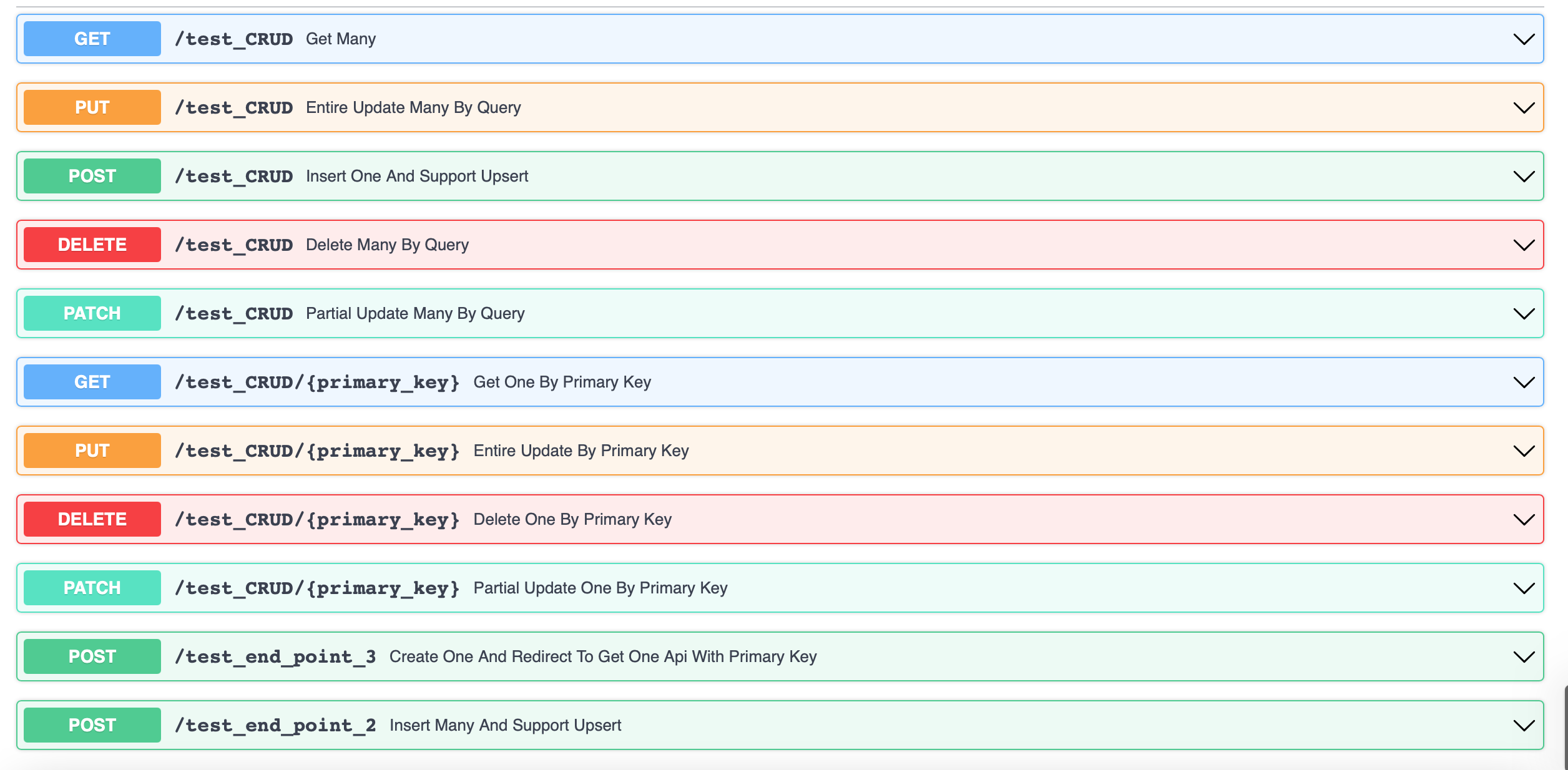
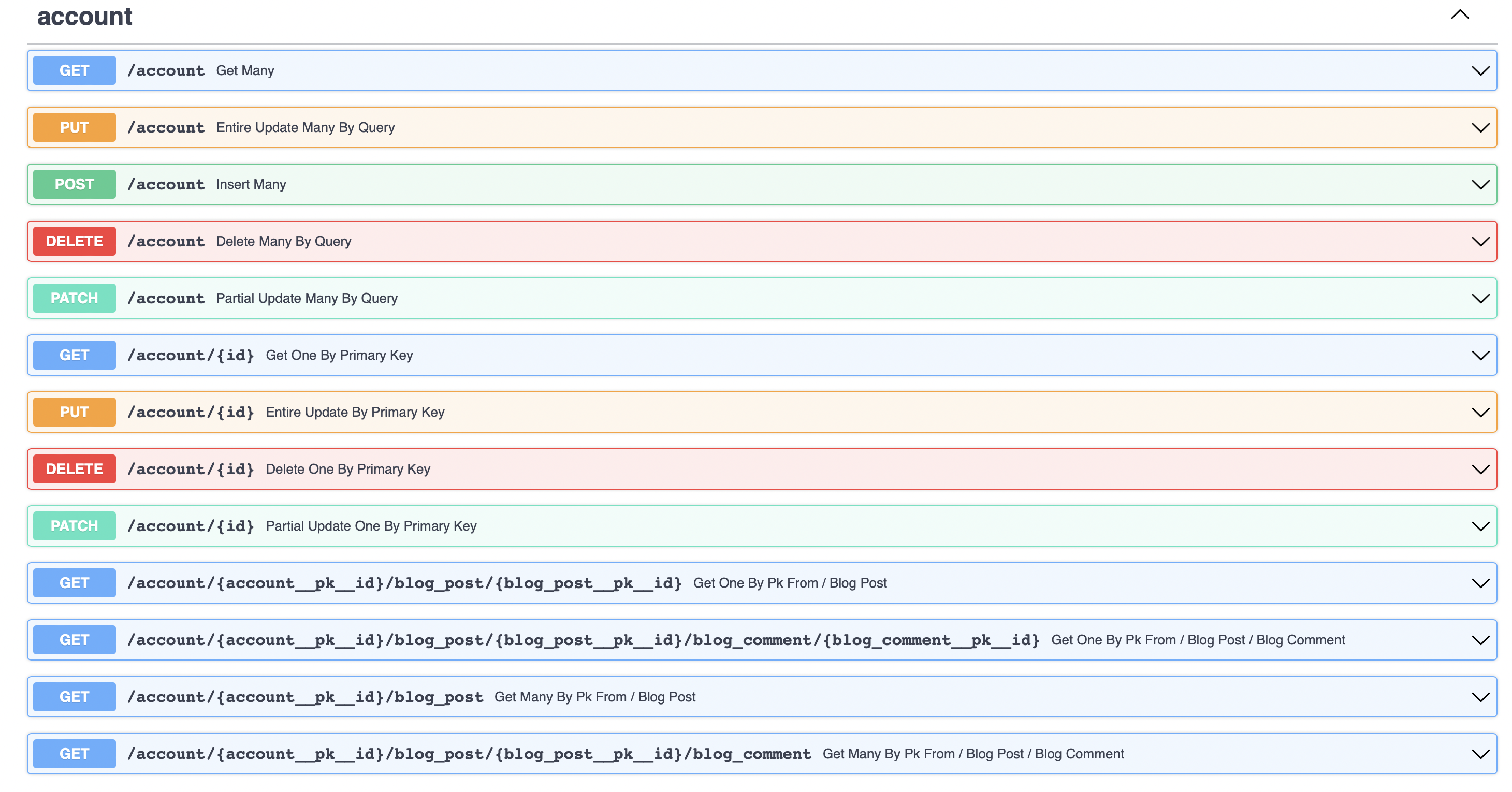
Advantages
-
Support SQLAlchemy 1.4 - Allows you build a fully asynchronous or synchronous python service
-
Full SQLAlchemy DBAPI Support - Support different SQL for SQLAlchemy
-
Support Pagination -
Get manyAPI supportorder byoffsetlimitfield in API -
Rich FastAPI CRUD router generation - Many operations of CRUD are implemented to complete the development and coverage of all aspects of basic CRUD.
-
CRUD route automatically generated - Support Declarative class definitions and Imperative table
-
Flexible API request -
UPDATE ONE/MANYFIND ONE/MANYPATCH ONE/MANYDELETE ONE/MANYsupports Path Parameters (primary key) and Query Parameters as a command to the resource to filter and limit the scope of the scope of data in request. -
SQL Relationship -
FIND ONE/MANYsupports Path get data with relationship
Limitations
- ❌ If there are multiple unique constraints, please use composite unique constraints instead
- ❌ Composite primary key is not supported
- ❌ Unsupported API requests with on resources
xxx/{primary key}for tables without a primary key;UPDATE ONEFIND ONEPATCH ONEDELETE ONE
Getting started
I try to update the version dependencies as soon as possible to ensure that the core dependencies of this project have the highest version possible.
fastapi<=0.68.2
pydantic<=1.8.2
SQLAlchemy<=1.4.30
starlette==0.14.2
Installation
pip install fastapi-quickcrud
I suggest the following library if you try to connect to PostgreSQL
pip install psycopg2
pip install asyncpg
Usage
run and go to http://127.0.0.1:port/docs and see the auto-generated API
Simple Code (or see the longer (example)
from fastapi import FastAPI
from sqlalchemy import Column, Integer, \
    String, Table, ForeignKey, orm
from fastapi_quickcrud import crud_router_builder

Base = orm.declarative_base()


class User(Base):
    __tablename__ = 'test_users'
    id = Column(Integer, primary_key=True, autoincrement=True, unique=True)
    name = Column(String, nullable=False)
    email = Column(String, nullable=False)


friend = Table(
    'test_friend', Base.metadata,
    Column('id', ForeignKey('test_users.id', ondelete='CASCADE', onupdate='CASCADE'), nullable=False),
    Column('friend_name', String, nullable=False)
)

crud_route_1 = crud_router_builder(db_model=User,
                                   prefix="/user",
                                   tags=["User"],
                                   async_mode=True
                                   )
crud_route_2 = crud_router_builder(db_model=friend,
                                   prefix="/friend",
                                   tags=["friend"],
                                   async_mode=True
                                   )

app = FastAPI()
app.include_router(crud_route_1)
app.include_router(crud_route_2)
Foreign Tree With Relationship
from fastapi import FastAPI
from fastapi_quickcrud import crud_router_builder
from sqlalchemy import *
from sqlalchemy.orm import *
from fastapi_quickcrud.crud_router import generic_sql_crud_router_builder

Base = declarative_base()

class Account(Base):
    __tablename__ = "account"
    id = Column(Integer, primary_key=True, autoincrement=True)
    blog_post = relationship("BlogPost", back_populates="account")


class BlogPost(Base):
    __tablename__ = "blog_post"
    id = Column(Integer, primary_key=True, autoincrement=True)
    account_id = Column(Integer, ForeignKey("account.id"), nullable=False)
    account = relationship("Account", back_populates="blog_post")
    blog_comment = relationship("BlogComment", back_populates="blog_post")


class BlogComment(Base):
    __tablename__ = "blog_comment"
    id = Column(Integer, primary_key=True, autoincrement=True)
    blog_id = Column(Integer, ForeignKey("blog_post.id"), nullable=False)
    blog_post = relationship("BlogPost", back_populates="blog_comment")


crud_route_parent = crud_router_builder(
    db_model=Account,
    prefix="/account",
    tags=["account"],
    foreign_include=[BlogComment, BlogPost]

)
crud_route_child1 = generic_sql_crud_router_builder(
    db_model=BlogPost,
    prefix="/blog_post",
    tags=["blog_post"],
    foreign_include=[BlogComment]

)
crud_route_child2 = generic_sql_crud_router_builder(
    db_model=BlogComment,
    prefix="/blog_comment",
    tags=["blog_comment"]

)

app = FastAPI()
[app.include_router(i) for i in [crud_route_parent, crud_route_child1, crud_route_child2]]
SQLAlchemy to Pydantic Model Converter And Build your own API(example)
import uvicorn
from fastapi import FastAPI, Depends
from fastapi_quickcrud import CrudMethods
from fastapi_quickcrud import sqlalchemy_to_pydantic
from fastapi_quickcrud.misc.memory_sql import sync_memory_db

from sqlalchemy import CHAR, Column, Integer
from sqlalchemy.ext.declarative import declarative_base

app = FastAPI()

Base = declarative_base()
metadata = Base.metadata


class Child(Base):
    __tablename__ = 'right'
    id = Column(Integer, primary_key=True)
    name = Column(CHAR, nullable=True)


friend_model_set = sqlalchemy_to_pydantic(db_model=Child,
                                          crud_methods=[
                                              CrudMethods.FIND_MANY,
                                              CrudMethods.UPSERT_MANY,
                                              CrudMethods.UPDATE_MANY,
                                              CrudMethods.DELETE_MANY,
                                              CrudMethods.CREATE_ONE,
                                              CrudMethods.PATCH_MANY,

                                          ],
                                          exclude_columns=[])


post_model = friend_model_set.POST[CrudMethods.CREATE_ONE]
sync_memory_db.create_memory_table(Child)

@app.post("/hello",
          status_code=201,
          tags=["Child"],
          response_model=post_model.responseModel,
          dependencies=[])
async def my_api(
        query: post_model.requestBodyModel = Depends(post_model.requestBodyModel),
        session=Depends(sync_memory_db.get_memory_db_session)
):
    db_item = Child(**query.__dict__)
    session.add(db_item)
    session.commit()
    session.refresh(db_item)
    return db_item.__dict__


uvicorn.run(app, host="0.0.0.0", port=8000, debug=False)
- Note: you can use sqlacodegen to generate SQLAlchemy models for your table. This project is based on the model development and testing generated by sqlacodegen
Main module
Generate CRUD router
crud_router_builder args
-
db_session [Optional]
execute session generator- default using in-memory db with create table automatically
- example:
- sync SQLALchemy:
  from sqlalchemy.orm import sessionmaker
  def get_transaction_session():
      try:
          db = sessionmaker(...)
          yield db
      except Exception as e:
          db.rollback()
          raise e
      finally:
          db.close()
- Async SQLALchemy
from sqlalchemy.orm import sessionmaker
from sqlalchemy.ext.asyncio import AsyncSession
async_session = sessionmaker(autocommit=False,
                     autoflush=False,
                     bind=engine,
                     class_=AsyncSession)

async def get_transaction_session() -> AsyncSession:
    async with async_session() as session:
        async with session.begin():
            yield session
-
db_model [Require]
SQLALchemy Declarative Base Class or TableNote: There are some constraint in the SQLALchemy Schema
-
async_mode [Optional (auto set by db_session)]
bool: if your db session is asyncNote: require async session generator if True
-
autocommit [Optional (default True)]
bool: if you don't need to commit by your selfNote: require handle the commit in your async session generator if False
-
dependencies [Optional]: API dependency injection of fastapi
Note: Get the example usage in
./example -
crud_methods:
CrudMethods- CrudMethods.FIND_ONE
- CrudMethods.FIND_MANY
- CrudMethods.UPDATE_ONE
- CrudMethods.UPDATE_MANY
- CrudMethods.PATCH_ONE
- CrudMethods.PATCH_MANY
- CrudMethods.UPSERT_ONE (only support postgresql yet)
- CrudMethods.UPSERT_MANY (only support postgresql yet)
- CrudMethods.CREATE_ONE
- CrudMethods.CREATE_MANY
- CrudMethods.DELETE_ONE
- CrudMethods.DELETE_MANY
- CrudMethods.POST_REDIRECT_GET
-
exclude_columns:
listset the columns that not to be operated but the columns should nullable or set the default value)
-
foreign_include:
list[declarative_base()]add the SqlAlchemy models here, and build the foreign tree get one/many api (don't support SqlAlchemy table)
-
dynamic argument (prefix, tags): extra argument for APIRouter() of fastapi
Design
In PUT DELETE PATCH, user can use Path Parameters and Query Parameters to limit the scope of the data affected by the operation, and the Query Parameters is same with FIND API
Path Parameter
In the design of this tool, Path Parameters should be a primary key of table, that why limited primary key can only be one.
Query Parameter
-
Query Operation will look like that when python type of column is
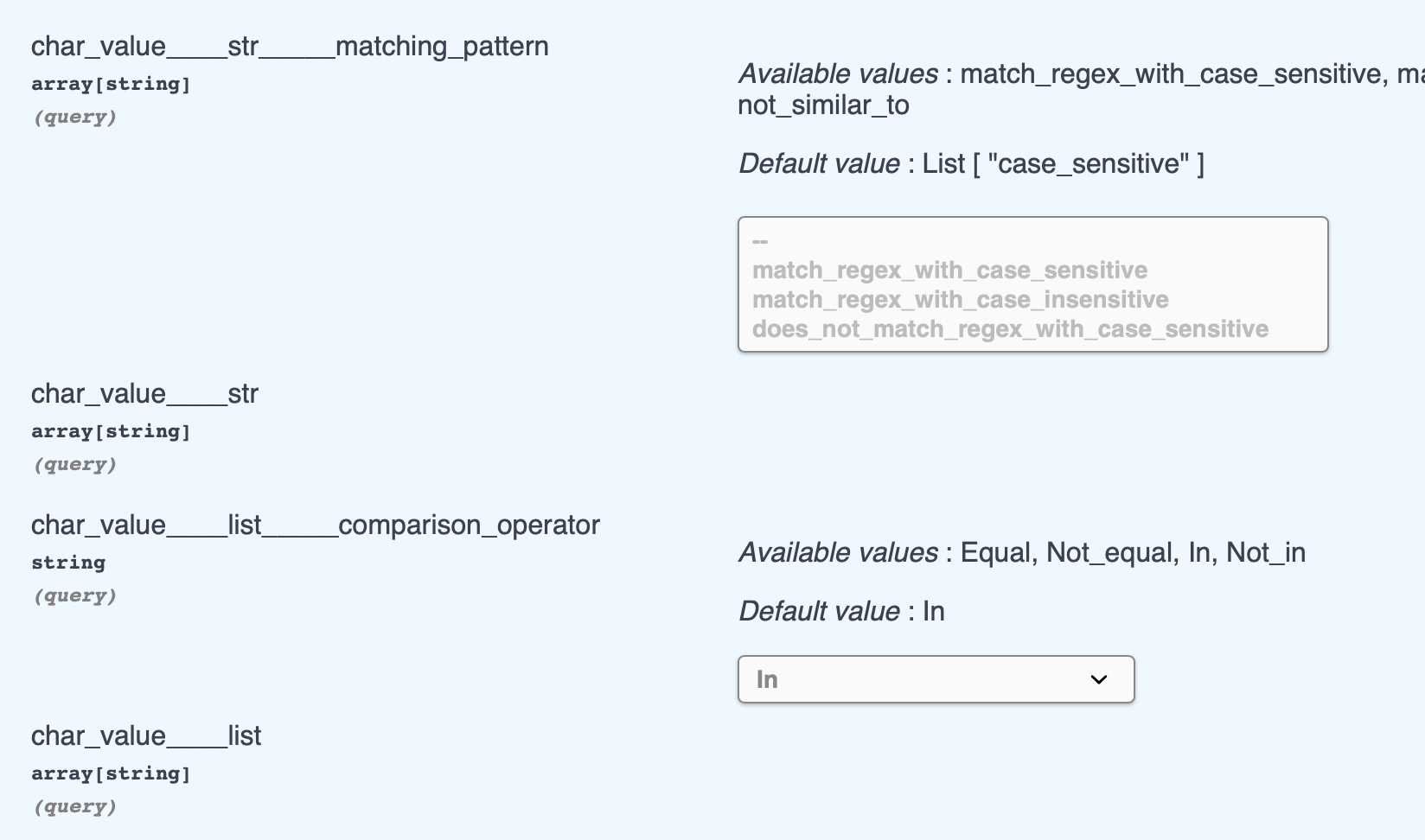
string
- support Approximate String Matching that require this
- (<column_name>____str, <column_name>____str_____matching_pattern)
- support In-place Operation, get the value of column in the list of input
- (<column_name>____list, <column_name>____list____comparison_operator)
- preview

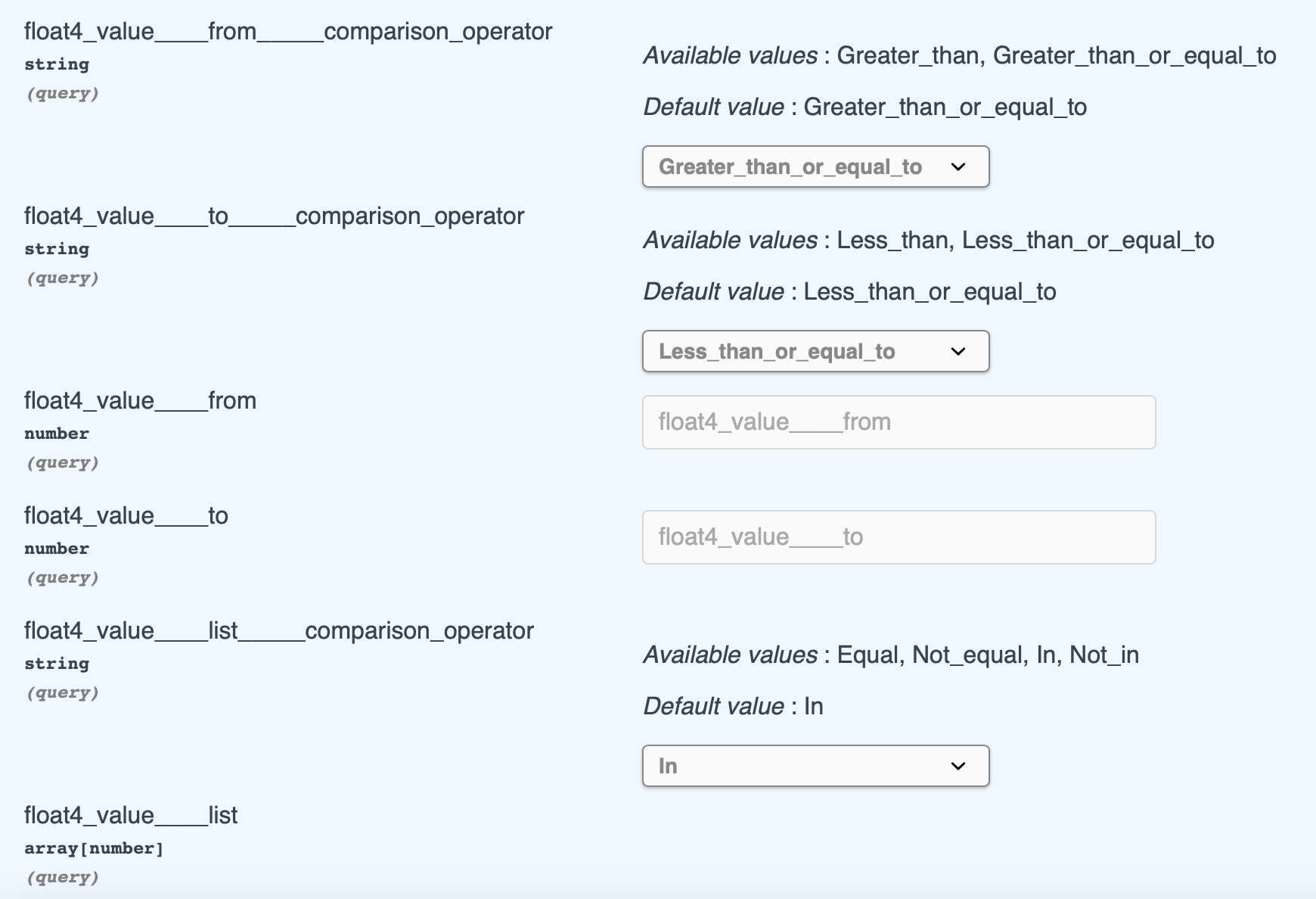
numeric or datetime
- support Range Searching from and to
- (<column_name>____from, <column_name>____from_____comparison_operator)
- (<column_name>____to, <column_name>____to_____comparison_operator)
- support In-place Operation, get the value of column in the list of input
- (<column_name>____list, <column_name>____list____comparison_operator)
- preview


uuid
uuid supports In-place Operation only
- support In-place Operation, get the value of column in the list of input
- (<column_name>____list, <column_name>____list____comparison_operator)
- support Approximate String Matching that require this
-
EXTRA query parameter for
GET_MANY:Pagination
- limit
- offset
- order by
- preview

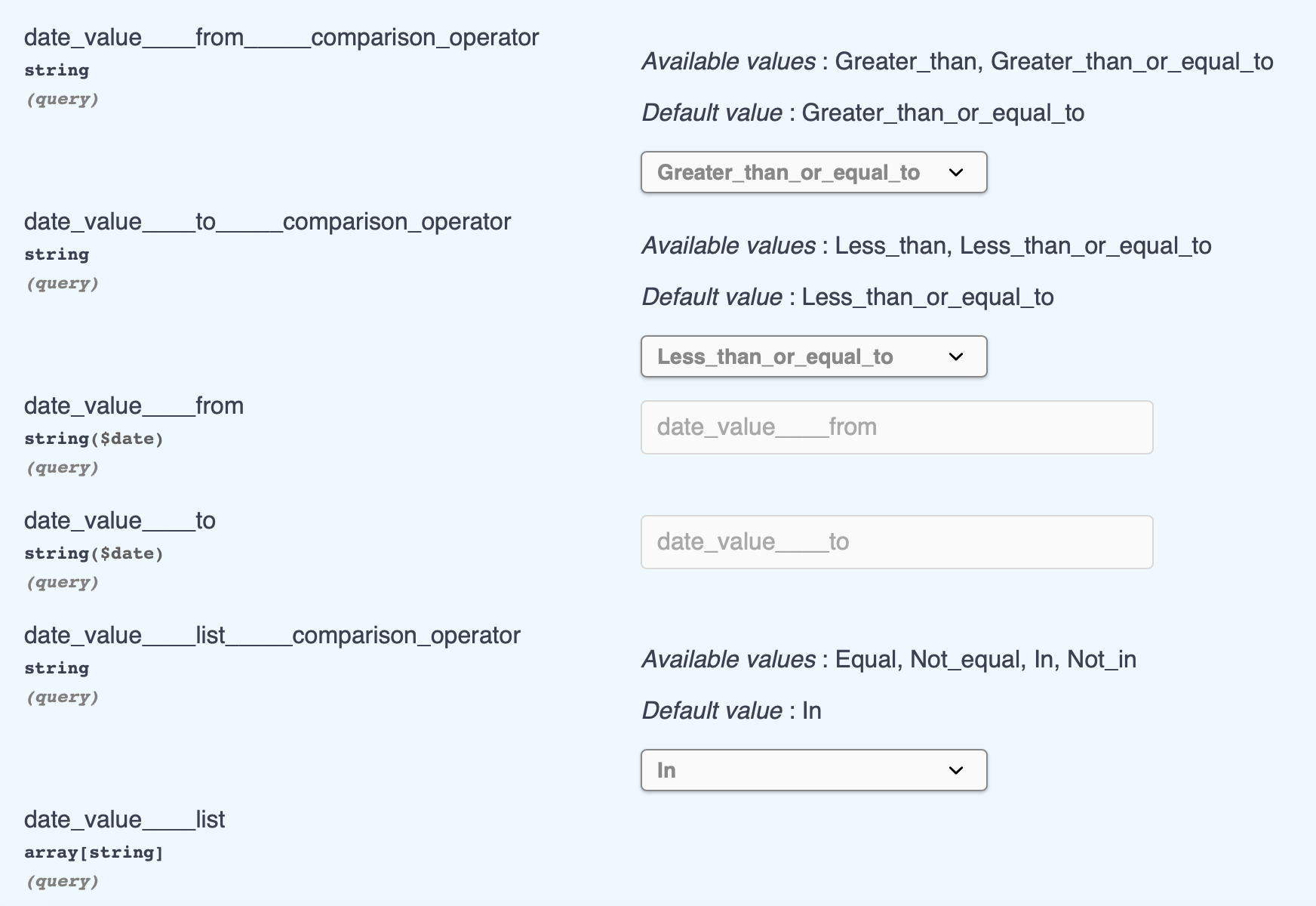
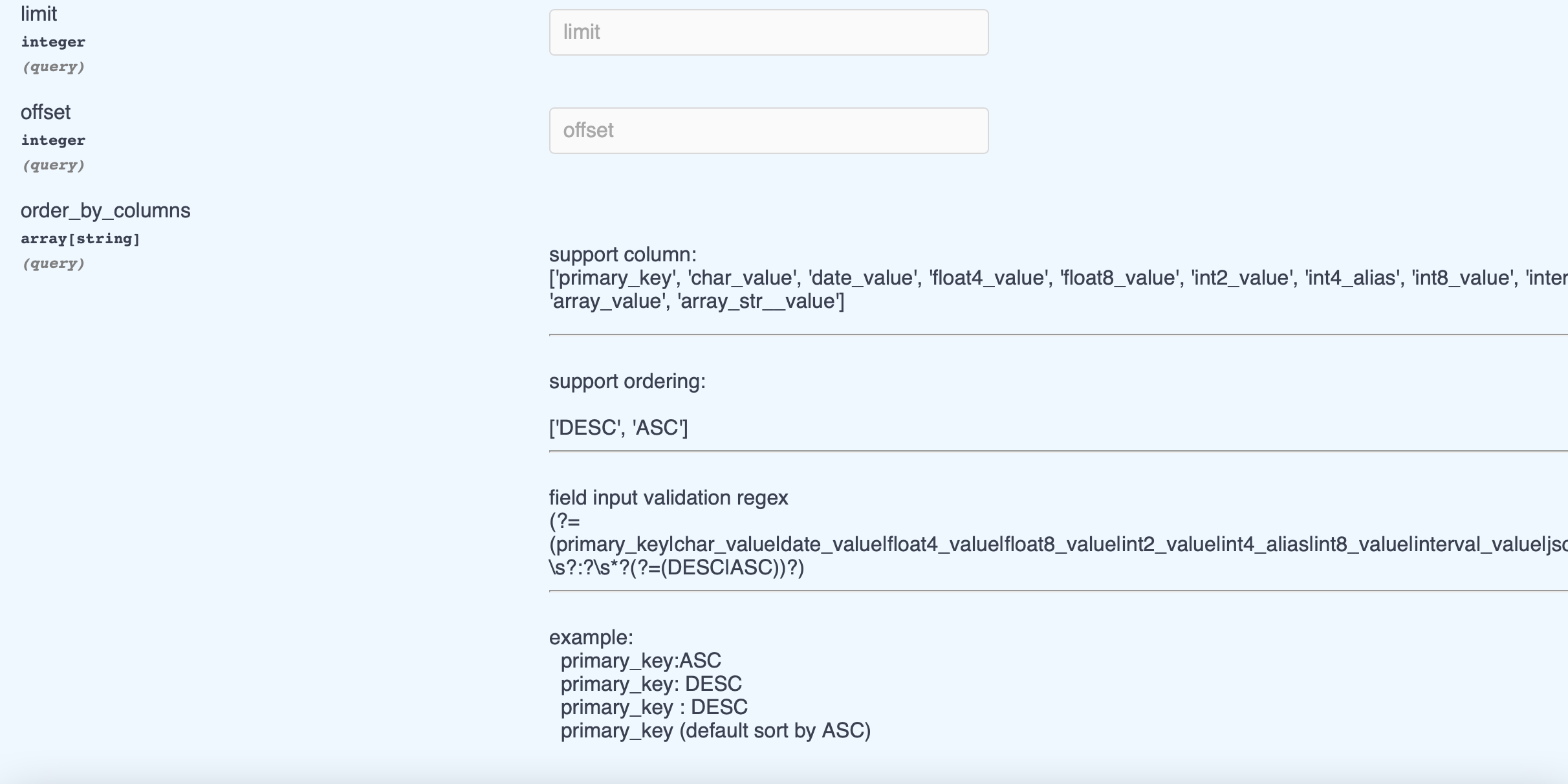
Query to SQL statement example
-
example
- request url
/test_CRUD? char_value____str_____matching_pattern=match_regex_with_case_sensitive& char_value____str_____matching_pattern=does_not_match_regex_with_case_insensitive& char_value____str_____matching_pattern=case_sensitive& char_value____str_____matching_pattern=not_case_insensitive& char_value____str=a& char_value____str=b - generated sql
  SELECT *
  FROM untitled_table_256
  WHERE (untitled_table_256.char_value ~ 'a') OR
  (untitled_table_256.char_value ~ 'b' OR
  (untitled_table_256.char_value !~* 'a') OR
  (untitled_table_256.char_value !~* 'b' OR
  untitled_table_256.char_value LIKE 'a' OR
  untitled_table_256.char_value LIKE 'b' OR
  untitled_table_256.char_value NOT ILIKE 'a'
  OR untitled_table_256.char_value NOT ILIKE 'b'
- request url
-
In-place Operation
example
-
In-place support the following operation
-
generated sql if user select Equal operation and input True and False
-
preview

-
generated sql
  select * FROM untitled_table_256
  WHERE untitled_table_256.bool_value = true OR
  untitled_table_256.bool_value = false
-
-
Range Searching
example
-
Range Searching support the following operation


-
generated sql
  select * from untitled_table_256
  WHERE untitled_table_256.date_value > %(date_value_1)s
  select * from untitled_table_256
  WHERE untitled_table_256.date_value < %(date_value_1)s
-
-
Also support your custom dependency for each api(there is a example in
./example)



Request Body
In the design of this tool, the columns of the table will be used as the fields of request body.
In the basic request body in the api generated by this tool, some fields are optional if :
- it is primary key with
autoincrementis True or theserver_defaultordefaultis True - it is not a primary key, but the
server_defaultordefaultis True - The field is nullable
Foreign Tree
TBC
Upsert
** Upsert supports PosgreSQL only yet
POST API will perform the data insertion action with using the basic Request Body, In addition, it also supports upsert(insert on conflict do)
The operation will use upsert instead if the unique column in the inserted row that is being inserted already exists in the table
The tool uses unique columns in the table as a parameter of on conflict , and you can define which column will be updated
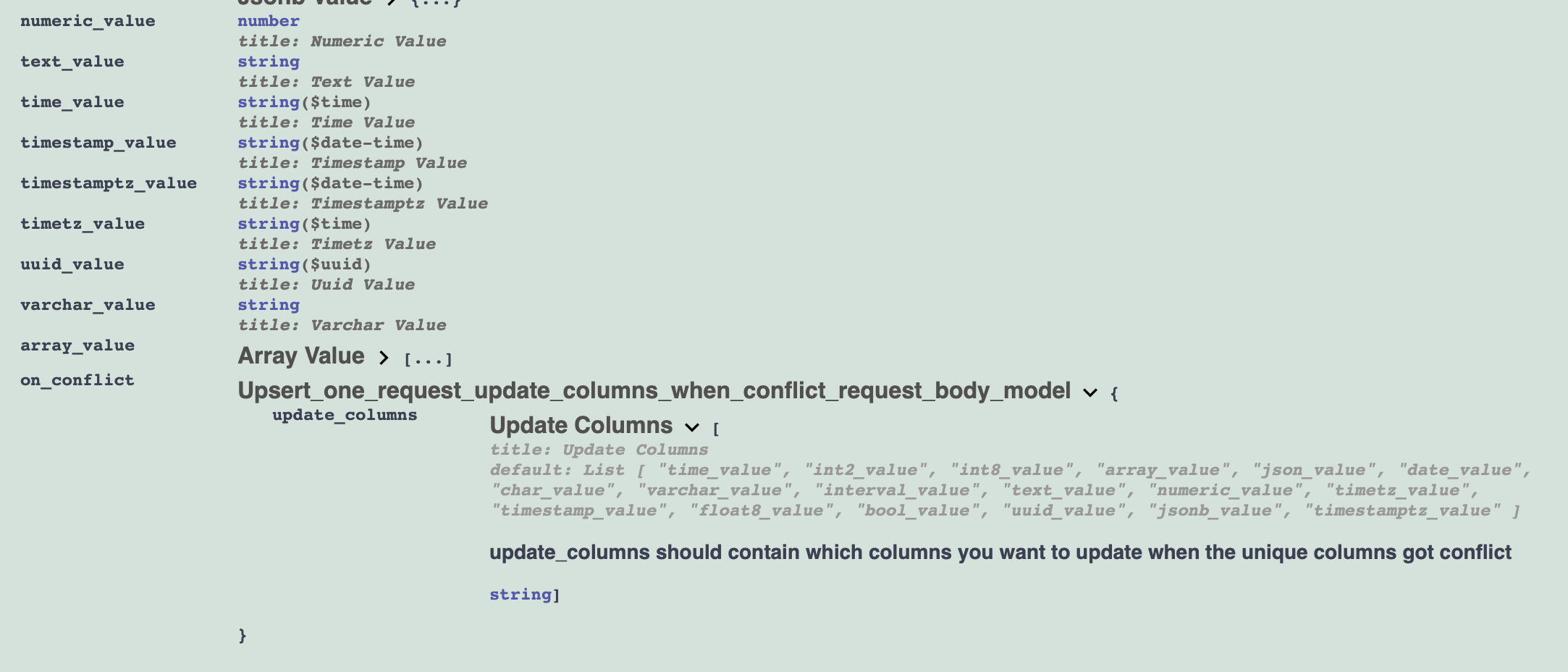
Add description into docs
You can declare comment argument for sqlalchemy.Column to configure the description of column
example:
class Parent(Base):
    __tablename__ = 'parent_o2o'
    id = Column(Integer, primary_key=True,comment='parent_test')

    # one-to-many collection
    children = relationship("Child", back_populates="parent")

class Child(Base):
    __tablename__ = 'child_o2o'
    id = Column(Integer, primary_key=True,comment='child_pk_test')
    parent_id = Column(Integer, ForeignKey('parent_o2o.id'),info=({'description':'child_parent_id_test'}))

    # many-to-one scalar
    parent = relationship("Parent", back_populates="children")
Relationship
Now, FIND_ONE and FIND_MANY are supporting select data with join operation
class Parent(Base):
    __tablename__ = 'parent_o2o'
    id = Column(Integer, primary_key=True)
    children = relationship("Child", back_populates="parent")

class Child(Base):
    __tablename__ = 'child_o2o'
    id = Column(Integer, primary_key=True)
    parent_id = Column(Integer, ForeignKey('parent_o2o.id'))
    parent = relationship("Parent", back_populates="children")
there is a relationship with using back_populates between Parent table and Child table, the parent_id in Child will refer to id column in Parent.
FastApi Quick CRUD will generate an api with a join_foreign_table field, and get api will respond to your selection of the reference data row of the corresponding table in join_foreign_table field,

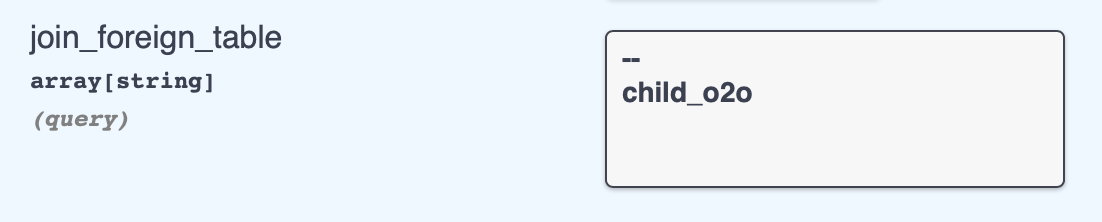
- Try Request now there are some data in these two table

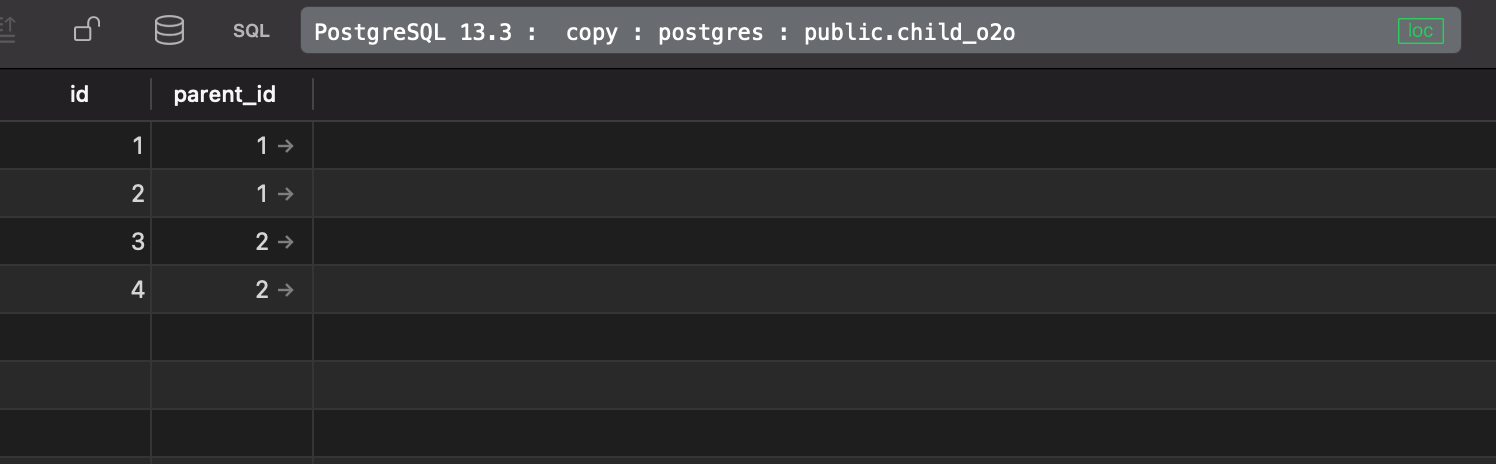
when i request
-
Case One
curl -X 'GET' \
'http://0.0.0.0:8000/parent?join_foreign_table=child_o2o' \
-H 'accept: application/json'
Response data
[
  {
    "id_foreign": [
      {
        "id": 1,
        "parent_id": 1
      },
      {
        "id": 2,
        "parent_id": 1
      }
    ],
    "id": 1
  },
  {
    "id_foreign": [
      {
        "id": 3,
        "parent_id": 2
      },
      {
        "id": 4,
        "parent_id": 2
      }
    ],
    "id": 2
  }
]
Response headers
x-total-count: 4There are response 4 data, response data will be grouped by the parent row, if the child refer to the same parent row
-
Case Two
curl -X 'GET' \
'http://0.0.0.0:8000/child?join_foreign_table=parent_o2o' \
-H 'accept: application/json'
Response data
[
  {
    "parent_id_foreign": [
      {
        "id": 1
      }
    ],
    "id": 1,
    "parent_id": 1
  },
  {
    "parent_id_foreign": [
      {
        "id": 1
      }
    ],
    "id": 2,
    "parent_id": 1
  },
  {
    "parent_id_foreign": [
      {
        "id": 2
      }
    ],
    "id": 3,
    "parent_id": 2
  },
  {
    "parent_id_foreign": [
      {
        "id": 2
      }
    ],
    "id": 4,
    "parent_id": 2
  }
]
Response Header
x-total-count: 4
FastAPI_quickcrud Response Status Code standard
When you ask for a specific resource, say a user or with query param, and the user doesn't exist
GET: get one : https://0.0.0.0:8080/api/:userid?xx=xx
UPDATE: update one : https://0.0.0.0:8080/api/:userid?xx=xx
PATCH: patch one : https://0.0.0.0:8080/api/:userid?xx=xx
DELETE: delete one : https://0.0.0.0:8080/api/:userid?xx=xx
then fastapi-qucikcrud should return 404. In this case, the client requested a resource that doesn't exist.
In the other case, you have an api that operate data on batch in the system using the following url:
GET: get many : https://0.0.0.0:8080/api/user?xx=xx
UPDATE: update many : https://0.0.0.0:8080/api/user?xx=xx
DELETE: delete many : https://0.0.0.0:8080/api/user?xx=xx
PATCH: patch many : https://0.0.0.0:8080/api/user?xx=xx
If there are no users in the system, then, in this case, you should return 204.
TODO
Questions
What is FastAPIQuickCRUD?
LuisLuii/FastAPIQuickCRUD is a public repo on GitHub by LuisLuii. Generate CRUD methods in FastApi from an SQLAlchemy schema.
Is FastAPIQuickCRUD open source?
It declares the MIT license on GitHub.
Does FastAPIQuickCRUD run on macOS, Windows or Linux?
Its maker has not tagged a system, so it is unknown here. Its README says what it needs.
How do I install FastAPIQuickCRUD?
Open "Take it" on its page: Take My Repo writes an install plan for your machine and hands it to your AI agent (Claude Code, Codex or Cursor), which asks you before each step. Take My Repo has not tested it on any machine.
Is FastAPIQuickCRUD still maintained?
Its last change on GitHub was on 2024-01-07. Take My Repo does not judge from that whether it is maintained.
What do people who ran FastAPIQuickCRUD say?
Nobody has reviewed it on Take My Repo yet, which says nothing about its quality.