
AgentMeter
Local-first observability dashboard for coding agent sessions, tracking tokens, costs, timing, and tool usage.
- 1
- Apache-2.0
- 2 mo ago
Repo LyleMi/AgentMeter, read from GitHub 11 h ago. LyleMi has not joined Take My Repo.
In short
LyleMi/AgentMeter is a public repo on GitHub by LyleMi. Local-first observability dashboard for coding agent sessions, tracking tokens, costs, timing, and tool usage. It declares the Apache-2.0 license on GitHub. It is written mainly in Go, has 1 stars and last changed on 2026-09-26. Nobody has reviewed it on Take My Repo yet, which says nothing about its quality. Read from GitHub on 2026-11-24.
Similar repos


AgentMeter
Local-first coding-agent usage analytics for tokens, cost, timing, sessions, and tool calls.
Live demo | Downloads | Screenshot | Install | Privacy
AgentMeter is an open-source Go + Vue dashboard for understanding local coding-agent session usage. It reads local agent JSONL session files, indexes them into SQLite, and organizes tokens, cost, timing, model health, audit evidence, privacy, and local resources around the tasks users need to complete. The Web dashboard and terminal UI share the same local read models.
No proxy, no cloud service, no telemetry.
At A Glance
- Supported agents: Codex, Claude Code, CodeBuddy, WorkBuddy, DeepSeek Harness (dsh), and generic JSONL directories.
- Privacy model: session data stays on your machine in a local SQLite database; AgentMeter does not proxy traffic or upload telemetry.
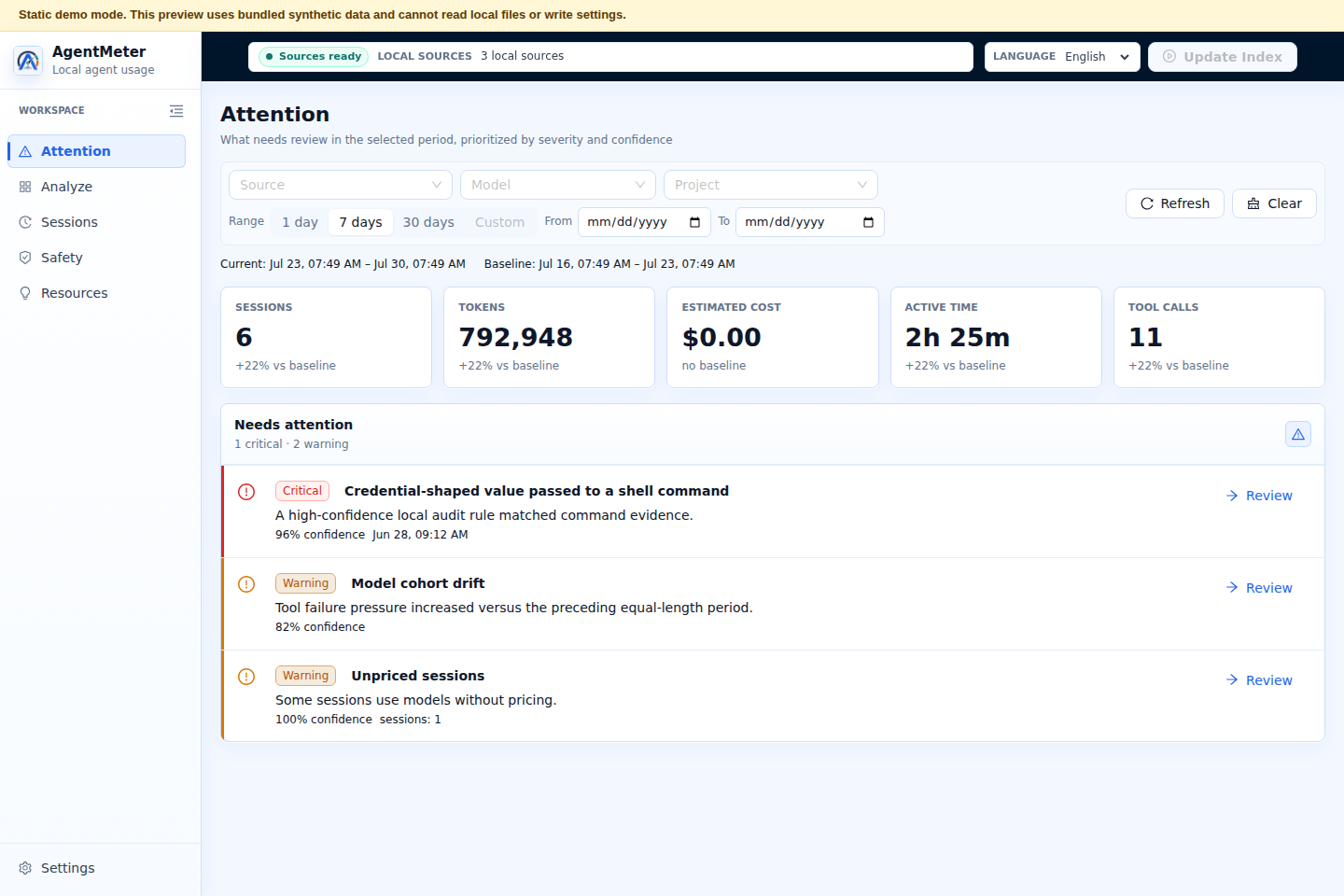
- Primary views: Attention, Analyze, Sessions, Safety, Resources, and Settings. Attention prioritizes index, pricing, audit, model, anomaly, and privacy signals for the selected period.
- Interfaces: local Web dashboard by default, plus a terminal UI over the same database and query behavior.
- Release assets: cross-platform archives are published on
GitHub Releases as
AgentMeter-<platform>-<arch>builds.
Why AgentMeter
Coding agents leave useful local session data behind, but raw JSONL is hard to inspect directly. AgentMeter turns that data into answers you can use:
- How many sessions did I run?
- How many tokens did they consume?
- What did those tokens roughly cost?
- Which models, days, projects, or sessions used the most?
- How stable is cache hit behavior by day, model, or project?
- Where are cost per session, cost per active hour, cache savings, retry pressure, or failure pressure changing by day or project?
- Where did model health, service drift, throughput, cache, or tool-use symptoms change in real usage?
- Which tools were called most often?
- How long did sessions and tool calls take?
Features
- Local Web dashboard for sessions, tokens, estimated cost, daily usage, model usage, project usage, cache-hit trends by day/model/project, and tool-call analytics.
- Model Signals for raw operational signals, daily/project operational efficiency, and health/drift monitoring, including output expansion, reasoning share, cache miss, throughput, model call status when available, token/cost shape, cost per session, cost per active hour, cache savings, retry/failure pressure, low-confidence cohorts, and anomaly sessions. These are local operational proxies, not universal model benchmark scores.
- Offline audit view for command-risk and privacy/secret findings derived from indexed local session data.
- Terminal UI mode over the same database, indexing pipeline, pricing rules, and query behavior.
- Codex, Claude Code, CodeBuddy, WorkBuddy, DeepSeek Harness (dsh), and generic JSONL source detection.
- Multiple labeled source instances for developers running several local coding agents or several roots from the same agent family.
- Incremental SQLite indexing with source path traceability and parse status.
- Built-in pricing registry with unknown models clearly marked as
unpriced.
Quick Start
For most users, start with a packaged build:
- Download the matching
AgentMeter-<platform>-<arch>archive from Releases. - Unpack the archive.
- Start the local Web app.
On Windows:
.\AgentMeter.exe -start
On macOS or Linux:
./AgentMeter -start
Open the dashboard if your browser does not open automatically:
http://127.0.0.1:34115
On first launch, click Update Index in the app. AgentMeter defaults to
detected local agent homes such as ~/.codex and ~/.claude; you can add more
source roots in Settings and label them when paths alone are ambiguous. A
source instance is one local root, while the agent family (codex, claude,
and so on) controls parser behavior and family-level filters. Update Index
scans only new or changed JSONL files; Rebuild Index clears indexed files
for enabled sources and parses them all again.
DeepSeek Harness logs are discovered under ~/.dsh or DSH_HOME, including
compressed session logs. See dsh support for supported formats
and accounting details.
For alternate install methods, CLI modes, data locations, and developer workflows, see Install and Getting Started.
Privacy Model
AgentMeter is designed to stay local:
- Reads local session files only.
- Does not proxy model traffic.
- Does not upload session data.
- Does not require a cloud account.
- Stores normalized data in a local SQLite database.
- Audit findings may store raw local evidence so command and privacy issues can be inspected without leaving the machine.
Current Status
AgentMeter is an MVP for local coding-agent JSONL usage. The Web UI is the default interface; the TUI is available as a terminal MVP over the same application core.
See Roadmap for planned work.
Documentation
- Install
- Supported Agents
- Privacy
- Comparison
- Release Distribution
- Getting Started
- Project Brief
- Architecture
- UI Modes
- Data Model
- Model Signals
- Session Formats
- Pricing Sources
- Validation
- Roadmap
Contributing
Issues and pull requests are welcome, especially for parser edge cases, pricing updates, packaging, and adapters for other coding agents.
Questions
What is AgentMeter?
LyleMi/AgentMeter is a public repo on GitHub by LyleMi. Local-first observability dashboard for coding agent sessions, tracking tokens, costs, timing, and tool usage.
Is AgentMeter open source?
It declares the Apache-2.0 license on GitHub.
Does AgentMeter run on macOS, Windows or Linux?
Its maker has not tagged a system, so it is unknown here. Its README says what it needs.
How do I install AgentMeter?
Open "Take it" on its page: Take My Repo writes an install plan for your machine and hands it to your AI agent (Claude Code, Codex or Cursor), which asks you before each step. Take My Repo has not tested it on any machine.


