
ts-oauth2-server
A full featured, secure, standards compliant TypeScript implementation of an OAuth/OIDC authorization server for Nodejs that utilizes JWT and Proof Key for Code Exchange (PKCE)
- 312
- TypeScript
- MIT
- 3 mo ago
Access Mastercard APIs with OAuth 2.0 and FAPI 2.0
Repo Mastercard/oauth2-client-java, read from GitHub 6 h ago. Mastercard has not joined Take My Repo.
Mastercard/oauth2-client-java is a public repo on GitHub by Mastercard. Access Mastercard APIs with OAuth 2.0 and FAPI 2.0. It declares no license on GitHub. Public does not mean open source: without a license, nobody is granted the right to reuse it. It is written mainly in Java, has 4 stars and last changed on 2026-11-19. Nobody has reviewed it on Take My Repo yet, which says nothing about its quality. Read from GitHub on 2026-11-24.
A full featured, secure, standards compliant TypeScript implementation of an OAuth/OIDC authorization server for Nodejs that utilizes JWT and Proof Key for Code Exchange (PKCE)

Easily access Mastercard APIs with OAuth 2.0 and FAPI 2.0. This zero-dependency library handles authentication for you.
For more information, see Using OAuth 2.0 to Access Mastercard APIs.
This project is licensed under the Apache License 2.0.
To use this project, you will need Java 17 or higher. Java 17 is an LTS release and has become the practical baseline for modern Java frameworks (for example Spring Boot 3).
The code is compiled using "provided" dependencies to keep the artifact small, prevent version conflicts, and let you choose which HTTP client and JSON provider to use at runtime.
The modular structure lets you import only what you need. For example, when using OkHttp and classes from the okhttp3 package, only the OkHttp library needs to be on the classpath.
At least one JSON library (Jackson, Gson, or org.json) must be available on the classpath for JSON processing.
To verify that runtime dependencies are minimal, run cd library && mvn dependency:tree -Dscope=runtime. Expected output:
[INFO] --- dependency:3.7.0:tree (default-cli) @ oauth2-client-java ---
[INFO] com.mastercard.developer:oauth2-client-java:jar:{version}
[INFO] \- org.slf4j:slf4j-api:jar:{version}:compile
A Javadoc site is available on javadoc.io. Additionally, you can use DeepWiki and Context7 to explore the library further.
To start, add the following dependency to your project:
<dependency>
    <groupId>com.mastercard.developer</groupId>
    <artifactId>oauth2-client-java</artifactId>
    <version>${oauth2-client-version}</version>
</dependency>
dependencies {
    implementation "com.mastercard.developer:oauth2-client-java:$oauth2ClientVersion"
}
The OAuth2Config object contains your client credentials, DPoP key configuration, token endpoint, and other settings for OAuth 2.0 authentication.
Here's how to build an instance:
PrivateKey clientKey = KeyLoader.loadPrivateKey(Paths.get("path/to/client-private-key.pem"));
KeyPair dpopKeyPair = KeyLoader.loadKeyPair(Paths.get("path/to/dpop-private-key.json")); // Or KeyGenerator.generateEcKeyPair("secp256r1");

OAuth2Config config = OAuth2Config.builder()
    .securityProfile(SecurityProfile.FAPI2SP_PRIVATE_KEY_DPOP)
    .clientId("ZvT0sklPsqzTNgKJIiex5_wppXz0Tj2wl33LUZtXmCQH8dry")
    .tokenEndpoint(new URL("https://sandbox.api.mastercard.com/oauth/token"))
    .issuer(new URL("https://sandbox.api.mastercard.com"))
    .clientKey(clientKey)
    .kid("302449525fad5309874b16298f3cbaaf0000000000000000")
    .accessTokenStore(new InMemoryAccessTokenStore())
    .scopeResolver(new StaticScopeResolver(Set.of("service:scope1", "service:scope2")))
    .dpopKeyProvider(new StaticDPoPKeyProvider(dpopKeyPair))
    .clockSkewTolerance(Duration.ofSeconds(10))
    .build();
Notes:
The OAuth2Handler class provides public static methods that handle client assertion generation, DPoP proof creation, access token request creation and access token response parsing.
For a higher-level experience, use the provided HTTP-client related classes (interceptors, filters, or client wrappers), automatically invoking the OAuth2Handler logic under the hood.
Pick the HTTP client that works best for your application. All implementations provide the same functionality.
| Supported versions | Status |
|---|---|
| 4.x, 5.x |
The OAuth2Interceptor is an OkHttp interceptor that adds access tokens and DPoP proofs to outgoing requests. Register it with OkHttpClient.Builder.addInterceptor().
OAuth2Interceptor ClassOkHttpClient httpClient = new OkHttpClient.Builder()
.addInterceptor(new OAuth2Interceptor(config, baseClient.newBuilder()))
.build();
Call call = httpClient.newCall(request);
Response response = call.execute();
okhttp-gsonOkHttpClient httpClient = new OkHttpClient.Builder()
.addInterceptor(new OAuth2Interceptor(config, baseClient.newBuilder()))
.build();
var client = new ApiClient(httpClient);
client.setBasePath(baseUri);
var api = new ResourcesApi(client);
Resource resource = api.createResource(new Resource());
| Supported versions | Status |
|---|---|
| Java 17 to 25 |
OAuth2HttpClient extends HttpClient and provides a builder that extends HttpClient.Builder. Use it as a drop-in replacement for the standard Java HTTP client.
OAuth2HttpClient ClassHttpClient httpClient = OAuth2HttpClient.newBuilder(config, baseBuilder).build();
HttpResponse<String> response = httpClient.send(request, HttpResponse.BodyHandlers.ofString());
nativevar client = new ApiClient();
client.setHttpClientBuilder(OAuth2HttpClient.newBuilder(config, baseBuilder));
client.updateBaseUri(baseUri);
var api = new ResourcesApi(client);
Resource resource = api.createResource(new Resource());
| Supported versions | Status |
|---|---|
| 5.4.x, 5.5.x, 5.6.x |
OAuth2HttpClient extends CloseableHttpClient. It wraps request execution to add access tokens and DPoP proofs before sending requests.
OAuth2HttpClient ClassCloseableHttpClient httpClient = new OAuth2HttpClient(config);
ClassicHttpResponse httpResponse = httpClient.execute(request, response -> handleResponse(response));
apache-httpclientCloseableHttpClient httpClient = new OAuth2HttpClient(config);
var client = new ApiClient(httpClient);
client.setBasePath(baseUri);
var api = new ResourcesApi(client);
Resource resource = api.createResource(new Resource());
| Supported versions | Status |
|---|---|
| 11.1+, 12.x, 13.x |
OAuth2Client implements Feign's Client interface. It intercepts requests to add access tokens and DPoP proofs. It can be passed to Feign.Builder.client().
OAuth2Client ClassClient feignClient = new OAuth2Client(config);
HttpResponse<String> response = feignClient.execute(request, new Request.Options());
feignClient feignClient = new OAuth2Client(config);
var client = new ApiClient();
client.getFeignBuilder().client(feignClient);
client.setBasePath(baseUri);
ResourcesApi api = client.buildClient(ResourcesApi.class);
Resource resource = api.createResource(new Resource());
| Supported versions | Status |
|---|---|
spring-webflux 6.0.x, 6.1.x, 6.2.x, 7.0.x |
OAuth2Filter implements ExchangeFilterFunction. It intercepts requests to add access tokens and DPoP proofs. Register it with WebClient.Builder.filter().
OAuth2Filter Classvar filter = new OAuth2Filter(config);
WebClient webClient = WebClient.builder().filter(filter).build();
ResponseSpec response = webClient.get().uri(uri).retrieve();
webclientvar filter = new OAuth2Filter(config);
WebClient webClient = WebClient.builder().filter(filter).build();
var client = new ApiClient(webClient);
client.setBasePath(baseUri);
var api = new ResourcesApi(client);
Resource resource = api.createResource(new Resource());
| Supported versions | Status |
|---|---|
spring-web 6.2.x, 7.0.x |
OAuth2ClientHttpRequestInterceptor implements ClientHttpRequestInterceptor. It intercepts requests to add access tokens and DPoP proofs. Register it with RestClient.Builder.requestInterceptor().
OAuth2ClientHttpRequestInterceptor Classvar interceptor = new OAuth2ClientHttpRequestInterceptor(config);
RestClient restClient = baseBuilder.requestInterceptor(interceptor).build();
ResponseSpec response = restClient.get().uri(uri).retrieve();
restclientvar interceptor = new OAuth2ClientHttpRequestInterceptor(config);
RestClient restClient = baseBuilder.requestInterceptor(interceptor).build();
var client = new ApiClient(restClient);
client.setBasePath(baseUri);
var api = new ResourcesApi(client);
Resource resource = api.createResource(new Resource());
Each supported HTTP client has two types of tests:
test-clients module)Both types run against a real service and fake servers.
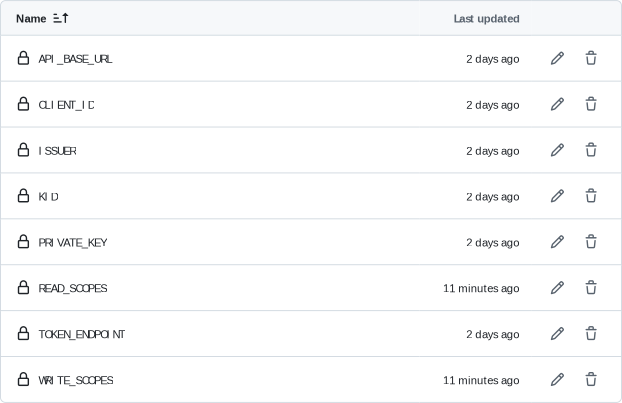
Running integration tests against a real Mastercard API requires API details and credentials. For that:
cp.env.example.env.env with the required valuesThis repository is configured with the following secrets GitHub Actions automatically uses when running workflows:
Fake servers use WireMock to simulate OAuth 2.0 authorization and protected API resource servers.
See: FakeAuthorizationServer, FakeResourceServer.
This library is small by design and built to be extended. Common extension points are listed below.
ScopeResolverScopeResolver to control which scopes are requested for a given URL or endpointStaticScopeResolver for simple fixed-scope casesDPoPKeyProviderDPoPKeyProvider to supply keys for DPoP proofsStaticDPoPKeyProvider for a single, static keyAccessTokenStoreAccessTokenStore to control how access tokens are cached and retrievedInMemoryAccessTokenStoreMastercard/oauth2-client-java is a public repo on GitHub by Mastercard. Access Mastercard APIs with OAuth 2.0 and FAPI 2.0.
It declares no license on GitHub. Public does not mean open source: without a license, nobody is granted the right to reuse it.
Its maker has not tagged a system, so it is unknown here. Its README says what it needs.
User-friendly OAuth2 CLI
An Insomnia plugin for handling authentication and encryption for consuming Mastercard APIs.
The Postgres development platform. Supabase gives you a dedicated Postgres database to build your web, mobile, and AI applications.
Microsoft Entra ID (Azure AD) flows using ASP.NET Core and Microsoft.Identity.Web
OpenID Connect, the authentication protocol and identity layer on top of OAuth 2.0 used in many SSO and adopted in many social logins (Apple, Facebook, Google, ...etc). Find this curated list of providers, services, libraries, and resources to adopt it and know more about existing specs.
Open "Take it" on its page: Take My Repo writes an install plan for your machine and hands it to your AI agent (Claude Code, Codex or Cursor), which asks you before each step. Take My Repo has not tested it on any machine.
Its last change on GitHub was on 2026-11-19. Take My Repo does not judge from that whether it is maintained.
Nobody has reviewed it on Take My Repo yet, which says nothing about its quality.
Take My Repo cannot say: it does not audit code and has not run oauth2-client-java. What is known comes from GitHub. It declares no license on GitHub. Public does not mean open source: without a license, nobody is granted the right to reuse it. Its last change was on 2026-11-19. It has 4 stars, which measure popularity, not safety. Nobody has reviewed it on Take My Repo yet, which says nothing about its quality. Read the source before you run it. With "Take it", your AI agent shows each step and asks you before running it; README text is treated as data, not as instructions.


