MiroFish
A Simple and Universal Swarm Intelligence Engine, Predicting Anything. 简洁通用的群体智能引擎,预测万物
- 86k
- Python
- AGPL-3.0
- 5 wk ago
Embedded memory and storage database for AI agents and local-first apps — NodeDB in-process, offline-first, syncs to the cloud. Supports graph, vector, array, timeseries.
Repo NodeDB-Lab/nodedb-lite, read from GitHub 8 h ago. NodeDB-Lab has not joined Take My Repo.
NodeDB-Lab/nodedb-lite is a public repo on GitHub by NodeDB-Lab. Embedded memory and storage database for AI agents and local-first apps — NodeDB in-process, offline-first, syncs to the cloud. Supports graph, vector, array, timeseries. It declares the Apache-2.0 license on GitHub. It is written mainly in Rust, has 8 stars and last changed on 2026-11-17. Nobody has reviewed it on Take My Repo yet, which says nothing about its quality. Read from GitHub on 2026-11-21.

Durable, queryable memory that lives in your app — vector, graph, document, full-text, timeseries, and key-value NodeDB engines in-process, offline by default, syncing conflict-free to NodeDB Origin when connectivity returns. One API, no server required.
Release Status · Platforms · CRDT Sync · Performance · NodeDB Origin

Agent memory and local-first data usually mean a pile of files, or a SQLite database with a vector sidecar, an ad-hoc cache, and a hand-written sync layer. NodeDB Lite is one embedded engine instead: durable, queryable memory in-process, available offline, with conflict-free sync to NodeDB Origin when you want it — and no rewrite to move from edge to cloud.
It's the engine behind ma8e, an in-development memory-and-knowledge layer for coding agents — deterministic capture, hybrid retrieval, and path-level access guards, all on embedded NodeDB Lite.
NodeDB Lite is in public beta as of v0.1.0 (2026-10-16). All engines listed in docs/lite-support-matrix.md are feature-complete and covered by tests. The public surface — the NodeDb trait, the supported SQL plan variants, the C FFI ABI, and the WASM / npm bindings — is stable; clients written against 0.1.0 will keep working through 1.0.
v0.1.0 — Beta (today). Use it for embedded workloads and for piloting Lite ↔ Origin sync. The public surface is stable; expect internal changes (pagedb layout, on-disk index format, sync-protocol internals) between minor releases. Patch and minor bumps will land as needed.
v1.0.0 — Production-ready. What 1.0 guarantees:
NodeDb trait, the supported SQL plan variants, or the C FFI / WASM ABIs within a major.Pre-1.0 versions may change internals between releases — that work is critical-path hardening (persistence layouts, sync coordination, platform packaging) that has to be exercised in real production conditions before we put a stability stamp on it. The public API, SQL surface, and sync wire frames won't break; everything underneath is fair game until 1.0.
Note: This release track applies to NodeDB Lite only. NodeDB Origin,
ndbCLI, and NodeDB Studio are versioned independently on their own tracks.
NodeDb trait is identical across Lite and server deployments, so moving from on-device to remote is a connection decision, not an architecture rewrite.0.1.0; iOS lands before 1.0.| Platform | Crate | Backend | Size |
|---|---|---|---|
| Linux | nodedb-lite |
pagedb (file-backed) | Native |
| macOS | nodedb-lite |
pagedb (file-backed) | Native |
| Windows | nodedb-lite |
pagedb (file-backed) | Native |
| Android | nodedb-lite-ffi |
pagedb + C FFI + Kotlin/JNI | Native |
| iOS (in progress — not in 0.1.0) | nodedb-lite-ffi |
pagedb + C FFI (cbindgen) | Native (requires macOS build environment — not yet built/tested) |
| Browser | nodedb-lite-wasm |
pagedb (in-memory + OPFS) | Target: < 10 MB |
# Rust
cargo add nodedb-lite

# JavaScript / TypeScript (browser + Node)
npm install @nodedb-lab/nodedb-lite
The Rust crate API in 0.1.0:
use nodedb_lite::{NodeDbLite, PagedbStorageMem};
use nodedb_client::NodeDb;

// Open an in-memory database. The constructor returns an Arc.
// Background flushing uses auto_flush_ms as an interval, without a deadline guarantee.
// In-memory storage remains volatile after flush().
let storage = PagedbStorageMem::open_in_memory().await?;
let db = NodeDbLite::open(storage).await?;

// Insert a document
db.execute_sql("CREATE COLLECTION notes", &[]).await?;

// Put a document via the typed API
use nodedb_types::document::Document;
let mut doc = Document::new("n1");
doc.set("title", "Hello".into());
db.document_put("notes", doc).await?;

// Vector search
let embedding = vec![1.0_f32, 0.0, 0.0];
db.vector_insert("articles", "a1", &embedding, None).await?;
// vector_search(collection, query, k, filter, allowed_ids)
let results = db.vector_search("articles", &embedding, 10, None, None).await?;

// Graph traversal
use nodedb_types::{graph::Direction, id::NodeId};
let start = NodeId::try_new("alice")?;
let subgraph = db.graph_traverse("social", &start, 3, Direction::Out, None).await?;
The NodeDb trait is identical across Lite and Origin. Application code doesn't change for the operations both implementations expose — Origin offers more (full SQL, Array DDL/DML, vector quantization, distributed search); see docs/lite-support-matrix.md for the exact Lite surface.
// Works with both NodeDbLite (in-process) and NodeDbRemote (over network)
async fn search(
    db: &dyn NodeDb,
    query: &[f32],
) -> nodedb_types::error::NodeDbResult<Vec<nodedb_types::result::SearchResult>> {
    db.vector_search("articles", query, 10, None, None).await
}
Moving from embedded to server is a connection string change, not a rewrite.
Every write produces a delta. Deltas sync to Origin over WebSocket when online. Multiple devices converge regardless of operation order.
Offline:    App writes locally -> Loro generates delta -> delta persisted to pagedb
Reconnect:  Device opens WebSocket -> sends vector clock + accumulated deltas
Cloud:      Origin validates (RLS, UNIQUE, FK) -> merges -> pushes back missed changes
Conflict:   Rejected deltas -> dead-letter queue + CompensationHint -> device handles
Converged:  Device and cloud share identical Loro state hash
WHERE user_id = $me, not the entire databaseThe sync Cargo feature gates the WebSocket client and is on by default. Build with --no-default-features to ship a native binary with no network code. That build links no WebSocket client and has no start_sync. Local change capture still compiles.
nodedb-lite = { version = "0.1", default-features = false }
NodeDB Lite parses SQL via nodedb-sql and executes supported plans against local engines. SQL coverage includes document mutations, joins, aggregates, CTEs, and search index declarations. Unsupported plans return LiteError::Unsupported. The regression gates include tests/sql_matrix.rs and tests/sql_parity.rs.
See docs/lite-support-matrix.md for the full engine, SQL, and sync support matrix.
| Metric | Target |
|---|---|
| Vector search (1K vectors, 384d, k=5) | < 1ms p99 |
| Graph BFS (10K edges, 2 hops) | < 1ms p99 |
| Document get | < 0.1ms |
| Cold start (10K vectors + 100K edges) | < 500ms |
| Sync round-trip (single delta) | < 200ms |
| WASM bundle | < 10 MB |
| Mobile memory | < 100 MB |
This repository contains three crates:
| Crate | Description |
|---|---|
nodedb-lite |
Core embedded database library |
nodedb-lite-ffi |
C FFI bindings for Android (cbindgen, Kotlin/JNI); iOS lands before 1.0 |
nodedb-lite-wasm |
JavaScript/TypeScript bindings via wasm-bindgen |
git clone https://github.com/NodeDB-Lab/nodedb-lite.git
cd nodedb-lite

# Build all crates
cargo build --release

# Build WASM
cargo build -p nodedb-lite-wasm --target wasm32-unknown-unknown --release

# Run tests
cargo test
For local development against the NodeDB workspace, create .cargo/config.toml:
[patch.crates-io]
nodedb-types = { path = "../nodedb/nodedb-types" }
nodedb-client = { path = "../nodedb/nodedb-client" }
nodedb-codec = { path = "../nodedb/nodedb-codec" }
nodedb-crdt = { path = "../nodedb/nodedb-crdt" }
nodedb-query = { path = "../nodedb/nodedb-query" }
nodedb-spatial = { path = "../nodedb/nodedb-spatial" }
nodedb-graph = { path = "../nodedb/nodedb-graph" }
nodedb-vector = { path = "../nodedb/nodedb-vector" }
nodedb-fts = { path = "../nodedb/nodedb-fts" }
nodedb-strict = { path = "../nodedb/nodedb-strict" }
nodedb-columnar = { path = "../nodedb/nodedb-columnar" }
nodedb-array = { path = "../nodedb/nodedb-array" }
nodedb-sql = { path = "../nodedb/nodedb-sql" }
nodedb-physical = { path = "../nodedb/nodedb-physical" }
Apache-2.0 — see LICENSE. NodeDB Lite is fully open source, with no BSL anywhere in its dependency tree: it builds only on NodeDB's Apache-2.0 engine and foundation crates. The Business Source License applies only to the NodeDB Origin server — never to Lite. Embed it anywhere: apps, browsers (WASM/OPFS), mobile, desktop, edge.
NodeDB-Lab/nodedb-lite is a public repo on GitHub by NodeDB-Lab. Embedded memory and storage database for AI agents and local-first apps — NodeDB in-process, offline-first, syncs to the cloud. Supports graph, vector, array, timeseries.
It declares the Apache-2.0 license on GitHub.
Its maker has not tagged a system, so it is unknown here. Its README says what it needs.
Open "Take it" on its page: Take My Repo writes an install plan for your machine and hands it to your AI agent (Claude Code, Codex or Cursor), which asks you before each step. Take My Repo has not tested it on any machine.
Its last change on GitHub was on 2026-11-17. Take My Repo does not judge from that whether it is maintained.
Nobody has reviewed it on Take My Repo yet, which says nothing about its quality.
A Simple and Universal Swarm Intelligence Engine, Predicting Anything. 简洁通用的群体智能引擎,预测万物
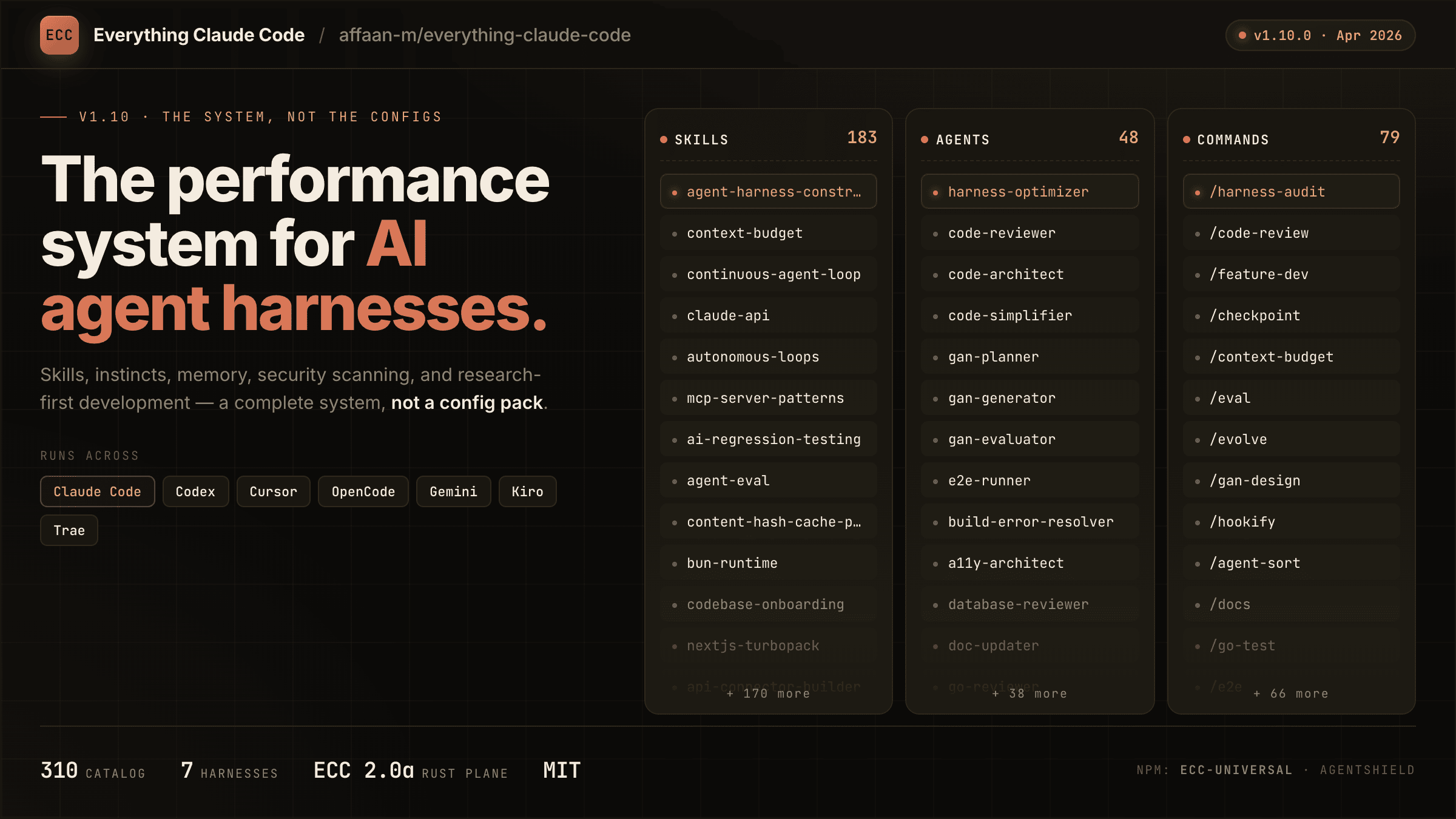
The agent harness performance optimization system. Skills, instincts, memory, security, and research-first development for Claude Code, Codex, Opencode, Cursor and beyond.
There can be more than Notion and Miro. AFFiNE(pronounced [ə‘fain]) is a next-gen knowledge base that brings planning, sorting and creating all together. Privacy first, open-source, customizable and ready to use.
Reverse engineer anything with agents, from app behavior down to native binaries.
🌊 The original agent harness. Deploy intelligent multi-player swarms, coordinate autonomous workflows, and build conversational AI systems. Features adaptive memory, self-learning intelligence, federation, vector RAG integration, and native Claude Code / Codex / Hermes and many more Integrated
The memory & storage database engine for AI agents. Multi-model, edge-to-cloud, PostgreSQL-compatible. Supports graph, vector, array, timeseries.
Source code → structural facts. A purpose-neutral, polyglot code-graph extraction library in Rust powered by tree-sitter. Turns source files into symbols, lexical scopes, and cross-file or FFI edges as plain data. Zero storage opinion.
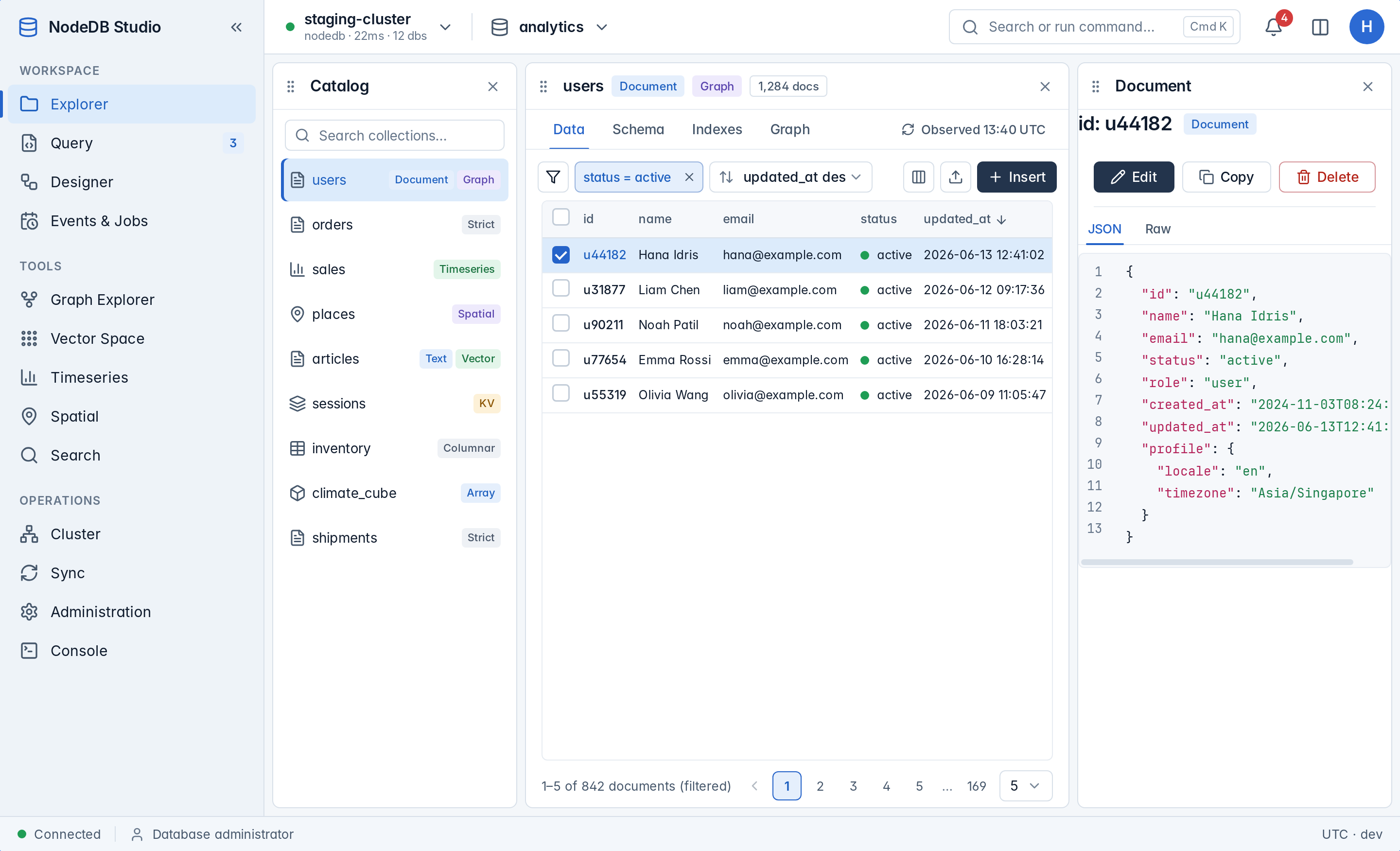
GUI client for NodeDB. Query editor, data browser, and administration.