StringEncrypt-Rust
Rust SDK crate for the StringEncrypt. It allows you to encrypt strings and files using a randomly generated algorithm, generating a unique decryption code (so-called polymorphic code) each time in the selected programming language.
- 3
- Apache-2.0
- 7 mo ago
Repo PELock/StringEncrypt-Rust, read from GitHub 1 min ago. PELock has not joined Take My Repo.
In short
PELock/StringEncrypt-Rust is a public repo on GitHub by PELock. Rust SDK crate for the StringEncrypt. It allows you to encrypt strings and files using a randomly generated algorithm, generating a unique decryption code (so-called polymorphic code) each time in the selected programming language. It declares the Apache-2.0 license on GitHub. It is written mainly in Rust, has 3 stars and last changed on 2026-04-29. Nobody has reviewed it on Take My Repo yet, which says nothing about its quality. Read from GitHub on 2026-11-22.
StringEncrypt — String & File Encryption for Rust Developers
StringEncrypt allows you to encrypt strings and files using a randomly generated algorithm, generating a unique decryption code (so-called polymorphic code) each time in the selected programming language.
Available editions
StringEncrypt can be used:
- Directly on its website - https://www.stringencrypt.com/
- You can download standalone Windows client - https://www.stringencrypt.com/download/
- You can use it via WebAPI interface https://www.stringencrypt.com/api/
- Visual Studio Code extension - https://marketplace.visualstudio.com/items?itemName=PELock.stringencrypt
- VS Code based editors (like Cursor etc.) - https://open-vsx.org/extension/PELock/stringencrypt
Plain text Rust string
let secret = "Rust string encryption";
Rust encryption (UNICODE example)
// encrypted with https://www.stringencrypt.com (v1.5.0) [Rust]
// secret = "Rust string encryption"
let mut ZaoBk: [u16; 23] = [0u16; 23];

ZaoBk[7] = 0x1051; ZaoBk[12] = 0xA2E0; ZaoBk[13] = 0x500D; ZaoBk[1] = 0x92D4;
ZaoBk[18] = 0xEB9E; ZaoBk[9] = 0x4C0C; ZaoBk[0] = 0x946F; ZaoBk[19] = 0x5D14;
ZaoBk[14] = 0x8C80; ZaoBk[22] = 0xCE49; ZaoBk[11] = 0x694D; ZaoBk[5] = 0x83CE;
ZaoBk[20] = 0x37A6; ZaoBk[6] = 0xE77D; ZaoBk[4] = 0x5888; ZaoBk[15] = 0x8741;
ZaoBk[2] = 0x958E; ZaoBk[17] = 0xE60C; ZaoBk[16] = 0xCEB0; ZaoBk[10] = 0xF880;
ZaoBk[3] = 0xF6E5; ZaoBk[8] = 0x81CB; ZaoBk[21] = 0xC00E;

let mut nqUGQ: u16 = 0;
for snfNx in 0..23
{
    nqUGQ = ZaoBk[snfNx];
    for DRCeJ in 0..3
    {
        for VLPwO in 0..2
        {
            nqUGQ = (nqUGQ ^ (((nqUGQ & 0xFFFF).wrapping_shl((8u32) & 15)) & 0xFFFF)) & 0xFFFF;
            nqUGQ = (nqUGQ ^ ((nqUGQ & 0xFFFF).wrapping_shr((14u32) & 15))) & 0xFFFF;
            for ZbJNQ in 0..3
            {
                nqUGQ = (nqUGQ & 0xFFFF).wrapping_add(0xE7FA) & 0xFFFF;
            }
        }
    }
    for xbozp in 0..4
    {
        nqUGQ = ((nqUGQ & 0xFFFF).wrapping_shl((snfNx as u32) % 16u32) | (nqUGQ & 0xFFFF).wrapping_shr((16u32).wrapping_sub((snfNx as u32) % 16u32).wrapping_rem(16u32))) & 0xFFFF;
    }
    for JYDzH in 0..4
    {
        for QaNjY in 0..4
        {
            nqUGQ = (nqUGQ & 0xFFFF).wrapping_sub(1) & 0xFFFF;
            nqUGQ = (nqUGQ ^ 0xDF4F) & 0xFFFF;
        }
        nqUGQ = (nqUGQ ^ ((nqUGQ & 0xFFFF).wrapping_shr((13u32) & 15))) & 0xFFFF;
    }
    nqUGQ = (nqUGQ & 0xFFFF).wrapping_add(0xC1D6) & 0xFFFF;
    for bDPFc in 0..4
    {
        nqUGQ = ((nqUGQ ^ 0xFFFF).wrapping_add(1)) & 0xFFFF;
    }
    for GuCTV in 0..3
    {
        for RNIXt in 0..3
        {
            nqUGQ = (nqUGQ ^ (((nqUGQ & 0xFFFF).wrapping_shl((14u32) & 15)) & 0xFFFF)) & 0xFFFF;
            for ijnWa in 0..4
            {
                nqUGQ = ((nqUGQ & 0xFFFF).wrapping_shr((14u32) % 16u32) | (nqUGQ & 0xFFFF).wrapping_shl((16u32).wrapping_sub((14u32) % 16u32).wrapping_rem(16u32))) & 0xFFFF;
                nqUGQ = ((nqUGQ ^ 0xFFFF).wrapping_add(1)) & 0xFFFF;
                nqUGQ = (nqUGQ ^ 0xFFFF) & 0xFFFF;
            }
            nqUGQ = (nqUGQ & 0xFFFF).wrapping_add(0xF8AA) & 0xFFFF;
        }
        nqUGQ = (nqUGQ & 0xFFFF).wrapping_sub(1) & 0xFFFF;
    }
    nqUGQ = (nqUGQ ^ 0xFFFF) & 0xFFFF;
    nqUGQ = ((nqUGQ & 0xFFFF).wrapping_shl((1u32) % 16u32) | (nqUGQ & 0xFFFF).wrapping_shr((16u32).wrapping_sub((1u32) % 16u32).wrapping_rem(16u32))) & 0xFFFF;
    for LaUbu in 0..4
    {
        for aHhFw in 0..4
        {
            for EqgMf in 0..3
            {
                nqUGQ = (nqUGQ ^ (snfNx as u16)) & 0xFFFF;
            }
            nqUGQ = ((nqUGQ & 0xFFFF).wrapping_shr((snfNx as u32) % 16u32) | (nqUGQ & 0xFFFF).wrapping_shl((16u32).wrapping_sub((snfNx as u32) % 16u32).wrapping_rem(16u32))) & 0xFFFF;
            for bYSgs in 0..2
            {
                nqUGQ = ((nqUGQ ^ 0xFFFF).wrapping_add(1)) & 0xFFFF;
                nqUGQ = (nqUGQ ^ 0x0FD8) & 0xFFFF;
                nqUGQ = (nqUGQ ^ 0xFFFF) & 0xFFFF;
            }
        }
    }
    for dkTWb in 0..4
    {
        nqUGQ = (nqUGQ & 0xFFFF).wrapping_add(1) & 0xFFFF;
    }
    nqUGQ = (nqUGQ & 0xFFFF).wrapping_add(0x02F4) & 0xFFFF;
    for HcirN in 0..2
    {
        for zqcmB in 0..4
        {
            nqUGQ = (nqUGQ ^ 0xBDF6) & 0xFFFF;
            nqUGQ = ((nqUGQ & 0xFFFF).wrapping_shl((4u32) % 16u32) | (nqUGQ & 0xFFFF).wrapping_shr((16u32).wrapping_sub((4u32) % 16u32).wrapping_rem(16u32))) & 0xFFFF;
        }
        for zeBCZ in 0..3
        {
            nqUGQ = (nqUGQ & 0xFFFF).wrapping_add(0x3DF3) & 0xFFFF;
            nqUGQ = (nqUGQ ^ 0xFFFF) & 0xFFFF;
        }
        for XLSda in 0..2
        {
            for oafFd in 0..4
            {
                nqUGQ = ((nqUGQ & 0xFFFF).wrapping_shr((snfNx as u32) % 16u32) | (nqUGQ & 0xFFFF).wrapping_shl((16u32).wrapping_sub((snfNx as u32) % 16u32).wrapping_rem(16u32))) & 0xFFFF;
                nqUGQ = ((nqUGQ & 0xFFFF).wrapping_shl((9u32) % 16u32) | (nqUGQ & 0xFFFF).wrapping_shr((16u32).wrapping_sub((9u32) % 16u32).wrapping_rem(16u32))) & 0xFFFF;
                nqUGQ = ((nqUGQ ^ 0xFFFF).wrapping_add(1)) & 0xFFFF;
            }
        }
    }
    ZaoBk[snfNx] = nqUGQ;
}
let secret = String::from_utf16_lossy(&ZaoBk[..]);

println!("{}", secret);
The problem with plain text strings
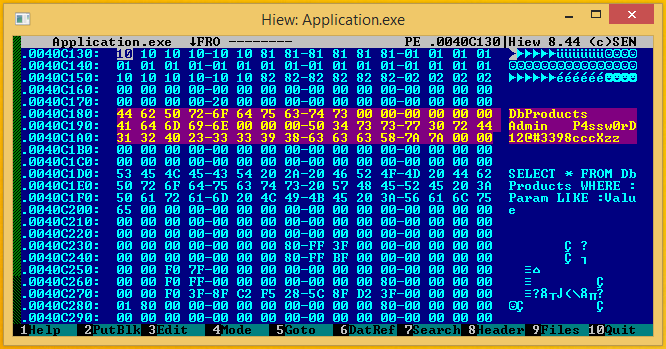
I'm a developer, and I love programming. I'm also an avid reverse engineer. I perform a wide array of software analysis in my daily work and sometimes I find things in compiled applications that shouldn't be exposed to the first person with a simple hex-editor in hand.
What can be found in application binaries?
Everything! I've listed a few examples of the things I found below. Sometimes these things shouldn't even be included in applications at all (they are there due to poor design choices or rushed work), but some are just cannot be avoided.
- API keys
- Database passwords
- FTP passwords
- Login credentials
- Encryption & decryption keys
- Custom code scripts in readable text
- Complex SQL queries in plain text
- Hidden website endpoints
- BitCoin wallets locations
- ...and many more
Ask yourself, did you ever put some sensitive content in your software that you later regret?
Why should I care?
If any of these things were to fall into the wrong hands, they could be used to compromise your software or your infrastructure.
Take for example database passwords. A competitor could use them to view your database structure or dump all of its contents. You don't want to lose all your hard work because someone with a simple hex-editor can discover your password in plain text.
The solution — String Encrypt
I've decided to create a simple service called String Encrypt for developers, offering fast string & file encryption without the need to write custom encryption tools over and over again because I did that many times.
String Encrypt can help you hide the things that shouldn't be visible at first glance to anyone with a hex-editor.
Say hello to polymorphic encryption!
Forget about simple xor encryption! StringEncrypt comes with a unique encryption engine.
It's a polymorphic encryption engine, similar to the encryption methods used by the software protection solutions and advanced computer viruses.
How it works?
Let me explain how the polymorphic encryption process works.
- A random set of encryption commands is selected (
xor,addition,subtraction,bit rotations,bit shifts,logical negationetc.). - A random set of helper
encryption keysis generated. - Every byte of the input string is encrypted with every encryption command in the random set.
- Nested encryption loops are constructed
- The decryption code in the selected programming language is generated with a reverse set of encryption commands.
You can learn more about polymorphic engines from my articles and projects:
- How to build a polymorphic engine in C++ - https://www.pelock.com/articles/polymorphic-encryption-algorithms
- Polymorphic engine in 32-bit MASM assembler - https://github.com/PELock/Simple-Polymorphic-Engine-SPE32
- Poly Polymorphic Engine - https://www.pelock.com/products/poly-polymorphic-engine
What does it mean?
The encrypted content is different every time you apply StringEncrypt encryption to it.
The algorithm is always unique, the encryption keys are always randomly selected and the decryption code is also unique for every time you use our encryption.
StringEncrypt features
- Out of box support for
UNICODE(WideChar type inC/C++languages),UTF-8(multibyte) &ANSI(single byte) strings encodings - Configurable minimum & maximum number of encryption commands
- Different ways to store the encrypted string (as a
globalorlocalvariable if the selected programming language supports it) - Wide array of supported programming languages
- You can automate the encryption process in your builds using our
WebAPIinterface (Rust,JavaScript,PHP, andPythonbindings)
How to use StringEncrypt from Rust code?
Add the crate to your project (published on crates.io):
cargo add stringencrypt
Or in Cargo.toml:
[dependencies]
stringencrypt = "1.0"
Basic string encryption usage example (with default options)
///////////////////////////////////////////////////////////////////////////////
//
// StringEncrypt WebApi interface usage example.
//
// In this example we will encrypt sample string with default options.
//
// Version        : v1.0.0
// Language       : Rust
// Author         : Bartosz Wójcik
// Project page   : https://www.stringencrypt.com
// Web page       : https://www.pelock.com
//
///////////////////////////////////////////////////////////////////////////////

use stringencrypt::{ErrorCode, StringEncrypt};

#[tokio::main]
async fn main() {
    let mut string_encrypt = StringEncrypt::new("YOUR-API-KEY-HERE", false); // leave empty for demo mode

    let result = string_encrypt
        .encrypt_string("Hello!", "$label")
        .await;

    let Some(result) = result else {
        println!("Cannot connect to the API.");
        std::process::exit(1);
    };

    if result.error != Some(ErrorCode::SUCCESS as i64) {
        println!("API error: {:?}", result.error);
        std::process::exit(1);
    }

    println!("{}\n", result.source.unwrap_or_default());
}
Return values:
result.error (Option<i64>)- error coderesult.source (Option<String>)- decryptor source coderesult.expired (Option<bool>)- expiration flagresult.credits_left (Option<i64>)- number of credits leftresult.credits_total (Option<i64>)- initial number of credits
Error codes:
ERROR_SUCCESS (0)- everything went fineERROR_EMPTY_LABEL (1)- label parameter is emptyERROR_LENGTH_LABEL (2)- label length is too longERROR_EMPTY_STRING (3)- input string is emptyERROR_EMPTY_BYTES (4)- input file bytes array is emptyERROR_EMPTY_INPUT (5)- input source (either string or file) is missingERROR_LENGTH_STRING (6)- string length is too longERROR_INVALID_LANG (7)- programming language not supportedERROR_INVALID_LOCALE (8)- language locale is not supportedERROR_CMD_MIN (9)- invalid number of minimum encryption commandsERROR_CMD_MAX (10)- invalid number of maximum encryption commandsERROR_LENGTH_BYTES (11)- bytes/file length is too longERROR_DEMO (100)- you need a valid code to use full version features
Custom string encryption for other programming languages
///////////////////////////////////////////////////////////////////////////////
//
// StringEncrypt WebApi interface usage example.
//
// In this example we will encrypt sample string with default options.
//
// Version        : v1.0.0
// Language       : Rust
// Author         : Bartosz Wójcik
// Project page   : https://www.stringencrypt.com
// Web page       : https://www.pelock.com
//
///////////////////////////////////////////////////////////////////////////////

use stringencrypt::{ErrorCode, Language, NewLine, StringEncrypt};

#[tokio::main]
async fn main() {
    let mut string_encrypt = StringEncrypt::new("YOUR-API-KEY-HERE", false); // leave empty for demo mode
    string_encrypt
        .set_compression(false)
        .set_unicode(true)
        .set_lang_locale("en_US.utf8")
        .set_new_lines(NewLine::LF)
        .set_language(Language::CPP)
        .set_cmd_min(1)
        .set_cmd_max(3)
        .set_local(false);

    let result = string_encrypt
        .encrypt_string("Hello!", "wszLabel")
        .await;

    let Some(result) = result else {
        println!("Cannot connect to the API.");
        std::process::exit(1);
    };

    if result.error != Some(ErrorCode::SUCCESS as i64) {
        println!("API error: {:?}", result.error);
        std::process::exit(1);
    }

    println!("{}\n", result.source.unwrap_or_default());
}
Return values:
result.error (Option<i64>)- error coderesult.source (Option<String>)- decryptor source coderesult.expired (Option<bool>)- expiration flagresult.credits_left (Option<i64>)- number of credits leftresult.credits_total (Option<i64>)- initial number of credits
Error codes:
ERROR_SUCCESS (0)- everything went fineERROR_EMPTY_LABEL (1)- label parameter is emptyERROR_LENGTH_LABEL (2)- label length is too longERROR_EMPTY_STRING (3)- input string is emptyERROR_EMPTY_BYTES (4)- input file bytes array is emptyERROR_EMPTY_INPUT (5)- input source (either string or file) is missingERROR_LENGTH_STRING (6)- string length is too longERROR_INVALID_LANG (7)- programming language not supportedERROR_INVALID_LOCALE (8)- language locale is not supportedERROR_CMD_MIN (9)- invalid number of minimum encryption commandsERROR_CMD_MAX (10)- invalid number of maximum encryption commandsERROR_LENGTH_BYTES (11)- bytes/file length is too longERROR_DEMO (100)- you need a valid code to use full version features
Encrypt binary file content
///////////////////////////////////////////////////////////////////////////////
//
// StringEncrypt WebApi interface usage example.
//
// In this example we will encrypt sample file with default options.
//
// Version        : v1.0.0
// Language       : Rust
// Author         : Bartosz Wójcik
// Project page   : https://www.stringencrypt.com
// Web page       : https://www.pelock.com
//
///////////////////////////////////////////////////////////////////////////////

use std::path::PathBuf;

use stringencrypt::{ErrorCode, Language, NewLine, StringEncrypt};

#[tokio::main]
async fn main() {
    let mut string_encrypt = StringEncrypt::new("YOUR-API-KEY-HERE", false); // leave empty for demo mode
    string_encrypt
        .set_compression(false)
        .set_unicode(true)
        .set_lang_locale("en_US.utf8")
        .set_new_lines(NewLine::LF)
        .set_ansi_encoding("WINDOWS-1250")
        .set_language(Language::PHP)
        .set_cmd_min(1)
        .set_cmd_max(3)
        .set_local(false);

    let mut path = PathBuf::from(env!("CARGO_MANIFEST_DIR"));
    path.push("examples");
    path.push("sample.bin");

    // Full license: raw bytes from file (demo may return ERROR_DEMO).
    let result = string_encrypt
        .encrypt_file_contents(&path, "$label")
        .await;

    let Some(result) = result else {
        println!("Cannot connect to the API or file is missing/empty.");
        std::process::exit(1);
    };

    if result.error != Some(ErrorCode::SUCCESS as i64) {
        println!("API error: {:?}", result.error);
        std::process::exit(1);
    }

    println!("{}\n", result.source.unwrap_or_default());
}
Return values:
result.error (Option<i64>)- error coderesult.source (Option<String>)- decryptor source coderesult.expired (Option<bool>)- expiration flagresult.credits_left (Option<i64>)- number of credits leftresult.credits_total (Option<i64>)- initial number of credits
Error codes:
ERROR_SUCCESS (0)- everything went fineERROR_EMPTY_LABEL (1)- label parameter is emptyERROR_LENGTH_LABEL (2)- label length is too longERROR_EMPTY_STRING (3)- input string is emptyERROR_EMPTY_BYTES (4)- input file bytes array is emptyERROR_EMPTY_INPUT (5)- input source (either string or file) is missingERROR_LENGTH_STRING (6)- string length is too longERROR_INVALID_LANG (7)- programming language not supportedERROR_INVALID_LOCALE (8)- language locale is not supportedERROR_CMD_MIN (9)- invalid number of minimum encryption commandsERROR_CMD_MAX (10)- invalid number of maximum encryption commandsERROR_LENGTH_BYTES (11)- bytes/file length is too longERROR_DEMO (100)- you need a valid code to use full version features
Check the status of the activation code and show current limitations
This example shows how to get information about the current activation code and its features.
///////////////////////////////////////////////////////////////////////////////
//
// StringEncrypt WebApi interface usage example.
//
// In this example we will verify our activation code status.
//
// Version        : v1.0.0
// Language       : Rust
// Author         : Bartosz Wójcik
// Project page   : https://www.stringencrypt.com
// Web page       : https://www.pelock.com
//
///////////////////////////////////////////////////////////////////////////////

use stringencrypt::StringEncrypt;

#[tokio::main]
async fn main() {
    let mut string_encrypt = StringEncrypt::new("", false);

    let result = string_encrypt.is_demo().await;

    let Some(result) = result else {
        println!("Cannot connect to the API.");
        std::process::exit(1);
    };

    if result.demo.unwrap_or(false) {
        println!("DEMO mode");
    } else {
        println!("FULL mode");
        println!("Credits left: {}", result.credits_left.unwrap_or(0));
    }

    println!("Label max length: {}", result.label_limit.unwrap_or(0));
    println!("String max length: {}", result.string_limit.unwrap_or(0));
    println!("Bytes max length: {}", result.bytes_limit.unwrap_or(0));
    println!(
        "cmd_min / cmd_max: {} / {}",
        result.cmd_min.unwrap_or(0),
        result.cmd_max.unwrap_or(0)
    );
}
Return values:
result.demo (Option<bool>)- demo mode flagresult.label_limit (Option<i64>)- label limit lengthresult.string_limit (Option<i64>)- string/file limit lengthresult.credits_left (Option<i64>)- number of credits leftresult.credits_total (Option<i64>)- initial number of creditsresult.cmd_min (Option<i64>)- minimum number of encryption commandsresult.cmd_max (Option<i64>)- maximum number of encryption commands
Supported programming languages
StringEncrypt engine supports code generation for the following programming languages:
- C & C++
- C# (C Sharp for .NET)
- Visual Basic .NET (VB.NET)
- Delphi / Pascal
- Java
- Kotlin
- JavaScript
- Python
- PHP
- Ruby
- Dart
- Go
- Rust
- Swift
- Lua
- Objective-C
- AutoIt
- PowerShell
- Haskell
- MASM assembler
- FASM assembler
- NASM assembler
Some examples of generated source code for supported programming languages (with display / run example enabled, matching the full client include example option):
C/C++ encryption (UNICODE example)
// encrypted with https://www.stringencrypt.com (v1.5.0) [C/C++]
#include <cstdio>
#include <cwchar>
// wszLabel = "C/C++ String Encryption"
wchar_t wszLabel[24];

wszLabel[20] = 0xEDD6; wszLabel[22] = 0xA64D; wszLabel[3] = 0x733C; wszLabel[19] = 0x96B6;
wszLabel[12] = 0xBCA7; wszLabel[6] = 0xDBD5; wszLabel[18] = 0x8D05; wszLabel[1] = 0xD61B;
wszLabel[9] = 0x16AC; wszLabel[13] = 0xCA4A; wszLabel[16] = 0xAB02; wszLabel[8] = 0xB392;
wszLabel[21] = 0xE785; wszLabel[10] = 0x18AB; wszLabel[14] = 0x2AF8; wszLabel[23] = 0x7099;
wszLabel[5] = 0xAF1B; wszLabel[15] = 0xFC72; wszLabel[7] = 0x05AE; wszLabel[0] = 0x9BF3;
wszLabel[2] = 0x14D8; wszLabel[4] = 0xD30F; wszLabel[11] = 0xEDE7; wszLabel[17] = 0x1158;

for (volatile unsigned int iZASt = 0, tmLMB = 0; iZASt < 24; iZASt++)
{
	tmLMB = wszLabel[iZASt];
	for (unsigned int sfIcm = 0; sfIcm < 2; sfIcm++)
	{
		for (unsigned int MUhVa = 0; MUhVa < 3; MUhVa++)
		{
			tmLMB = (tmLMB ^ (((tmLMB & 0xFFFF) << 15) & 0xFFFF)) & 0xFFFF;
			tmLMB = (((tmLMB & 0xFFFF) << (iZASt % 16)) | ((tmLMB & 0xFFFF) >> (16 - (iZASt % 16)))) & 0xFFFF;
		}
	}
	tmLMB = (tmLMB ^ 0x2BFD) & 0xFFFF;
	tmLMB = (((tmLMB & 0xFFFF) >> 8) | ((tmLMB & 0xFFFF) << 8)) & 0xFFFF;
	for (unsigned int qiTBF = 0; qiTBF < 2; qiTBF++)
	{
		tmLMB = ((tmLMB & 0xFFFF) - iZASt) & 0xFFFF;
		tmLMB = (((tmLMB & 0xFFFF) >> 8) | ((tmLMB & 0xFFFF) << 8)) & 0xFFFF;
	}
	tmLMB = ((tmLMB & 0xFFFF) - 0x51B1) & 0xFFFF;
	tmLMB = (((tmLMB & 0xFFFF) >> 8) | ((tmLMB & 0xFFFF) << 8)) & 0xFFFF;
	tmLMB = ((tmLMB ^ 0xFFFF) & 0xFFFF);
	tmLMB = ((tmLMB & 0xFFFF) + iZASt) & 0xFFFF;
	for (unsigned int HOCjn = 0; HOCjn < 4; HOCjn++)
	{
		tmLMB = (((tmLMB & 0xFFFF) >> 8) | ((tmLMB & 0xFFFF) << 8)) & 0xFFFF;
		tmLMB = ((tmLMB & 0xFFFF) - iZASt) & 0xFFFF;
		for (unsigned int JpQxh = 0; JpQxh < 2; JpQxh++)
		{
			tmLMB = (((tmLMB & 0xFFFF) >> 12) | ((tmLMB & 0xFFFF) << 4)) & 0xFFFF;
		}
	}
	wszLabel[iZASt] = tmLMB;
}

fputws(wszLabel, stdout);
fputwc(L'\n', stdout);
C# Sharp encryption (UNICODE example)
// encrypted with https://www.stringencrypt.com (v1.5.0) [C#]
// superSecretString = "Easy encryption in C#"
String superSecretString = "\uA1A2\uE379\uB64C\u7816\u238A\uD7E4\u0CFA\uD465" +
                           "\u7CE4\uA305\u2C46\uD27B\u533A\u6F43\u91A5\u3B36" +
                           "\u181E\uC1B8\uA827\uC1FC\u9073";

for (int ugcqt = 0, TSGdn = 0; ugcqt < 21; ugcqt++)
{
	TSGdn = superSecretString[ugcqt];
	TSGdn = (((TSGdn & 0xFFFF) << (ugcqt % 16)) | ((TSGdn & 0xFFFF) >> (16 - (ugcqt % 16)))) & 0xFFFF;
	TSGdn = (TSGdn ^ ugcqt) & 0xFFFF;
	for (int IjFDX = 0; IjFDX < 3; IjFDX++)
	{
		for (int scVKQ = 0; scVKQ < 2; scVKQ++)
		{
			TSGdn = (TSGdn ^ (((TSGdn & 0xFFFF) << 9) & 0xFFFF)) & 0xFFFF;
			for (int tKeJi = 0; tKeJi < 4; tKeJi++)
			{
				TSGdn = (((TSGdn & 0xFFFF) << (ugcqt % 16)) | ((TSGdn & 0xFFFF) >> (16 - (ugcqt % 16)))) & 0xFFFF;
				TSGdn = ((TSGdn & 0xFFFF) - 0x7198) & 0xFFFF;
				TSGdn = (TSGdn ^ 0xFFFF) & 0xFFFF;
			}
			TSGdn = (((TSGdn & 0xFFFF) << 6) | ((TSGdn & 0xFFFF) >> 10)) & 0xFFFF;
		}
		TSGdn = ((TSGdn & 0xFFFF) + 1) & 0xFFFF;
		for (int Hmtef = 0; Hmtef < 3; Hmtef++)
		{
			for (int CEwoz = 0; CEwoz < 2; CEwoz++)
			{
				TSGdn = (TSGdn ^ (((TSGdn & 0xFFFF) << 11) & 0xFFFF)) & 0xFFFF;
			}
		}
	}
	for (int OomDf = 0; OomDf < 3; OomDf++)
	{
		for (int WCOqH = 0; WCOqH < 4; WCOqH++)
		{
			TSGdn = (((TSGdn & 0xFFFF) >> 1) | ((TSGdn & 0xFFFF) << 15)) & 0xFFFF;
		}
		for (int ikutC = 0; ikutC < 2; ikutC++)
		{
			for (int HJjpq = 0; HJjpq < 2; HJjpq++)
			{
				TSGdn = (TSGdn ^ 0x5539) & 0xFFFF;
			}
			for (int FKCPT = 0; FKCPT < 3; FKCPT++)
			{
				TSGdn = (TSGdn ^ 0xFFFF) & 0xFFFF;
				TSGdn = ((TSGdn & 0xFFFF) + 0xC1C1) & 0xFFFF;
			}
			TSGdn = (TSGdn ^ (((TSGdn & 0xFFFF) << 10) & 0xFFFF)) & 0xFFFF;
		}
	}
	TSGdn = ((TSGdn & 0xFFFF) - ugcqt) & 0xFFFF;
	TSGdn = ((TSGdn & 0xFFFF) + 1) & 0xFFFF;
	TSGdn = ((TSGdn & 0xFFFF) + 0x6B27) & 0xFFFF;
	for (int knhQm = 0; knhQm < 2; knhQm++)
	{
		for (int dxIem = 0; dxIem < 4; dxIem++)
		{
			for (int LvAum = 0; LvAum < 3; LvAum++)
			{
				TSGdn = (((TSGdn & 0xFFFF) >> 2) | ((TSGdn & 0xFFFF) << 14)) & 0xFFFF;
				TSGdn = (((~(TSGdn & 0xFFFF)) & 0xFFFF) + 1) & 0xFFFF;
				TSGdn = (((TSGdn & 0xFFFF) << (ugcqt % 16)) | ((TSGdn & 0xFFFF) >> (16 - (ugcqt % 16)))) & 0xFFFF;
			}
		}
		TSGdn = ((TSGdn & 0xFFFF) - 1) & 0xFFFF;
		TSGdn = (TSGdn ^ ugcqt) & 0xFFFF;
	}
	TSGdn = (TSGdn ^ 0xEDF3) & 0xFFFF;
	TSGdn = (((TSGdn & 0xFFFF) >> (ugcqt % 16)) | ((TSGdn & 0xFFFF) << (16 - (ugcqt % 16)))) & 0xFFFF;
	TSGdn = (((~(TSGdn & 0xFFFF)) & 0xFFFF) + 1) & 0xFFFF;
	for (int tJDYH = 0; tJDYH < 2; tJDYH++)
	{
		for (int jqFXP = 0; jqFXP < 4; jqFXP++)
		{
			TSGdn = (((TSGdn & 0xFFFF) >> (ugcqt % 16)) | ((TSGdn & 0xFFFF) << (16 - (ugcqt % 16)))) & 0xFFFF;
			TSGdn = (((TSGdn & 0xFFFF) << 3) | ((TSGdn & 0xFFFF) >> 13)) & 0xFFFF;
			TSGdn = ((TSGdn & 0xFFFF) - 0x4E43) & 0xFFFF;
		}
	}
	superSecretString = superSecretString.Substring(0, ugcqt) + (char)(TSGdn & 0xFFFF) + superSecretString.Substring(ugcqt + 1);
}

MessageBox.Show(superSecretString);
Visual Basic .NET encryption (UNICODE example)
' encrypted with https://www.stringencrypt.com (v1.5.0) [Visual Basic .NET]
' vbSecret = "Option Strict On in VB.NET"
Dim HudbE() As Integer = { &H6606, &H39FF, &H14BC, &HFFD1, &HF714, &HF242, &H6EBC, &H2E90,
                           &H2E4B, &H8DF2, &H9DD0, &H85C4, &HC1C3, &H37DD, &HD0D9, &H1C50,
                           &H3716, &H372F, &H13AC, &HF731, &HF5EC, &HF172, &H6F64, &H2F1B,
                           &HEE8D, &HAE75 }
Dim vbSecret As String
Dim XidVf As Integer
Dim oqtRy As Integer
Dim SKjiG As Integer
Dim QhyUd As Integer
Dim YHFWS As Integer
Dim EVNCa As Integer

Dim eRLNZ As Integer
For eRLNZ = 0 To 25
  XidVf = HudbE(eRLNZ)
  XidVf = (XidVf Xor eRLNZ) And &HFFFF
  XidVf = ((XidVf And &HFFFF) + 1) And &HFFFF
  For oqtRy = 0 To 1
    For SKjiG = 0 To 3
      XidVf = ((XidVf And &HFFFF) - eRLNZ) And &HFFFF
    Next
    XidVf = ((XidVf And &HFFFF) - &HF6B4) And &HFFFF
  Next
  XidVf = ((XidVf And &HFFFF) + 1) And &HFFFF
  XidVf = (((XidVf And &HFFFF) << (eRLNZ Mod 16)) Or ((XidVf And &HFFFF) >> (16 - (eRLNZ Mod 16)))) And &HFFFF
  For QhyUd = 0 To 3
    For YHFWS = 0 To 2
      XidVf = ((XidVf And &HFFFF) - 1) And &HFFFF
    Next
    XidVf = ((XidVf And &HFFFF) - &H4A45) And &HFFFF
    XidVf = (XidVf Xor eRLNZ) And &HFFFF
  Next
  XidVf = (((XidVf And &HFFFF) >> 8) Or ((XidVf And &HFFFF) << 8)) And &HFFFF
  XidVf = (XidVf Xor (((XidVf And &HFFFF) << 15) And &HFFFF)) And &HFFFF
  For EVNCa = 0 To 3
    XidVf = (XidVf Xor eRLNZ) And &HFFFF
    XidVf = (((XidVf And &HFFFF) >> 8) Or ((XidVf And &HFFFF) << 8)) And &HFFFF
  Next
  vbSecret = vbSecret + ChrW(XidVf And &HFFFF)
Next eRLNZ

MessageBox.Show(vbSecret)
Delphi & Pascal encryption (UNICODE example)
// encrypted with https://www.stringencrypt.com (v1.5.0) [Delphi / Pascal]
var
  // mySecret = "Delphi is awesome!"
  mySecret: array[0..19] of WideChar;
  HFisk: Integer;
  ZnzLM: Integer;
  XMlUh: Integer;
  pSdQr: Integer;
  clrza: Integer;
  GPvNR: Integer;
  lFOKB: Integer;

begin

  mySecret[6] := WideChar($EF77); mySecret[15] := WideChar($766A);
  mySecret[5] := WideChar($4E77); mySecret[1] := WideChar($F277);
  mySecret[2] := WideChar($3B77); mySecret[17] := WideChar($FE72);
  mySecret[14] := WideChar($7268); mySecret[9] := WideChar($9362);
  mySecret[0] := WideChar($EB77); mySecret[3] := WideChar($4B77);
  mySecret[13] := WideChar($E06A); mySecret[16] := WideChar($0A75);
  mySecret[11] := WideChar($5462); mySecret[4] := WideChar($AF74);
  mySecret[7] := WideChar($2A77); mySecret[10] := WideChar($F060);
  mySecret[8] := WideChar($FA64); mySecret[18] := WideChar($5F70);
  mySecret[12] := WideChar($4464);

  for lFOKB := 0 to 19 do
  begin
    HFisk := Ord(mySecret[lFOKB]);
    HFisk := (HFisk xor $FFFF) and $FFFF;
    HFisk := (HFisk xor lFOKB) and $FFFF;
    HFisk := ((HFisk and $FFFF) - $0124) and $FFFF;
    HFisk := ((HFisk and $FFFF) - lFOKB) and $FFFF;
    HFisk := (((HFisk and $FFFF) shr 8) or ((HFisk and $FFFF) shl 8)) and $FFFF;
    HFisk := (HFisk xor $168C) and $FFFF;
    HFisk := (((HFisk and $FFFF) shr 8) or ((HFisk and $FFFF) shl 8)) and $FFFF;
    HFisk := (((HFisk and $FFFF) xor $FFFF) + 1) and $FFFF;
    HFisk := (((HFisk and $FFFF) shr 8) or ((HFisk and $FFFF) shl 8)) and $FFFF;
    HFisk := (HFisk xor $FFFF) and $FFFF;
    for ZnzLM := 0 to 3 do
    begin
      HFisk := ((HFisk and $FFFF) + lFOKB) and $FFFF;
      for XMlUh := 0 to 2 do
      begin
        HFisk := (HFisk xor lFOKB) and $FFFF;
        HFisk := ((HFisk and $FFFF) + lFOKB) and $FFFF;
        HFisk := (HFisk xor ((HFisk and $FFFF) shr 10)) and $FFFF;
      end;
    end;
    HFisk := (HFisk xor $71DB) and $FFFF;
    HFisk := (HFisk xor ((HFisk and $FFFF) shr 8)) and $FFFF;
    for pSdQr := 0 to 2 do
    begin
      for clrza := 0 to 2 do
      begin
        HFisk := ((HFisk and $FFFF) - lFOKB) and $FFFF;
      end;
      HFisk := (HFisk xor $FFFF) and $FFFF;
      for GPvNR := 0 to 2 do
      begin
        HFisk := (HFisk xor lFOKB) and $FFFF;
        HFisk := (HFisk xor $FFFF) and $FFFF;
      end;
    end;
    mySecret[lFOKB] := WideChar(HFisk);
  end;

  ShowMessage(mySecret);
Java encryption (UNICODE example)
// encrypted with https://www.stringencrypt.com (v1.5.0) [Java]
// myJavaPassword = "Very secret password! QWERTY"
String myJavaPassword = "";

int LcnEg[] = { 0x8DEC, 0x1C11, 0x38B7, 0x7266, 0xE77C, 0xD369, 0xA92B, 0x6FC7,
                0xF70E, 0x331E, 0xEC3C, 0xF379, 0x0CF7, 0x51F2, 0x9BEC, 0x47EA,
                0x3008, 0xA052, 0x411F, 0x834F, 0x09B7, 0x16F6, 0x36CC, 0x7088,
                0x1D71, 0x75E2, 0x6445, 0x9E8B };

for (int syzDT = 0, ZAfcE = 0; syzDT < 28; syzDT++)
{
	ZAfcE = LcnEg[syzDT];
	ZAfcE = (((ZAfcE & 0xFFFF) >>> 13) | ((ZAfcE & 0xFFFF) << 3)) & 0xFFFF;
	ZAfcE = (((ZAfcE & 0xFFFF) >>> (syzDT % 16)) | ((ZAfcE & 0xFFFF) << (16 - (syzDT % 16)))) & 0xFFFF;
	ZAfcE = (((~(ZAfcE & 0xFFFF)) & 0xFFFF) + 1) & 0xFFFF;
	ZAfcE = (((ZAfcE & 0xFFFF) >>> 8) | ((ZAfcE & 0xFFFF) << 8)) & 0xFFFF;
	for (int gyKZB = 0; gyKZB < 3; gyKZB++)
	{
		ZAfcE = ((ZAfcE & 0xFFFF) - 0xAE0D) & 0xFFFF;
	}
	ZAfcE = ((ZAfcE & 0xFFFF) + syzDT) & 0xFFFF;
	for (int KnuGq = 0; KnuGq < 4; KnuGq++)
	{
		for (int kbnLT = 0; kbnLT < 4; kbnLT++)
		{
			ZAfcE = (((ZAfcE & 0xFFFF) >>> 8) | ((ZAfcE & 0xFFFF) << 8)) & 0xFFFF;
		}
		ZAfcE = (ZAfcE ^ syzDT) & 0xFFFF;
	}
	ZAfcE = (((ZAfcE & 0xFFFF) >>> 8) | ((ZAfcE & 0xFFFF) << 8)) & 0xFFFF;
	for (int oVJfW = 0; oVJfW < 3; oVJfW++)
	{
		ZAfcE = (ZAfcE ^ 0xC49D) & 0xFFFF;
		for (int LzJBK = 0; LzJBK < 2; LzJBK++)
		{
			ZAfcE = ((ZAfcE & 0xFFFF) - 1) & 0xFFFF;
		}
	}
	for (int JKcZp = 0; JKcZp < 2; JKcZp++)
	{
		ZAfcE = (ZAfcE ^ syzDT) & 0xFFFF;
		for (int kvRTO = 0; kvRTO < 2; kvRTO++)
		{
			for (int uFglb = 0; uFglb < 2; uFglb++)
			{
				ZAfcE = (((ZAfcE & 0xFFFF) << 7) | ((ZAfcE & 0xFFFF) >>> 9)) & 0xFFFF;
			}
			ZAfcE = (ZAfcE ^ 0xFFFF) & 0xFFFF;
		}
	}
	ZAfcE = ((ZAfcE & 0xFFFF) + 0x4453) & 0xFFFF;
	ZAfcE = (((ZAfcE & 0xFFFF) >>> 8) | ((ZAfcE & 0xFFFF) << 8)) & 0xFFFF;
	myJavaPassword = myJavaPassword + (char)(ZAfcE & 0xFFFF);
}

System.out.println(myJavaPassword);
Encrypted string in JavaScript (UNICODE) source code format
<script type="text/javascript">
// encrypted with https://www.stringencrypt.com (v1.5.0) [JavaScript]
// hiddenJavaScriptString = "How to encrypt strings in JavaScript? That\'s how!"
var hiddenJavaScriptString = "\u98EC\u8931\u84BF\u08CA\uA678\u97CB\uBD14\u3A9B" +
                             "\u3BD4\uD21D\uAA4B\u9A60\u9A11\uBF64\u99DB\u549D" +
                             "\u5BD7\u034C\uD869\uA2A6\uAA7F\u97AF\u7D26\uBEFD" +
                             "\u4865\u1981\u9F3A\u9254\u36C7\u3F07\uD9A5\uA14C" +
                             "\u50E2\uF715\u1CA3\uE7DF\u18B2\uCEC8\uB697\u5BCE" +
                             "\u55F5\uB391\u232E\u82D0\u12BD\uB78E\uB1E9\uBF57" +
                             "\uF0FB";

for (var rAQLB = 0, JyFfr = 0; rAQLB < 49; rAQLB++)
{
	JyFfr = hiddenJavaScriptString.charCodeAt(rAQLB);
	JyFfr = (JyFfr ^ (((JyFfr & 0xFFFF) << 15) & 0xFFFF)) & 0xFFFF;
	JyFfr = ((JyFfr & 0xFFFF) + rAQLB) & 0xFFFF;
	for (var ZvqmG = 0; ZvqmG < 2; ZvqmG++)
	{
		JyFfr = (JyFfr ^ 0x702B) & 0xFFFF;
		for (var VbsGy = 0; VbsGy < 3; VbsGy++)
		{
			for (var ToslH = 0; ToslH < 4; ToslH++)
			{
				JyFfr = (((JyFfr & 0xFFFF) << 8) | ((JyFfr & 0xFFFF) >>> 8)) & 0xFFFF;
				JyFfr = (((JyFfr & 0xFFFF) >>> (rAQLB % 16)) | ((JyFfr & 0xFFFF) << (16 - (rAQLB % 16)))) & 0xFFFF;
			}
			for (var oreEi = 0; oreEi < 3; oreEi++)
			{
				JyFfr = ((JyFfr & 0xFFFF) - 0x804C) & 0xFFFF;
				JyFfr = (((~(JyFfr & 0xFFFF)) & 0xFFFF) + 1) & 0xFFFF;
				JyFfr = ((JyFfr & 0xFFFF) - 0xDECB) & 0xFFFF;
			}
			JyFfr = ((JyFfr & 0xFFFF) + 0xF170) & 0xFFFF;
		}
		for (var viVTW = 0; viVTW < 2; viVTW++)
		{
			for (var eUMlC = 0; eUMlC < 2; eUMlC++)
			{
				JyFfr = (JyFfr ^ rAQLB) & 0xFFFF;
			}
			for (var bZrxF = 0; bZrxF < 3; bZrxF++)
			{
				JyFfr = (((JyFfr & 0xFFFF) << (rAQLB % 16)) | ((JyFfr & 0xFFFF) >>> (16 - (rAQLB % 16)))) & 0xFFFF;
				JyFfr = (JyFfr ^ (((JyFfr & 0xFFFF) << 11) & 0xFFFF)) & 0xFFFF;
			}
			JyFfr = (((JyFfr & 0xFFFF) << 9) | ((JyFfr & 0xFFFF) >>> 7)) & 0xFFFF;
		}
	}
	JyFfr = (((JyFfr & 0xFFFF) >>> 8) | ((JyFfr & 0xFFFF) << 8)) & 0xFFFF;
	JyFfr = (((JyFfr & 0xFFFF) << 1) | ((JyFfr & 0xFFFF) >>> 15)) & 0xFFFF;
	for (var nzOko = 0; nzOko < 4; nzOko++)
	{
		JyFfr = (((JyFfr & 0xFFFF) >>> (rAQLB % 16)) | ((JyFfr & 0xFFFF) << (16 - (rAQLB % 16)))) & 0xFFFF;
	}
	JyFfr = (JyFfr ^ 0xFFFF) & 0xFFFF;
	JyFfr = (((JyFfr & 0xFFFF) << (rAQLB % 16)) | ((JyFfr & 0xFFFF) >>> (16 - (rAQLB % 16)))) & 0xFFFF;
	JyFfr = ((JyFfr & 0xFFFF) + 0xCB9C) & 0xFFFF;
	JyFfr = ((JyFfr & 0xFFFF) - rAQLB) & 0xFFFF;
	for (var xiFsy = 0; xiFsy < 3; xiFsy++)
	{
		for (var JPxQM = 0; JPxQM < 3; JPxQM++)
		{
			JyFfr = (((JyFfr & 0xFFFF) << 10) | ((JyFfr & 0xFFFF) >>> 6)) & 0xFFFF;
		}
	}
	JyFfr = ((JyFfr & 0xFFFF) + rAQLB) & 0xFFFF;
	for (var DBPwg = 0; DBPwg < 4; DBPwg++)
	{
		JyFfr = (((JyFfr & 0xFFFF) << 14) | ((JyFfr & 0xFFFF) >>> 2)) & 0xFFFF;
	}
	hiddenJavaScriptString = hiddenJavaScriptString.substr(0, rAQLB) + String.fromCharCode(JyFfr & 0xFFFF) + hiddenJavaScriptString.substr(rAQLB + 1);
}

alert(hiddenJavaScriptString);

</script>
Kotlin encryption (UNICODE example)
// encrypted with https://www.stringencrypt.com (v1.5.0) [Kotlin]
// kotlinSecret = "Kotlin on the JVM"
var kotlinSecret: String = ""

val MapNJ: IntArray = intArrayOf( 0x4B2E, 0x0223, 0xC7ED, 0x4032, 0x96E3, 0x7865, 0x23EB, 0x599C,
                                  0xC383, 0x264E, 0x5F09, 0x7EFE, 0xA113, 0xA2A3, 0x00E5, 0x780D,
                                  0x8E55 )

var Qtqma: Int = 0
for (LZjJi in 0 until 17)
{
	Qtqma = MapNJ[LZjJi]
	Qtqma = ((Qtqma and 0xFFFF) + 0xA521) and 0xFFFF
	Qtqma = (Qtqma xor (((Qtqma and 0xFFFF) shl 10) and 0xFFFF)) and 0xFFFF
	for (rZUBD in 0 until 4)
	{
		for (ZXqdA in 0 until 2)
		{
			Qtqma = (((Qtqma and 0xFFFF) shr (LZjJi % 16)) or ((Qtqma and 0xFFFF) shl (16 - (LZjJi % 16)))) and 0xFFFF
			for (vxUnf in 0 until 4)
			{
				Qtqma = ((Qtqma and 0xFFFF) + 0x0CA9) and 0xFFFF
				Qtqma = ((Qtqma and
Questions
What is StringEncrypt-Rust?
PELock/StringEncrypt-Rust is a public repo on GitHub by PELock. Rust SDK crate for the StringEncrypt. It allows you to encrypt strings and files using a randomly generated algorithm, generating a unique decryption code (so-called polymorphic code) each time in the selected programming language.
Is StringEncrypt-Rust open source?
It declares the Apache-2.0 license on GitHub.
Does StringEncrypt-Rust run on macOS, Windows or Linux?
Its maker tagged it for Windows. That is declared by the maker; Take My Repo has not tested it.
How do I install StringEncrypt-Rust?
Open "Take it" on its page: Take My Repo writes an install plan for your machine and hands it to your AI agent (Claude Code, Codex or Cursor), which asks you before each step. Take My Repo has not tested it on any machine.
Is StringEncrypt-Rust still maintained?
Its last change on GitHub was on 2026-04-29. GitHub counts 0 open issues and pull requests. Take My Repo does not judge from that whether it is maintained.