framework-benchmarks
Reproducible application framework benchmarks under realistic resource constraints
- 1
- 48 min ago
Repo PVRLabs/framework-benchmarks, read from GitHub 11 min ago. PVRLabs has not joined Take My Repo.
In short
PVRLabs/framework-benchmarks is a public repo on GitHub by PVRLabs. Reproducible application framework benchmarks under realistic resource constraints. It declares no license on GitHub. Public does not mean open source: without a license, nobody is granted the right to reuse it. It is written mainly in Python, has 1 stars and last changed on 2026-11-24. Nobody has reviewed it on Take My Repo yet, which says nothing about its quality. Read from GitHub on 2026-11-24.

Framework Benchmarks
Framework Benchmarks is an extensible, cross-language project for comparing application frameworks under realistic resource constraints. It measures readiness, memory consumption, throughput, and latency with equivalent applications, shared workloads, and documented environments. Correctness checks establish comparable behavior before measurement.
Initial v1 candidates
The implementations use Jex + CoilBase + Jdbi + HikariCP, Quarkus REST + CoilBase + Jdbi + Agroal, Spring Boot + Spring JDBC + HikariCP, and Micronaut HTTP + Micronaut Data JDBC + HikariCP. CoilBase provides application structure and persistence integration for Jex and Quarkus. The benchmark maintainer is also the CoilBase author. The measurements describe complete application stacks and do not isolate framework overhead.
Market Replay Portfolio simulates an investment portfolio service with portfolio reads and updates, valuations, and periodic market price ingestion. These operations exercise HTTP, database access, transactions, and background processing.
All four use the same PostgreSQL schema, correctness contract, and public synthetic replay. The featured results below use the accepted Debian 13 suite. See the v1 suite guide.
Featured benchmark — v1
The accepted comparison ran two rounds on a Debian 13 QEMU/KVM guest on an
AMD Ryzen 7 4700U Linux host. The guest had 1 vCPU, 512 MiB RAM and no swap.
Each application shared the guest with PostgreSQL 18.7
(18.7-1.pgdg13+5). Both rounds used HotSpot 27 (build 27+35-2325).
Measurement evidence was written to ext4. All eight runs sustained 40 RPS
with zero workload errors, timeouts, unsent requests or OOM kills.
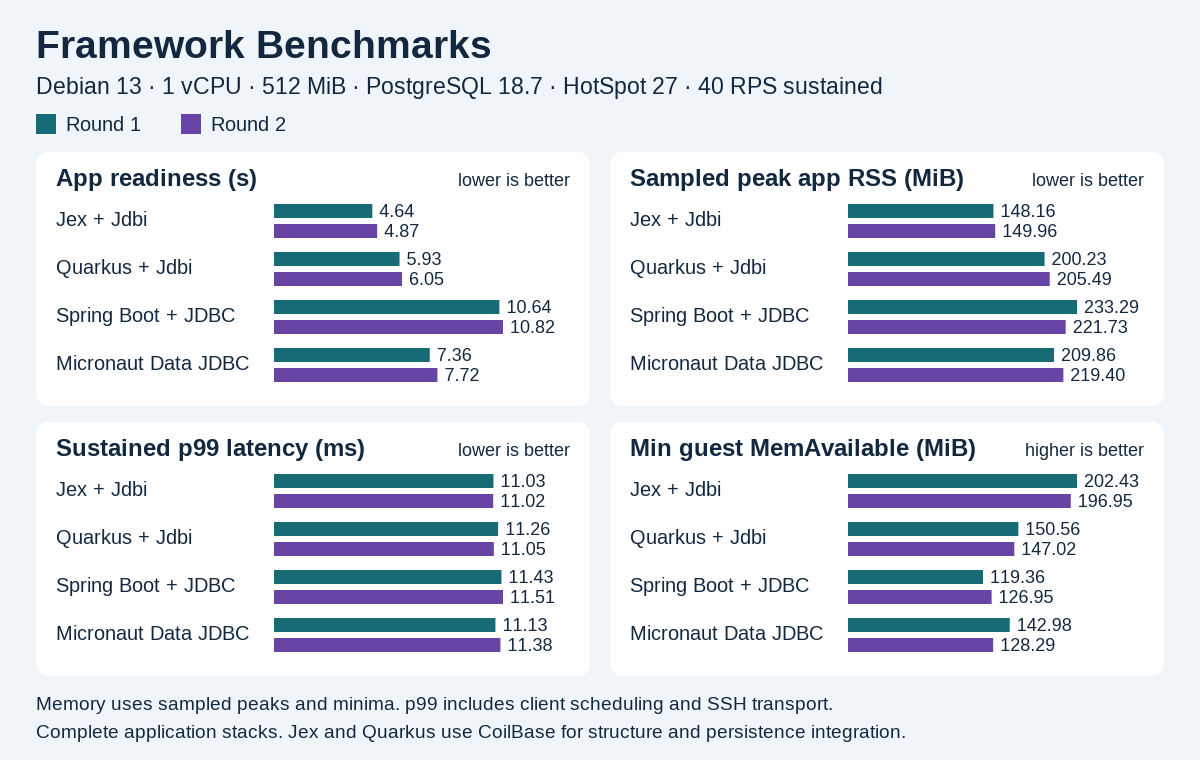
| Stack | Round | App readiness (s) | Peak app RSS (MiB) | Sustained p99 (ms) | Min guest MemAvailable (MiB) |
|---|---|---|---|---|---|
| Jex + Jdbi | 1 | 4.64 | 148.16 | 11.03 | 202.43 |
| Quarkus + Jdbi | 1 | 5.93 | 200.23 | 11.26 | 150.56 |
| Spring Boot + JDBC | 1 | 10.64 | 233.29 | 11.43 | 119.36 |
| Micronaut Data JDBC | 1 | 7.36 | 209.86 | 11.13 | 142.98 |
| Jex + Jdbi | 2 | 4.87 | 149.96 | 11.02 | 196.95 |
| Quarkus + Jdbi | 2 | 6.05 | 205.49 | 11.05 | 147.02 |
| Spring Boot + JDBC | 2 | 10.82 | 221.73 | 11.51 | 126.95 |
| Micronaut Data JDBC | 2 | 7.72 | 219.40 | 11.38 | 128.29 |
Readiness measures application launch to a successful database-backed check. The memory figures are sampled sustained-phase extrema. Sustained p99 includes client scheduling and SSH transport.
| Stack | HTTP framework | Persistence | Connection pool | PostgreSQL JDBC | Artifact manifests |
|---|---|---|---|---|---|
| Jex + Jdbi | Avaje Jex 3.6, Avaje HTTP 3.12.1 | CoilBase Core and Jex adapter 0.1.0-preview5, Jdbi 3.55.0 | HikariCP 7.0.2 | 42.7.8 | R1, R2 |
| Quarkus + Jdbi | Quarkus REST 3.40.1 | CoilBase Core 0.1.0-preview5, Jdbi 3.55.0 | Agroal 3.2.1 | 42.7.13 | R1, R2 |
| Spring Boot + JDBC | Spring Boot 4.1.1, Tomcat 11.0.24 | Spring JDBC 7.0.9 | HikariCP 7.0.2 | 42.7.13 | R1, R2 |
| Micronaut Data JDBC | Micronaut HTTP Server Netty 5.2.11 | Micronaut Data JDBC 5.2.0 | Micronaut JDBC Hikari 7.2.0, HikariCP 7.1.0 | 42.7.13 | R1, R2 |
Try your own JVM settings
Fork the repository, customize the JVM settings, and run the same benchmark protocol. Share your configuration and results in a GitHub issue or pull request.
Fork this repository · Custom runs guide
Why CoilBase instead of Hibernate in Quarkus?
Spring Boot + Spring JDBC is the reference implementation. This benchmark
compares lightweight, SQL-first applications with equivalent functionality.
Quarkus REST handles HTTP, Quarkus supplies JDBC connectivity, and Agroal
manages the connection pool. The Quarkus target uses only coilbase-core
from CoilBase, with Jdbi for SQL access and explicit transaction management.
Neither coilbase-jex nor Avaje Jex is part of this target.
In the earlier Hibernate isolation experiment, the same demo app used either Jdbi or direct Hibernate without Spring Data JPA. Under the mixed workload, the Jdbi implementation used about 55–58 MiB less process RSS (95.2–96.4 MiB versus 151.8–153.6 MiB). That is an application-level difference, not an isolated measurement of Hibernate's library overhead. It motivates keeping Hibernate ORM outside the current SQL-first comparison.
Readers interested in Hibernate or another persistence approach are welcome to reproduce the benchmark and submit a proposal or PR with supporting measurements. Additions should answer a specific comparison question.
See the full HTML report, recorded evidence, and frozen v1 protocol. The three-stack Ubuntu pre-release report remains archived with its own evidence.
Suite completion and the offline report command regenerate report.html
and, for complete measurement suites, featured.svg beside suite.json.
Review the generated SVG and copy it to docs/featured-v1.svg only after
publication approval. Preparation and failed or incomplete suites produce
only the detailed report.
Each target is one evolving implementation. Historical results stay tied to the exact component versions and configuration used.
Why AOT is not featured
Featured HotSpot results prioritize conventional deployments, reproducibility and low maintenance overhead. Framework AOT and JDK AOT caches can deliver meaningful runtime improvements, as the PetClinic AOT experiment shows. They also add build and training workflows, deployment validation and cache compatibility requirements. We aim to represent practical, maintainable application deployments, and may evaluate AOT or Native Image separately as optional optimization studies.
The pre-release runs used historical market prices. The v1 suite uses synthetic prices with the same symbols, sample count, and replay cadence. The pre-release archive omits historical prices and derived valuations from the post-load portfolio snapshots. The accepted performance measurements are unchanged. The featured Debian results use the public fixture.
The archived evidence retains slot observations, memory samples, pressure counters, and artifact hashes. Host identifiers and local paths were redacted, and infrastructure captures unrelated to report regeneration were omitted.
Building and verifying
Run commands from the checkout root. Build with JDK 25 and Maven 3.9:
mvn -B -f market-replay-portfolio/app/pom.xml package
mvn -B -f framework-benchmarks/quarkus-coilbase/pom.xml package
mvn -B -f framework-benchmarks/jex-coilbase/pom.xml package
mvn -B -f framework-benchmarks/micronaut-data-jdbc/pom.xml package
python3 -m unittest discover -s framework-benchmarks/tests
Correctness CI
GitHub Actions runs on pushes and pull requests. It builds all four applications on Ubuntu with Temurin 25.0.4.1 and Maven 3.9.9, runs the available Java tests, checks the Linux distributions, runs the shared PostgreSQL verifier for all four candidates, and runs the fixture, workload and harness tests. It also compares a freshly generated offline report byte for byte with the accepted HTML.
VM setup
Use an x86-64 Linux host with working /dev/kvm, QEMU, Lima 2.2+, OpenSSH,
Python 3, Bash and standard archive and checksum tools. The pinned official Debian 13 genericcloud image
allocates one vCPU and 512 MiB. Lima verifies the image against the pinned
SHA-512 from the Debian manifest.
Setup disables swap, masks scheduled package and firmware maintenance,
installs PostgreSQL 18.7, and verifies the pinned OpenJDK archive.
tools/vm.sh create fb-debian-v1 framework-benchmarks/vm-linux.yaml
tools/vm.sh start fb-debian-v1
tools/provision-benchmark-storage.sh fb-debian-v1
curl -fL -o fb-jdk.tar.gz https://download.java.net/java/GA/jdk27/55ce5470a6294008af0057ff4626d0e5/35/GPL/openjdk-27_linux-x64_bin.tar.gz
printf '%s  %s\n' 95fc37eb3a18a27a26d5904c2d89d52bace8dafa9a078ca27f4747fbc4bf070b fb-jdk.tar.gz | sha256sum -c -
tools/vm.sh put fb-debian-v1 fb-jdk.tar.gz /var/tmp/fb-jdk.tar.gz
tools/vm.sh put fb-debian-v1 framework-benchmarks/scripts /tmp/fb-setup
tools/vm.sh exec fb-debian-v1 sudo bash /tmp/fb-setup/setup-vm.sh
The v1 PostgreSQL profile adapts Theory A from the PostgreSQL 18 low-memory experiment to leave more memory for the application sharing the VM. That experiment used a read-only workload with no colocated application. Here, PostgreSQL allows 10 connections instead of five, including one reserved superuser slot. See the v1 PostgreSQL settings.
PostgreSQL correctness
Use the dedicated disposable database created above. The checks reset its tables and temporarily change its availability. Start PostgreSQL and leave the SSH tunnel running in a separate terminal:
tools/vm.sh exec fb-debian-v1 sudo systemctl start postgresql@18-main
tools/vm.sh tunnel fb-debian-v1 15432 5432
Run the checks sequentially, with a new output path each time:
Questions
What is framework-benchmarks?
PVRLabs/framework-benchmarks is a public repo on GitHub by PVRLabs. Reproducible application framework benchmarks under realistic resource constraints.
Is framework-benchmarks open source?
It declares no license on GitHub. Public does not mean open source: without a license, nobody is granted the right to reuse it.
Does framework-benchmarks run on macOS, Windows or Linux?
Its maker has not tagged a system, so it is unknown here. Its README says what it needs.