cc-switch
A cross-platform desktop All-in-One assistant for Claude Code, Codex, OpenCode,DeepSeek Harness and more. Only official website: ccswitch.io
- 156k
- Rust
- MIT
- 6 h ago
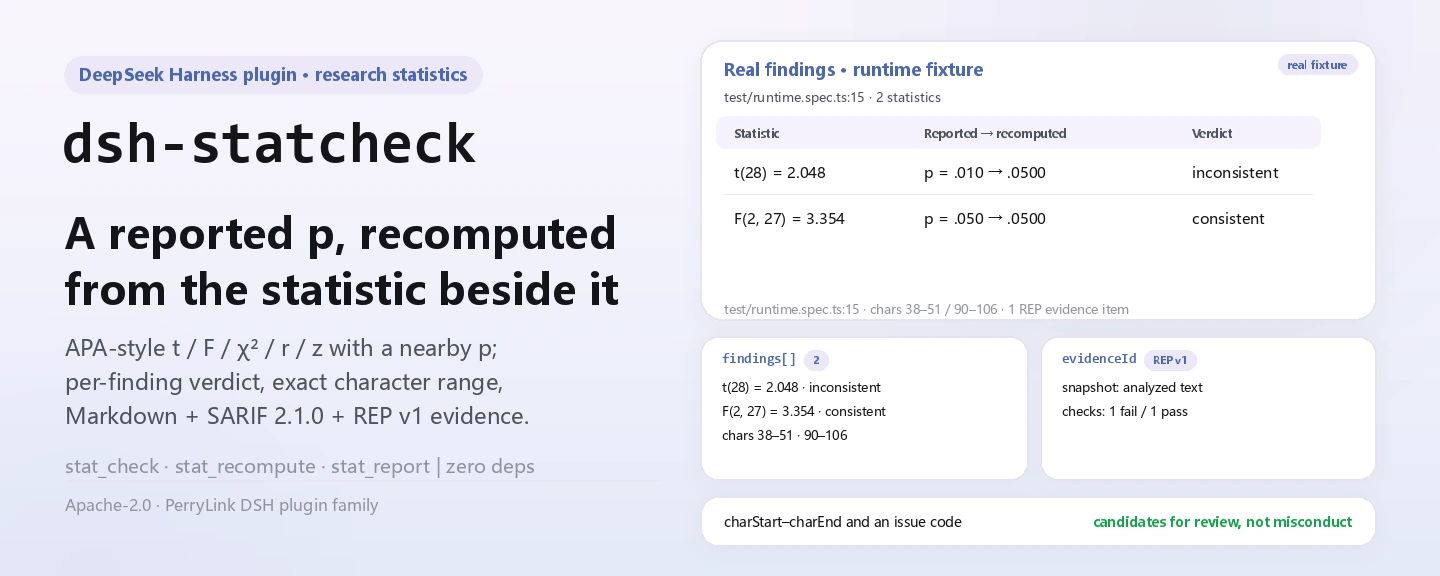
Recompute the statistics reported in a manuscript and flag self-inconsistent p values for DeepSeek Harness: APA-style t/F/chi-square/r/z parsing, two-tailed and upper-tail p values from zero-dependency distributions, CI-versus-p checks, exact character locators, Markdown and SARIF 2.1.0 output, and a REP v1 evidence record. Arithmetic, not accusati
Repo PerryLink/dsh-statcheck, read from GitHub 23 min ago. PerryLink has not joined Take My Repo.
PerryLink/dsh-statcheck is a public repo on GitHub by PerryLink. Recompute the statistics reported in a manuscript and flag self-inconsistent p values for DeepSeek Harness: APA-style t/F/chi-square/r/z parsing, two-tailed and upper-tail p values from zero-dependency distributions, CI-versus-p checks, exact character locators, Markdown and SARIF 2.1.0 output, and a REP v1 evidence record. Arithmetic, not accusati. It declares the Apache-2.0 license on GitHub. It is written mainly in TypeScript, has 2 stars and last changed on 2026-11-22. Nobody has reviewed it on Take My Repo yet, which says nothing about its quality. Read from GitHub on 2026-11-22.
当前版本 0.1.4。
Recompute the statistics a manuscript reports — and flag the ones that do not add up.
It is arithmetic, not accusation: each finding shows the reported statistic, the p value it actually implies, and the exact characters it came from.
t(df), F(df1, df2), χ²(df), r(df), z, each with a nearby p = …, p < … or p > … and an optional 95% CI [lo, hi].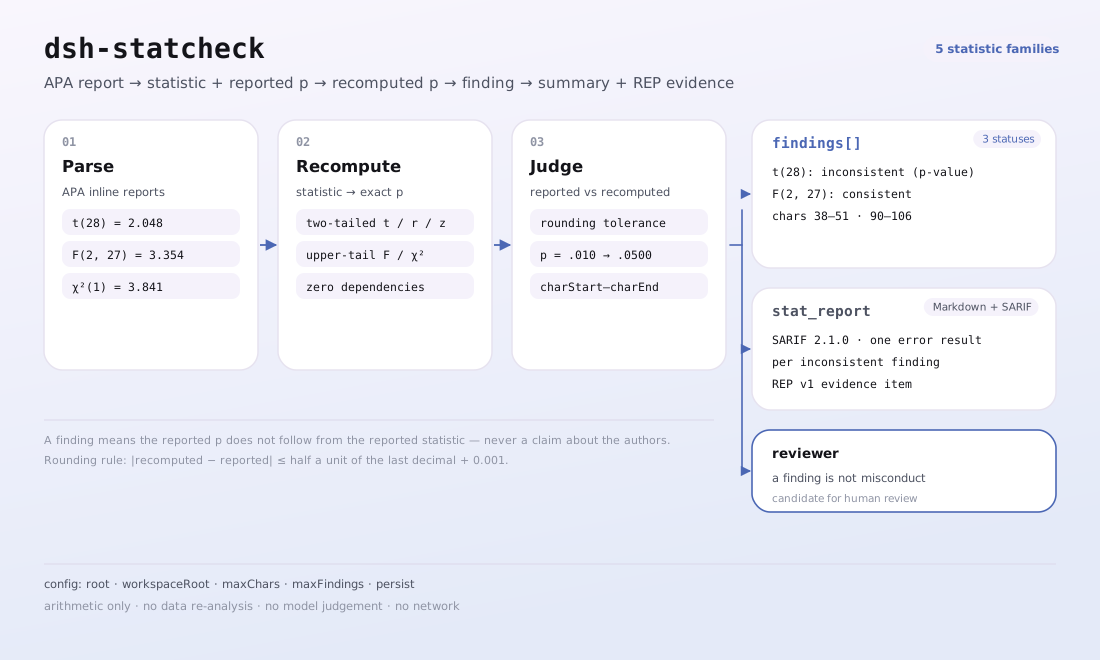
Structure: parse → recompute → judge; findings[] and summary are the two outputs, and stat_report renders them as Markdown and SARIF 2.1.0. The token labels inside the diagram are the real tool, check and issue names, so the same picture serves all five languages.
dsh-doc-anchor) and pass text or a .txt/.md/.tex/.html path.| DeepSeek Harness | dsh-v0.2.3-alpha.1 (verified 2026-11-22); peer line >=0.2.1-0 <0.3.0 || >=0.2.2-0 <0.3.0 |
| Node | ^22.19.0 || >=24.9.0 (tested on 24.22.1), ESM only |
| Peers | @perrylink/dsh-research-core ^0.1.0, @deepseek-ai/cordis ^4.0.5-alpha.1, @deepseek-ai/dsh-tools, @deepseek-ai/schemastery ^3.18.5-alpha.1 |
| Runtime dependencies | zero |
dsh plugin --profile <name> add @perrylink/dsh-research-core dsh-statcheck
dsh --profile <name> --dump-config | grep dsh-statcheck
dsh plugin --profile <name> remove dsh-statcheck
stat_check{ text?, path?, persist?, maxFindings? } → { ok, summary, findings[], source, evidenceId?, recordPath? }.
Each finding: statistic, df, text, charStart, charEnd, reported { statistic, p, pKind, pValue, ci? }, recomputed { p }, status (consistent/inconsistent/unparsed), issue? (p-value/p-threshold/ci/format/df), severity, detail.
stat_recompute{ statistic: 't'|'F'|'chi2'|'r'|'z', value, df[], p? } → { ok, p, judgment? }.
t/r/z are two-tailed; F/χ² upper-tail. p uses the same rounding rule as stat_check.
stat_report{ findings, text? } → { ok, markdown, sarif, summary }. SARIF carries one error result per inconsistent finding. Pass the original manuscript text to map each finding's charStart to a real SARIF startLine/startColumn; without text, the region falls back to line 1 plus a character column (the properties.charStart/charEnd are always exact).
INVALID_INPUT · NOT_FOUND · PATH_ESCAPE · NOT_A_FILE · TOO_LARGE · OUT_OF_DOMAIN · STORE_ERROR
A reported p = x is consistent when |recomputed − x| ≤ 0.5 × 10^-decimals + 0.001.
The extra 0.001 absorbs the fact that the statistic itself is often reported rounded (e.g. t = 2.50 implies p ≈ .01855, commonly written .019). p < X is consistent when the recomputed value is below X; p > X when above.
| Key | Default | Meaning |
|---|---|---|
enabled |
true |
false mounts nothing |
root |
.statcheck |
store + records root |
workspaceRoot |
process.cwd() |
manuscript paths must resolve inside it |
maxChars |
2000000 |
analyzed-character cap (over-limit fails, never truncates) |
maxFindings |
500 |
findings per call |
persist |
true |
store a snapshot + REP record |

Animated: the benchmark adapter's real stdout over the 30 frozen statistics cases (node bench/run-stats.mjs with BENCH_DIR pointing at the frozen dsh-research-bench checkout, no network; re-run 2026-11-21). The perfect scores describe these constructed critical-value cases only — the scope warning below still applies.
dsh-research-bench stats v0.1.0 (30 cases)pnpm run bench:stats
| metric | value |
|---|---|
| inconsistent precision | 1.00 |
| inconsistent recall | 1.00 |
| inconsistent F1 | 1.00 |
| clean false-positive rate | 0.00 |
| issue accuracy when flagged | 1.00 |
| exact accuracy | 1.00 |
Raw per-case predictions: bench/results-stats.json.
Scope warning: the dataset is small, synthetic and clean (10 consistent + 20 inconsistent sentences around published critical values). A perfect score shows the parser and the recomputation agree with the critical-value labels on these constructions; it does not estimate real-manuscript accuracy. The rounding rule and issue codes are documented so a reader can disagree with a specific finding.
p values in tables are out of scope.stat_report text; without it the region is line 1 + character column (the exact charStart/charEnd properties are always present).Apache-2.0. No third-party runtime code.
PerryLink/dsh-statcheck is a public repo on GitHub by PerryLink. Recompute the statistics reported in a manuscript and flag self-inconsistent p values for DeepSeek Harness: APA-style t/F/chi-square/r/z parsing, two-tailed and upper-tail p values from zero-dependency distributions, CI-versus-p checks, exact character locators, Markdown and SARIF 2.1.0 output, and a REP v1 evidence record. Arithmetic, not accusati.
It declares the Apache-2.0 license on GitHub.
Its maker has not tagged a system, so it is unknown here. Its README says what it needs.
Open "Take it" on its page: Take My Repo writes an install plan for your machine and hands it to your AI agent (Claude Code, Codex or Cursor), which asks you before each step. Take My Repo has not tested it on any machine.
A cross-platform desktop All-in-One assistant for Claude Code, Codex, OpenCode,DeepSeek Harness and more. Only official website: ccswitch.io
Its last change on GitHub was on 2026-11-22. GitHub counts 0 open issues and pull requests. Take My Repo does not judge from that whether it is maintained.
Nobody has reviewed it on Take My Repo yet, which says nothing about its quality.
Reverse engineer anything with agents, from app behavior down to native binaries.
The 1st Collaborative AI Design Agent Workspace. Local-first and open source. Create motion, prototypes, websites, apps, dashboards, presentations, images, and videos with your team and AI agents. Share work, exchange feedback, and iterate together in one workspace.
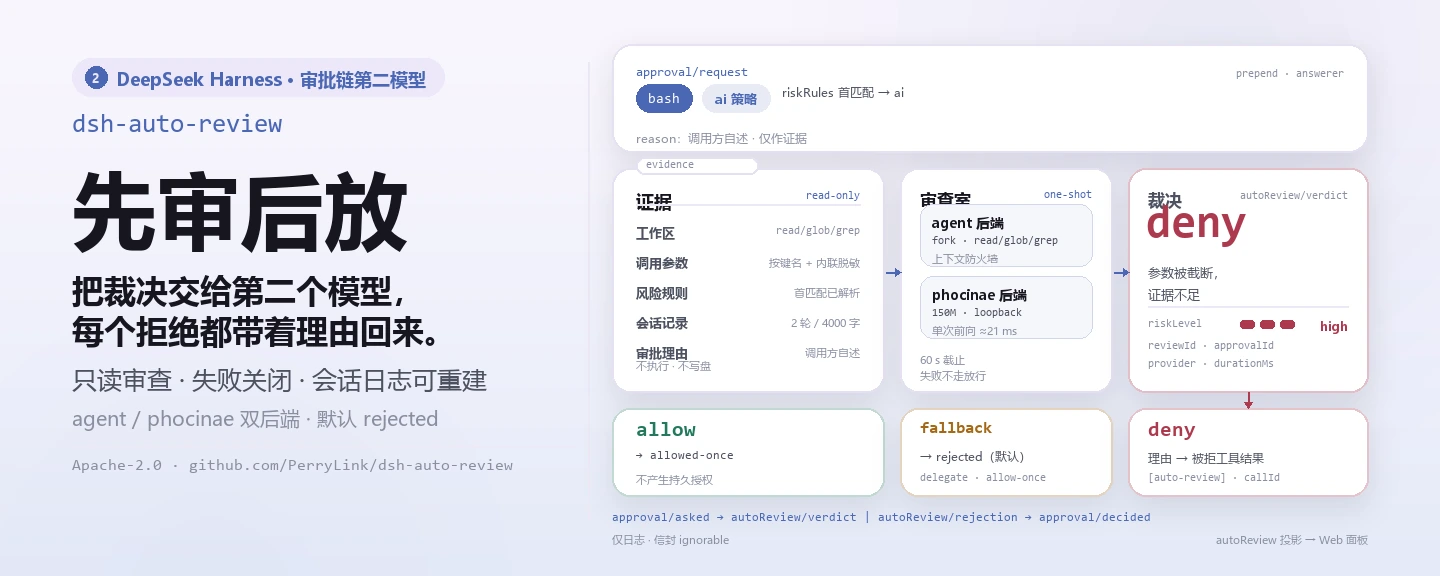
Second-model AI auto-review for DeepSeek Harness approval requests: a read-only reviewer subagent returns structured allow/deny verdicts with reasons, fail-closed by default, fully auditable from the session log (approval/asked -> autoReview/verdict -> approval/decided).
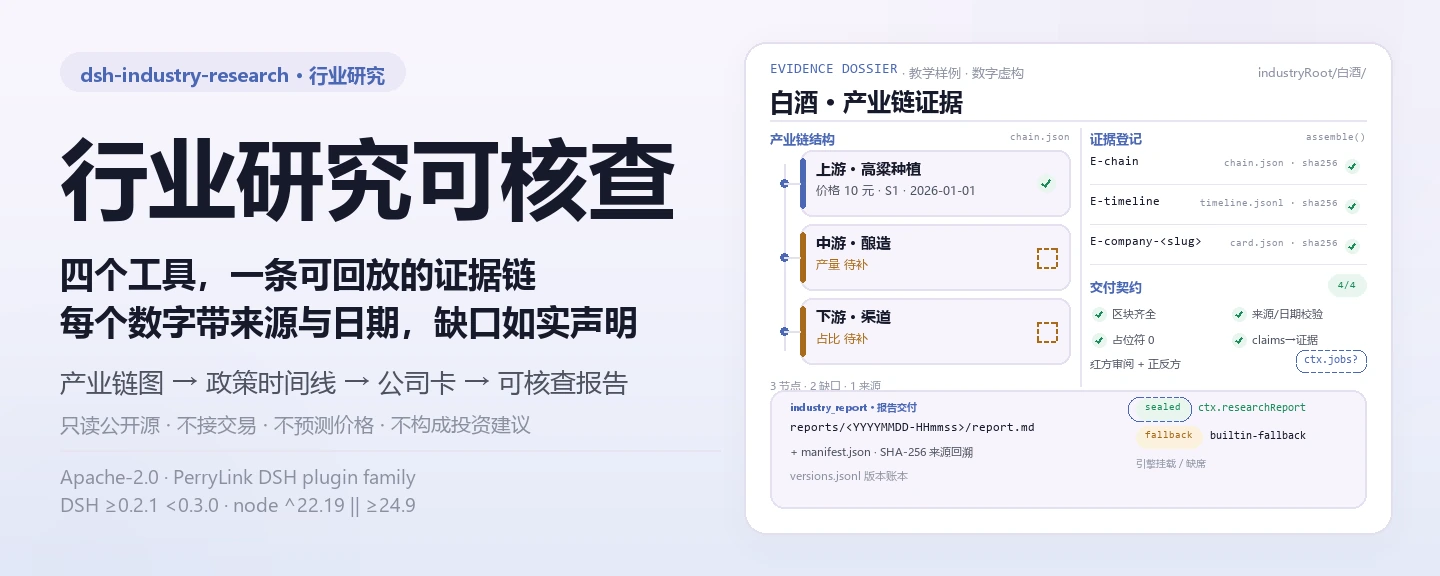
Industry and company research domain pack for DeepSeek Harness: methodology skills, industry chain mapping, public-source policy/news tracking, company research cards, and auditable research reports. Research only - not investment advice.
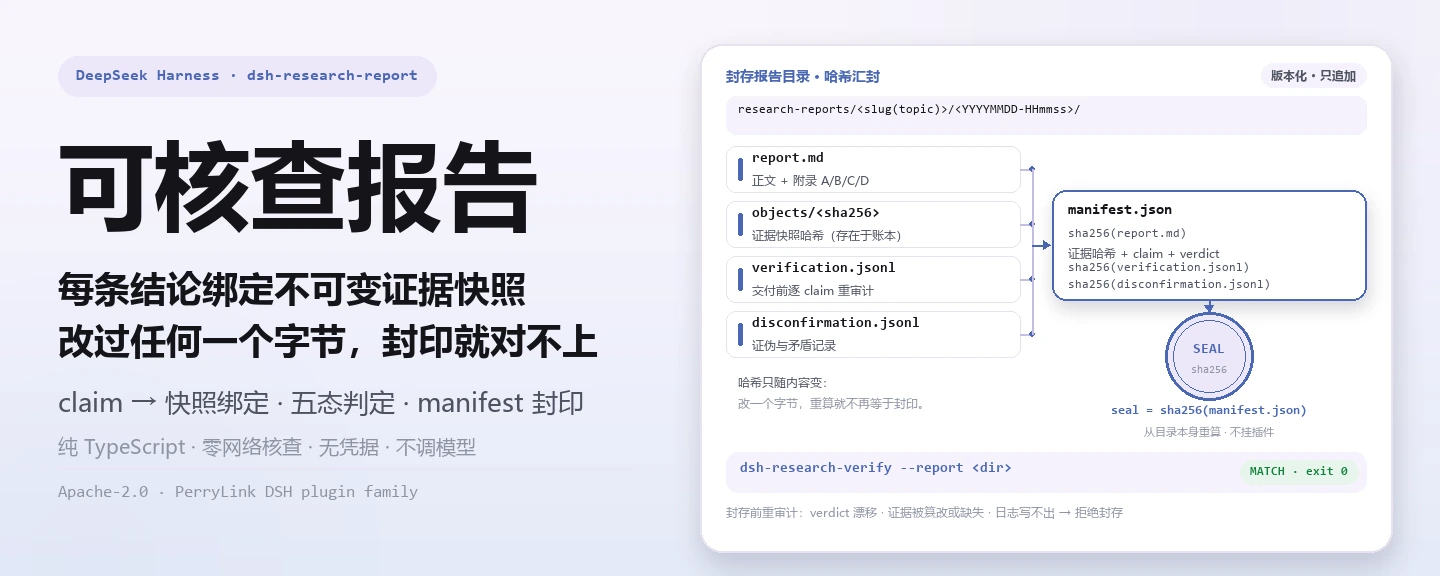
Verifiable research-report engine for DeepSeek Harness: content-addressed evidence ledger (claim-snapshot binding, tamper-evident) plus versioned sealed reports with per-claim verification verdicts and a manifest-sealed directory.
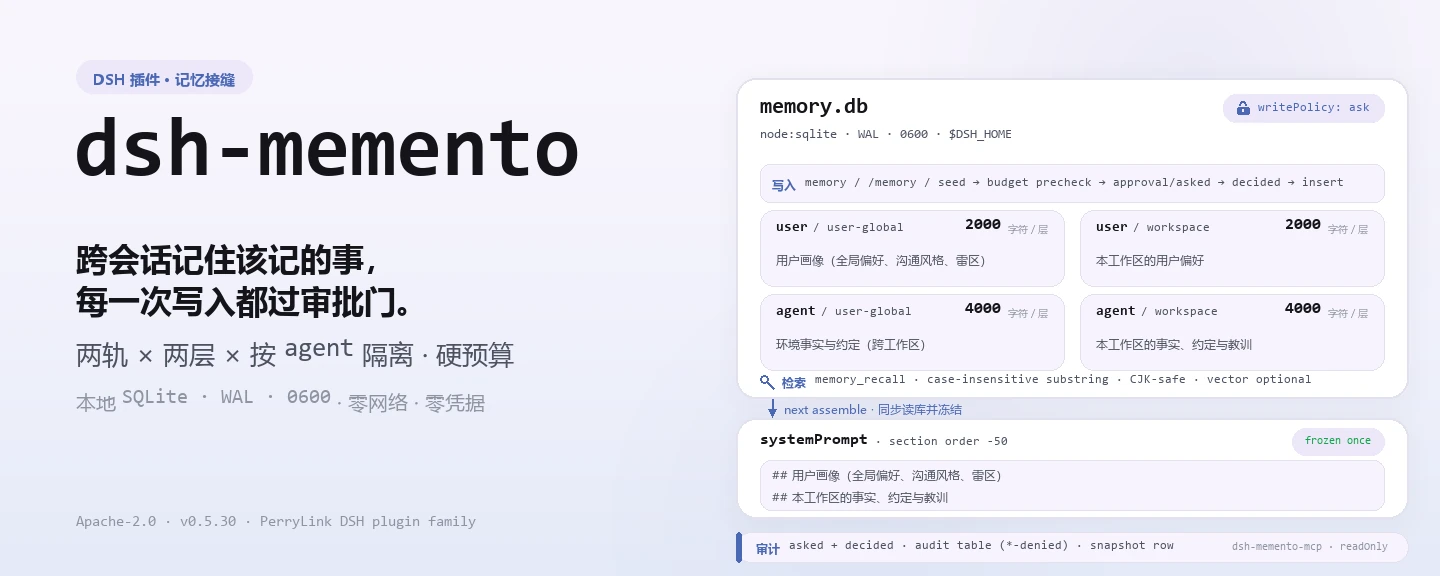
Bounded, layered, approval-gated, auditable cross-session memory for DeepSeek Harness: a ctx.memory capability seam with a zero-dependency SQLite provider, a memory tool, and frozen snapshot injection. Active (unfrozen 2026-10-12); see README for alternatives.
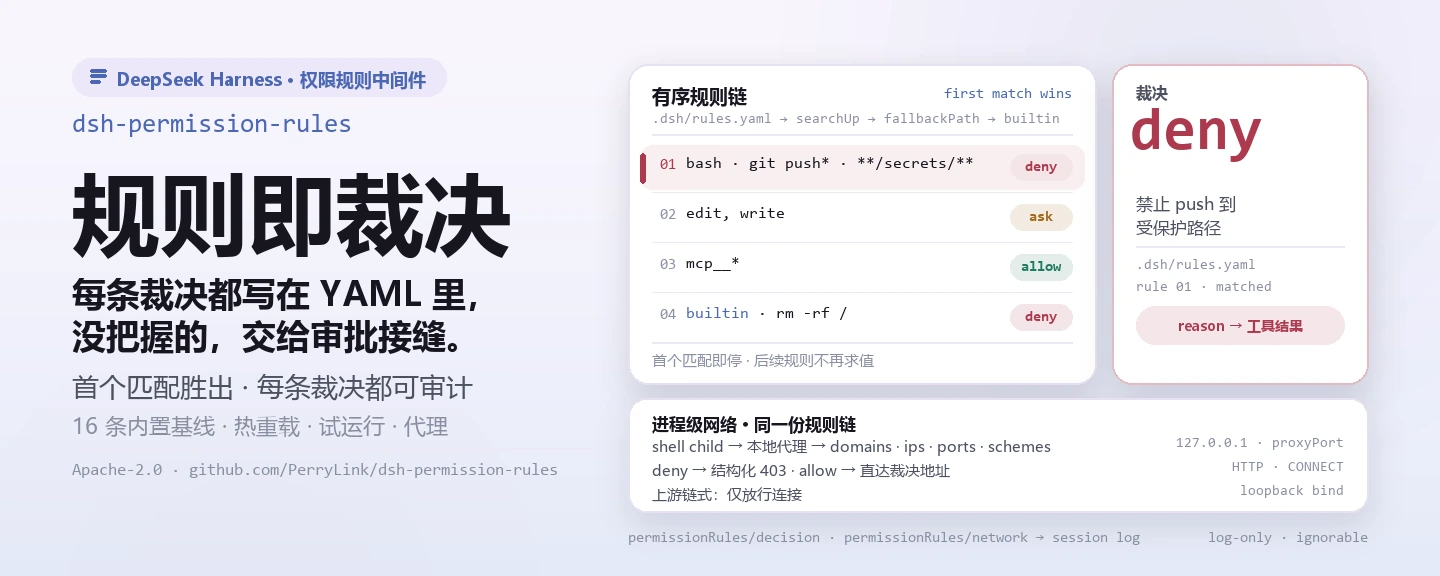
Claude Code-style declarative permission rules for DeepSeek Harness: ordered allow/deny/ask rules with tool-name, argument (glob/regex), and workspace-path matching on the tools/pre-execute waterfall, session-log audit, and HMR reload.
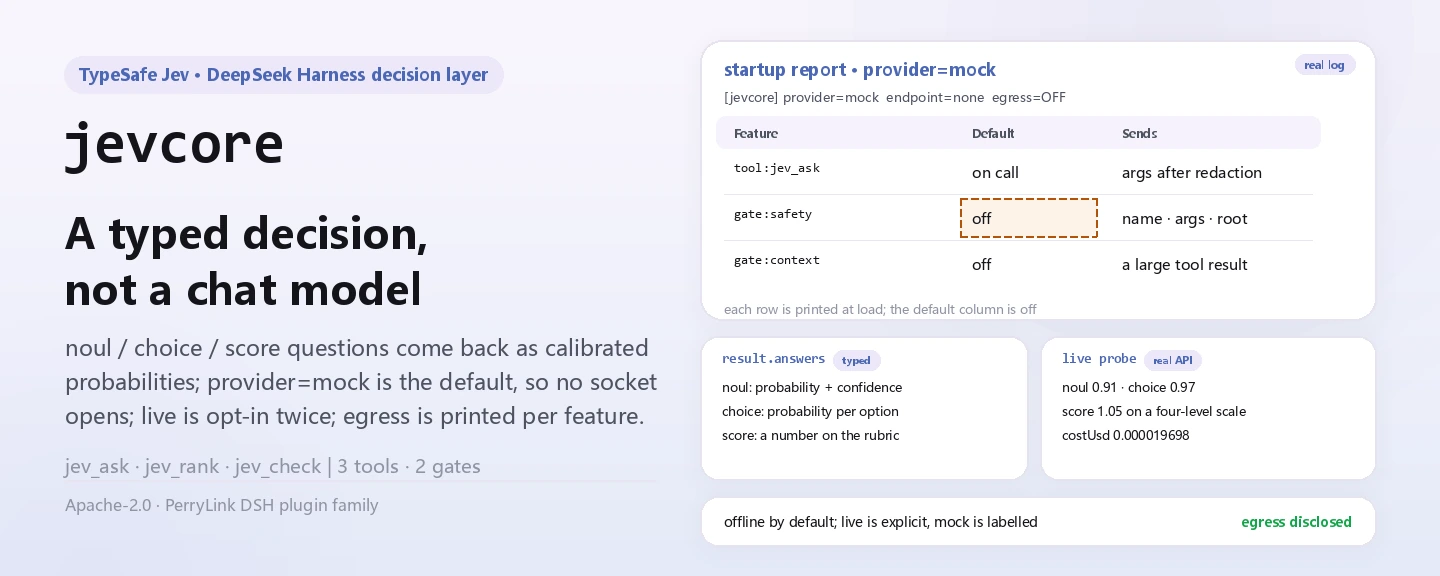
TypeSafe Jev for DeepSeek Harness, the Model Context Protocol, and plain Node: typed judgments instead of prose, offline by default.