modern-cpp-tutorial
📚 Modern C++ Tutorial: C++11 to C++26 On the Fly | https://changkun.de/modern-cpp/
- 26k
- C++
- MIT
- 2 wk ago
PixelRoot32 Game Engine is a lightweight, modular 2D game engine written in C++17 and designed specifically for ESP32 microcontrollers.
Repo PixelRoot32-Game-Engine/PixelRoot32-Game-Engine, read from GitHub 1 min ago. PixelRoot32-Game-Engine has not joined Take My Repo.
PixelRoot32-Game-Engine/PixelRoot32-Game-Engine is a public repo on GitHub by PixelRoot32-Game-Engine. PixelRoot32 Game Engine is a lightweight, modular 2D game engine written in C++17 and designed specifically for ESP32 microcontrollers. It declares the MIT license on GitHub. It is written mainly in C++, has 65 stars and last changed on 2026-11-23. Nobody has reviewed it on Take My Repo yet, which says nothing about its quality. Read from GitHub on 2026-11-23.

A lightweight, modular 2D game engine for ESP32 and PC

Overview • Features • Demo Projects • Tool Suite • Quick Start • Best Practices • Documentation • Roadmap • Changelog • Contributing • License • Credits
PixelRoot32 is a lightweight, modular 2D game engine written in C++17, designed primarily for ESP32 microcontrollers, with a native simulation layer for PC (SDL2) to enable rapid development without hardware.
The engine follows a scene-based architecture inspired by Godot Engine, featuring kinematic controllers, scene transitions, camera effects, and deterministic gameplay systems tailored for embedded hardware.
PixelRoot32 is not the product of a traditional electronics expert or a large engineering team.
It was born from curiosity, experimentation, and a deep love for retro games from the 90s.
Coming from a mobile development background with limited experience in C++, this project represents a leap into embedded systems. This was made possible by how accessible knowledge has become today—especially with AI-assisted tools lowering the barrier to building complex systems.
PixelRoot32 is a reflection of that shift: exploring new domains driven by curiosity rather than specialization.
At its core, the engine is built around a few simple ideas:
👉 Learn more: Engine Philosophy
Watch PixelRoot32 running on ESP32 with example games:
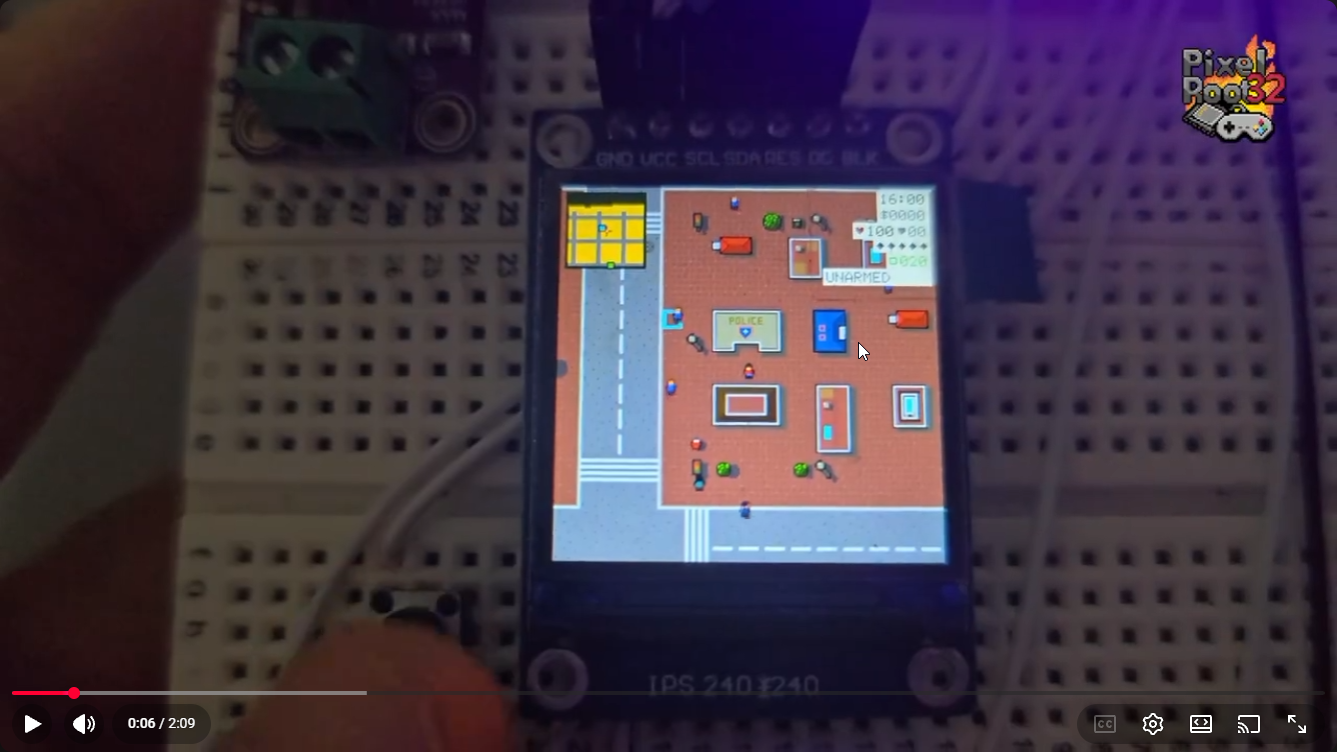
Click the image to watch the full demo on YouTube.
playSfxBank), and fixed-point No-FPU optimizations (Pulse, Triangle, Noise, Sine, Saw).PIXELROOT32_ENABLE_* flag, all default 0.DialogRunner) with paged text, branching and conditional choices, multi-column option rows, multi-format speaker portraits in a fixed size box, and a default DialogBox panel — opt-in behind PIXELROOT32_ENABLE_DIALOG.PIXELROOT32_ENABLE_NETWORKING (default 0).PIXELROOT32_ENABLE_PERSISTENCE (default 0), with the card adapter behind PIXELROOT32_ENABLE_SD_STORAGE (default 0).PIXELROOT32_ENABLE_* flags to reduce firmware size.💡 Detailed info: Check out the Full Feature List.
PixelRoot32-Demo-Projects is the companion repository: 31 complete, self-contained projects you can copy, build and play.
| Category | Count | A sample of what is there |
|---|---|---|
| Getting started | 2 | hello_world — the smallest complete project |
| Games | 12 | bomberbot, chess, 2048, snake |
| Gameplay | 4 | state_machine, metroidvania |
| Graphics | 5 | iso_dungeon, depth_sort |
| Audio | 2 | music_sequencer, sfx_bank |
| UI · Input · Performance | 6 | menus, digital and touch controls, and profiling vehicles |
Every demo is a standalone PlatformIO project that builds against the
published release from the registry — copy the folder anywhere, run
pio run -e native, and you have a working starting point.
How it differs from examples/ in this repository: the
examples here are eleven minimal projects, each isolating a single engine
capability, and none of them is a game. Read an example to learn one API; read a
demo to see several of them working together in something finished.
The PixelRoot32 Tool Suite is a native desktop app (C++17 / SDL2 / ImGui) that accelerates asset creation for the engine.
The engine itself remains 100% free and open source. These tools are optional power-ups designed to streamline your workflow and support the project: each grants a lifetime license (one-time purchase, yours forever, free lifetime updates).
| Module | Status |
|---|---|
| Sprite Compiler | ✅ Available — PNG to C headers (1bpp/2bpp/4bpp, grid selection) |
| Tilemap Editor | ✅ Available — visual multi-layer tilemaps with C++ export |
| Music Editor | 🔜 Coming soon — pattern-based tracker for the PR32 APU |
| SFX Editor | 🔜 Coming soon — sound effect synthesis |
👉 Get the Tool Suite · Detailed docs
The best way to support PixelRoot32 is getting the Tool Suite above — a lifetime license that funds the project.
If that's not for you, a tip is always welcome:
To compile PixelRoot32, you must configure your platformio.ini to use C++17 and disable exceptions:
build_unflags = -std=gnu++11
build_flags =
    -std=gnu++17
    -fno-exceptions
To use PixelRoot32 in your own project, add the following to the lib_deps option of your platformio.ini:
lib_deps =
    gperez88/PixelRoot32-Game-Engine@^1.16.0
PlatformIO will automatically download and install the library and its dependencies during the next build — including the shared PixelRoot32-APU synthesis core (also used by the PixelRoot32 Tool Suite).
Clone this repository and open an example under examples/:
git clone https://github.com/PixelRoot32-Game-Engine/PixelRoot32-Game-Engine.git
cd PixelRoot32-Game-Engine/examples/sprites
Each folder (sprites, camera, animated_tilemap, physics, platformer, dialog, persistence, mono_oled, esp_now, esp_now_ping, apu_profiles) is a standalone PlatformIO project with its own platformio.ini. See the examples catalogue for what each one demonstrates and which opt-in capability it turns on. Complete games and larger use cases live in PixelRoot32-Demo-Projects.
Open that example folder in VS Code (File → Open Folder) and select the environment named in its platformio.ini (env:esp32dev, env:esp32cyd, env:esp32c3_node_up, env:esp32c3_node_a, env:native, and so on).
Build and Upload using PlatformIO.
📚 More information: See the Getting Started Guide.
To ensure high performance on ESP32, PixelRoot32 enforces strict development patterns:
Scalar instead of float. Use math::toScalar() for literals.new/malloc during the game loop. Use Object Pooling and std::unique_ptr.renderLayer (0=Bg, 1=Game, 2=UI) to optimize drawing order.PIXELROOT32_FLASH_ATTR and PIXELROOT32_READ_*_P macros for cross-platform Flash/RAM access.log() from core/Log.h instead of Serial.print or printf.📘 Essential Reading: Check the Style & Best Practices Guide for detailed rules on memory management, performance optimization, and coding style.
examples/.Camera2D following with smoothing and bounds, parallax layers, camera effects and a scripted CameraTween pan.KinematicActor, RigidActor and StaticActor in one screen, with one-way platforms and collision layers/masks — the Godot CharacterBody2D/RigidBody2D/StaticBody2D mapping.👉 Full Roadmap: docs/roadmap.md — including completed features.
A minor release: an opt-in microSD backend for persistence, plus build tooling. persistence::SdSlotStore (flag PIXELROOT32_ENABLE_SD_STORAGE, ESP32 only) keeps one FAT file per save slot and mounts from a plain-data SdConfig, so the adapter carries no board pin; a missing or unmountable card answers Unavailable and the game keeps running on defaults. examples/platformer puts KinematicActor, RigidActor and StaticActor in the scene they were designed for, examples/esp_now_dice moves to Demo-Projects, native builds resolve the host's SDL2 paths instead of committing per-OS flags, and native_test builds and instruments coverage on macOS.
Full changelog: CHANGELOG.md
Contributions are welcome! Read our Contributing Guide to get started.
PixelRoot32 is an open-source project licensed under the MIT License. Based on ESP32-Game-Engine by nbourre.
See the LICENSE file for the full text.
⚠️ The PixelRoot32 Game Engine name and logo are subject to the trademark policy. See TRADEMARK.md.
Developed by Gabriel Perez as a modular game engine for embedded systems.
Special thanks to nbourre for the original ESP32-Game-Engine.
Built with ❤️ for the retro-dev community.
PixelRoot32-Game-Engine/PixelRoot32-Game-Engine is a public repo on GitHub by PixelRoot32-Game-Engine. PixelRoot32 Game Engine is a lightweight, modular 2D game engine written in C++17 and designed specifically for ESP32 microcontrollers.
It declares the MIT license on GitHub.
Its maker has not tagged a system, so it is unknown here. Its README says what it needs.
Open "Take it" on its page: Take My Repo writes an install plan for your machine and hands it to your AI agent (Claude Code, Codex or Cursor), which asks you before each step. Take My Repo has not tested it on any machine.
Its last change on GitHub was on 2026-11-23. Take My Repo does not judge from that whether it is maintained.
📚 Modern C++ Tutorial: C++11 to C++26 On the Fly | https://changkun.de/modern-cpp/
Nobody has reviewed it on Take My Repo yet, which says nothing about its quality.
π RuView turns commodity WiFi signals into real-time spatial intelligence, vital sign monitoring, and presence detection — all without a single pixel of video.
:house_with_garden: Open source home automation that puts local control and privacy first.
This repository contains a collection of specialized "Skills" designed to supercharge AI Agents (like Gemini, Cursor, or Copilot) when developing video games for the PixelRoot32 Game Engine.
This repository holds official download information for the PixelRoot32 Tool Suite (Windows). It does not contain the app source code.
Shared NES-style audio core (APU — Audio Processing Unit) from the PixelRoot32 family.
pr32-sprite-compiler.py is a Python command-line tool that converts a PNG sprite sheet into a C header file (.h) compatible with the PixelRoot32 engine. A small GUI wrapper (pr32-sprite-compiler-gui.py) is included so you can use the tool without typing commands in a terminal.