
plotjuggler_bridge
The ROS2 bridge you deserve. Life is too short to use DDS.
- 30
- AGPL-3.0
- 2 mo ago
Repo PlotJuggler/plotjuggler_bridge, read from GitHub 48 min ago. PlotJuggler has not joined Take My Repo.
In short
PlotJuggler/plotjuggler_bridge is a public repo on GitHub by PlotJuggler. The ROS2 bridge you deserve. Life is too short to use DDS. It declares the AGPL-3.0 license on GitHub. It is written mainly in C++, has 30 stars and last changed on 2026-09-20. Nobody has reviewed it on Take My Repo yet, which says nothing about its quality. Read from GitHub on 2026-11-24.
plotjuggler_bridge
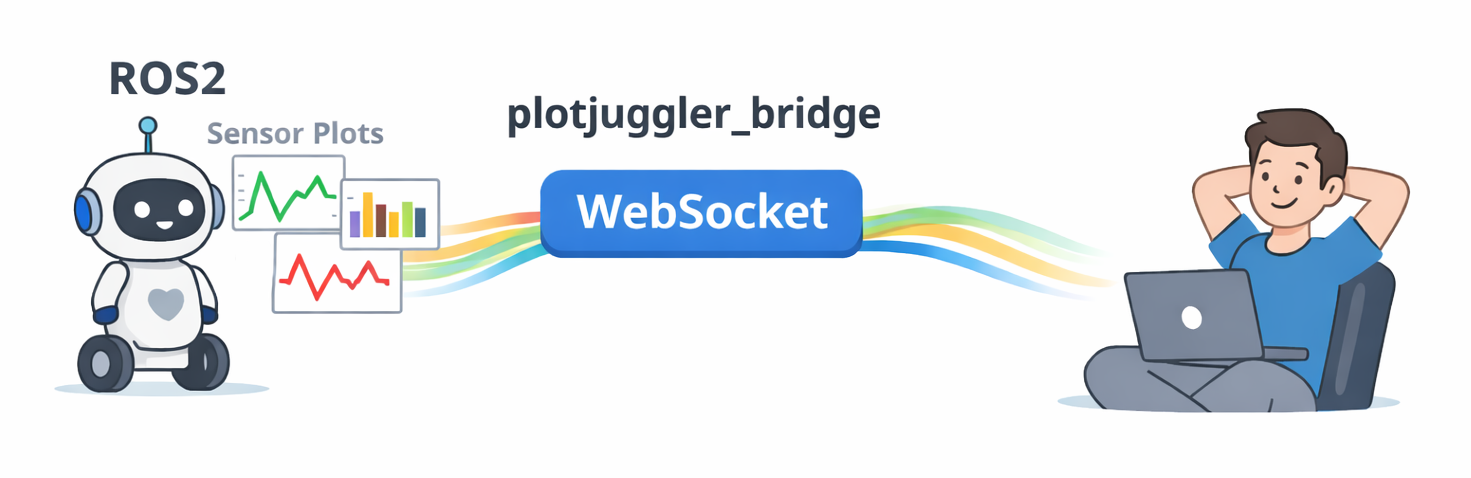
A high-performance bridge server that forwards middleware topic content over WebSocket to PlotJuggler clients. Three backends share a common core:
- ROS2 (
pj_bridge_ros2) — ROS2 Humble / Jazzy / Kilted / Lyrical viarclcpp - FastDDS (
pj_bridge_fastdds) — eProsima Fast DDS 3.4 (standalone, no ROS2 required) - RTI (
pj_bridge_rti) — RTI Connext DDS (build disabled, code preserved)
Even if primarily created for PlotJuggler, this can be considered a general purpose DDS-to-Websocket bridge and be used independently.
Overview
pj_bridge enables clients to subscribe to topics and receive aggregated messages at 50 Hz without needing a full middleware installation. This is useful for visualization tools like PlotJuggler, remote monitoring, and lightweight clients.
Key Features
- No ROS required: if you have PlotJuggler 3.16+ installed on your computer, you don't need ROS installed on it.
- No DDS Communication: Clients connect via WebSocket (single port) without needing ROS2/DDS installed
- High Performance: 50 Hz message aggregation with ZSTD compression. The original message timestamp is preserved, and less bandwidth is used.
- Multi-Client Support: Multiple clients can connect simultaneously with shared subscriptions
- Runtime Schema Discovery: Automatic extraction of message schemas from installed ROS2 packages on the server side.
- Large Message Stripping (opt-in): Optional stripping of large array fields (Image, PointCloud2, LaserScan, OccupancyGrid) to reduce bandwidth while preserving metadata. Disabled by default — full message data is forwarded; enable with
strip_large_messages:=truefor low-bandwidth links - Topic Whitelist: Restrict which topics are visible/subscribable via full-match regex patterns (
topic_whitelist/--topic-whitelist), mirroring foxglove_bridge's option of the same name - QoS Depth Heuristics (ROS2 only): KEEP_LAST subscription depth is derived from the discovered publishers' depths and clamped to a configurable
[min_qos_depth, max_qos_depth]range - Pushed Topic Advertisement (opt-in): Clients can subscribe to a
topics_changednotification instead of pollingget_topics, at a configurabletopic_poll_interval - Slow-Client Backpressure: A bounded, drop-oldest per-client send queue (
client_backlog_size) keeps a lagging client from blocking the publish loop or growing an unbounded backlog, instead of disconnecting it - Latched Topic Replay (ROS2 only): New subscribers to a
TRANSIENT_LOCALtopic (e.g./tf_static) immediately receive the retained last message instead of waiting for the next publish; such topics are badgedlatched: trueinget_topics - Schemas Up Front (opt-in):
get_topics/subscribe_topic_updatesacceptinclude_schemasso demand-driven clients (PlotJuggler 4) can classify topics before subscribing - Capability Discovery:
get_topicsresponses identify the server (name,version) and list itscapabilities, so clients feature-detect additive protocol features by name —protocol_versionremains the only hard compatibility gate - TLS /
wss://(opt-in): Serve the WebSocket endpoint over TLS with a server certificate + private key (tls/--certfile+--keyfile); clients connect viawss://instead ofws://
CI Status
| Humble | Jazzy | Kilted | Lyrical | |
|---|---|---|---|---|
| Pixi | — | |||
| colcon |
Configuration Parameters
ROS2 (via --ros-args -p)
| Parameter | Type | Default | Description |
|---|---|---|---|
port |
int | 9090 | WebSocket server port |
publish_rate |
double | 50.0 | Aggregation publish rate in Hz |
session_timeout |
double | 10.0 | Client timeout duration in seconds |
strip_large_messages |
bool | false | Opt-in: strip large arrays from Image, PointCloud2, LaserScan, OccupancyGrid messages |
topic_whitelist |
string array | [".*"] |
Full-match regex patterns (ECMAScript) restricting visible/subscribable topics |
min_qos_depth |
int | 10 | ROS2 only: minimum KEEP_LAST subscription depth after aggregating publisher depths |
max_qos_depth |
int | 100 | ROS2 only: maximum KEEP_LAST subscription depth after aggregating publisher depths |
ingest_poll_interval_ms |
double | 5.0 | ROS2 only: interval between ingest executor polls; subscription callbacks drain their DDS reader each poll. 0 uses a blocking spin instead |
topic_poll_interval |
double | 1.0 | Seconds between topics_changed notification polls; 0 disables polling |
client_backlog_size |
int | 100 | Max binary frames queued per slow client before the oldest is dropped (must be > 0) |
heavy_frame_threshold_bytes |
int | 262144 | Isolate messages ≥ this size (bytes) into their own size-class frame so they don't starve small topics; 0 disables (must be >= 0) |
tls |
bool | false | Enable TLS (wss://); requires certfile and keyfile |
certfile |
string | "" |
TLS server certificate file |
keyfile |
string | "" |
TLS private key file |
FastDDS / RTI (via CLI flags)
| Flag | Type | Default | Description |
|---|---|---|---|
--domains, -d |
int list | (required) | DDS domain IDs |
--port, -p |
int | 9090 | WebSocket server port |
--publish-rate |
double | 50.0 | Aggregation publish rate in Hz |
--session-timeout |
double | 10.0 | Client timeout duration in seconds |
--log-level |
string | info |
Log level (trace, debug, info, warn, error) |
--stats |
flag | off | Print statistics every 5 seconds |
--topic-whitelist |
string list | .* |
Full-match regex patterns (ECMAScript), repeatable |
--topic-poll-interval |
double | 1.0 | Seconds between topics_changed notification polls; 0 disables polling |
--client-backlog-size |
int | 100 | Max binary frames queued per slow client before the oldest is dropped (range 1-1000000) |
--heavy-frame-threshold-bytes |
int | 262144 | Isolate messages ≥ this size (bytes) into their own size-class frame; 0 disables (range 0-1000000000) |
--certfile |
string | (none) | TLS server certificate file; enables wss://, requires --keyfile |
--keyfile |
string | (none) | TLS private key file; enables wss://, requires --certfile |
--qos-profile |
string | (none) | RTI only: QoS profile XML file path |
Just "Download and Run"
Pixi
Install the pre-built package from the PlotJuggler conda channel — no build step required.
# Install (change humble to jazzy or kilted as needed)
pixi global install pj-bridge-ros2-humble \
  -c https://prefix.dev/plotjuggler -c robostack-humble -c conda-forge

# Run (add arguments if different from default)
pj_bridge_ros2 --ros-args -p port:=9090
AppImage
Pre-built AppImages are available from GitHub Releases.
Example for ROS2 Humble:
# Do once after downloading the file
chmod +x pj_bridge_ros2-humble-x86_64.AppImage

# Run (add arguments if different from default)
./pj_bridge_ros2-humble-x86_64.AppImage --ros-args -p port:=9090
Build Instructions
All dependencies (spdlog, nlohmann_json, ZSTD) are provided by the dependency manager. IXWebSocket is resolved via find_package first, with a FetchContent fallback for colcon builds. Only tl::expected is vendored.
TLS (wss://) support depends on IXWebSocket being built with OpenSSL. The CMake option PJ_BRIDGE_TLS (default ON) controls this for the FetchContent path (-DPJ_BRIDGE_TLS=OFF to disable); a system/conda-provided IXWebSocket must likewise have been built with TLS. See docs/API.md for details.
ROS2 — Pixi
Pixi manages the full toolchain including ROS2 via RoboStack.
From the cloned plotjuggler_bridge directory:
# Build and test (change humble to jazzy or kilted as needed)
pixi run -e humble build
pixi run -e humble test

# Run
pixi shell -e humble
ros2 run pj_bridge pj_bridge_ros2
ROS2 — colcon
Standard ROS2 build using colcon. Dependencies are installed via rosdep; only IXWebSocket is fetched automatically via CMake FetchContent.
# Set up workspace
mkdir -p ~/ws_plotjuggler/src && cd ~/ws_plotjuggler/src
git clone https://github.com/PlotJuggler/plotjuggler_bridge && cd plotjuggler_bridge

# Install dependencies
source /opt/ros/${ROS_DISTRO}/setup.bash
rosdep install --from-paths pj_bridge --ignore-src -y

# Build and test
cd ~/ws_plotjuggler
colcon build --packages-select pj_bridge --cmake-args -DCMAKE_BUILD_TYPE=Release
colcon test --packages-select pj_bridge && colcon test-result --verbose

# Run
source install/setup.bash
ros2 run pj_bridge pj_bridge_ros2
FastDDS — Conan
Standalone build using eProsima Fast DDS (no ROS2 required).
From the cloned plotjuggler_bridge directory:
# Build
conan install . --output-folder=build_fastdds --build=missing -s build_type=Release
cd build_fastdds
cmake .. -DCMAKE_BUILD_TYPE=Release -DENABLE_FASTDDS=ON \
         -DCMAKE_TOOLCHAIN_FILE=conan_toolchain.cmake
make -j$(nproc)

# Run
./pj_bridge_fastdds --domains 0 1
Documentation
- For detailed architecture documentation, see docs/ARCHITECTURE.md.
For the full API protocol documentation (commands, responses, binary wire format), see docs/API.md.
Troubleshooting
Server fails to start with "Failed to listen on port"
Another process is using the port. Either kill the conflicting process or use a custom port:
ros2 run pj_bridge pj_bridge_ros2 --ros-args -p port:=9090
Client receives no data
- Verify server is running:
ps aux | grep pj_bridge - Check topics are being published:
ros2 topic list - Verify heartbeat is being sent (required every 1 second)
- Check server logs:
ros2 run pj_bridge pj_bridge_ros2 --ros-args --log-level debug
"Failed to get schema for topic" error
The message type's .msg file was not found. Ensure the ROS2 package containing the message type is installed and sourced:
ros2 interface show <package_name>/msg/<MessageType>
Session timeout / Automatic unsubscription
The client stopped sending heartbeats. Ensure the client sends a heartbeat every 1 second. The default timeout is 10 seconds. Increase if needed:
ros2 run pj_bridge pj_bridge_ros2 --ros-args -p session_timeout:=20.0
License
pj_bridge is licensed under the GNU Affero General Public License v3.0 (AGPL-3.0).
Copyright (C) 2026 Davide Faconti
This program is free software: you can redistribute it and/or modify it under the terms of the GNU Affero General Public License as published by the Free Software Foundation, either version 3 of the License, or (at your option) any later version.
See the LICENSE file for the full license text.
License FAQ
Can I use this software commercially?
Yes, absolutely. The AGPL does not restrict commercial use. You can:
- Use pj_bridge in commercial products and services
- Deploy it in production environments for profit
Does using pj_bridge affect my proprietary software?
No, it does not. Because pj_bridge is a standalone application that communicates via inter-process communication (WebSocket), it does not impose license restrictions on:
- Your ROS2 nodes and packages
- Client applications connecting to the bridge
Questions
What is plotjuggler_bridge?
PlotJuggler/plotjuggler_bridge is a public repo on GitHub by PlotJuggler. The ROS2 bridge you deserve. Life is too short to use DDS.
Is plotjuggler_bridge open source?
It declares the AGPL-3.0 license on GitHub.
Does plotjuggler_bridge run on macOS, Windows or Linux?
Its maker has not tagged a system, so it is unknown here. Its README says what it needs.
How do I install plotjuggler_bridge?
Open "Take it" on its page: Take My Repo writes an install plan for your machine and hands it to your AI agent (Claude Code, Codex or Cursor), which asks you before each step. Take My Repo has not tested it on any machine.